
The Ghosts of the Gold Rush:
The Dead Have Never Left Bannack

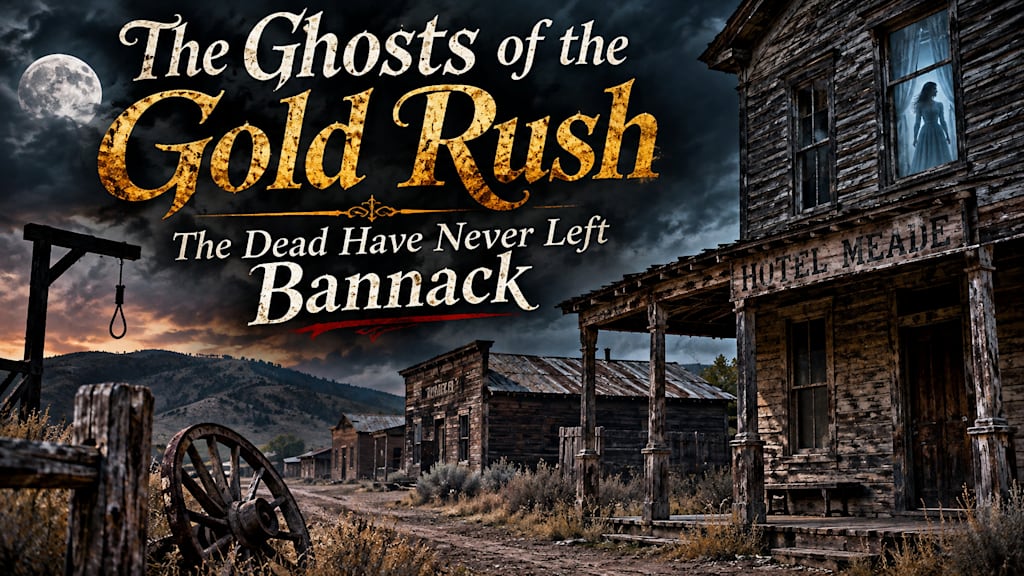
The Ghosts of the Gold Rush: The Dead Have Never Left Bannack
In the mountains of Montana stands a town where gold brought fortunes, greed brought bloodshed, and the past may still be walking the streets. Welcome to Bannack, where some residents apparently never checked out.
A Town Born From Gold and Greed
Picture it.
It's 1862. You're standing beside a creek in the rugged Montana Territory. The air is cold, the landscape unforgiving, and you've traveled hundreds of miles chasing the one thing that might change your life: gold.
Then somebody finds it.
On July 28, 1862, gold was discovered along Grasshopper Creek. Word spread, as it tends to do when someone finds a way to get rich without having to marry into money. Before long, prospectors came pouring into the area.
And Bannack was born.
By 1863, the settlement had grown to more than 3,000 people. What had started as a mining camp quickly became a bustling community. Hotels, saloons, shops, businesses, and homes sprang up along its muddy streets. People came with dreams of striking it rich, escaping their pasts, or simply finding a place where they could start again.
But where there's gold, there's greed. And where there's greed, there's usually someone willing to put a bullet in another man's back.
Bannack was no exception.
This wasn't the romanticized Wild West of pretty postcards and handsome cowboys tipping their hats. This was a rough settlement where robberies, murders, drunken fights, and lawlessness were part of everyday life.
The gold was plentiful, but apparently so were people who thought someone else's money belonged in their pockets.
And that brings us to one of Bannack's most infamous residents.
Henry Plummer: The Sheriff Who Couldn't Escape the Gallows
If Bannack had a villainous leading man, Henry Plummer would certainly qualify for the role.
Plummer arrived in the gold fields with a complicated history. He was charming, well-spoken, handsome by contemporary accounts, and had already spent time in prison in California.
Somehow, despite his past, he managed to convince the residents of Bannack that he was exactly the sort of man they needed to keep order.
In May 1863, he was elected sheriff.
Let that sink in for a moment.
The man responsible for enforcing the law became the central figure in one of the most notorious criminal accusations in Montana's early history.
Plummer was accused of secretly leading a gang of highwaymen known as the Innocents. These men were suspected of robbing stagecoaches, stealing gold shipments, and murdering travelers throughout the region.
The accusations grew. So did the fear.
Eventually, residents who had grown tired of the violence organized the Vigilance Committee. They decided that if the law couldn't protect them, they would take matters into their own hands.
And they did.
In January 1864, Henry Plummer and two of his deputies were captured and hanged in Bannack.
More than twenty men were executed or otherwise punished during the vigilante campaign that swept through the region.
But here's where history gets uncomfortable.
The guilt of Plummer and the men accused alongside him has been debated by historians. Some argue that the vigilantes were necessary to restore order. Others question their methods, their evidence, and whether their campaign became something far more dangerous than justice.
There were no modern courts, no careful protections against wrongful conviction, and certainly no shortage of men willing to decide another person's fate.
Justice, it seems, wore a noose in Bannack.
And according to local ghost stories, Henry Plummer may still have unfinished business.
Some accounts suggest his spirit continues to haunt the town, an unsettling possibility considering the manner of his death.
Perhaps the sheriff is still making his rounds.
Or perhaps Bannack simply has a very long memory.
The Girl in the Blue Dress
Now, let's step away from the gallows for a moment.
Because not every ghost story in Bannack involves murderers, outlaws, and men with questionable ideas about law enforcement.
Some are considerably sadder.
Meet Dorothy Dunn.
Dorothy was just sixteen years old when she drowned in 1916.
She had been wading in a dredge pond near Bannack with friends. None of the girls knew how to swim. When Dorothy stepped from a shallow area into deeper water, she disappeared beneath the surface.
A passerby managed to rescue the other two girls, but Dorothy did not survive.
The place where she drowned eventually became known as Dorothy's Hole.
And that's where her story becomes something altogether more haunting.
Dorothy had lived and worked at the Hotel Meade, one of Bannack's best-known historic buildings. After her death, her friend Bertie Mathews reportedly saw an apparition of Dorothy inside the hotel.
She recognized her friend by the long blue dress she had been wearing.
Over the years, other visitors reportedly described seeing a young girl in a blue dress near the hotel, including in its windows and hallways.
Some visitors have reported sudden cold spots. Others have described encounters in which children seemed particularly aware of the young girl.
Imagine walking through an old hotel, surrounded by silence and the creaking of timber that has survived more than a century.
You glance toward an upstairs window.
There's a girl standing there.
She's wearing blue.
You blink.
She's gone.
Now, I'm not saying I'd be sprinting toward the nearest exit, but I am saying I'd suddenly remember several very important things I needed to do somewhere else.
Dorothy's story is one of Bannack's best-known ghost legends, and unlike some of the more sensational tales attached to abandoned places, it begins with a documented tragedy.
Whether Dorothy's spirit remains at the Hotel Meade is another matter entirely.
But if you happen to visit, perhaps spare a thought for the sixteen-year-old girl whose life ended far too soon.
Not every ghost story needs a monster.
Sometimes sadness is frightening enough.
The House of Sickness and the Sound of Children
If the Hotel Meade gives you the chills, there's another building in Bannack with a particularly unsettling history.
The Bessette House.
During the early twentieth century, the building was used to quarantine people suffering from contagious diseases.
Influenza, scarlet fever, diphtheria, whooping cough, and other illnesses were a very real threat to communities that lacked the medical resources we take for granted today.
People were separated from their families and placed in quarantine to prevent diseases from spreading.
Some recovered.
Others never went home.
And then there are the stories.
Visitors have reportedly described hearing the cries of infants and young children around the building. These accounts have become part of Bannack's paranormal folklore, with some suggesting the sounds belong to children who died during the town's difficult years.
Think about that for a moment.
A house that once held sick and frightened people, many of them separated from their loved ones, now stands quiet.
No bustling household.
No footsteps running through the rooms.
Just an old building holding the memories of people whose names may have disappeared from the stories.
Are those sounds the echoes of a tragic past, the product of an overactive imagination, or something we haven't figured out?
We don't have evidence that ghosts are responsible.
But I can tell you this: knowing what the building was used for gives those stories a rather different weight.
More Than a Ghost Town
There's something particularly unsettling about Bannack.
Unlike many abandoned settlements that have crumbled into foundations and scattered rubble, Bannack remains remarkably intact.
More than fifty historic buildings still line its Main Street. Wooden storefronts, old homes, historic businesses, and structures that once housed the living now stand preserved as reminders of Montana's gold-rush beginnings.
Bannack became Montana's first territorial capital in 1864. That distinction didn't last long. The capital moved to Virginia City in 1865, and the town gradually lost its importance.
As the gold dwindled, people moved away.
Some chased better opportunities elsewhere. Others stayed for decades. The community survived well into the twentieth century before eventually becoming the ghost town visitors recognize today.
Montana acquired the town as a state park in 1954, and Bannack was designated a National Historic Landmark in 1961.
Today, Bannack State Park protects this remarkable piece of history.
And here's something I find particularly interesting: the goal isn't to turn Bannack into a shiny, polished recreation of the Old West. Preservation is about allowing visitors to experience the historic town as an abandoned mining settlement.
In other words, the silence is part of the experience.
You aren't walking through a movie set.
You're walking through a place where people actually lived, loved, worked, fought, suffered, and died.
And some of those buildings have witnessed more human misery than most of us will encounter in a lifetime.
Are the Dead Still Walking Bannack?
Bannack has become known for its ghost stories, and the town's paranormal reputation has even inspired seasonal ghost walks.
These experiences bring historical figures back to life through reenactments, allowing visitors to encounter characters from Bannack's colorful past, including Henry Plummer, Joe Pizanthia, Cyrus Skinner, Doctor Glick, and Mattie Silks.
It's an interesting way to explore the town, particularly when you consider how many of its residents met rather unpleasant endings.
But there's a difference between portraying the dead and wondering whether they've actually left.
And that's where the questions begin.
Why do people report seeing Dorothy in her blue dress?
Why do visitors describe unexplained cold spots inside the Hotel Meade?
Why do stories of children crying continue to follow the Bessette House?
Are these experiences connected to the town's history? Could the atmosphere, the age of the buildings, and the power of suggestion explain some of them?
Or is there something about Bannack that refuses to be explained away?
I won't pretend to have the answers.
I'm a writer, not a paranormal investigator with a fancy gadget that beeps every time someone says the word ghost.
But I do believe places can carry the weight of their histories.
And Bannack has an awful lot of history to carry.
The Gold Is Gone. The Stories Remain.
There are plenty of places in America with ghost stories. Some have legends that stretch back centuries, while others have acquired their reputations through a handful of strange encounters.
Bannack is different because its history doesn't need embellishment.
Gold brought thousands of hopeful people into the Montana wilderness. Some found fortunes. Others found poverty, violence, disease, and death.
A sheriff was hanged. Men were executed by vigilantes. A young girl drowned before she had the opportunity to grow old. Families suffered through illnesses that could tear entire households apart.
And then the people left.
The buildings remained.
Today, the streets are quieter. The saloons no longer ring with drunken laughter, the stores no longer welcome miners hoping to spend their latest earnings, and the sound of horses has largely disappeared.
But the stories remain.
Perhaps the girl in the blue dress is nothing more than a legend born from a terrible tragedy. Perhaps the cold spots and unexplained sounds are simply the peculiarities of old buildings.
Perhaps Henry Plummer's ghost is nothing more than a story attached to a particularly controversial chapter of Montana history.
Perhaps.
But if I ever find myself wandering Bannack after dark, I think I'll be perfectly content to leave some questions unanswered.
Because here's the thing about ghost towns.
The buildings may be empty.
The streets may be deserted.
But sometimes, the most frightening thing about an abandoned place isn't imagining who might be haunting it.
It's remembering who once lived there.
And what happened to them.
So, dear readers, the next time someone tells you there's nothing left in an old gold-rush town, remember Bannack.
The gold is gone.
The people are gone.
But if the stories are to be believed, not everyone got the memo.
Until next Thursday, keep your eyes open, your doors locked, and perhaps don't follow anyone wearing a blue dress into an empty hotel.
Just a little friendly advice from Miss Lil. ☕🖤
Sources and Further Reading
Montana Fish, Wildlife & Parks: Bannack State Park
Montana Outdoors: Bannack
Southwest Montana: Bannack History
Southwest Montana: The Story of Dorothy Dunn
Montana Historical Society: Vigilantes and Vigilantism
About the Creator
Lilithea Adasia
I dig where others look away. 🖤 True crime, paranormal mysteries, uncomfortable truths, and the beautifully broken human experience. I chase the stories others bury and ask the questions others avoid. Come curious. Leave questioning.
Enjoyed the story? Support the Creator.
Subscribe for free to receive all their stories in your feed. You could also become a paid subscriber or give them a one-off tip, letting them know you appreciate their work.
Comments
There are no comments for this story
Be the first to respond and start the conversation.