
The Foreman Who Still Walks the Furnace
Sloss Furnaces: Where the Fires Went Out, but the Stories Never Did

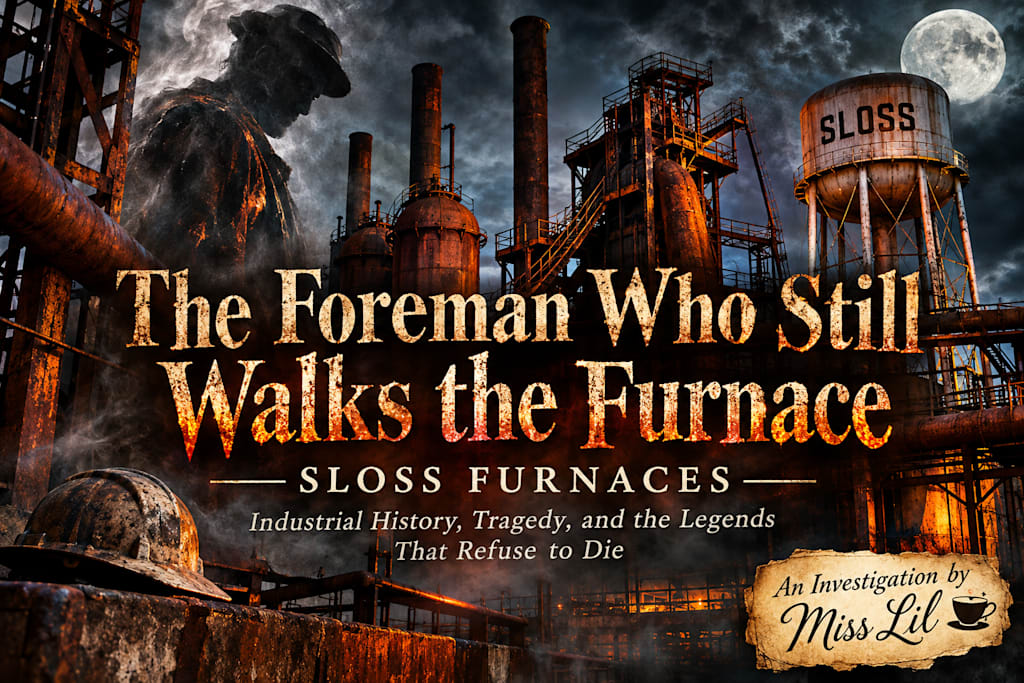
The Foreman Who Still Walks the Furnace
Sloss Furnaces: Where the Fires Went Out, but the Stories Never Did
By Miss Lil | Lily Writes
There are places where history is preserved behind glass, carefully labeled and arranged for visitors to admire. Then there are places where history seems to have seeped into the very walls, where the rust is more than rust, the silence feels heavier than it should, and the past has left behind something that refuses to be forgotten.
Sloss Furnaces in Birmingham, Alabama, is one of those places.
Picture yourself standing beneath enormous industrial towers. Rusted iron stretches toward the sky. Narrow walkways connect buildings that once shook with the thunder of machinery. Pipes snake through brick structures, and enormous furnaces stand like the skeletons of some long-dead industrial beast.
Now imagine what this place sounded like when it was operating.
The roaring of the furnaces. The grinding of machinery. The shouting of workers trying to communicate over the industrial din. The hiss of steam, the clanging of iron, and the terrifying glow of molten metal moving through channels in the casting floor.
This was no ordinary workplace.
For nearly ninety years, Sloss Furnaces helped build Birmingham's reputation as an industrial powerhouse. Thousands of workers passed through its operations, many laboring under dangerous conditions that would be difficult for most modern workers to imagine.
Today, the fires are gone.
The machinery has fallen silent.
But the stories remain.
Some are rooted in historical records. Others have been passed down through generations. And a few have become the sort of ghost stories that make you wonder whether the truth is sometimes considerably more frightening than the legend.
So, pour yourself something warm, settle in, and come along with Miss Lil.
We're going to investigate Sloss Furnaces.
And we're starting with the people who built it.
Building the Magic City: The Birth of Sloss Furnaces
To understand why Sloss Furnaces is such an important part of Alabama's history, we need to travel back to the years following the American Civil War.
In 1871, Birmingham was founded in Jones Valley, an area blessed with something industrialists desperately wanted: the natural resources necessary to manufacture iron.
Iron ore was available in Red Mountain. Coal deposits could be found nearby, and limestone was plentiful throughout the region.
In other words, Birmingham was sitting on an industrial gold mine.
Railroads connected these resources to expanding markets, and entrepreneurs began investing heavily in the area's industrial potential.
One of those entrepreneurs was Colonel James Withers Sloss.
In 1880, Sloss founded the Sloss Furnace Company. Construction began the following year on a fifty-acre property, and in April 1882, the furnaces officially went into operation.
The company initially produced pig iron, a raw material used in manufacturing other iron and steel products.
The operation was successful almost immediately. During its first year, the furnace sold approximately 24,000 tons of iron.
Birmingham was growing, and Sloss Furnaces was helping fuel that growth.
The city eventually earned the nickname "The Magic City," a reference to its astonishing industrial expansion.
But magic had very little to do with what was happening behind those enormous furnace walls.
It was hard labor, dangerous machinery, extreme temperatures, and thousands of people whose lives revolved around the production of iron.
And not everyone shared equally in the rewards.
The Human Cost of Industrial Progress
This is where our investigation becomes considerably darker.
Sloss Furnaces wasn't simply a place where iron was manufactured. It was a workplace shaped by the racial and economic inequalities of its time.
African Americans made up a substantial portion of Birmingham's industrial workforce, but employment opportunities were sharply divided along racial lines.
At Sloss, white workers generally occupied management, engineering, and higher-status skilled positions. Black workers were frequently restricted to lower-paid helper positions, even when they possessed the experience and ability to perform more advanced work.
Workers used separate bathhouses, separate time clocks, and even attended separate company picnics.
And the inequality extended beyond the furnace grounds.
Sloss-Sheffield operated coal mines that used convict leasing, a system that allowed companies to lease prisoners from the state and put them to work in dangerous industrial operations.
The practice disproportionately exploited Black men in the aftermath of slavery.
The conditions in these mines could be horrific. The Encyclopedia of Alabama documents that in 1890, ninety out of one thousand prisoners died in the Coalburg mines associated with the industrial operation.
Let that number sink in.
Ninety men.
Not ghost stories. Not folklore. Not something whispered by a paranormal investigator walking through an abandoned building.
Real people.
Real deaths.
And the furnace itself was hardly a safe working environment.
Historical documentation describes loaders working high above the furnaces, handling raw materials while exposed to leaking furnace gases. Men tapping molten iron had to work in extraordinary heat, sometimes being relieved every two or three minutes during the process.
Iron carriers performed some of the most physically demanding work of all.
After molten iron cooled in sand molds, workers used crowbars and sledgehammers to break the finished iron bars loose. Those bars could weigh between 100 and 115 pounds, and workers carried them across loose sand to waiting railcars.
Imagine doing that repeatedly, surrounded by extreme heat, dangerous equipment, and the constant threat of an industrial accident.
The work was brutal.
And the consequences could be permanent.
Death Among the Furnaces
According to Alabama Public Radio's investigation into Sloss's haunted history, at least forty-seven workers were confirmed to have died at the ironworks site.
Forty-seven lives.
Forty-seven families who had someone leave for work and never return.
The exact circumstances surrounding individual deaths are not always easy to reconstruct from the surviving historical record, and we shouldn't attach ghost stories to real fatalities without evidence.
But the larger picture is unmistakable.
Sloss Furnaces was a dangerous place to earn a living.
The industrial environment was unforgiving, and the people who worked there faced hazards that could turn an ordinary shift into a tragedy.
Now, think about the physical environment that remains today.
The towering structures. The casting floors. The machinery. The enormous industrial spaces where workers once spent their days and nights.
It's easy to understand why a place with this kind of history would become fertile ground for ghost stories.
And that brings us to one of the most interesting legends associated with Birmingham's iron industry.
Theophilus Calvin Jowers: The Ironworker Who Never Went Home
If there is one ghost story associated with Sloss Furnaces that deserves particular attention, it's the legend of Theophilus Calvin Jowers.
Unlike some of the more modern stories attached to the property, Jowers has a connection to Birmingham's actual industrial history.
His story begins at Alice Furnace, another Birmingham ironworks.
According to accounts preserved by Alabama folklorist Kathryn Tucker Windham and later discussed by Birmingham historians, Jowers was an experienced ironworker who had spent much of his life connected to the industry.
He married Sarah Latham in 1870. The couple eventually had five children, and in 1887, they moved to Birmingham as Jowers pursued employment at Alice Furnace No. 1.
He had found his place in the industrial world.
Unfortunately, he would not remain there for long.
On September 10, 1887, Jowers reportedly suffered a horrific accident at Alice Furnace and fell into molten iron.
He was burned to death.
According to the story passed down through his family, almost nothing of his body could be recovered.
The only remains they could retrieve, the legend says, were his heart.
Now, before we go any further, it's important to distinguish the family legend from independently verified forensic evidence. The heart detail belongs to the traditional account, not an established medical record.
But the story doesn't end with his death.
In fact, that's where things become interesting.
According to the Jowers family tradition, Theophilus had loved his work so much that he once promised his wife he would continue working as long as there was a furnace operating in Jefferson County.
The promise became the foundation of one of Alabama's most enduring industrial ghost stories.
Workers reportedly began seeing his figure around the furnaces after his death.
He wasn't described as a violent apparition or a terrifying monster.
Instead, he was supposedly still doing his job.
Checking the equipment.
Walking the work areas.
Making sure everything was operating properly.
A working man's ghost, apparently unwilling to retire even after death.
When Alice Furnace eventually closed, the story says Jowers simply moved on to another furnace.
And eventually, that furnace was Sloss.
The story claims that workers began reporting sightings of him around Sloss in the 1920s.
Some accounts describe him appearing alongside employees, almost as though he were another member of the workforce.
Think about that for a moment.
A man who supposedly died in a furnace decades earlier, continuing to walk the industrial grounds, keeping an eye on the very work that took his life.
Perhaps the most unsettling part of this legend isn't the possibility of a ghost.
It's the idea that even death couldn't convince him to leave the place he loved.
The Foreman Who Still Walks the Furnace: Meet Slag Wormwood
Of course, we cannot investigate Sloss Furnaces without addressing the infamous foreman.
If you've watched paranormal programs or read accounts of the haunting, you've probably encountered the name James "Slag" Wormwood.
The story is certainly memorable.
Wormwood is described as a cruel and demanding foreman who supposedly supervised the night shift. He allegedly pushed workers beyond their limits, cared little about their safety, and demanded production regardless of the consequences.
According to the popular version of the tale, his workers eventually reached their breaking point.
The story claims that in October 1906, Wormwood fell into molten iron and met a gruesome end.
But unlike the Jowers legend, there is a significant problem with this particular character.
There is no reliable historical evidence that James "Slag" Wormwood ever worked at Sloss Furnaces.
In fact, the story has been traced to the Sloss Fright Furnace Halloween attraction, where the character was created as part of the haunted attraction's promotional folklore.
That's right.
The infamous foreman was fictional.
His story was designed to frighten visitors, and it certainly succeeded in becoming part of the location's paranormal reputation.
But here's where I think the story becomes more interesting.
Why did this particular legend become so believable?
Perhaps because it fit the environment.
Sloss really was a dangerous industrial workplace. Workers really did face brutal conditions. People really did die in the iron industry.
The idea of a cruel foreman who treated his workers as expendable wasn't difficult to imagine.
The fictional Wormwood became a convenient villain for a place whose real history already contained plenty of suffering.
And while I wouldn't report him as a historical person, I certainly wouldn't dismiss the reason his story found such fertile ground.
Sometimes folklore doesn't need to be historically accurate to reveal something about the fears and memories of a community.
What About the Hauntings?
Now we get to the part many of you have been waiting for.
The paranormal reputation of Sloss Furnaces.
Over the years, the site has become a popular destination for ghost enthusiasts, paranormal investigators, and television crews interested in its industrial history and reported supernatural activity.
Stories associated with the property include unexplained footsteps, voices, strange sounds, and the sensation of being watched.
The legend of Jowers is particularly persistent, with accounts describing a figure moving through the industrial structures as though he were still working his shift.
Other stories have become associated with the fictional Wormwood character, adding another layer to the site's haunted reputation.
But what can actually be established?
There is a difference between a reported paranormal experience and independently verified evidence of supernatural activity.
A strange sound in an industrial building might be a ghost. It might also be old machinery shifting, metal contracting, or the natural acoustics of an enormous structure.
A shadow on a catwalk might be something unexplained. It might also be an unusual angle of light.
And that is precisely why an investigation should begin with history rather than assumptions.
We know people died here.
We know the working conditions were dangerous.
We know that the Jowers story has been passed down through generations and documented by Alabama folklorists.
We also know that the Wormwood story was invented for a Halloween attraction.
What we don't have is independently verified proof that spirits remain at Sloss.
That doesn't make the location any less fascinating.
It simply means we should keep our feet planted firmly in reality while allowing ourselves to explore the unexplained.
The Fires Finally Went Out
Sloss Furnaces continued operating through decades of industrial change.
The facility underwent major modernization during the late 1920s and early 1930s, with new equipment and rebuilt furnaces increasing its production capacity.
By the Second World War, Sloss-Sheffield was an important part of the American iron industry.
But the industrial world was changing.
Economic pressures, changing production methods, and the eventual decline of Birmingham's traditional iron industry brought the operation toward its final years.
In 1971, Sloss Furnaces stopped producing iron.
For the first time in nearly ninety years, the enormous furnaces went quiet.
But what would happen to the property?
There were plans to demolish the complex and sell its remaining materials for scrap.
Thankfully, a group of concerned Birmingham residents believed the site deserved better.
In 1976, the Sloss Furnaces Association formed to help preserve the property.
Their efforts helped save an extraordinary piece of American industrial history.
Sloss eventually received National Historic Landmark recognition in 1981 and opened as a museum in 1983.
Today, visitors can walk through the historic complex and see the machinery, furnaces, structures, and workspaces that helped build Birmingham.
The fires may be gone, but the industrial legacy remains.
So, Is Sloss Furnaces Haunted?
I suppose that's the question we should be asking after everything we've uncovered.
Is Theophilus Jowers still walking the furnace?
Does some part of the industrial past remain trapped among the rusted machinery and towering structures?
Are the reported footsteps and voices evidence of something supernatural, or are they the natural sounds of an enormous industrial complex with nearly a century of history behind it?
I don't have the answers.
And I'm certainly not going to pretend that every shadow is a spirit or every unexplained noise is a message from beyond.
But I do think Sloss Furnaces deserves its reputation as one of America's more fascinating haunted locations.
Not because every ghost story can be proven.
Not because a fictional foreman makes a good Halloween headline.
But because this is a place where history and folklore have become deeply intertwined.
The real people who worked there deserve to be remembered. Their labor, their struggles, and the dangers they faced should never become background decoration for a ghost story.
And perhaps that is the most important part of this investigation.
Before we go looking for the dead, we should remember the lives they lived.
As for Theophilus Jowers?
Well, if the old story is true, he made a promise to keep working as long as there was a furnace operating in Jefferson County.
Sloss stopped producing iron in 1971.
But the site is still standing. It is still open to visitors. Its machinery remains. Its history continues to be told.
And according to the legend, that's all it takes.
So if you happen to find yourself walking beneath those enormous structures, keep an eye on the catwalks.
You might just see a figure making his rounds.
And if you do, perhaps it's best not to interrupt him.
After all, he's been working a very long shift.
Until next time, keep your flashlight charged, your curiosity sharp, and your tea close.
You never know what history might be hiding in the shadows.
Miss Lil ☕🖤
Sources & Further Reading
For readers who want to explore the history and folklore themselves:
City of Birmingham, Sloss Furnaces History
Sloss Furnaces National Historic Landmark, Official History
Alabama Public Radio, Yellowhammer Haunted History: Sloss Furnaces
Birmingham Historical Society, The Ghost of Sloss Furnaces: Kathryn Tucker Windham's Haunting Tale
Encyclopedia of Alabama, Sloss Furnaces
WVTM 13, The Tragic Legend of Theophilus Jowers
About the Creator
Lilithea Adasia
I dig where others look away. 🖤 True crime, paranormal mysteries, uncomfortable truths, and the beautifully broken human experience. I chase the stories others bury and ask the questions others avoid. Come curious. Leave questioning.
Enjoyed the story? Support the Creator.
Subscribe for free to receive all their stories in your feed. You could also become a paid subscriber, letting them know you appreciate their work.
Comments
There are no comments for this story
Be the first to respond and start the conversation.