
The Drummer of Tedworth
The Haunted House That Wouldn't Stop Beating

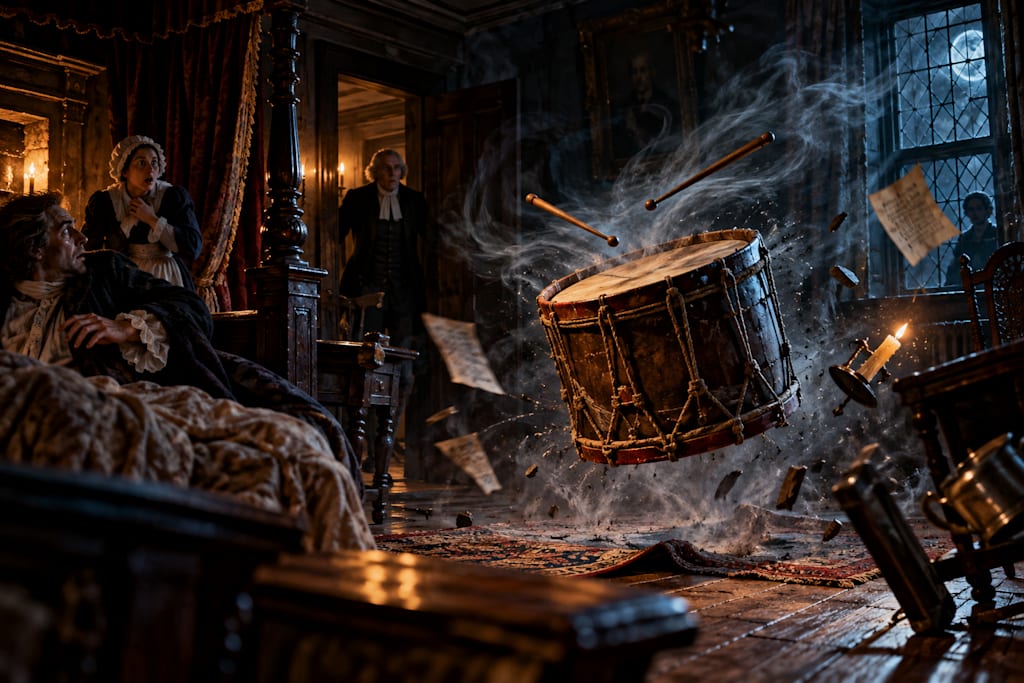
The house was quiet when the drumming began. Not music exactly. More of a rhythm. A "military tattoo" (a historic military signal played on a drum or sometimes a bugle to order soldiers to return to their quarters for the night), the sort of cadence that belonged outdoors, beneath open skies, where soldiers marched, and commands carried across fields. Except this was inside a house.
It was 1662, in the Wiltshire village then known as Tedworth, and John Mompesson had a problem. Something was making noise in his home. Sometimes it thumped. Sometimes it scratched. Sometimes witnesses described panting like a dog. People reported strange lights and unpleasant smells. Objects supposedly moved or flew. Beds were said to rise from the floor. And sometimes, unmistakably, came the sound of a drum. There was just one problem. No one appeared to be beating it...
More than 360 years later, the story might be easy to dismiss as another old English ghost tale. Something polished by generations of retelling until a creaking floorboard became a demon in the attic. Except the Drummer of Tedworth left something behind. Paperwork... And quite a lot of it.
The Drummer
John Mompesson was not an anonymous villager destined to become folklore. He was a landowner, an excise officer and an officer in the local militia. In March 1662, he became involved with a traveling drummer named William Drury.
Drury had been seeking money under the authority of a pass that proved to be counterfeit. Mompesson intervened; Drury was arrested, and authorities confiscated the man's drum. The instrument subsequently arrived at Mompesson's house in April. Then things became very strange.
According to accounts that emerged from the household, unexplained pounding began. The noises developed into drum tattoos and other disturbances. Suspicion naturally settled on Drury.
In seventeenth-century England, however, that suspicion could travel considerably farther than an accusation of revenge or practical joking. The drummer was suspected of witchcraft.
The disturbances allegedly continued even while Drury spent part of the period imprisoned at Gloucester on a theft charge, complicating the obvious explanation that he was sneaking back to torment the family personally.
Whatever was happening, people noticed. And they started coming to the house.
The House
The list of reported phenomena reads less like a conventional haunting than a household slowly losing an argument with something it cannot see. There were knocks and thumps. Scratching. Drumming. Objects reportedly thrown across rooms. Beds allegedly lifted. Strange lights and unusual smells. Even horses were said to have been injured or lamed.
Some claims are more securely rooted in early documentation than others, an important distinction in a story retold for centuries. But historian Michael Hunter's study of surviving contemporary material confirms that reports of these phenomena circulated while the events were occurring, not merely generations afterward.
Most importantly, Mompesson wrote about the disturbances himself. A surviving copy of a letter dated December 6, 1662, sent by Mompesson to the Reverend William Creed, provides something invaluable in an old supernatural case: the alleged victim describes events as they were happening. That doesn't prove the noises were supernatural. It proves that the story existed then.
And by 1663, Tedworth was attracting attention well beyond the Mompesson household. Among the visitors was a man named Joseph Glanvill. And with his arrival, a noisy house in Wiltshire became part of a much larger argument.
The Investigator
Glanvill was a clergyman, philosopher and defender of what was then called the "new philosophy." He was also deeply interested in evidence for spirits and witchcraft. Those facts are not contradictory. Not in 1663.
The intellectual world of Restoration England was changing rapidly. What we now recognize as modern scientific institutions and methods were emerging, but belief in witchcraft, spirits and divine intervention remained widespread. Glanvill believed supernatural phenomena deserved investigation rather than automatic dismissal. He visited Tedworth. And according to the account he later published, he heard something himself... strange scratching beneath a bed in the children's room. Glanvill became convinced that the case provided evidence for an invisible world.
In 1668, he published a lengthy narrative of Tedworth in: A Blow at Modern Sadducism. After his death, the story appeared prominently again in the 1681 collection Saducismus Triumphatus, one of the era's best-known works defending the reality of witches and apparitions. That agenda matters... a lot.
Glanvill was not a neutral investigator operating under modern evidentiary standards. He believed cases such as Tedworth had philosophical and religious significance. But neither was he simply a nineteenth-century storyteller repeating an ancient legend. He went to the house. And other people were paying attention.
The Story Escapes the House
By early 1663, Tedworth had become news. A ballad appeared describing the "strange and invisible beating of a drum." Reports appeared that April in two newspapers, Mercurius Publicus and The Kingdoms Intelligencer. References also survived in contemporary diaries and correspondence. Even Samuel Pepys encountered the story.
On Christmas Day 1667, Pepys recorded in his famous diary that his wife had read the Tedworth account to him. He considered it a strange story of spirits and worth reading.
Tradition also connects the affair with the court of King Charles II, with later accounts describing courtiers investigating the disturbances. But this is exactly where a responsible retelling must slow down. The royal connection became entangled with competing versions of the story, and the strongest surviving evidence does not justify turning Charles II into the seventeenth-century commander of a royal ghost-hunting squad.
The court nevertheless becomes important for another, much more intriguing reason. Because eventually another story began circulating. Perhaps there was no ghost at all...
The Other Tedworth
Skepticism about the Drummer isn't new. People doubted it then. Critics accused Glanvill of credulity and suggested the disturbances involved trickery. In 1677, writer John Webster attacked the Tedworth phenomena as cheats and impostures. Glanvill's defenders responded.
Then came an especially damaging allegation: Mompesson himself, it was said, had privately acknowledged a fraud, including claims that some admission had been made in connection with Charles II.
Does that mean case closed? Not remotely... Mompesson explicitly denied it.
In a 1672 letter to Glanvill, Mompesson addressed rumors that he had confessed a cheat to the king or someone else. He insisted that he had made no such confession and maintained that what happened in his house had not been fraudulent. Which leaves us in an uncomfortable place.
If Tedworth was a hoax, who engineered it? Was Mompesson deceived? Were members of the household responsible? Were witnesses interpreting ordinary events through the supernatural assumptions of their time? Were some incidents genuine misunderstandings while others were embellishments? Or was the entire affair exactly what Mompesson and Glanvill believed it to be? The surviving evidence cannot answer those questions with certainty. And that's precisely why the case endured.
The Drum Goes Silent
The Drummer of Tedworth eventually became much larger than whatever happened inside one Wiltshire house. It became ammunition...
Believers used it as evidence for spirits and witchcraft. Skeptics used it as evidence of credulity and fraud. Later writers recycled it. John Wesley championed the account. Joseph Addison transformed elements of the story into a skeptical play. William Hogarth eventually used the Tedworth drummer as a symbol of superstition. Everybody seemed able to find the part of Tedworth they needed.
Three centuries later, we should resist doing the same. No surviving physical evidence can establish that a supernatural entity invaded Mompesson's home. There is also no need to pretend that the entire story materialized centuries afterward.
Something was being reported at Tedworth in 1662 and 1663. Mompesson wrote about it. Newspapers reported it. Visitors came. Glanvill investigated it. Skeptics challenged it. The argument spread far beyond Wiltshire and continued long after the noises themselves had ended.
Perhaps frightened people mistook ordinary noises for extraordinary ones. Perhaps someone in the household was remarkably committed to an elaborate deception. Perhaps several different causes became fused into one increasingly famous story. Or perhaps something happened in that house for which its occupants genuinely had no explanation.
We cannot hear what they heard. We cannot inspect the rooms. Everyone who could answer our questions has been dead for centuries. All that remains are their words.
Letters.
Newspapers.
Books.
Accusations.
Denials.
And somewhere among them, the echo of a military cadence supposedly beaten inside a darkened house by hands no one could see. Whatever moved through Tedworth eventually fell silent. But the argument never did...
About the Creator
Veil of Shadows
Ghost towns, lost agents, unsolved vanishings, and whispers from the dark. New anomalies every Monday and Friday. The veil is thinner than you think....
Enjoyed the story? Support the Creator.
Subscribe for free to receive all their stories in your feed.
Comments
There are no comments for this story
Be the first to respond and start the conversation.