
The Devil: The Most Fascinating Villain in History
An exploration of the Prince of Darkness

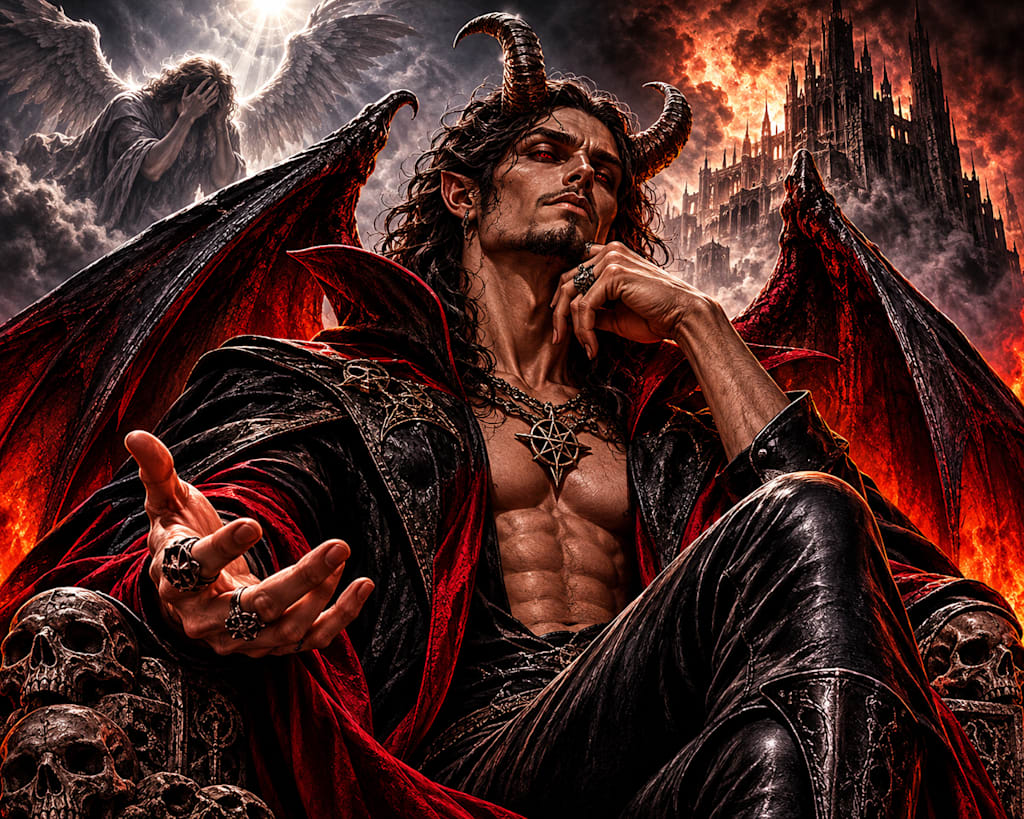
We've discussed vampires, werewolves, witches, and zombies, so I thought it was time to turn our attention to another familiar figure from mythology, religion, and popular culture: the Devil himself.
Depending on your religious or philosophical perspective, the Devil is either a literal supernatural being, a symbolic representation of evil, or perhaps one of the most fascinating characters ever created by the human imagination. But regardless of what you believe, his origin story is certainly an interesting one.
According to traditional Judeo-Christian theology, the Devil was once Lucifer, an angel of extraordinary beauty, intelligence, and elegance. Often described as the most magnificent of God's creations, Lucifer was gifted with extraordinary qualities and occupied a position of considerable importance in Heaven. Unfortunately, somewhere along the way, admiration for his own perfection turned into something considerably more dangerous: pride.
Lucifer began to believe that he was not simply God's most beautiful creation but an equal, perhaps even superior, to his Creator. His arrogance eventually became rebellion. When God created humanity and instructed the angels to acknowledge His new creation, Lucifer allegedly refused. Disgusted by the idea that these imperfect beings should receive such attention, he turned against God and persuaded other angels to follow him.
The rebellion ultimately failed. Lucifer and his followers were cast out of Heaven, and the once magnificent angel became the embodiment of everything he had once represented the opposite of. The Prince of Light became the Prince of Darkness, and his resentment toward his Creator evolved into an enduring hatred of humanity.
It's an impressive origin story, if you stop and think about it. The Devil wasn't simply some hideous creature crawling out of the depths of Hell. He was supposedly beautiful, intelligent, persuasive, and charismatic enough to convince other angels to follow him into rebellion against an all-powerful God.
And that's where the character becomes particularly interesting.
Think about the audacity involved. According to the very mythology that establishes God as all-powerful and all-knowing, Lucifer knew exactly who he was challenging. He wasn't rebelling against an ordinary king or attempting to overthrow some earthly authority. He was challenging the being responsible for his very existence.
What makes this even more fascinating is how recognizable his personality becomes when viewed through a human lens. Pride, vanity, arrogance, jealousy, resentment, violence, and self-delusion are hardly unfamiliar characteristics. They're qualities that have existed throughout human history, and Lucifer's traditional story brings many of our darkest impulses together in one character.
He is often described as petulant, vindictive, and extraordinarily proud, with an ego that apparently couldn't tolerate the existence of anything greater than himself. In that respect, the Devil is almost disturbingly human.
Of course, the Devil didn't always occupy the same position in mythology that he does today. The modern image of Satan as the supreme ruler of Hell and the ultimate adversary of God developed gradually through centuries of religious interpretation, folklore, literature, and cultural influences.
In many earlier mythologies, evil wasn't necessarily represented by one supreme supernatural villain. Instead, ancient civilizations frequently explored the struggle between opposing forces, particularly order and chaos. Babylonian mythology, for example, featured the conflict between Marduk and Tiamat, while Egyptian mythology portrayed the ongoing struggle between Ra and the serpent Apophis.
Other traditions developed more clearly defined cosmic divisions between good and evil. Zoroastrianism, for instance, introduced the opposing spiritual principles of Ahura Mazda and Angra Mainyu.
Even within biblical tradition, Satan's role wasn't originally identical to the familiar medieval image of the Devil. In the Book of Job, Satan appears more as an accuser or adversarial figure operating within a divine framework than as the independent monarch of an underground kingdom of eternal punishment.
Over time, however, Christian theology and European folklore helped transform this figure into something much more elaborate. Pagan imagery and artistic influences contributed to the familiar depiction of the Devil with horns, hooves, a tail, and other monstrous characteristics. Associations with figures from classical mythology, particularly Pan, also helped shape the visual language used to portray him.
Eventually, the Devil became much more than a religious adversary. He evolved into a symbol of temptation, corruption, rebellion, forbidden knowledge, and humanity's capacity for destruction.
Interestingly, literature and popular storytelling have also given us several different interpretations of this character. In some older tales, the Devil was almost comical, constantly devising elaborate schemes to tempt unsuspecting humans, only to have his plans ruined by someone's cleverness, innocence, or good fortune. He was often portrayed as a somewhat foolish trickster rather than the terrifying mastermind we recognize today.
But as storytelling evolved, so did the character. The Devil became increasingly intelligent, calculating, persuasive, and psychologically complicated. He wasn't simply interested in frightening people. He understood their weaknesses and knew precisely how to exploit them.
Perhaps that's one of the reasons the character has remained so enduring.
The Devil archetype represents something universal: the temptation to surrender to our worst instincts, the desire to challenge authority, and the eternal struggle between our better judgment and our darker impulses. He can be interpreted as an external adversary, but he can also serve as a mirror reflecting the less flattering aspects of human nature.
And perhaps that's the uncomfortable part.
Humanity has given the Devil countless names and countless faces. We portray him as the ultimate adversary, the great deceiver, and the tormentor of souls. Yet we also repeatedly depict him as beautiful, charismatic, intelligent, and persuasive enough to convince people to willingly follow him.
There is something strangely compelling about that contradiction.
Why would anyone willingly follow a figure supposedly responsible for eternal damnation? What makes someone so destructive appealing enough to inspire loyalty? Perhaps the answer lies in the very qualities that make him dangerous: confidence, ambition, independence, charisma, and the promise of power without restraint.
Of course, these qualities can be seductive, particularly when they're separated from compassion, responsibility, and any meaningful sense of morality.
The Devil has appeared in countless books, paintings, films, television programs, and religious interpretations. Sometimes he's a monstrous creature lurking in the shadows. Other times he's an impeccably dressed gentleman offering someone a deal they probably shouldn't accept. Occasionally, he's even portrayed as a charming, sarcastic character who seems considerably more entertaining than the people supposedly fighting against him.
But beneath all those interpretations is a character who continues to fascinate us because he represents something we recognize, even if we aren't particularly comfortable admitting it.
Perhaps the Devil's greatest accomplishment isn't convincing humanity that evil doesn’t exists. Perhaps it's convincing us that evil can be beautiful, intelligent, charming, and even desirable.
And that's what makes him such an enduring character.
After all, monsters are relatively easy to recognize when they look like monsters. The truly interesting ones are the ones who don’t
About the Creator
mark bradley (mark45xxx)
I'm a published Comic Book Creator & freelance illustrator specializing in dark,surreal, & cinematic artwork. I help authors, indie creators, and collectors, bring intense ideas to life
Enjoyed the story? Support the Creator.
Subscribe for free to receive all their stories in your feed.
Comments
There are no comments for this story
Be the first to respond and start the conversation.