
The Death of Zigmund Adamski: Britain's Most Unsettling Mystery?
Fearful Friday Edition

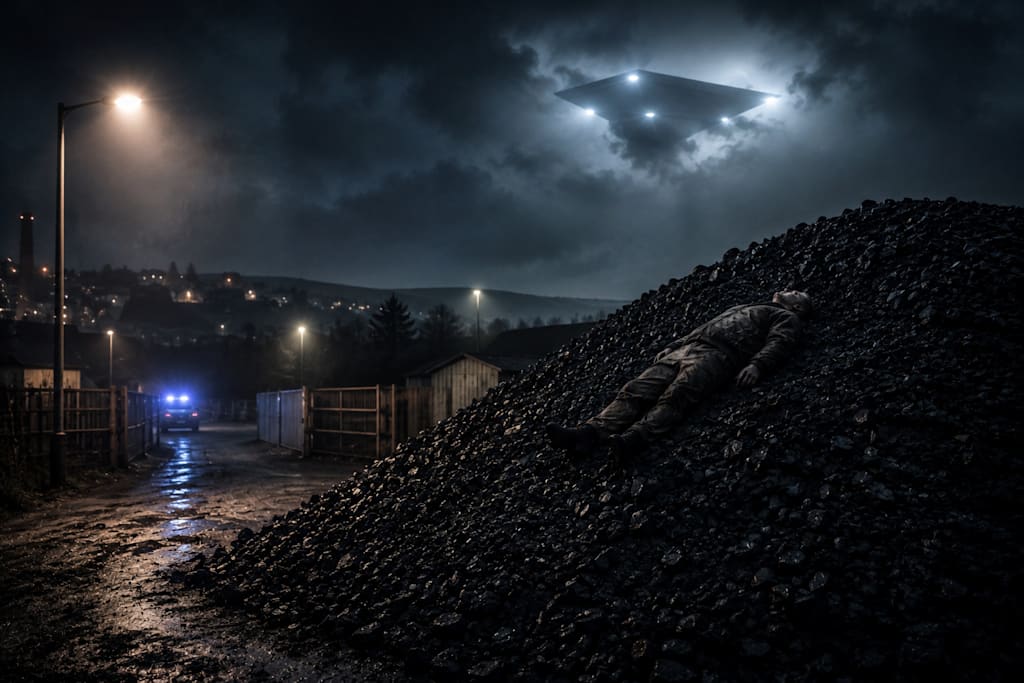
On the afternoon of June 6, 1980, fifty-six-year-old Zigmund Adamski, left his home in the Yorkshire town of Tingley with a simple errand in mind. He intended to walk to the local shops, carrying cash in his wallet. Nothing about his plans suggested anything out of the ordinary. His wife expected him home later that day. But he never returned...
At first, his disappearance seemed tragically familiar. Every year, countless people vanish without explanation. Some become lost, others leave voluntarily, and many are eventually found safe. But as the hours stretched into days, concern grew. Family members searched, police began making inquiries, and neighbors wondered where the quiet former coal miner could have gone. Then, five days later, the mystery took a turn so strange that it would still be debated more than four decades later.
Adamski's body was discovered atop a ten-foot-high pile of coal at Todmorden, roughly twenty miles from where he had disappeared. The location alone was baffling: the coal pile stood inside a secured yard, and workers familiar with the site insisted they had not seen a body there during previous inspections. Yet on June 11, Adamski was suddenly found lying on top of the mound as though he had simply appeared there.
The questions began immediately. How had he reached the coal pile? Why had no one seen him before? And what had happened during the five days he had been missing? As investigators examined the body, the mystery deepened. Adamski was fully dressed, though some of his clothing appeared strangely arranged. His watch and wallet were missing, and the cash he had been carrying when he left home had also disappeared. Even more puzzling were unusual marks around his neck and shoulders. Medical personnel noted burns or abrasions that appeared to have been treated with some type of ointment or gel. A substance that could not be readily identified. That detail alone might have remained a curious footnote in the investigation. Instead, it became one of the central mysteries of the case. Who had treated the injuries? Why? And with what?
Perhaps the strangest observation involved something most people never think about: Adamski had been missing for five days, yet the pathologist reportedly observed about one day's worth of beard growth. Beard growth varies between individuals, of course, and estimating it is hardly an exact science. And yet, it was so long that to a medical professional, it would stand out like a sore thumb. The observation has remained one of the most discussed aspects of the case because it is inconsistent with the known timeline. Had Adamski truly been missing for five full days? Or had something happened during that period that investigators never uncovered?
The official postmortem offered only limited answers. The cause of death was determined to be heart failure associated with emphysema and coronary artery disease, yet doctors could not satisfactorily explain the injuries to his neck or how he had come to rest atop the coal pile. The evidence suggested that he had not remained there for the entire five-day span. Workers believed they would have noticed a body lying in such a prominent position. If they were correct, someone, or something, had placed Adamski there shortly before his discovery. That realization transformed an ordinary missing-person investigation into one of Britain's most enduring mysteries.
Police interviewed witnesses. Friends and family were questioned. Searches were conducted. No convincing explanation emerged. Had Adamski been abducted? Had he wandered away while suffering a medical episode? Had another person been involved? Every theory solved one problem while creating another. The missing money suggested robbery, yet little else supported that conclusion. The injuries suggested an assault, yet no obvious motive emerged. The isolated location hinted that someone had transported the body, yet no witnesses reported seeing such activity. As the investigation stalled, the mystery slowly faded from newspaper headlines.
It might have remained an obscure Yorkshire cold case. Instead, events later that same year would propel it into an entirely different category of mystery. The connection came through one of the responding police officers: Constable Alan Godfrey had been involved in the Adamski investigation during its early stages. Several months later, while on patrol near Todmorden, Godfrey reported experiencing something extraordinary. He claimed that while driving during the early hours of the morning, he encountered a strange object hovering above the road. The account quickly attracted national attention. According to Godfrey, the object appeared metallic and diamond-shaped, rotating silently before him. His next clear memory involved finding himself farther along the road than expected, with a puzzling gap in his recollection. Hypnosis sessions conducted later explored the possibility of missing time, though such techniques remain controversial and are not regarded as reliable evidence of historical fact. Nevertheless, the story spread rapidly. Before long, newspapers and television programs began linking the two mysteries. A strange death, an unusual police encounter, the same general area, the same year. The coincidence proved irresistible.
Did the two events have anything to do with one another? No evidence has ever demonstrated that they did. But once the connection entered public consciousness, it became inseparable from the Adamski case itself. From that point forward, the mystery developed two parallel lives. One existed in police records, the other flourished in popular imagination. Researchers interested in criminal investigations focused on the unexplained injuries, the missing five days, and the mysterious appearance of the body. Those fascinated by unidentified aerial phenomena pointed toward Alan Godfrey's experience and wondered whether the two stories represented pieces of a larger puzzle. Both camps asked reasonable questions, but neither found definitive answers. Naturally, theories multiplied…
Some suggested Adamski had suffered a medical emergency while wandering far from home. Perhaps unknown individuals discovered him, attempted to treat his injuries, and later moved his body. Others proposed a criminal encounter that somehow escaped detection: could someone have robbed him, treated superficial wounds, and abandoned him atop the coal pile? Again, evidence remained frustratingly thin. Then came the more extraordinary explanations: alien abduction, secret military experiments, government cover-ups. These ideas captured public imagination precisely because the known facts seemed so unusual. Yet extraordinary theories require extraordinary evidence, and despite decades of speculation, such evidence has never emerged. What remains are questions. Real questions.
Why did Adamski disappear? Where was he during those five missing days? What caused the unusual injuries? What was the unidentified gel reportedly found upon them? Why was he discovered atop the coal pile instead of where he had originally disappeared? And why did one of the officers involved in the investigation later become associated with one of Britain's most famous UFO encounters? None of those questions have received universally accepted answers.
Perhaps the most unsettling aspect of the Adamski mystery is how ordinary it begins. A man leaves home to buy groceries. There is no dramatic farewell, no ominous warning, no indication that anything extraordinary is about to happen. Then history quietly veers off course, one missing afternoon becomes five missing days, a routine search becomes an unsolved mystery, and an unexplained death becomes intertwined with one of Britain's most debated UFO stories. Whether those threads truly connect or merely cross by coincidence remains impossible to say. History is filled with remarkable coincidences. Sometimes they remain only coincidences. Sometimes they become legends.
Today, the Yorkshire towns connected to the Adamski case carry on much as they always have. Roads are busier, buildings have changed, and new generations pass through without knowing the events that unfolded there during the summer of 1980. Yet among students of unexplained mysteries, the case refuses to fade, because it doesn’t prove anything extraordinary, nor does it offer clear evidence of the paranormal. Instead, it survives because it occupies that rare place where fact and mystery overlap. Every strange detail is documented somewhere; every explanation leaves something unanswered; every theory contains both possibility and doubt. That is the hallmark of history's most enduring enigmas.
The Death of Zigmund Adamski reminds us that reality often creates mysteries stranger than fiction ever could. Some disappearances end with answers, some end with arrests, some end with tragedy understood. And then there are those rare cases that seem to stand forever in the space between certainty and speculation. A man walked to the shops. Five days later, he was found atop a coal pile miles from home. The questions began that day. More than forty years later, they still have not ended…
About the Creator
Veil of Shadows
Ghost towns, lost agents, unsolved vanishings, and whispers from the dark. New anomalies every Monday and Friday. The veil is thinner than you think....
Enjoyed the story? Support the Creator.
Subscribe for free to receive all their stories in your feed.
Comments
There are no comments for this story
Be the first to respond and start the conversation.