
The Curse That Killed Three Men in One Year
In 1314, a dying man named his killers before God. Within the year, they were all dead. Within fourteen years, their dynasty had disappeared. The records provide an explanation for all of this.
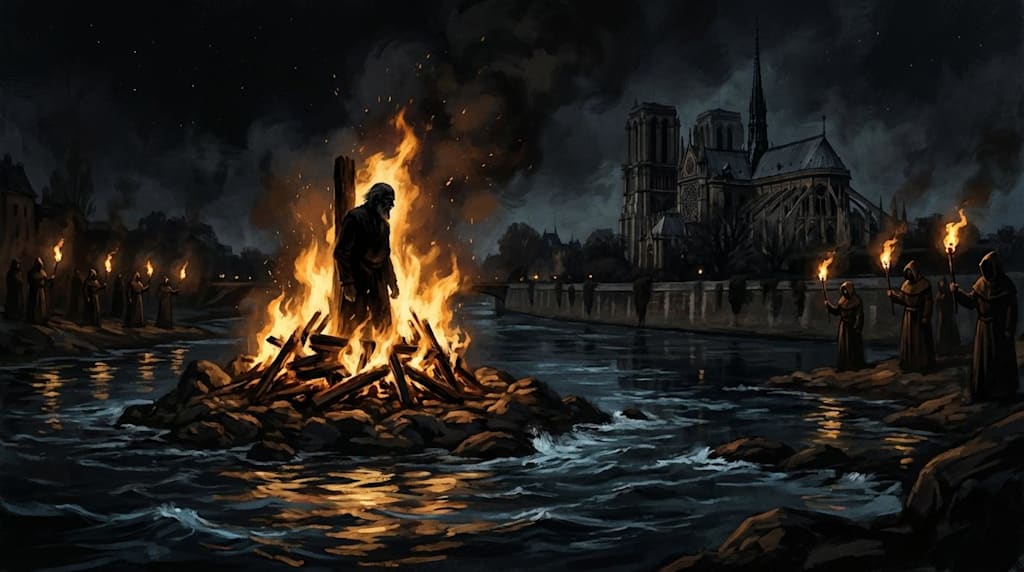
On the morning of 18 March 1314, a 70-year-old man was burned alive on a small island in the middle of Paris.
You can still visit the island today. Many people do so without realising.
His name was Jacques de Molay. He was the Grand Master of the Knights Templar. By the time they brought him to the fire, he had been in prison for seven years. His teeth had fallen out. The court records describe the interrogation methods only as 'questioning'. He did not retract his retraction. He stood in the flames and spoke.
Every account agrees on what he said, more or less.
He summoned Pope Clement V and King Philip IV of France to answer before God. He gave them a year.
Clement died within 33 days.
His physicians noted a sudden deterioration in a condition he had managed for years. They also noted that his body had turned an unusual colour after death. They did not elaborate. Vatican records swiftly gloss over this detail, much like you would when driving and you see something you don't want to look at directly.
Philip lasted longer. He made it to November. Eight months.
He was 46. He had survived wars, assassination plots and the systematic destruction of the most powerful private army in medieval Europe. It was a hunting accident — or rather, what followed it — that killed him. His court physicians recorded a collapse without explanation. They were careful men. They knew which questions to avoid.
Both deaths are documented.
Neither was investigated.
There is a clean version of this story.
Clement was already ill. Philip had lived hard. Coincidences cluster around famous deaths because we pay more attention to them. The human brain is a pattern-recognition machine that works with flawed information.
Historians prefer this version. It requires nothing from you.
But it doesn't account for everything.
Philip had three sons. Each became King of France. Each died without leaving a male heir. The Capetian dynasty, which had enjoyed 300 years of unbroken rule, collapsed completely within fourteen years of the burning.
Those who had witnessed de Molay's death were still alive to witness this.
They had a name for it. La malédiction des rois the curse of the kings. They started using that phrase before the third son had even died. Before they knew how it would end.
The island is called the Île de la Cité.
Notre-Dame stands on it. It has stood there for 850 years.
On 15 April 2019, the cathedral caught fire. The spire came down. The flames could be seen across the city. Investigators found an electrical fault. The case is closed; the cause is known and there is nothing unusual here.
The fire started in the same week and month as the execution.
705 years later, almost to the day.
This is a coincidence. It has to be. The alternative would require us to believe something that no official record supports and that no serious historian would consider.
However, the records also tell us that Clement died of natural causes.
Philip died in a hunting accident.
The Templars also confessed willingly.
The records are very good at explaining things.
What they don't explain is why the explanations always seem forced.
About the Creator
Chronicle and Void
Every collapse has a cover story. Every war has a cause that didn't make it into the history books. History is not an accurate record of what happened. It's a record of what they allowed to survive.
Enjoyed the story? Support the Creator.
Subscribe for free to receive all their stories in your feed.
Comments
There are no comments for this story
Be the first to respond and start the conversation.