
The Crow Who Borrowed a Song
𝕺𝖈𝖙𝖔𝖇𝖊𝖗 𝕮𝖆𝖒𝖕𝖋𝖎𝖗𝖊 𝕾𝖙𝖔𝖗𝖎𝖊𝖘

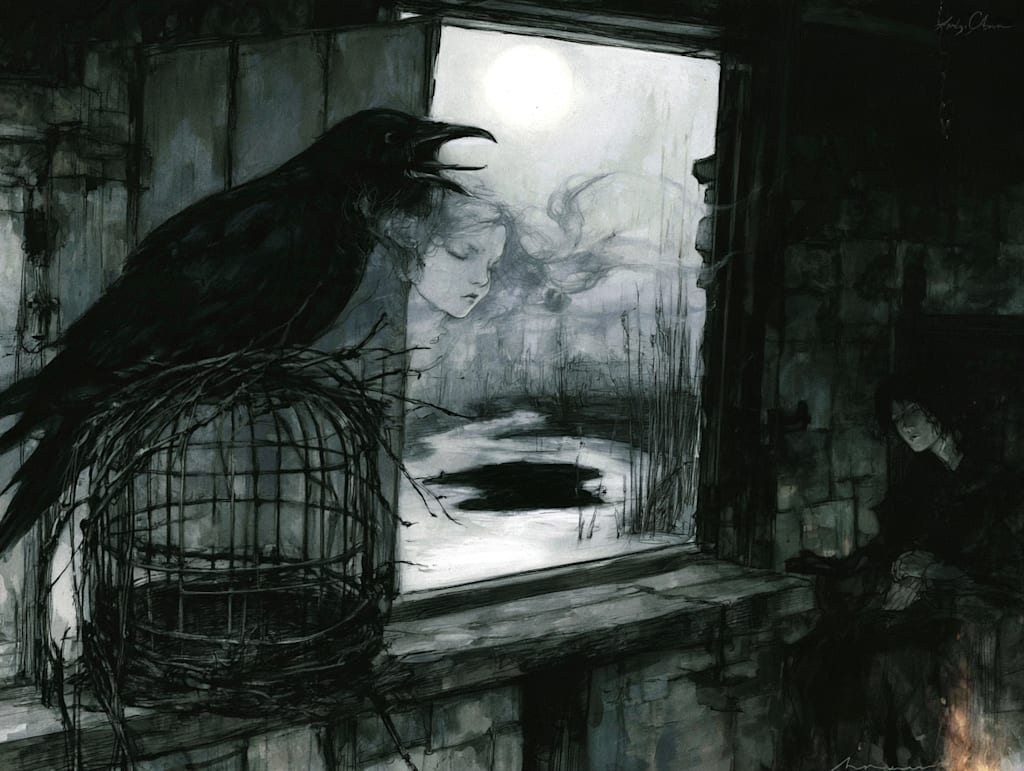
The village of Hollie Ford, located near the river's two bends before reaching the mill, was home to a crow named Sedge. Sedge was unable to receive a single crumb from anyone due to her voice.
Every time Sedge called from the top of the church, the baker's wife threw a pan at her. Every time Sedge cawed from the well, the children threw stones at her. Even the other crows, who also had ugly voices, flew away when Sedge spoke because she had a habit of cawing at the most inappropriate times; during weddings, funerals, and the long silences after sermons.
"If I sounded like a thrush," Sedge told the willow tree by the water, "they would put out bread for me. They would call me lucky." The willow did not respond, as it was a willow.
However, the river did hear. The spirit of the river at Hollie Ford was old and patient and did not have a face; however, there was a place in the reeds where the water flowed smoothly and darkly regardless of whether or not there was wind. On that evening, while Sedge sat on a branch feeling sorry for herself, the smooth area spoke.
"I have a voice that will suit you," it said. "Sweeter than a thrush. Sweeter than anything that has ever sung in this valley."
Sedge tilted her head. She was vain but she was not stupid. "And what would you want for it?"
"Only your old one. I collect them. Every voice the river takes, I keep."
It seemed like a fair trade. No one wanted her old voice, especially Sedge.
Therefore, she leaned down to the smooth black water and opened her beak, and something cold left her throat and something colder entered it, and when she tried to caw, she sang.
It was a girl's voice. High and clear, with a little catch at the top of each phrase, as if someone were laughing privately at a joke. Sedge sang from the church roof the next morning and the baker's wife dropped her pan, not to throw it but because her hands had stopped working. The children stood beneath the eaves with their mouths wide open. By noon there was bread on every windowsill in Hollie Ford, and by evening someone had placed a saucer of milk with honey in it, which was more than Sedge had been given in her entire life.
She sang for a week. She sang hymns she had heard through the chapel windows and rhymes the children skipped to and old harvest songs the men hummed at the mill. The voice seemed to know them all already. Sometimes it knew songs Sedge had never heard, and she would open her beak and an entire verse would come out about a blue ribbon and a boy with a crooked tooth, and the village would go silent.
On the eighth day, a woman came out of the last cottage on the river road. Her name was Agnes Tull, and she had not been seen in the village since spring when her daughter Marrow went down to the ford to wash linen and did not return. They had found the linen tangled in the reeds. They had never found Marrow. Agnes had kept her door closed ever since, and people said she sat by the window day and night watching the water.
She stood beneath the oak tree where Sedge was singing about the blue ribbon, and she listened until the final line, and then she said very softly, "That's my girl."
Sedge stopped. The entire lane stopped.
"That's my Marrow's voice," said Agnes Tull. "She made that song up herself. No one else knows it." She looked up at the crow with eyes like two wet stones. "Where did you get it?"
Sedge could have flown off. She was a crow, and crows are good at running away.
However, the woman's face held her to the branch, and for the first time in her life she felt something other than hunger or vanity. She felt ashamed.
"From the river," she said, in the dead girl's voice. "I didn't know whose it was."
Agnes Tull did not cry or scream. She extended her arm, as falconers do, and after a long time Sedge descended and sat on it.
"Then you'll come home with me," said Agnes, "and sing for me, since she can't."
At first, it was a nice house. There was a perch near the fire and a dish of barley that was always full. Each night Agnes sat in her chair with her eyes closed, and Sedge sang every song the voice knew, and Agnes moved her lips along with her. The village said it was a kind act. The village said the crow was a blessing sent to comfort a grieving mother. Sedge, who had never been called a blessing, tried to believe it.
However, on the twelfth night she was tired, and she paused halfway through a hymn to rest.
Agnes's eyes opened. "Keep going."
"I will in a moment," Sedge said. "My throat hurts."
"Marrow's throat hurt too," said Agnes. "Always hurting, always some excuse. I took her to every fair from here to Low Market, and she would have made twice what she did if she had stopped complaining." She stood up, and there was something in her hand that Sedge had not seen previously. It was a cage made of willow branches, small and tight, recently bent. "You'll sing when I tell you. That's what the voice is for."
The door to the cage shut with a sound similar to a twig snapping.
That night, in the dark, Sedge sang quietly to herself because she could not help it. And the voice sang the song it had never sung during the day. It was about a girl who walked down to the ford on a spring morning with a basket of linen she had no intention of washing. It was about how the water was cold and kind, and how the smooth dark area in the reeds had asked her what she wanted most in the world, and she had said, to never have to sing again.
Sedge understood then. The river had not taken Marrow's voice. Marrow had given it away willingly and walked into the water after it because she had found the only place her mother could not follow. And Sedge had gone down to that same water and asked for it back.
Agnes Tull is very old now. The village still talks about the miracle at the last cottage on the river road where each evening a dead girl's songs come through the shutters sweet and high with a little catch at the top of each phrase. People stop in the lane to listen. Some of them leave bread on the step.
No one notices that the songs have become slower over the years. No one notices that during the long pauses between verses if you stand close enough to the shutters you can hear something scratching at willow bars.
And on the river where the water flows smoothly and darkly sometimes a crow's ugly voice calls out over the reeds harshly and freely from a throat that is no longer there.
Moral: Before accepting a gift find out who gave it up and why they were so happy to be rid of it.
About the Creator
Daisy Fernsby
I’ve spent years writing about the natural world, and I still get a thrill from a fact that changes how someone sees an animal. History pulls at me just as hard, especially the Tudor and medieval world with all its scandal and consequence.
Enjoyed the story? Support the Creator.
Subscribe for free to receive all their stories in your feed. You could also become a paid subscriber, letting them know you appreciate their work.
Comments
There are no comments for this story
Be the first to respond and start the conversation.