
The Crimson Stall: Why Japanese Schools Are Haunted by Design
From Hanako-san to the cursed anatomical models—exploring the psychological architecture behind Japan’s classroom terrors.

1. The Silence After the Bell
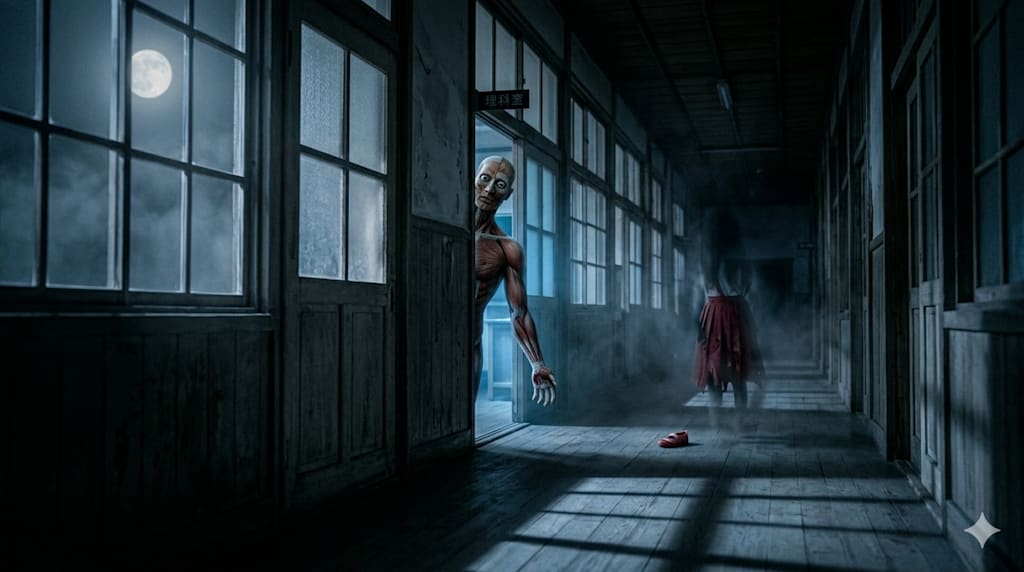
In the West, ghosts haunt gothic mansions or abandoned asylums. In Japan, they prefer the pristine, wax-floored hallways of elementary schools. If you’ve ever stayed late in a Japanese school building, you know the feeling: a heavy, humid silence, the faint smell of chalk dust, and the long, dark corridors that seem to stretch into another dimension as the sun sets.
As seen in the popular "School Ghost Stories" that resonated with so many readers, the Japanese school is not just a place of learning. It is a repository of collective anxiety. In a culture that prizes harmony and the group, the empty school at night represents the ultimate fear: being the one left behind.
2. The Ritual of the Third Stall: Hanako-san
The most famous resident of these hallways is Hanako-san. Her legend is so pervasive that it has become a staple of Japanese pop culture, yet its origins remain chillingly grounded in reality. The ritual is deceptively simple: go to the third-floor girls' bathroom, knock three times on the third stall, and ask, "Are you there, Hanako-san?"
Unlike the jump-scare spirits of Hollywood, Hanako is a quiet, persistent presence. She represents the "Liminal Space"—the bathroom being a place of transition, vulnerability, and solitude. For decades, students have passed this legend down as a shared rite of passage. Hanako is the shadow of every child’s fear of being alone in a place that should be crowded. She is the manifestation of the "unseen student" who never went home.
3. The Uncanny Science Lab: The Anatomy Model
Perhaps the most visceral fear comes from the science lab. Almost every Japanese school houses a life-sized anatomical model—half-skin, half-muscle, with unblinking glass eyes. The legend says that at midnight, the model begins to run through the hallways, its wet, muscular feet slapping against the cold linoleum.
This taps into the ancient concept of Tsukumogami—the Japanese belief that objects can gain a soul after reaching a certain age or being imbued with enough human emotion. In the sterile, disciplined environment of a school, these educational tools become "uncanny." They are human enough to be terrifying, yet inanimate enough to be unpredictable. They represent the repressed energy of thousands of students, trapped in a plastic ribcage.
4. The Architecture of the "Seven Mysteries"
Every school in Japan has its "Seven Mysteries" (Gakko no Nana Fushigi). These are not just random stories; they are part of the school's psychological architecture.
The Thirteenth Step: A staircase that normally has twelve steps, but gains a thirteenth at midnight, leading to a world of no return.
The Bleeding Portrait: Fine art paintings in the music room whose eyes follow you, or whose lips move to whisper your name.
What’s fascinating is that the seventh mystery is often never told, or it changes depending on who hears it. This is a deliberate psychological trap. By leaving the final mystery open, the building itself becomes the haunting. The long straight lines, repetitive classroom doors, and large windows reflecting the pale moonlight create a "Labyrinth of the Ordinary," similar to the defensive spirals of Himeji Castle (image_26.png). You aren't being hunted by a monster; you are being swallowed by the building's own memory.
5. The Culture of the "Uwabaki" and the Threshold
In Japan, students change from outdoor shoes to indoor Uwabaki (slippers) at the entrance (Genkan). This act is more than just hygiene; it is a spiritual crossing of a threshold. To find a single, stray Uwabaki left in a darkened hallway is a classic trope of Japanese horror. It signals that someone—or something—has crossed back from the "outside" world into the "inside" sanctuary. It is a breach in the school’s armor, a sign that the boundary between the living and the dead has been blurred by the fading light.
6. Conclusion: The Echo in the Hallway
Why do these stories persist in one of the most technologically advanced nations on earth? Because the Japanese school system is built on "Wa" (harmony) and group identity. The ghosts represent the "outliers"—the ones who didn't fit in, the ones who were bullied, or the ones simply forgotten.
When a student whispers a ghost story in a darkened classroom, they aren't just trying to scare their friends. They are acknowledging that even in a modern society, there are shadows that fluorescent lights cannot reach. The school ghost is a reminder that the past is always just one hallway away, waiting for someone to knock.
About the Creator
Takashi Nagaya
I want everyone to know about Japanese culture, history, food, anime, manga, etc.
Enjoyed the story? Support the Creator.
Subscribe for free to receive all their stories in your feed.
Comments
There are no comments for this story
Be the first to respond and start the conversation.