
The Coyne Helicopter Incident
A Veil of Shadows Exclusive

A particular kind of fear belongs to pilots... It is not necessarily the fear of falling. Pilots train for emergencies. They learn what their aircraft can do, how it responds, and what to do when something goes wrong. The more unsettling possibility is that the aircraft might stop responding as expected.
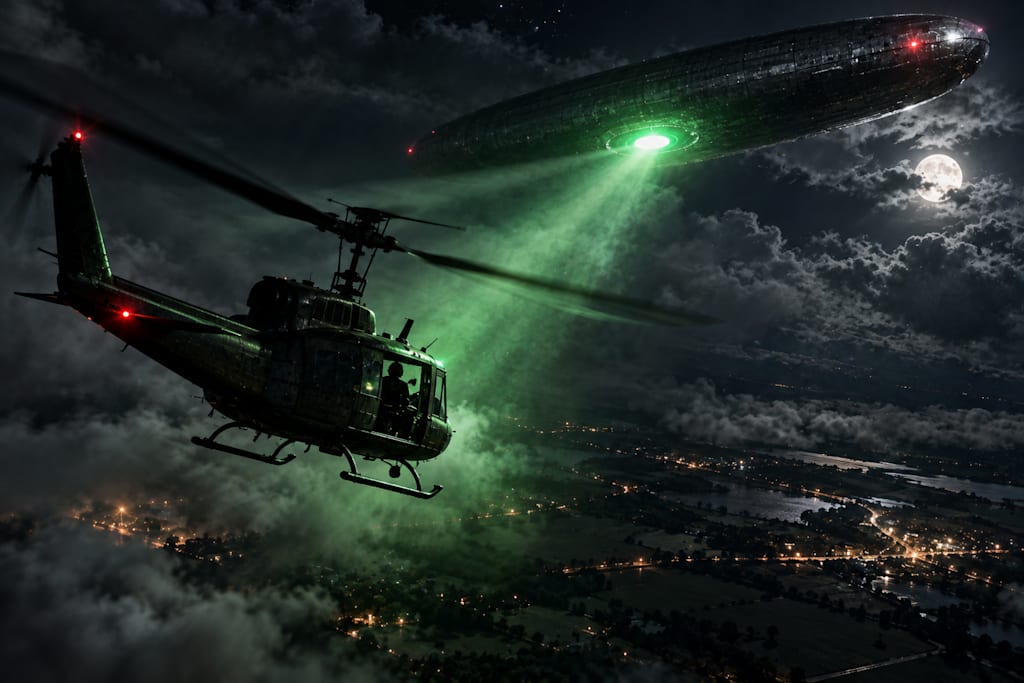
On the night of October 18, 1973, four U.S. Army Reserve aviators were flying a UH-1H Huey helicopter over Ohio when a red light appeared on the horizon. At first, it was simply another light in the night sky. Then it appeared to turn toward them.
Within moments, the crew believed they were facing a midair collision. Their pilot took evasive action, descending to avoid the approaching object's path. What happened next became one of the most discussed UFO encounters in American aviation history.
The crew reported that a strange object passed close to the helicopter, flooding its cockpit with green light. And when Captain Lawrence Coyne checked his instruments, he found something that seemed impossible. The helicopter was climbing. He had been trying to make it descend.
Four Men in the Darkness
The flight was routine. Captain Lawrence J. Coyne, First Lieutenant Arrigo Jezzi, Staff Sergeant Robert Yanacsek, and Staff Sergeant John Healey were returning from Columbus to Cleveland in Army helicopter 68-15444. They belonged to the 316th Medical Detachment, a helicopter ambulance unit.
At approximately 11:05 p.m., the aircraft was near Mansfield, Ohio, flying at an altitude of about 2,500 feet. Yanacsek, the crew chief, noticed a red light on the eastern horizon.
There was nothing inherently unusual about seeing another aircraft at night. The important thing was determining its position, direction, and whether it might cross their flight path. But as Yanacsek watched, the light appeared to approach at extraordinary speed. He warned Coyne.
According to the crew's subsequent Army report, the object seemed to be converging with the helicopter at the same altitude, on a collision course. Coyne took the controls. He initiated a powered descent, bringing the helicopter from about 2,500 feet to 1,700 feet to avoid impact.
The crew contacted Mansfield Tower and asked whether any high-performance aircraft were operating nearby. The tower acknowledged the helicopter, but the crew reported receiving no answer.
Then the approaching light reached them. And the ordinary explanation of another aircraft became much harder for the men aboard to accept.
Something Above the Helicopter
In accounts given after the encounter, crew members described an elongated, gray object with a slightly domed shape. Its lights included red and white illumination, and a brilliant green light reportedly swept across the helicopter.
The description is often condensed into the phrase metallic cigar-shaped craft. But it is worth distinguishing the records.
The Army's signed report concentrates on the approaching red light, the near collision, the object's departure, and the helicopter's unusual altitude readings. The more elaborate description of a structured object and green illumination comes from the crew's additional testimony.
That does not automatically make those details false. It means they belong to a different layer of the evidence.
The crew said the object appeared to pause above or near the helicopter before moving west. Imagine the scene from Coyne's seat. Only moments earlier, he had believed another aircraft was about to strike them. He had taken evasive action. A brilliant light had filled the cockpit. Now the apparent danger was departing.
It should have been time to stabilize the helicopter and resume the flight. Instead, Coyne looked at his instruments. And discovered that the aircraft was gaining altitude.
The Instrument Reading
This detail elevates the Coyne incident beyond a simple report of unusual lights.
The Army document records that Coyne observed a climb indication of about 1,000 feet per minute and an altimeter reading of 3,500 feet, with the helicopter's collective control fully lowered. The collective is the control a helicopter pilot uses to change the pitch of the main rotor blades, affecting lift. Lowering it generally reduces the commanded lift.
Coyne had descended to approximately 1,700 feet. Now his altimeter indicated 3,500 feet. That was not merely a return to the altitude at which the encounter began. The reported reading placed the helicopter roughly 1,000 feet above its original cruising altitude.
The crew's report does not say that an unidentified object physically grabbed the helicopter. It does not establish that the controls mechanically locked. It records what Coyne reported seeing on the instruments while the collective was down.
That distinction matters. A pilot's testimony is evidence of what the pilot experienced and observed. A signed report documents that the account was formally made. Neither, by itself, proves what external force, if any, caused the reported climb.
But the question remains remarkable: Why did the helicopter appear to be climbing when its pilot was trying to descend?
Coyne regained normal control, returned the aircraft to approximately 2,500 feet, and continued to Cleveland. The crew landed. The flight was over, but the mystery was assuredly not.
Four Signatures
On November 23, 1973, an Army disposition form documented the incident under the subject of a near midair collision with an unidentified flying object. All four crew members signed it.
This is one reason the case has endured. It was not merely an anonymous tale passed from one UFO enthusiast to another. The aircraft, crew, date, location, and reported altitude sequence were recorded through an official military reporting process.
But an official report is not an official determination that an extraordinary explanation is correct. The document establishes that the crew reported an encounter and attested to its account. It does not establish the identity of the object or independently reconstruct the helicopter’s flight path.
Another potential source of evidence emerged. People on the ground had reportedly seen something too.
The View from Below
Several years after the incident, UFO investigator Jennie Zeidman located a family who said they had witnessed unusual aerial activity near Mansfield that night. Their recollections described a helicopter, unusual red and green lights, and an object apparently moving in relation to the aircraft.
To an investigator, that was an intriguing development. The helicopter crew had described a frightening encounter from inside the aircraft. Here were people who said they had seen something unusual from outside it.
Two vantage points. Two sets of observations. But they were not interchangeable.
The ground witnesses could not see Coyne's altimeter. They could not see the collective's position. They could not know what commands he was making or how the helicopter responded. Even an observation that the helicopter appeared to rise would not establish why it rose.
Another complication was that the family was identified and interviewed in 1976, almost three years after the event, following a newspaper appeal. Their account was therefore not a contemporaneous report made on the night of the encounter. Memory can remain sincere while changing over time. Public accounts of an event can also influence what later witnesses remember or emphasize.
None of that requires anyone to be dishonest. It simply means that the family's testimony cannot be treated as a second recording of the cockpit instruments.
This is where the Coyne incident becomes especially fascinating. The crew reported an object, a green light and an unexpected climb. The ground witnesses reported unusual lights and activity around a helicopter. Those accounts may describe the same event. But the witnesses on the ground cannot confirm the crew’s most extraordinary technical claim. And the crew’s instrument observations cannot tell us exactly what the family saw.
The two perspectives meet in the night sky. They do not completely explain one another.
A Fireball, an Aircraft or Something Else?
Skeptics have proposed conventional explanations. One suggestion was that the approaching light was a meteor or fireball, with the helicopter’s unusual movement resulting from the pilot’s response during a frightening encounter. Other proposed explanations involve a conventional aircraft whose lights, apparent motion, or proximity were misinterpreted.
These possibilities deserve consideration. Nighttime visual perception is difficult. Distance and speed can be hard to judge when an observer sees little more than a light against a dark sky. A sudden perceived collision threat can also make an event seem longer, closer, or faster than it was.
But proposed explanations must account for the details rather than simply dismissing them. A meteor might explain a rapidly moving light, but it does not automatically explain the crew’s descriptions of an object apparently pausing nearby. A conventional aircraft might explain multiple lights, but identifying the specific aircraft and reconstructing its movements would require supporting records. And neither possibility, without further evidence, resolves the reported climb.
There is no publicly established flight-recorder trace or synchronized record of the helicopter’s controls, engine power, and altitude that independently reconstructs those seconds. The surviving evidence leaves important questions unanswered. That is frustrating. It is also what makes the incident a genuine investigative puzzle rather than a solved story with an exciting ending.
We cannot establish that an unknown craft controlled the helicopter. We also cannot confidently identify the approaching object from the surviving public record. The evidence takes us only so far.
The Question That Followed Coyne
Years later, Coyne continued to speak publicly about the encounter, including at a United Nations meeting in 1978 devoted to unidentified flying objects. For him, the incident had not become an amusing story about a strange light. He remembered a near collision. He remembered the object. And he remembered the helicopter climbing when he had not intended it to climb.
Perhaps that is why the case remains so compelling. The four men returned safely. Their helicopter did not vanish. No mysterious wreckage was discovered. There was no final revelation waiting at the airfield. They simply landed and reported what they believed had happened. And decades later, the questions remain almost exactly where they were on that October night.
What approached the helicopter? What produced the green illumination described by the crew? Did the ground witnesses observe the same encounter? What caused the unexpected altitude reading? Was there an ordinary sequence of events that the crew, frightened by an apparent collision, could not perceive accurately? Or did something happen in the darkness over Ohio that the surviving evidence still cannot explain?
Behind the Veil
Picture the helicopter one last time. Four men suspended above the Ohio countryside. A red light approaching. The pilot descending. A brilliant green glow filling the cockpit.
Then the object is gone. For a moment, the danger seems to have passed. Coyne looks at his instruments. The helicopter is climbing. He has not commanded it to climb.
Far below, people on the ground see unusual lights in the sky. They cannot know what the pilot is seeing on his panel. Inside the helicopter, the crew cannot know exactly what those people are witnessing from the road. Both groups look toward the same patch of darkness. Both are left with questions.
And whatever passed near that Army helicopter on October 18, 1973, left behind no answer everyone could agree on. Only four signatures. A reported climb. A green light. And the unnerving possibility that, for a few moments above Ohio, an experienced pilot looked at his aircraft’s instruments and could not reconcile what they showed with what he had commanded.
The helicopter came home. The explanation never did. And somewhere over Mansfield, the unanswered questions remain securely hidden behind... the Veil of Shadows.
About the Creator
Veil of Shadows
Ghost towns, lost agents, unsolved vanishings, and whispers from the dark. New anomalies every Monday and Friday. The veil is thinner than you think....
Enjoyed the story? Support the Creator.
Subscribe for free to receive all their stories in your feed.
Comments
There are no comments for this story
Be the first to respond and start the conversation.