
The Cleveland Torso Murderer: America's Forgotten Ripper
Veil of Shadows Exclusive

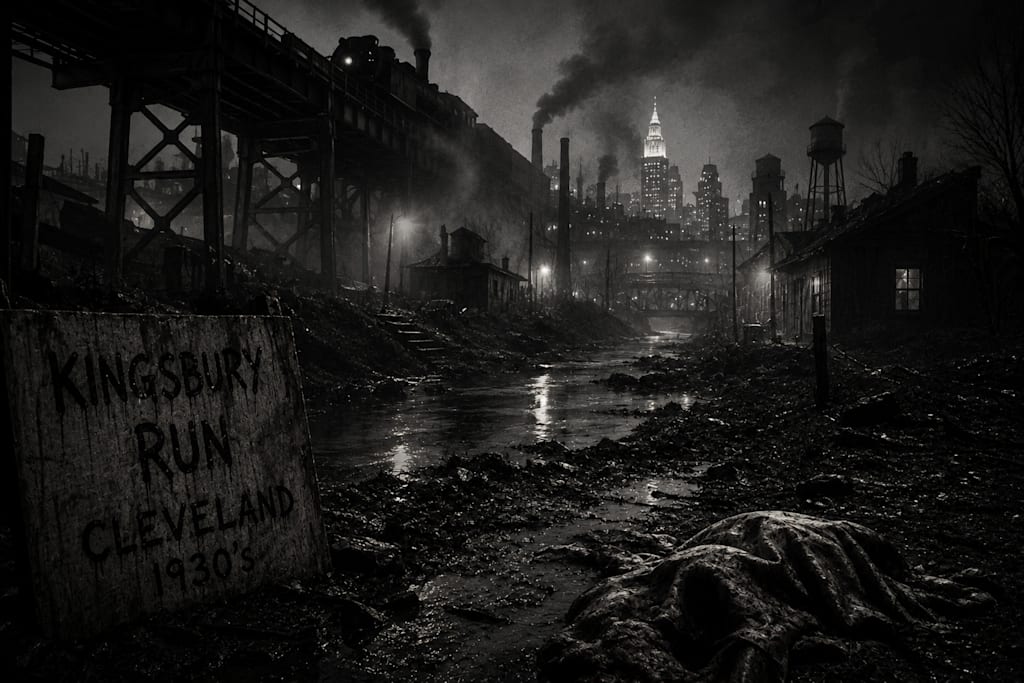
By the mid-1930s, Cleveland was a city under strain. The Great Depression had hollowed out entire neighborhoods, leaving factories that once roared with life standing silent. Men who had come to the city in search of work found themselves sleeping in shantytowns assembled from scrap wood and sheet metal. Along the banks of the Cuyahoga River, beneath railroad trestles and smokestacks, lay Kingsbury Run. A sprawling, industrial wasteland that cut through the heart of the city. It was a place of forgotten people. And somewhere in its shadows, a killer was waiting.
Over the next several years, bodies would begin appearing in and around Kingsbury Run under circumstances so horrifying that newspapers struggled to find language equal to the crimes. The victims came from society's margins: drifters, laborers, sex workers, and transients. Some were never identified, and many had no family nearby to report them missing.
The newspapers soon gave the murderer a name that would echo through American history: the Mad Butcher of Kingsbury Run. Today, he is better known as the Cleveland Torso Murderer. And despite one of the largest manhunts in the city's history, led in part by the legendary lawman Eliot Ness, the identity of the fugitive remains unknown.
The story began on September 23, 1935, when two teenage boys were exploring the area near Jackass Hill. A desolate rise overlooking Kingsbury Run, where they made a discovery they would never forget. Hidden among the weeds were the remains of a man. Investigators quickly realized they were dealing with something far more sinister than an ordinary homicide: the victim had been killed elsewhere and left in the rough terrain of the Run, a place where freight trains rattled overhead and smoke from the mills darkened the sky. Police initially hoped the murder was an isolated atrocity, but they were wrong. Less than a month later, another victim was found, then another. As the months stretched into years, the pattern became impossible to ignore.
The killer or killers displayed an unnerving consistency. Bodies appeared in vacant lots, riverbanks, wooded areas, and hidden corners of the city. The crimes suggested planning, confidence, and a chilling familiarity with anatomy. Detectives increasingly believed they were hunting someone methodical, perhaps even educated. The public, meanwhile, was horrified. Cleveland in the 1930s was already a city burdened by economic collapse. Unemployment remained high, crime was rising, and entire communities had been reduced to desperate poverty. Now an unknown predator seemed to be stalking the forgotten spaces between neighborhoods. Kingsbury Run itself became a character in the unfolding nightmare.
Stretching through Cleveland's industrial district, the area was a maze of railroad tracks, ravines, abandoned structures, and makeshift camps. Thousands of people passed through its hobo settlements during the Depression. It was a world unto itself, a city hidden beneath the city. For the killer, it was the perfect hunting ground. People disappeared there all the time. Few asked questions and even fewer received answers.
As the murders mounted, panic spread. Newspaper headlines transformed the unknown assailant into a monster lurking in the shadows of Cleveland. Citizens whispered about a phantom butcher who moved silently through the night while police struggled to understand his methods. Then came a twist that elevated the case into American legend.
In 1935, Cleveland's public safety director was none other than Eliot Ness. Ness was already famous. Only a few years earlier, he had earned national attention as one of the "Untouchables," the federal agents who pursued Al Capone during Prohibition. To many Americans, he embodied the ideal of the incorruptible lawman. Yet the Torso Murders presented a different challenge entirely.
Capone had operated in the open, commanding an empire of bootlegging and organized crime. The Mad Butcher left only silence behind. Ness threw himself into the investigation. Detectives interviewed witnesses, combed through Kingsbury Run, and pursued dozens of leads. The city's resources were mobilized. Fingerprints were analyzed. Suspects were questioned. Tips poured in from frightened citizens.
Nothing stuck. The killer remained maddeningly elusive. Meanwhile, the murders continued. The unknown assailant seemed to taunt the authorities, leaving victims in increasingly conspicuous locations. In some cases, bodies appeared within sight of major roads and landmarks, as though the killer wanted them found.
The psychological effect on Cleveland was profound. Parents warned children not to wander alone. Residents avoided the Run after dark. Rumors spread faster than facts. Every unfamiliar face became a potential suspect. And yet, for all the fear, investigators faced a grim reality: many of the victims had lived transient lives. Some had no identification. Others had family scattered across the country. In several cases, police could not even determine the victims' names. It was as though the killer had deliberately chosen people who might simply vanish into the chaos of Depression-era America.
Speculation flourished. Who was responsible? One theory suggested a doctor or other medical professional, citing the apparent anatomical knowledge displayed in the crimes. Another proposed that the murderer worked in one of Cleveland's slaughterhouses or meatpacking facilities, accustomed to handling knives and working unseen.
Others believed the killer was a drifter who blended seamlessly into Kingsbury Run's transient population. Then there were the darker possibilities. Could there have been multiple killers? Was the murderer aided by someone within the city? Had police overlooked an obvious suspect? The theories multiplied because the evidence remained frustratingly incomplete.
Perhaps the most intriguing suspect to emerge was a man named Francis Sweeney. Sweeney was a former Army medic with a troubled history and known struggles with alcoholism and mental illness. He had connections to influential figures in Cleveland, and some investigators privately became convinced that he was responsible. Eliot Ness himself reportedly considered Sweeney a prime suspect. Yet suspicion and proof are not the same thing.
Sweeney underwent questioning. He even submitted to early forms of lie-detector testing, with results that only deepened the investigators' unease. But prosecutors lacked the evidence necessary to bring charges.
The case stalled. And then something even stranger happened. According to later accounts, Ness began receiving taunting postcards from someone believed to be the killer. The messages mocked the investigation and suggested that the murderer knew exactly how close, or how far, the police truly were. Whether the writer was genuinely the Torso Murderer remains uncertain. But the effect was devastating. Cleveland's most celebrated lawman had become trapped in a public battle against an invisible enemy. Desperate to restore order, Ness authorized one of the most controversial actions of his career.
In August 1938, police raided Kingsbury Run. Shanties and encampments were demolished. Makeshift shelters were burned. Hundreds of people were forced from the area in an effort to disrupt the killer's hunting grounds. The operation made headlines across the nation. For some, it was a necessary response to an impossible situation. For others, it was an act of desperation. Either way, the raid failed to produce the breakthrough investigators had hoped for.
The murders eventually ceased. But the mystery maddeningly endured. That may be the most unsettling aspect of the entire case. There was no dramatic arrest. No courtroom confession from a grizzled murderer. No final confrontation between Eliot Ness and the Mad Butcher. The killings simply stopped… And somewhere amid Cleveland's factories, neighborhoods, and crowded streets, the person responsible either died, moved away, or quietly resumed an ordinary life.
History offers no answer. Over the decades, the Cleveland Torso Murderer has often been compared to Jack the Ripper and the Zodiac Killer, and the parallels are difficult to ignore. All three cases terrorized major cities. All three inspired feverish media coverage. And all three left behind numerous possible suspects and questions that continue to haunt investigators generations later.
Yet the Cleveland murders possess a uniquely American darkness. Jack the Ripper belongs to fog-shrouded Victorian London. Zodiac belongs to the freeways and suburbs of California. The Mad Butcher belongs to Depression-era Cleveland. A city of steel mills, rail yards, and forgotten communities struggling to survive one of the bleakest chapters in American history. There is something deeply unsettling about that. The killer did not stalk grand boulevards or wealthy neighborhoods. He moved through abandoned lots and hidden camps, preying on those whom society had already begun to overlook.
That fact lends the case a tragic weight beyond the mystery itself. Many of the victims were denied not only justice, but identity. Even now, nearly a century later, historians continue to debate the case. Books have been written. Documentaries have been produced. Amateur detectives pore over old police files, convinced that some overlooked clue still waits to be discovered.
Perhaps they are right. Perhaps somewhere in a forgotten archive sits a document capable of solving the mystery once and for all. Or perhaps the truth vanished with the era that produced it.
Today, Kingsbury Run has changed. The hobo camps are gone. The factories have faded. Modern Cleveland has grown over the places where investigators once searched by flashlight. But beneath the city's streets and highways lingers the memory of those terrible years, when fear spread through the industrial heart of America and one of the nation's most celebrated lawmen failed to stop a killer.
The Cleveland Torso Murderer remains one of history's most disturbing enigmas, not merely because of the crimes themselves, but because the story ends not with justice, but with silence. Somewhere, once, there was a person who knew exactly what happened in Kingsbury Run.
And that person carried the secret into the shadows, and more importantly, to their grave…
About the Creator
Veil of Shadows
Ghost towns, lost agents, unsolved vanishings, and whispers from the dark. New anomalies every Monday and Friday. The veil is thinner than you think....
Enjoyed the story? Support the Creator.
Subscribe for free to receive all their stories in your feed.
Comments
There are no comments for this story
Be the first to respond and start the conversation.