
The Chained Man of Athens: The Ghost Story That Refused to Die
Masterful Monday Edition

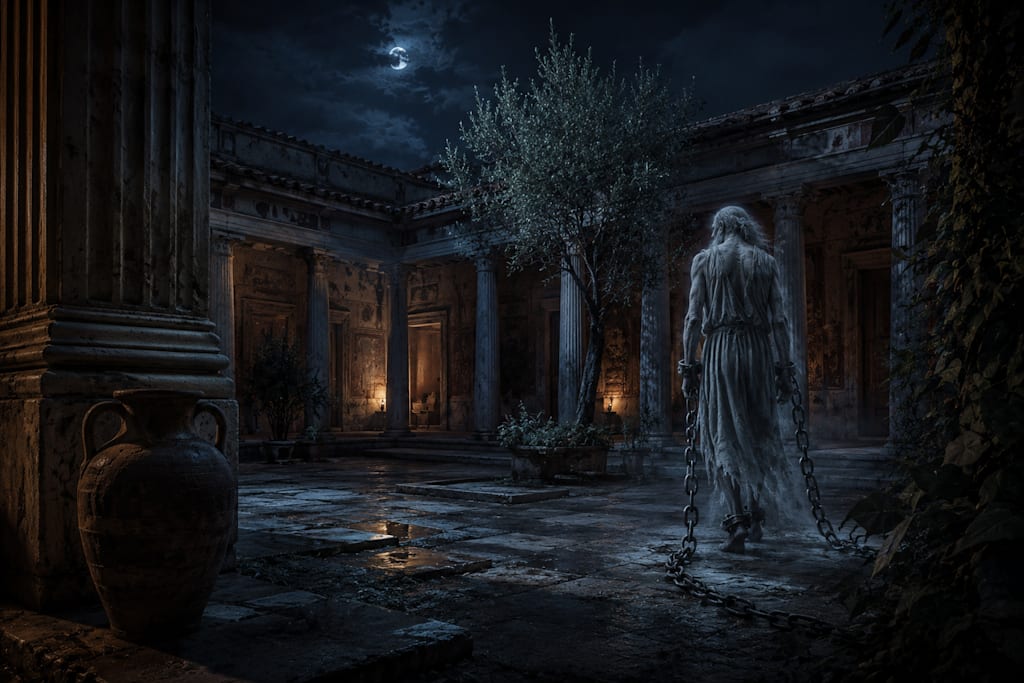
Long before haunted houses had creaking staircases, flickering electricity, or doors that moved by themselves, there was a house in ancient Athens where people were afraid to sleep. Because every night, the chains began to move.
At first, the sound seemed distant... iron scraping against iron, a faint metallic clatter somewhere beyond the room. Then it grew louder, closer, until finally, according to a story preserved by the Roman writer Pliny the Younger nearly two thousand years ago, the thing making the noise appeared: an old man, thin and filthy, with a long beard and disheveled hair. Heavy chains hung from his wrists and ankles as he moved through the house, dragging them behind him.
Those unfortunate enough to encounter the apparition reportedly became so terrified that they eventually abandoned the enormous residence. No one wanted it. No one would live there. And so, one of history’s earliest recorded haunted houses stood empty in Athens, waiting.
Our source for this extraordinary account is not a medieval monk or anonymous storyteller, but Pliny the Younger: Roman senator, lawyer, magistrate, and one of the most valuable letter writers surviving from the ancient world. Born around AD 61, Pliny lived during the height of the Roman Empire. His surviving correspondence offers historians remarkable glimpses into Roman politics, society, and everyday life. He also witnessed history firsthand: when Mount Vesuvius erupted in AD 79, burying Pompeii and Herculaneum, the teenage Pliny watched the catastrophe from across the Bay of Naples. His uncle and adoptive father, Pliny the Elder, sailed toward the disaster and died during the eruption. Years later, Pliny the Younger described what he had witnessed in letters that remain among our most important accounts of the catastrophe.
But another of his letters preserves something considerably stranger. In Book 7, Letter 27, Pliny writes to a man named Licinius Sura and asks a question humanity still debates today: Do ghosts exist? Pliny did not pretend to know. Instead, he offered stories. Among them was the tale of the haunted house in Athens.
According to Pliny, the building was spacious and impressive but carried a terrible reputation. At night, residents heard the unmistakable sound of iron, then chains. The noises approached gradually until the spectral old man appeared. His condition was horrifying: emaciated and neglected, hair and beard grown long, shackles binding his hands and feet. The apparition shook and dragged the chains as he moved. Eventually, fear drove the occupants away. The house became deserted. Its owner reportedly advertised it for sale or rent at an unusually low price, hoping someone unfamiliar with its reputation might take it. Apparently, haunted-property discounts existed long before modern real estate.
Then a philosopher named Athenodorus arrived in Athens. He noticed the suspiciously inexpensive house, asked why such a substantial property cost so little, and someone told him: there was a ghost. Most reasonable people would probably have thanked the owner for his honesty and continued looking, but Athenodorus bought, or according to some translations, rented, the house. Then he deliberately waited for nightfall.
He instructed that a bed be prepared for him in the front portion of the house, asked for writing materials and a lamp, and began working. Night settled over Athens. The house became quiet. Then... iron. A faint metallic noise sounded somewhere in the darkness. Athenodorus heard it. He continued writing. The chains grew louder. Closer. Still, the philosopher concentrated on his work. Finally, the sound seemed to come from directly behind him. Athenodorus turned. The old man was standing there. The apparition raised a finger and beckoned him to follow.
And then comes perhaps the greatest moment in the entire story: Athenodorus motioned for the ghost to wait... and returned to his writing. Apparently, even the dead had to respect a philosopher’s schedule. Eventually, the rattling chains became impossible to ignore. Athenodorus picked up his lamp and followed. The spectral figure moved slowly through the house, dragging its shackles behind it. It led him into the courtyard. Then it stopped. The apparition vanished. Athenodorus was left staring at an empty patch of ground.
Rather than begin digging in the darkness, he marked the location with grass and leaves and waited until morning. The following day, he contacted local authorities and asked that the spot be excavated. Beneath the earth, according to Pliny, they found bones, human bones, wrapped and entangled in chains. The body had apparently been buried without proper funeral rites. The remains were collected and given a public burial. And afterward, the house became quiet. The ghost never returned.
If that story sounds astonishingly familiar, it should. A restless spirit tied to a particular building. Unexplained noises. An apparition revealing the location of hidden remains. A violent or improper death. A proper burial. And finally, peace. It is the basic architecture of countless ghost stories told today, yet Pliny recorded this version in the early second century.
That does not mean the modern haunted-house story originated with Pliny. Beliefs concerning restless dead, improper burial, and spirits returning to the living existed across many ancient cultures and developed independently in societies worldwide. But Pliny gives us something precious: a surviving written example, one extraordinarily old snapshot of human beings telling exactly the kind of story human beings still tell.
Was it true? That is considerably harder to answer. Pliny never claimed to have visited the house. He did not personally witness Athenodorus confronting the apparition. He was repeating an account as part of a larger discussion about whether supernatural phenomena should be believed. Even the identity of Athenodorus is not completely certain. The philosopher is frequently identified as Athenodorus Cananites, a Stoic associated with the emperor Augustus, although scholars have debated precisely whom Pliny intended. There is no archaeological evidence establishing that a haunted Athenian residence contained a chained skeleton exactly as described. We therefore cannot responsibly call the story a documented paranormal event.
But perhaps asking whether the ghost was real misses something equally extraordinary, because the story certainly was. Someone told it. Pliny heard or learned of it. He considered it interesting enough to write down. His letter survived. And that survival is almost as remarkable as anything contained within it.
Think about the journey. Pliny lived nearly two thousand years ago. The Roman Empire eventually fractured. Emperors disappeared. Cities were conquered. Libraries burned. Languages changed. Ancient texts vanished forever. For centuries, books had to survive through manuscripts copied by human hands. Every surviving ancient work passed through an extraordinary chain of preservation: someone had to value it enough to copy it, someone else had to protect that copy, another generation had to copy it again. Eventually, printing transformed preservation. Translations appeared. Libraries expanded. Scholars studied Pliny. His letters crossed languages, borders, and centuries. And somewhere along that journey, the chained old man kept walking. Generation after generation heard the chains. Not literally, perhaps. But through words.
That may be the most haunting element of the entire story. The people who first told it are gone. The Athens they knew is gone. The house, assuming it existed, is almost certainly gone. The person whose chained bones supposedly lay beneath the courtyard has been dead for an unknowable length of time. Even Pliny himself has been gone for nearly nineteen centuries. Yet here we are. Still talking about the house. Still imagining the philosopher sitting beneath lamplight. Still hearing the distant metallic sound getting closer. Still wondering what we would have done when the old man appeared. Perhaps we would have followed him. Perhaps we would have fled into the Athenian night. Perhaps, like Athenodorus, we would have demanded that the ghost wait until we finished our work.
Human civilization has changed almost beyond recognition since Pliny put this story into a letter. But humanity itself? Perhaps not quite as much as we imagine. We are still fascinated by things we cannot explain. We still argue about whether extraordinary stories are true. We still fear death. We still wonder whether anything waits beyond it. And when someone begins a story by saying that a deserted house makes strange noises after dark, we still lean a little closer.
Maybe there never was a chained ghost in Athens. Maybe Athenodorus never followed an apparition into a courtyard. Maybe the skeleton beneath the earth existed only in a story that became more dramatic each time someone repeated it. After almost two thousand years, certainty is impossible.
But there is one thing we know: the chained man survived. Not as a ghost, but as a story. The apparition supposedly disappeared once the forgotten dead received a proper burial. The chains fell silent. The house was peaceful again. And yet somehow, across wars and collapsing empires, handwritten manuscripts and printed books, translations and generations beyond counting, the story continued traveling. Until eventually it reached us.
Nearly two thousand years after someone first imagined, or perhaps heard, the sound of chains approaching through an Athenian house, we are telling the story once more. And somewhere in that extraordinary journey lies a truth perhaps more profound than whether ghosts exist at all. People disappear. Buildings crumble. Civilizations fall. But sometimes, stories refuse to die.
And the chained man of ancient Athens is still walking... behind the Veil of Shadows.
About the Creator
Veil of Shadows
Ghost towns, lost agents, unsolved vanishings, and whispers from the dark. New anomalies every Monday and Friday. The veil is thinner than you think....
Enjoyed the story? Support the Creator.
Subscribe for free to receive all their stories in your feed.
Comments
There are no comments for this story
Be the first to respond and start the conversation.