

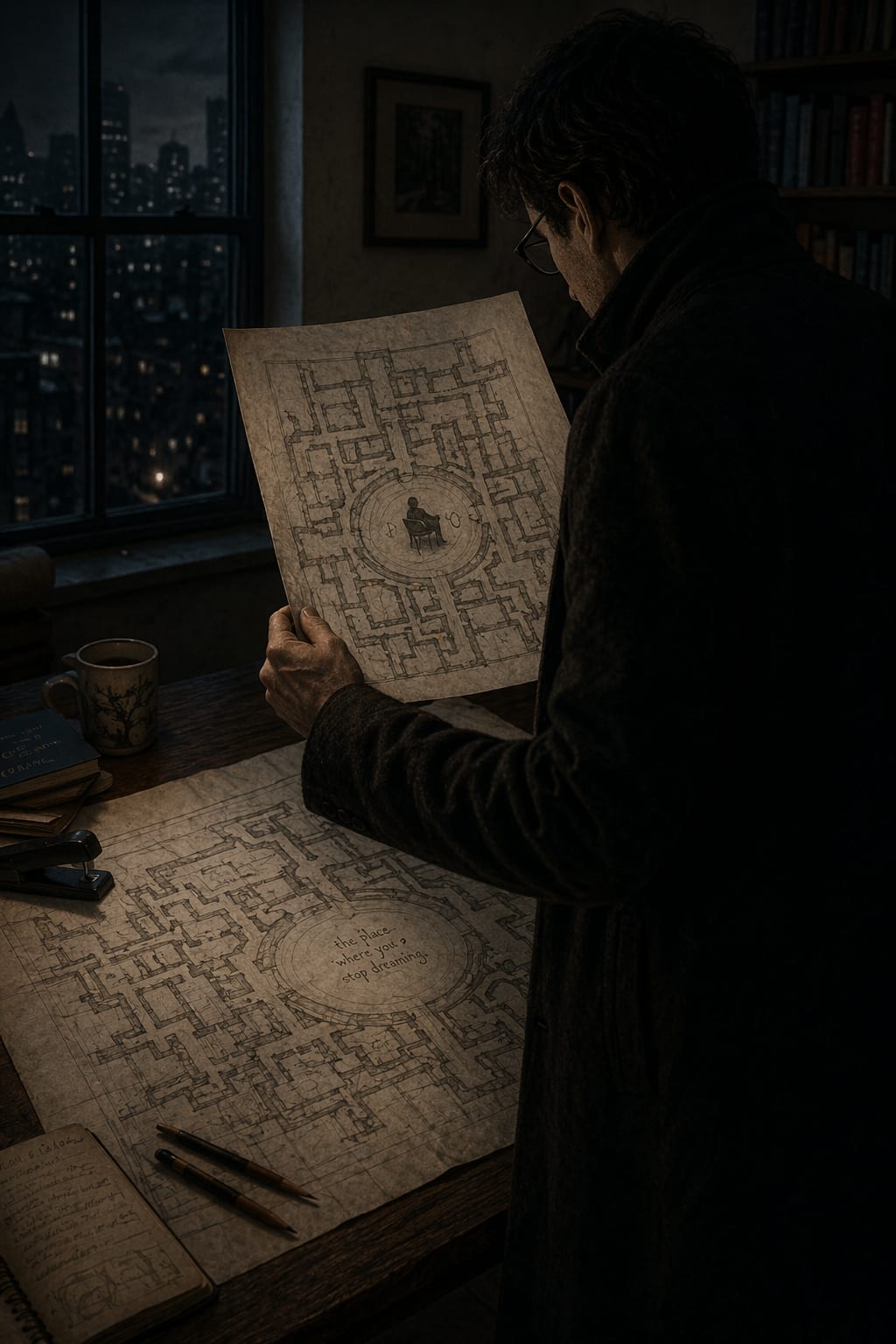
The map arrived rolled inside a cardboard tube with no postage and no return address, leaning against the door of Daniel Hare's apartment on a Tuesday morning in early March, as though it had simply grown there overnight like something fungal. He was not expecting a package. He had not ordered anything. He stood in the doorway for a moment in his socks, looking at it, and then picked it up the way one picks up something that is probably harmless but almost certainly not.
Daniel was a sleep researcher at the university — not a cartographer, not a geographer, not a person who received maps for any professional reason. He taught seminars on sleep paralysis and the architecture of dreams, published dense papers in journals that approximately forty people read, and lived alone in an apartment whose bookshelves were organized by color because he had found that organizing them by subject made the disorder in all other areas of his life harder to ignore.
He unrolled the map on his kitchen table, weighing the corners with a coffee mug, a stapler, and two books. It was hand-drawn — fine pencil lines, meticulous, the kind of work that implied either great expertise or great obsession, and he had learned through years of academic life that those two things were often the same. The paper was heavy and slightly textured, neither new nor old, the color of weak tea. There were no compass markings. There was no scale. There was no legend.
What it depicted was a building — or rather, the floor plan of a building — rendered in extraordinary detail. Corridors. Rooms of varying sizes. Staircases that seemed, if he traced them with his finger, to connect floors in ways that were not geometrically possible. A central chamber, larger than all the others, labeled in handwriting so small he needed his reading glasses to parse it. When he put his glasses on and bent close, the label read: the place where you stop dreaming.
He studied the map for twenty minutes, then rolled it back up, put it in the tube, and placed the tube on top of his refrigerator. He was a rational man. He was not frightened by architecture, even impossible architecture. He made coffee and went to work and did not think about it again until Thursday, when he woke at 3 a.m. with the absolute certainty that he had just been walking through a corridor he recognized.
* * *
The dreams began gradually, which was, he later thought, the precise method by which they avoided triggering alarm. A new dream that arrives fully formed is startling. A new dream that assembles itself over weeks, adding one corridor per night, one room per night, is simply a thing that seems to have always been there.
By the end of March he was navigating, each night, what he had begun privately to call the Interior — a vast structure of stone and dark wood and long windowless hallways lit by sources he could never locate directly. The quality of light was what troubled him most in the early weeks: it was the light of late afternoon in autumn, the specific gold of four o'clock in October, and it came from everywhere at once. He was a sleep researcher. He knew that anomalous lighting in dreams was common, neurologically explicable, meaningless. He told himself this with some frequency.
In the dreams, he always had the map. He would reach into his coat — he always wore a coat in the Interior, a heavy brown thing he did not own in waking life — and find it folded in the inside pocket. When he unfolded it, it showed not the building he had found in the tube but wherever he currently was: the corridor, the room, the staircase, rendered in the same fine pencil lines, with his own position marked by a small circle. The map was always accurate. The map always knew where he was.
In the fifth week, he reached the central chamber for the first time.
It was larger than the map had suggested, which should have been impossible given that the map had always been accurate. The ceiling was too high to see clearly. The floor was stone, and in the center of the stone floor was a chair — plain, wooden, facing away from him. He walked around it slowly. It was empty. On the seat was a piece of paper, folded once. He picked it up. He unfolded it. It was blank.
He woke immediately, which was unusual. Normally he drifted through the Interior for what felt like hours before surfacing. He lay in the dark of his bedroom and his heart was doing something loud and inconvenient and he was, for the first time since the map had arrived, genuinely frightened. Not of the chamber. Not of the chair. Of the blank paper. He could not explain why. The best he could manage, lying there at 3 a.m., was this: the blank paper felt like something that had not yet been written. Something that was waiting to be filled in. Something that was currently being decided.
* * *
He showed the map to a colleague — a cartography professor named Lena Marsh, who had an office covered in historical maps and a manner of looking at things that made them feel immediately more serious. She spread it on her desk and examined it for a long time without speaking.
"Where did you get this?" she said finally.
"It was left outside my apartment."
"Do you know this building?"
"No."
She pointed to the staircases — the impossible ones, the ones that connected floors in ways that defied the geometry of the structure. "These would require the building to occupy the same space on two different floors simultaneously. That's not a drafting error. Whoever drew this understood exactly what they were drawing. They drew it intentionally." She paused. "This style — the line weight, the notation, the paper — I've seen something like this before. In an archive. Documents from a researcher in the 1930s who was studying what he called persistent architectural hallucination. The belief that certain minds, under certain conditions, map the same interior space. Always the same building. Always with a central chamber." She looked at him over the top of her glasses. "He was eventually institutionalized. His colleagues believed he had become convinced the building was real."
"Was it?" Daniel said, and immediately regretted saying it.
Lena was quiet for a moment. "He disappeared from the institution in November of 1938. They found his room empty except for a coat — a heavy brown thing — folded on the chair. And on the seat of the chair, a piece of paper." She folded the map carefully and slid it back across the desk toward him. "It was blank."
* * *
Daniel took the map home. He did not sleep that night, which was, he recognized, its own form of avoidance — if he did not sleep, he could not dream; if he could not dream, he could not return to the Interior. He sat at his kitchen table with the map unrolled before him and a cup of coffee going cold at his elbow and he looked at the central chamber and at its label and at the chair drawn at its center in fine pencil lines.
He had been studying sleep for nineteen years. He understood, better than most, that the architecture of dreams is not random — that the sleeping mind builds from materials it has gathered in waking life, assembles structures from emotional residue and unprocessed memory. He believed this. He had published papers defending this position with rigor and evidence.
He did not believe, and had never believed, in buildings that existed outside the mind.
He picked up the map and carried it to the window. Below, the city went about its business in the ordinary dark. He stood there for a long time. Then he went to his coat closet — his winter coat, the heavy dark one he rarely wore — and reached into the inside pocket.
His fingers found paper. Folded once. He stood very still for a moment that felt much longer than a moment. Then he drew it out and opened it under the kitchen light.
It was not blank.
It was a map. Hand-drawn, fine pencil lines, meticulous. A building he recognized. A central chamber, labeled in handwriting he recognized as his own. And in the central chamber, marked with a small circle indicating current position: a chair.
Facing him.
Occupied.
About the Creator
Alpha Cortex
As Alpha Cortex, I live for the rhythm of language and the magic of story. I chase tales that linger long after the last line, from raw emotion to boundless imagination. Let's get lost in stories worth remembering.
Enjoyed the story? Support the Creator.
Subscribe for free to receive all their stories in your feed.
Comments
There are no comments for this story
Be the first to respond and start the conversation.