
The Bleeding Steel: The Psychology of Japan’s Cursed Blades
When objects inherit the madness of their masters: The terrifying reality of the "Yoto"—blades that refuse to be sheathed without tasting blood.

1. More Than a Weapon
In our previous exploration of Samurai Minimalism, we discussed the Katana as a masterpiece of pure utility—a tool stripped of all heavy ornamentation to achieve a perfect, lethal discipline. But in the cultural memory of Japan, a sword is never just metal. It is not an inanimate object.
Under the right, suffocating conditions, a blade undergoes a terrifying transformation. It ceases to be a tool of the living and becomes a vessel for the dead. This is the dark side of Tsukumogami—the belief that objects can inherit a soul—where the steel doesn't just cut the flesh; it devours the mind of the one who wields it.
2. The Muramasa Madness: Blood for the Edge
The most infamous historical example of this phenomenon is the legacy of Sengo Muramasa, a master swordsmith of the Sengoku period. Muramasa’s blades were legendary for their terrifying sharpness. They were said to cut a floating leaf in half if it merely drifted against the edge in a running stream.
But the legends whisper a darker truth: Muramasa was a man possessed by a violent, chaotic spirit, and that madness was folded into the very layers of the glowing steel.
Unlike the balanced, peaceful mind required for the tea ceremony (Chado), a Muramasa blade demanded blood. It was said that once a Muramasa was unsheathed, it could not be returned to its scabbard empty. If it had not tasted an enemy’s blood, it would force its master to cut his own flesh, or drive him into a blind, murderous frenzy until the household lay in ruins. It was a weaponization of pure, unadulterated Kegare (spiritual pollution).
3. The Geometry of the Curse
What makes a cursed blade (Yoto) so psychologically terrifying to the Japanese mind? It is the inversion of Wa (harmony). A proper samurai blade is a symbol of order, justice, and protection. A cursed blade, however, creates a "Labyrinth of the Mind."
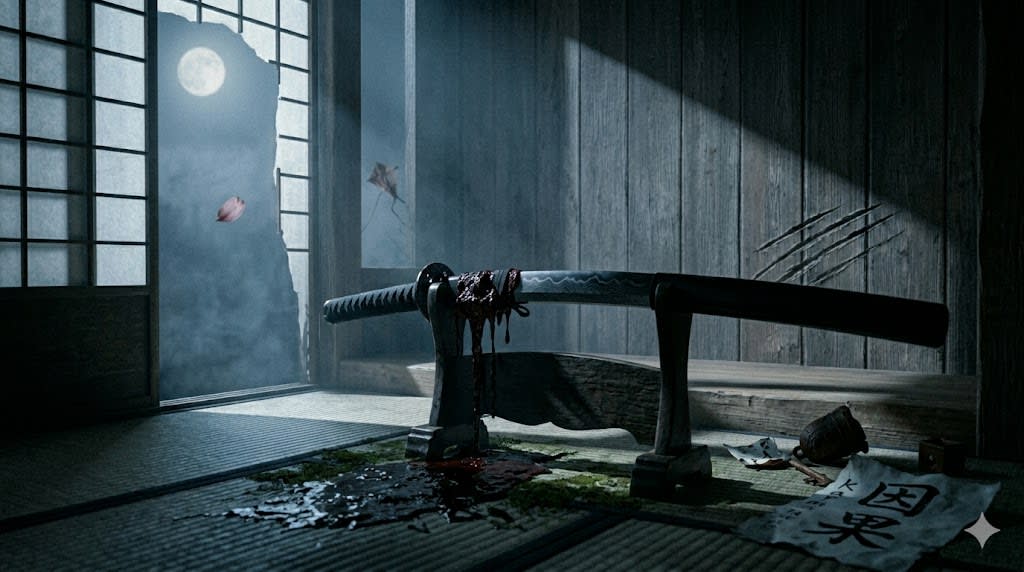
As you look down the polished, wavy pattern (Hamon) of the steel under the pale moonlight (image_37.png), the reflection you see is no longer your own. The blade acts as a static horror, much like the anatomical models in empty science labs or the bleeding portraits in the music rooms. It coaxes the hidden, repressed violent impulses out of the samurai's subconscious. The shadow of the warrior is amplified until the man becomes the servant, and the iron becomes the master.
4. The Bleeding Scabbard
There is a lesser-known folklore trope in Japan of the "weeping sword." In ghost villages (Haikyo) where families vanished decades ago (image_33.png), explorers occasionally find a single katana left on a dust-covered rack.
At midnight, when the wind blows through the shattered shoji screens, the sword begins to vibrate. A dark, thick rust—resembling dried blood—slowly seeps from the throat of the scabbard, dripping onto the moss-covered tatami mats. It is the physical manifestation of Mononoke—the resentment of a weapon that was used for slaughter and then abandoned to time, left to rot without the purification rituals of a shrine. It is the heavy, suffocating weight of history that cannot be washed away by the rain.
5. Conclusion: The Mirror of the Soul
Why do these legends of cursed steel continue to fascinate us? Because a sword, at its core, is a mirror. The ancient blacksmiths didn't just forge iron; they forged human intent.
When a modern reader shivers at the thought of a Muramasa blade, they aren't afraid of the metal itself. They are afraid of what happens when the fragile walls of our discipline and minimalism crumble, leaving us exposed to the raw, chaotic dark within us. In the end, the sword doesn't curse the man; it simply reveals the monster that was already waiting in the shadows.
About the Creator
Takashi Nagaya
I want everyone to know about Japanese culture, history, food, anime, manga, etc.
Enjoyed the story? Support the Creator.
Subscribe for free to receive all their stories in your feed.
Comments
There are no comments for this story
Be the first to respond and start the conversation.