
THE BEAST OF BRAY ROAD
Wisconsin's Most Infamous Werewolf Legend

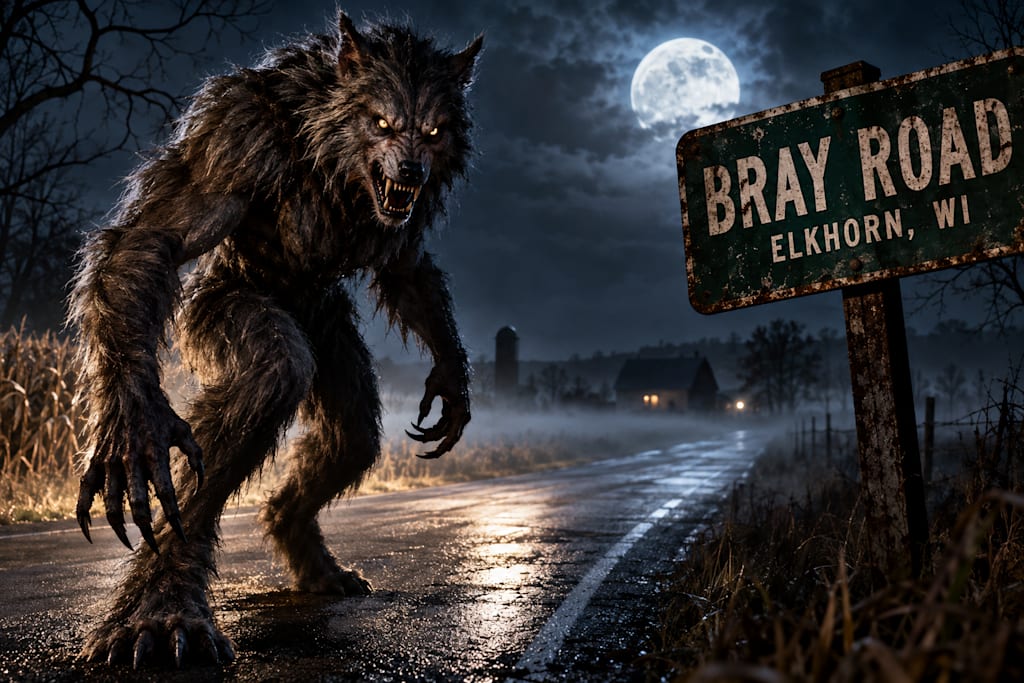
THE BEAST OF BRAY ROAD
Wisconsin's Most Infamous Werewolf Legend
There are roads that seem ordinary in daylight but acquire an entirely different character after dark.
Bray Road is one of them.
Located near Elkhorn in Walworth County, Wisconsin, the rural road winds through farmland, wooded areas, fields, and scattered homes. Nothing about the landscape immediately suggests monsters.
Yet for decades, people have claimed that something strange moves through this countryside.
Something covered in hair.
Something with the face of a wolf.
Something that can walk upright.
The creature has become known as the Beast of Bray Road, one of Wisconsin's most famous modern cryptid legends.
Some call it a werewolf.
Others call it a Dogman.
Some believe it is an unidentified animal.
Others believe the entire phenomenon can be explained by misidentification, fear, poor visibility, or folklore.
Before getting into the darker parts of the story, however, there is an important distinction to make.
DOCUMENTED FACTS VS. ALLEGED SIGHTINGS
The legend is documented. The creature is not.
That distinction is essential.
There is reliable historical evidence that:
Reports about a strange creature circulated in the Elkhorn area.
Local reporter Linda Godfrey investigated those reports in the early 1990s.
Godfrey interviewed people who claimed to have encountered an unusual animal.
Walworth County Humane Officer Jon Fredrickson had reportedly received and documented unusual animal complaints.
Newspaper coverage helped bring the stories to a wider audience.
Additional people later came forward claiming similar encounters.
The Beast of Bray Road subsequently became an established piece of Wisconsin folklore.
Those are claims about people, reporting, and the history of the legend.
They are different from evidence proving that the creature itself existed.
The actual sightings are alleged encounters.
When this article says that a witness "saw," "encountered," or "reported" the Beast, it means that person claimed to have experienced it. It does not mean the animal's identity was independently confirmed.
There is currently no scientifically verified evidence establishing the Beast of Bray Road as an unknown species, supernatural creature, or werewolf.
No authenticated specimen has been produced.
No confirmed DNA sample has established an unknown creature.
No photograph has been universally accepted as definitive proof.
No independent scientific investigation has confirmed the existence of the Beast.
That doesn't mean witnesses were lying.
It means their testimony and the physical evidence are two different things.
A person can sincerely report seeing something strange and still be mistaken about what they saw.
And that uncertainty is where the legend begins.
THE FIRST REPORTS
The modern Beast of Bray Road legend took shape during the late 1980s and early 1990s, when reports of a strange creature began circulating around the Elkhorn area.
The story eventually attracted the attention of Linda Godfrey, a reporter and illustrator for The Week, a Walworth County newspaper.
Godfrey initially approached the reports skeptically.
A werewolf roaming rural Wisconsin sounded more like Halloween folklore than serious news.
Then she began interviewing witnesses.
According to her reporting, several people described a remarkably similar creature.
They alleged that it was large, heavily built, covered in gray, brown, or reddish hair, and possessed a canine-like head, pointed ears, long arms, and large claws.
Several witnesses also alleged that the creature could walk upright.
Some claimed it moved on two legs before dropping onto all fours and running away.
These similarities became an important part of the legend.
But they remain eyewitness allegations.
Similar descriptions do not, by themselves, establish that the witnesses encountered the same animal or that the animal was an unknown species.
THE WEREWOLF FILE
One of the most famous pieces of the early story concerns Jon Fredrickson, a Walworth County Humane Officer.
According to accounts of the investigation, Fredrickson had received reports concerning unusual animals and kept notes about them.
Those reports were reportedly stored in a manila folder marked:
WEREWOLF.
The existence of a folder and animal complaints is evidence that unusual reports were being made.
It is not evidence that a werewolf existed.
Fredrickson reportedly considered ordinary explanations, including wolves, coyotes, and other animals.
That distinction is often lost when the story is retold.
A documented report that someone claimed to see a strange animal is not the same thing as documented proof that the animal was strange.
THE CREATURE BESIDE THE ROAD
One early witness, identified by Godfrey as Barbara, allegedly encountered a strange creature beside Bray Road.
According to her account, she initially believed she was looking at an animal feeding beside the road.
Then she noticed what appeared to be hands rather than paws.
She described a large, hairy creature with pointed ears, a long muzzle, teeth, and claws.
The creature allegedly noticed her and looked toward her vehicle.
Its eyes appeared to reflect brightly in her headlights.
She drove away.
This is one of the most frequently repeated early Beast accounts.
But it remains exactly that:
an alleged sighting.
There is documentation that the story was reported.
There is no independent physical evidence proving that the animal described actually existed.
HALLOWEEN, 1991
One of the more dramatic alleged encounters occurred on October 31, 1991.
A woman reportedly believed her vehicle had struck something while traveling along Bray Road.
She stopped to investigate but allegedly found no obvious animal in the roadway.
She then reported seeing a large, dark, hairy creature approaching.
According to her account, she attempted to escape in her vehicle and claimed that the creature struck or grabbed at the car, leaving scratches.
She later reportedly encountered the creature again that same night.
The account became part of the growing Bray Road legend.
But again, the distinction matters:
The incident is a reported encounter, not verified evidence of a creature.
The scratches, if documented, could potentially demonstrate contact with something.
They would not, by themselves, establish that the thing responsible was a werewolf or unknown species.
THE CHILDREN WHO ALLEGEDLY SAW IT
Another early account involved an 11-year-old girl identified as Heather Bowey.
According to the story, she and a friend saw what they initially believed was a large dog.
The animal allegedly stood upright.
It was described as having silvery-gray and brown fur, a canine-like face, and large hind legs.
The children reportedly ran when it began moving toward them.
The creature allegedly followed before disappearing into a cornfield.
Again, what is documented is the claim that this encounter was reported.
What remains unverified is what the children actually encountered.
That distinction applies to every witness account associated with the Beast.
WHAT THE WITNESSES DESCRIBED
Over time, a recognizable image of the Beast developed.
Witnesses have allegedly described a creature that is:
Five to seven feet tall when upright
Covered in gray, brown, reddish, or dark fur
Broad and muscular
Equipped with a canine-like head
Long-muzzled
Large-eared
Long-armed
Equipped with claws
Capable of walking on two legs
Capable of running on four
Descriptions vary, however.
Some later reports describe considerably larger creatures.
Others differ in color, proportions, behavior, and apparent intelligence.
That variation matters because the modern image of the Beast has been shaped by decades of retelling.
Books, documentaries, artwork, television programs, internet discussions, and other forms of popular culture have all contributed to the creature's modern appearance.
The Beast described by folklore today may not perfectly match the creature described in the earliest reports.
WEREWOLF OR DOGMAN?
The word "werewolf" became attached to the legend early on.
But the Beast of Bray Road does not neatly fit traditional werewolf folklore.
There is no established human identity.
No verified transformation.
No curse.
No documented connection to the full moon.
Instead, the creature gradually became associated with the broader modern Dogman phenomenon, in which witnesses claim to have encountered large, upright, canine-like creatures.
Skeptics have proposed more conventional explanations.
A bear viewed under poor lighting.
A large dog.
A coyote.
A wolf.
An unusual animal behaving in an unexpected way.
Or simply a person or animal whose appearance was distorted by distance, darkness, and fear.
None of these possibilities has been definitively demonstrated to explain every report.
But neither has the existence of the Beast been demonstrated.
THE STORIES BEFORE THE STORY
As the legend became better known, additional people came forward claiming they had seen similar creatures years or even decades earlier.
One frequently cited account dates to 1936 in Jefferson County, roughly 40 miles from Bray Road.
That story is now sometimes presented as an earlier Beast encounter.
However, the connection is folkloric rather than scientifically established.
There is no evidence proving that the 1936 incident involved the same creature described in the later Bray Road reports.
This is an important pattern in cryptid folklore.
Once a creature becomes famous, older unexplained stories are sometimes reinterpreted through the new legend.
A strange animal seen decades earlier becomes a possible Beast.
An unexplained noise becomes a possible encounter.
A story that once had no connection to Bray Road becomes part of its mythology.
That doesn't make the older story meaningless.
It simply means the connection should not be presented as established fact.
WHY BRAY ROAD?
The geography provides a perfectly reasonable environment for wildlife and for misidentification.
The area contains farmland, wooded patches, fields, waterways, deer, and other wildlife.
Roadkill attracts scavengers.
Rural roads can be extremely dark.
Visibility can be limited.
An animal can cross the road and disappear into cover within seconds.
Those facts offer plausible explanations for at least some reports.
They also happen to create an excellent setting for a monster legend.
The Beast does not need a haunted castle.
It has cornfields.
It has tree lines.
It has empty roads.
And it has the darkness.
WHAT DO WE ACTUALLY KNOW?
We know the legend exists.
We know people reported unusual encounters.
We know journalists investigated those reports.
We know witnesses described creatures that they believed resembled enormous, upright canines.
We know the stories became sufficiently widespread to develop into a major piece of Wisconsin folklore.
What we do not know is what those witnesses actually encountered.
There is no confirmed biological evidence demonstrating that the Beast of Bray Road is a real creature.
That means several possibilities remain open.
Perhaps the witnesses encountered ordinary animals under unusual circumstances.
Perhaps different sightings were unrelated.
Perhaps expectation and folklore influenced later reports.
Perhaps an unidentified animal was involved in some cases.
Or perhaps the witnesses encountered something genuinely unusual that has never been identified.
There simply isn't enough physical evidence to determine which explanation is correct.
THE LEGEND THAT REFUSES TO DIE
That uncertainty is what makes the Beast of Bray Road so compelling.
The story isn't frightening because science has confirmed a monster.
Science hasn't.
It is frightening because the original mystery was never neatly resolved.
There is no specimen sitting behind glass.
No skeleton that scientists can examine.
No DNA result that settles the argument.
Just reports.
Descriptions.
Interviews.
Newspaper stories.
And generations of people repeating the same question:
What was out there?
Maybe it was wildlife.
Maybe it was human error.
Maybe it was folklore taking shape in real time.
Or maybe something unusual really did move through those Wisconsin fields.
We don't know.
And that is the line between the documented history of the Beast and the alleged existence of the creature itself.
The history is real.
The reports are real reports.
The witnesses were real people.
The monster remains unverified.
THE BEAST OF BRAY ROAD
Bray Road is an ordinary Wisconsin road.
That may be the strangest part.
There is no confirmed monster waiting there.
No scientific evidence tells us that travelers are being stalked by a werewolf.
But somewhere along that road, decades ago, people began reporting something they could not explain.
Their stories became newspaper articles.
The articles became investigations.
The investigations became books.
The books became folklore.
And the folklore gave the creature a name.
The Beast of Bray Road.
🌑🐺
It may be a werewolf.
It may be a misidentified animal.
It may be several unrelated encounters stitched together by decades of storytelling.
Or it may be something we simply haven't identified.
There is no verified evidence that settles the question.
So for now, the most accurate description remains the simplest:
The Beast of Bray Road is a documented legend built around unverified eyewitness reports.
The road is real.
The stories are real.
The creature?
That's still the mystery.
About the Creator
Lilithea Adasia
I am here, I am there, I am everywhere. Somethings will have you laughing & smiling, others have you reaching for the nearest tissue. In the end they are my stories, some are fiction some are not, which is which is for me to know.
Enjoyed the story? Support the Creator.
Subscribe for free to receive all their stories in your feed.
Comments
There are no comments for this story
Be the first to respond and start the conversation.