
The Bargain Cabin
When the Walls Stopped Protecting Them

They thought they’d found a bargain.
A week in a handcrafted cabin tucked deep in the wilderness, miles from the nearest town, priced so low it felt like a mistake. Daniel joked that maybe the owner had forgotten a zero. Lena, worn down by the grind of city life, didn’t question it. They booked it within minutes.
The first evening felt like proof they’d made the right decision. The cabin stood exactly as advertised—polished wood, a wraparound porch, and a panoramic view of dense forest that seemed untouched by time. The air smelled clean, almost sweet. They cooked dinner, opened a bottle of wine, and laughed at the quiet.
But even then, the silence wasn’t complete.
Every so often, something moved beyond the tree line. A rustle. A snap. Once, a low, throaty sound that didn’t belong to the wind.
“Probably deer,” Daniel said, though he didn’t sound entirely convinced.
They locked the door that night more out of habit than fear. Sleep came easily.
Outside, unseen eyes watched the cabin, measuring its new occupants. On the second night, the silence had weight.
It pressed in from all sides, making every small noise inside the cabin feel amplified—the creak of the floorboards, the hum of the refrigerator, and the soft brush of tree limbs against the roof.
Then came the first real disturbance.
A heavy thud against the outer wall.
Lena sat up. “Did you hear that?”
Daniel listened—another thud. Then something dragged, slow and deliberate, along the side of the cabin.
“It’s probably just an animal,” he said, but this time the reassurance was thinner.
They turned off the lights and peered through the window, but the darkness outside felt impenetrable. Whatever was out there remained just beyond sight.
Later, as they tried to sleep, more sounds came—footsteps circling the cabin, faint scratching at the door, and something lurking outside the windows.
“They’re just curious,” Daniel whispered.
Neither of them slept much. By the third night, curiosity had turned into intrusion.
They went to bed early, feeling more exhausted from nerves than physical activity. Sometime in the early hours, they both heard a sound—but in that blurry state between sleep and wakefulness, they ignored it.
Just the wind.
Just imagination.
Morning proved otherwise.
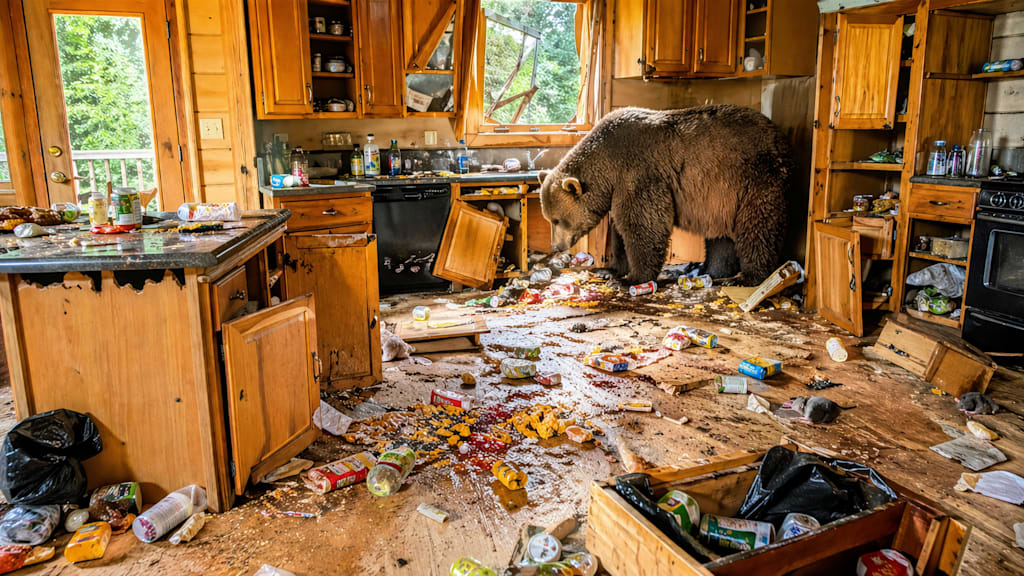
The kitchen was destroyed.
Cabinets hung open, splintered at the hinges. Food packaging lay shredded across the floor. A thick, musky odor clung to the air. Claw marks gouged the countertop, and muddy paw prints—massive, unmistakable—traced from the broken window to the back door.
“A bear,” Lena said, her voice barely audible.
The realization settled like a stone in their chests. Something large enough to tear through the cabin had been inside while they slept.
Worse, it had left something behind.
At first, it was just a flicker of movement near the baseboards. Then another. Then several.
Rats.
Not the small, skittish kind. These were large and bold, their bodies slick with grime as they emerged from gaps in the walls, drawn to the scraps the bear had discarded. They moved with unsettling confidence, climbing over debris and gnawing at what remained.
Lena stepped back, covering her mouth. “Daniel… rats carry diseases.”
He nodded, recalling one in particular, hantavirus. It's airborne, deadly, and spreads through droppings and contaminated dust. The idea of it remaining in the air made the room seem instantly toxic.
They backed out of the kitchen, closing the door as if that could contain it. That night, they locked themselves in the bedroom.
They dragged a dresser against the door. Daniel armed himself with a kitchen knife and a hammer. Lena gripped another knife with both hands, her knuckles white.
“What if we don’t leave food?” she whispered. “What if they come looking for it… and for us?”
“What if we do leave food,” Daniel countered, “and they keep coming back anyway?”
There was no good answer. Isolation had stripped away every safety net. No neighbors. No cell signal. No quick escape.
Outside, something moved again.
Then another thing.
Then several.
The visitors were multiplying.
Scratching began along the walls, louder than before. A heavy weight pressed briefly against the front door. A low growl vibrated through the floorboards.
“They’re getting closer,” Lena said.
As if in response, something slammed against the bedroom door.
Once.
Twice.
Then again, harder.
The dresser rattled. The doorframe creaked.
Scratching followed—deep, frantic, tearing at the wood as if trying to carve its way through.
Lena clamped a hand over her mouth to stifle a scream. Daniel stood frozen, the hammer trembling in his grasp.
The banging came again, louder, more insistent.
Whatever was on the other side wasn’t cautious anymore. It wasn’t testing boundaries.
It was claiming them.
They stayed like that for hours, listening as the noises rose and fell—claws, footsteps, breathing that sounded too close, too aware. At some point, the scratching slowed, and the weight shifted away.
But neither of them believed it had left.
Morning came eventually, gray and thin.
They didn’t open the bedroom door right away.
When they finally did, the cabin looked worse than before. More damage. More tracks. More signs that the boundary between inside and outside had collapsed.
Lena stared at the front door, its surface marred with deep, fresh gouges.
“We’re not safe here,” she said.
Daniel didn’t argue.
The bargain had been real. The price had been low.
But now they understood why.
Out here, isolation changed the rules.
And something in the wilderness had already decided the cabin wasn’t theirs anymore.
About the Creator
Anthony Chan
Chan Economics LLC, Public Speaker
Chief Global Economist & Public Speaker JPM Chase ('94-'19).
Senior Economist Barclays ('91-'94)
Economist, NY Federal Reserve ('89-'91)
Econ. Prof. (Univ. of Dayton, '86-'89)
Ph.D. Economics
Enjoyed the story? Support the Creator.
Subscribe for free to receive all their stories in your feed. You could also become a paid subscriber, letting them know you appreciate their work.
Comments
There are no comments for this story
Be the first to respond and start the conversation.