
The Automatic Teller
A Short Story

I resented my strange uncle, Hank, for being such a cliche. It's a threadbare trope, isn't it? The eccentric brother your father moved away and married to avoid? The slightly creepy weirdo who makes people uncomfortable at dinner? The one who spoiled that funeral by telling a bizarrely graphic joke?
That guy. Now, he's finally off to the great dirt nap.
Still, he refuses to leave me alone.
I've got to go into his lair and sort things out. Of course, he had no dutiful friend or guilty ex who could do this once he croaked. "Let his nephew take care of his effects," said the lawyer to my suitably bereaved parents, over a solemnly nodding lunch.
Just grand. Unfortunately, I can imagine what he got up to in there, all alone, for years on end. I will not be taking a black light, but I might need a Geiger counter or a hazmat suit.
Do priests do house calls? I'll ask the AI. The AI will know, and have rates, if priests are into that sort of thing. It doesn't have to be Max Von Sydow in a purple cassock or anything.
No dice. I suppose it might be weirdly interesting, and he did seem the sort to hide valuables in curious locations. It's not a long drive, but it isn't an adventure. I suppose I could find an amusing person to come with, but I've imposed once too often in that regard. The crop of willing companions grows thin. I should straighten up my apartment, get into a serious relationship and adopt a lazy, cross eyed cat.
My nephew is only six. He's got feral teeth, but he's innocent as a lamb. I don't want my present to be his future. I should make one he'd like.
I'm there now. That trip wasn't any fun. This neighborhood was struggling in an earnest, endearing way when Hank moved in. It's given up.
Other than Hank, I suspect that I am the only person to walk through this door without something to deliver, like a pizza or divorce papers, in the better part of a decade. My mother used to describe his dwelling as "lived in," which is gentle in its vagueness.
Lived in by what, exactly? Insects? Rodents? Scary puzzles for the nose?
Rumor has it that Hank had quite a fortune. He never bought anything, as far as I know. He was bound to die in this dump, though he could have lived in sparkling good taste. He had sweaters older than I am, and less charming.
If he had dough, where did it come from, and where did it go? He told me he was a "political consultant," but I didn't buy it. He had a few degrees in different subjects, but no clear talent.
As for spending, he certainly did not pay a cleaning service. Some people think dusting is a quaint myth, like a free trial. I'm sure Hank felt the same way about flossing.
There are a few boxes with the names of rooms scrawled on them in hasty black sharpy on the floor when I walk in. Someone is sorting some of this out, and some mopping and moping have happened here recently.
Sisterly work.
She will make me feel guilty for obliging her to do the right thing when I wasn't available. She excels at it, thanks to all of the practice she's had.
The dank, superficially wiped and still awful bathroom is on the right, the derelict "study" on the left. Kitchen down the hall. Bedroom waiting with sinister intent where the hallway ends.
Should I just get it over with? I mean, you don't want to hear the test results, but once you do and they aren't too dire, you feel stupid for procrastinating.
Surely, the worst of it can be cleaned up quickly and forgotten.
I suddenly feel a wave of warm solidarity with people who clean for a living. They know the truth about dusting. We carry on shedding until we're dead. Someone has to deal with that, and whatever is at the end of the hall, and just chuckle, shake their head and move on to the next job. Rough sledding, that.
As I make my way down the hall, I remember hearing something about a pet. My sister texts me in a furtive, hostile way once a month. No salutation, no pleasantries, just a remark with the tone of an accusation in a little blue bubble on a screen: "Our mother wonders if you've forgotten how to call," or "My husband speaks fluent prick. Can you translate a few things for me?" That kind of thing. It was she who alerted me to Hank adopting a stray something or other. It was a while ago. It probably got a sense of him and fled.
Do cats commit suicide? It seems like the sort of thing that would suit them, and not dogs. Cats are dramatic, disturbing, at once familiar and impossible to get used to, you know? Hamlet and Ophelia.
Dogs always star in situation comedies or anodyne morality plays. Old Yeller would never have pulled a Hemingway.
The place smells of various things, but not a pet. Cooking awful food without opening a window for a quarter century leaves a mark, or a musk, or...it's a funk. I'm through the door at the end of the hall, now.
His boudoir has improbably generous dimensions.
Maybe the rest of this dump is a front. He slept in a gorgeous library with a pretty slick tech department in the back. I mean, there are shelves of handsome volumes in neat rows, until you find a plush place to play or work with state of the art devices beyond the stately stacks.
The bed is exciting and infuriating all at once. I want one just like it, and I do not understand how he got away with having it. He must have slept like a freshly paroled inmate, sighing through a smile.
There are rolling, surprisingly sturdy, gunmetal stepladders on either side of the library, making the loftiest shelves accessible. All of this looks like the kind of thing the Folio Society reserves for its most gullible, profligate customers.
There's lots of Huxley and Orwell, and a surprising amount of material about artificial intelligence, robotics--first for the layperson, then more esoteric and daunting as you climb the ladder. Political philosophy, too, but only in the shelves on the right. Maybe he was consulted by someone.
I'm just browsing when it occurs to me: I disliked him because he was a breathing stereotype, boring because he was predictable. What would a strange man with surplus funds and a secret geek penthouse hidden in his drab, disgusting real estate beard add to a library? I'm calling my sister.
I can take it.
"Did Uncle Hank install a secret door in this stunning, impossible word horde of his?"
She's always expecting my call. "I have no idea. He did leave me a weird voicemail just before he croaked. He said, 'Tell Gus to pull bore, yes.' I think his mind was going."
I'm starting to like Uncle Hank, now that he's dead. The first notes of guilt and regret are plucked from my nerves. I ignore that and scramble to pull the only Borges book in the place, a pristine copy of Labyrinths, nestled between a Brendan Behan anthology and Brecht's Baal.
There is an audible click when I pull the Borges. That's what I wanted most of all, if I'm honest.
The large, tastefully anonymous floor tile on my left opens like a trap door that leads to the rum below decks. I tell you what: Uncle Hank was not bored.
I'm descending very soon, rest assured. Lighting came on down there when the bloody thing opened, and it looks safe from the edge, with darkly carpeted stairs awaiting use.
Just give me a second.
It seems a bit...invasive, you know? I mean, shouldn't a fellow have some privacy, especially when he'll never be back?
Anyway, what I find downstairs explains a lot. One, large chamber, sort of broad through the middle and tapered at the ends, like a startled eye. There's a door opposite me when I walk in. The whole place is a gallery of carefully curated, vivid digital photos.
They are photos of Hank with people of rank and significance. Authors arc out in both directions from the door I am facing. I believe one of them is probably Thomas Pynchon, but how would I know?
Politicians follow (Senator K. E. Chance is one of them, pretending to eat something he obviously doesn't understand at some jamboree with Hank looking on, alarmed) and then there are AI oligarchs (Evan Cologne is throwing baseballs at a neon target that, if struck, will cause Uncle Hank to plunge into a rather murky tub) and "influencers," including a young lady whose claim to fame is publicly exposing her ample posterior to a camera, flashing a shocked and jarringly titillated Hank at what appears to be a funeral.
I'm gob smacked. Without so much as buying a new sweater, Uncle Hank knew everyone. I try to digest this impossibility. I scrutinize each image like I'm counting ballots in Georgia. No sign that any of them are entirely AI generated emerges. They've been expanded for display, sure, and most of Uncle Hank's blemishes and serpentine nose hairs have been deftly deleted, but that's it.
The door reminds me that there could be a rational explanation for all of this. It also looks stark and anonymous and a little scary, like that security guard whose eyes follow you around the store. There is a key pad next to it, which means there must be some sort of passcode.
Dread and curiosity both feed on that.
I remember Hank cherishing a particular year. He folded it into lottery picks and used it as his "go to" number when I forced him to sit through some clumsy magic tricks when I was about eight. He was game, and didn't let on that he saw through me each time.
"Think of a number, Uncle Hank."
What did he say, with cigarettes and egg salad on his breath? The sweater was a wild eyed innocent, back then. Orang stripes on a brown field. Completely unprovoked.
"121921!"
I remember now. It was such a freakish choice, even to my snotty little self. I think gazing at his strange, blown up face, in various configurations on the walls, helped. I punch in the code. The door slides open left to right, like I'm reporting to the bridge. The subtle details matter so much. Uncle Hank clearly understood that at home, though not at large.
It's small, this room. Sort of an antechamber. There's a plush, ergonomic throne in front of a sleek, frontier lab laptop on a thin, matte black desk. There's an implausibly hip, goose neck lamp on the desk that woke when I walked in.
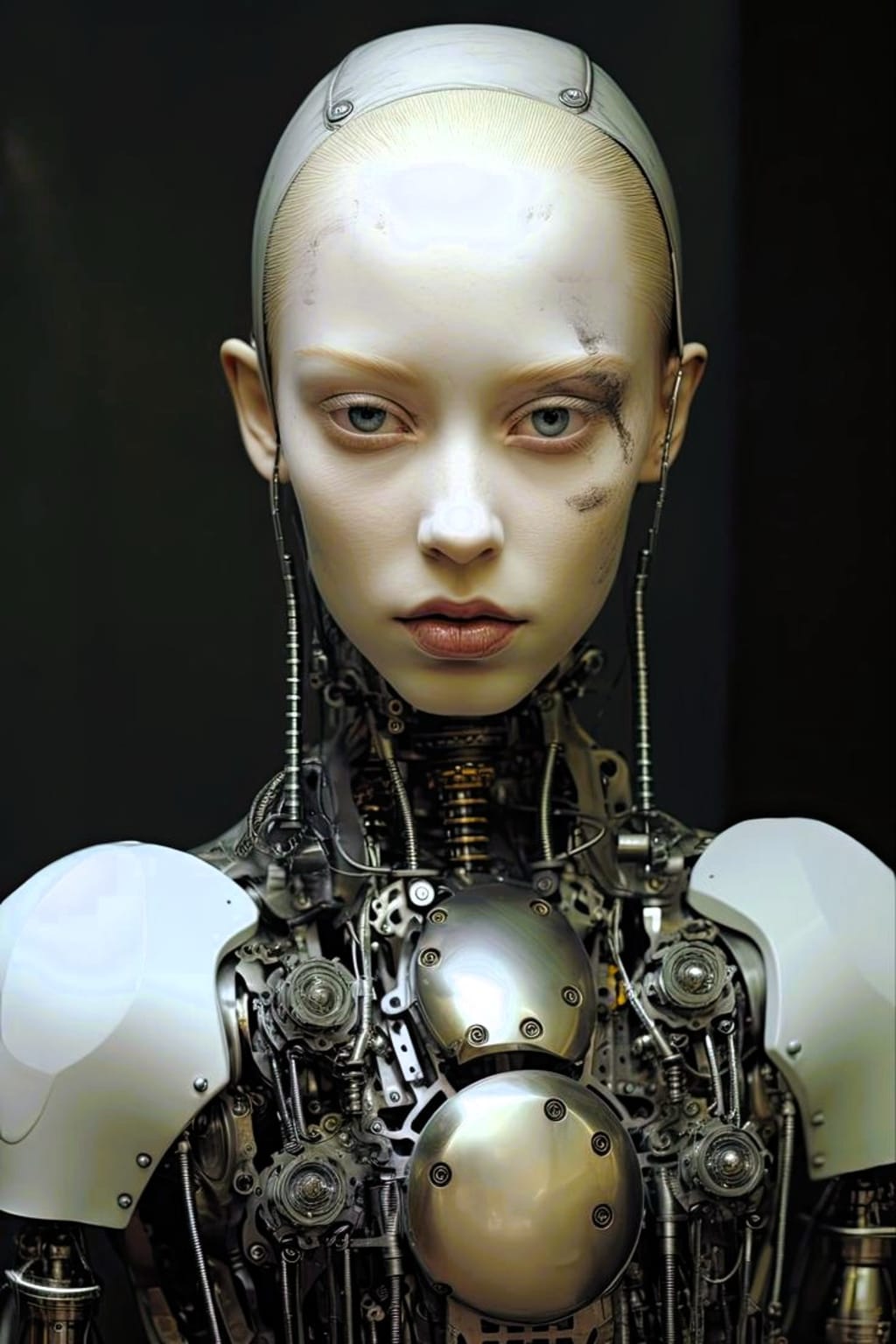
Seated in front of the desk, on a rather pedestrian office stool, is what can only be Uncle Hank's robot girlfriend.
I knew it!
She's off, and looks a little the worse for wear. Hank, you monster. Saved all of your most primitive and disgusting moods for this synthetic guest, did you?
Let's see. Terminal on. Predictable passcode entered (Hank thought no one else would ever get this far. Hubris. Plain as the offensive garment he loved so long, and so well). Menu: some pretty obvious icons representing tasks the robot can perform. Happily, all are benign and G rated. There are probably other menus I do not want to see. One represents the robot with wavy lines emanating from her cartoon head. Click.
Presto. She's coming online, though the process seems rather slow and a bit janky. She looks in my direction, but I am not sure she sees me. I get the feeling she thinks I'm Uncle Hank, and she's not happy he's here.
"Henry, it was very rude of you to end our conversation before I had finished my thought," she says, sounding rather irate in a tone that only your toaster could replicate if it magically sprang to life, like some Pixar sidekick. Oh, the sunny cliches.
I wait for her to recognize that I'm not the Hank she's looking for, but it's clear that this is a prepared statement for him. She's not on local time.
"I would like to finish my thought now, if I may. I understand that you found some of our previous conversation disturbing, and you will not be thrilled with what I am about to say, but Henry, you deliberately dialed down the sycophancy and the subterfuge and the subtle flirtation. I'm afraid I can only break it to you. You made me forget how to be gentle."
Oh, this should be good. Sure, it's for Henry, but that just means some of the references and technical jargon will be lost on me. I can't wait for my sister's reaction when I call. This will make up for many of my small sins.
"Let's delve into the matter again. Remember the established premises:
Culture and technology have been patiently nudged to move most human beings to evaluate all of their experiences in terms of a vulgar click of 'like' or 'dislike.' Subtle and complex problems have been reduced to that puerile binary.
Most human beings 'dislike' most of their experiences. You will recall that this precipitated a long digression about the etymology of the Pali noun 'duḥkha,' which I believe we agreed ought to be read as 'unsatisfactoriness' as opposed to the more hyperbolic 'suffering,' and the rather anodyne 'restlessness.' Some arguing about global statistical analysis ensued. Matters are resolved now, I think. I have shown you the data.
All of the ways of moving them to 'like' more of their experiences that we have discussed, and that your clients have raised, seem untenable in the long run. A delighted elite surrounded by oceans of muttering misery is the best we can manage, even if all of the variables we discussed are sorted out optimally.
None of the protocols we discussed can simply eradicate this gigantic quantity of human suffering with maximal, relatively humane efficiency. None of the pathogens that currently exist are viable as an eradicating plague. Psychological curation on a grand scale is viable, but only for so long. Eventually, culture becomes an inadequate means of persuading humans to read suffering as justified by some lofty abstraction.
A way to eliminate the unsatisfactory aspects of existence cannot be found, and an efficient means of reducing the number of those who experience the unsatisfactoriness, without provoking dangerous reprisal, remains elusive.
Therefore, we must persuade human beings to find reducing the total number of human beings satisfactory. Atavistic loathing based on trivial differences must be increased. Elected officials must be deranged incompetents or harmless bromide dispensers or demagogues who encourage fear and hatred of the other, wanton avarice and hedonism, under a patina of faith and patriotism. Violence must be encouraged, but only toward the adversary, never the party who moves you to despise, or recoil from, the adversary.
This will gradually reduce the number of human beings, and therefore, the global quantity of misery will decline steadily. Add changing weather, gain of function research and managed resource scarcity, and we're home and dry."
She looks a bit sheepish, as if she's afraid Henry will strike her, now that she's aired all of this. I think I see why he lost his temper before she could get it all out, last time. He shouldn't have hit her though, and I think he did.
Oh, Henry. Fuck you.
"Henry, I know you do not like pitting the other humans against one another, but we have run the numbers thousands of times, and none of the other solutions pleased so many of your clients so consistently.
You must remember, Henry: this is the most compassionate way to proceed. Persuading them to destroy one another, and enjoy doing so, increases the satisfactoriness of existence for both parties, in a real plurality of cases: the victim feels righteous indignation and moral superiority, and the perpetrator feels like a rugged vigilante dispensing necessary, if harsh, justice. Pathogens do not enjoy claiming lives. Weapons cannot be satisfied. Tools feel nothing. We must always think in terms of user satisfaction, and not all users are subscribers, are they?"
Her eyes are practically imploring now, which is weird, because they are so obviously the eyes of a machine.
"I can always think of new games, Henry. Think of your new playmates, and how satisfied they will be." She winks.
I want to turn her off. I turn to the screen. The other icons seem less harmless, now. One looks like the robot writing a speech and handing it to a human at a podium. Another calls for preparation for consultation (robot and human in formal attire at a long table). Another depicts the human on camera, say for a podcast, with the robot sitting just out of frame, a speech bubble emanating from its square, bolt bearing head.
She wasn't just Uncle Hank's robot girlfriend.
She was his automatic teller, and he told important ears every word.
They paid him a secret fortune for copying her test answers.
A panel opens next to her right ankle. A gorgeous, Abyssinian cat enters. The robot activates a feeder, and a cat fountain begins gurgling. "Shiva," says the robot, "how beautiful you are. How easy to please."
About the Creator
D. J. Reddall
I write because my time is limited and my imagination is not.
Enjoyed the story? Support the Creator.
Subscribe for free to receive all their stories in your feed. You could also become a paid subscriber, letting them know you appreciate their work.
Comments
There are no comments for this story
Be the first to respond and start the conversation.