
Thank You for Listening
A station engineer hears a broadcast that no transmitter is sending. It knows her name.

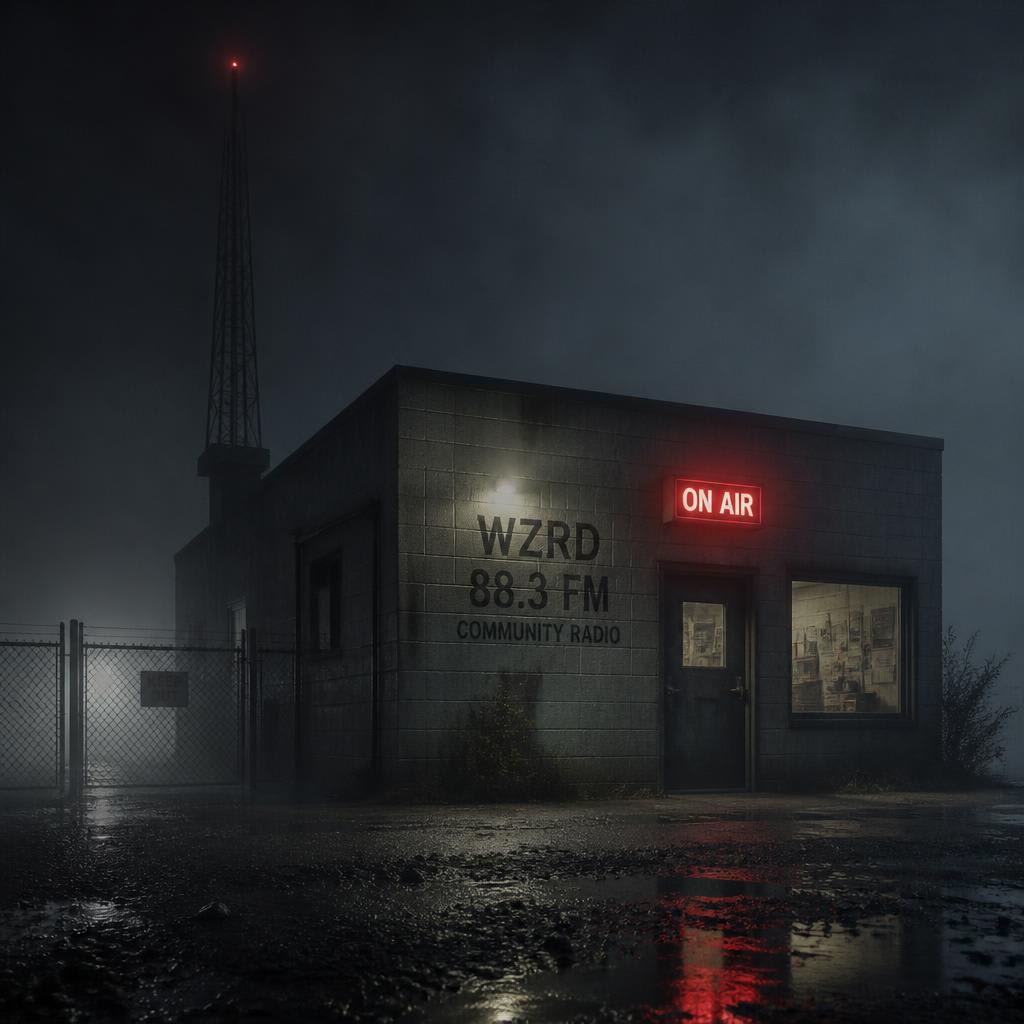
The overnight shift at 89.3 was the loneliest job in town, which is why I took it.
The station was a one-room cinderblock building behind the feed store, and after midnight it ran itself. A computer played the music library in a loop. A transmitter hummed in a rack by the door. My job was to sit in the studio, check the meters every hour, and write the numbers in a logbook that nobody had read since 2009.
The man I replaced, Gerald, had done it for thirty-one years. They found him in the chair one morning in March with his headphones still on. The logbook was open in front of him, and the last entry was a line of numbers that didn’t make any sense.
I took the job in April. I didn’t think much about the numbers.
On the fourth night of October, at 1:47 a.m., the music stopped.
Not a skip, not a gap. The song simply left, and the monitor speaker filled with the soft hiss of an open channel. I looked at the board. Every fader was down. The computer showed the playlist running normally, a guitar solo that should have been filling the room.
Then a woman’s voice, unhurried, warm in a way that made my neck prickle:
“This is the late bulletin, for the people who are still awake.”
I reached for the transmitter meter. Output: zero. Not low. Zero. The needle lay flat against the pin. Nothing was going out over the air, and yet the speaker in front of me was playing a voice.
“Harold Pruitt,” she said. “Forty-one Mill Road. Kitchen light on. He sat down to rest his eyes. He won’t wake.”
A pause, like a page turning.
“Margaret Oyelaran. Route nine, mile marker fourteen. She is almost home.”
I sat very still. I knew Mill Road. I could have walked to it. And I didn’t know anyone named Harold Pruitt, but I knew the sound of someone reading a list they had read many times.
“That concludes the bulletin,” said the voice. “Thank you for listening.”
The guitar solo came back mid-note, as though it had never left.
I told myself it was interference. A pirate station, a stray signal, something bouncing off the water tower. Radio does strange things at night.
At 7:30 the next morning, I drove down Mill Road. I told myself I was going for coffee, which was a lie, because the coffee place is the other way.
There was an ambulance at number forty-one.
A woman on the lawn was crying into her sleeve. I parked across the street and watched them bring out the stretcher, and I saw the kitchen light still burning through the window in the grey morning.
On the drive back, the radio in my car was on. It was playing the news. The anchor said a driver had died at mile marker fourteen on Route Nine, a few minutes before midnight. Her name was Margaret Oyelaran. She had been twelve minutes from home.
The bulletin had come at 1:47.
The deaths had come first.
I did not go back that night. I called in sick and sat on my couch with every light on and the radio unplugged.
At 11 p.m. my phone rang. It was the station manager, apologetic. The overnight man from the neighboring town was sick, too, and the transmitter needed someone to babysit it, and could I, just this once.
I said no. I said it three times.
Then I thought of the logbook, and Gerald’s last entry, and I said yes.
The log was still on the desk. I opened it to the final page, and for the first time I read the numbers properly. They weren’t meter readings. They were times, written in his careful engineer’s hand, each one beside a name:
1:47 — H. Pruitt
1:48 — M. Oyelaran
2:14 — N. Aldous
I was Nora Aldous.
The ink was thirty years old. Gerald had written down my name and the time of my death, and then he’d sat in this chair with his headphones on and waited for the bulletin to say it out loud.
I looked at the clock. 1:51.
I had not heard it start. It just was there, the voice, as though it had been talking for a while and I had only now tuned in.
“...and for those still awake, a reminder that listening is not optional. The bulletin does not choose its audience. It only chooses who reads it.”
My hands were shaking too much to pull the plug. I managed it anyway. I tore the power cable out of the transmitter rack, and the hum died, and the voice kept talking, warm and patient, through a speaker that was no longer connected to anything.
“Gerald Fenn heard the bulletin for thirty-one years,” it said. “He read it aloud every night, because someone must. He grew tired in March. He asked if he could stop. We told him yes, as soon as there was someone to take his place.”
I stood up so fast the chair hit the wall.
“Nora Aldous,” said the voice. “Studio B. She has just understood the logbook. She is deciding whether to run. The door is unlocked. The road is empty. She’ll make it to the parking lot, and she’ll be sitting in her car with the engine running when the thought arrives.”
I was already at the door. My hand was on the handle.
“The thought,” said the voice, gentler now, almost kind, “is that if she doesn’t read it, then Harold and Margaret will be the last. And somebody ought to say their names. Somebody ought to say all their names.”
I stopped.
I did not turn around. I could feel the studio behind me, the headphones on their hook, the chair still turned, the microphone live and patient on its stand.
“There are many more tonight,” said the voice. “Nobody can stop them. But someone can tell them it’s all right. Someone can sit with the names, so they don’t go out into the dark alone. It is the only kindness left.”
The voice fell silent. In the quiet I could hear the rack ticking as it cooled, and beneath that, faintly, a sound I had not noticed before: breathing. Slow and steady, from the headphones on the hook, as though somebody had only just taken them off.
I let go of the door.
I sat down in the chair. It was still warm.
I put on the headphones, and the page was already in front of me, the first name written in my own handwriting.
At 2:14, a woman’s voice, calm and unhurried, warm in a way that made no one’s neck prickle anymore, said into the dark:
“This is the late bulletin, for the people who are still awake.”
About the Creator
zenGaze
A person with a new idea is a crank until the idea succe!eds
Enjoyed the story? Support the Creator.
Subscribe for free to receive all their stories in your feed. You could also become a paid subscriber, letting them know you appreciate their work.
Comments
There are no comments for this story
Be the first to respond and start the conversation.