
Thank You, Five
The road washed out after final dress. The phones died before intermission. By midnight, the theater had started taking notes.

Jay said summer stock was basically adult sleepaway camp with worse pay and better trauma bonding.
That was how he sold it to everyone.
A month in the mountains. One creaky old theater. One company house. One diner that closed at eight. One lake with no lifeguard and a dock that looked like it had been built by someone losing an argument with wood. They would rehearse, perform, make art, drink cheap wine on the porch, and pretend bug spray counted as a personality.
“It’ll be magical,” Jay said.
Sabrina looked up from the packing list Ally had made. “Magical like charming, or magical like cursed?”
“Both, if we’re lucky.”
“We don’t say cursed in theaters,” Grace said.
Jay grinned. “That’s Macbeth.”
Grace pointed at him. “Exactly. The category is things we don’t say.”
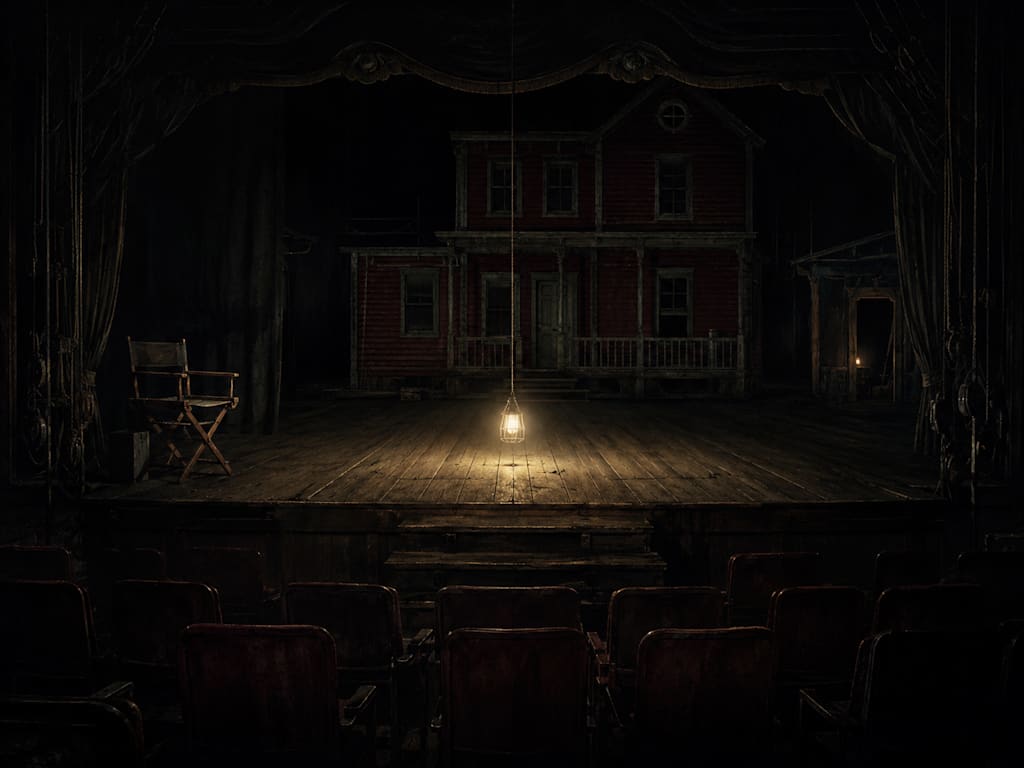
The theater was called The Pines Playhouse, though there were no pines near it. Mostly birch, wet rock, and thick black forest rising on all sides like an audience waiting for the curtain.
It had been built in 1937 as a summer retreat for wealthy people who liked culture as long as it did not require air conditioning. The lobby still smelled like old programs, damp carpet, and mice. The backstage hallway sloped. The dressing rooms had mirrors framed in bulbs that flickered even when they were off.
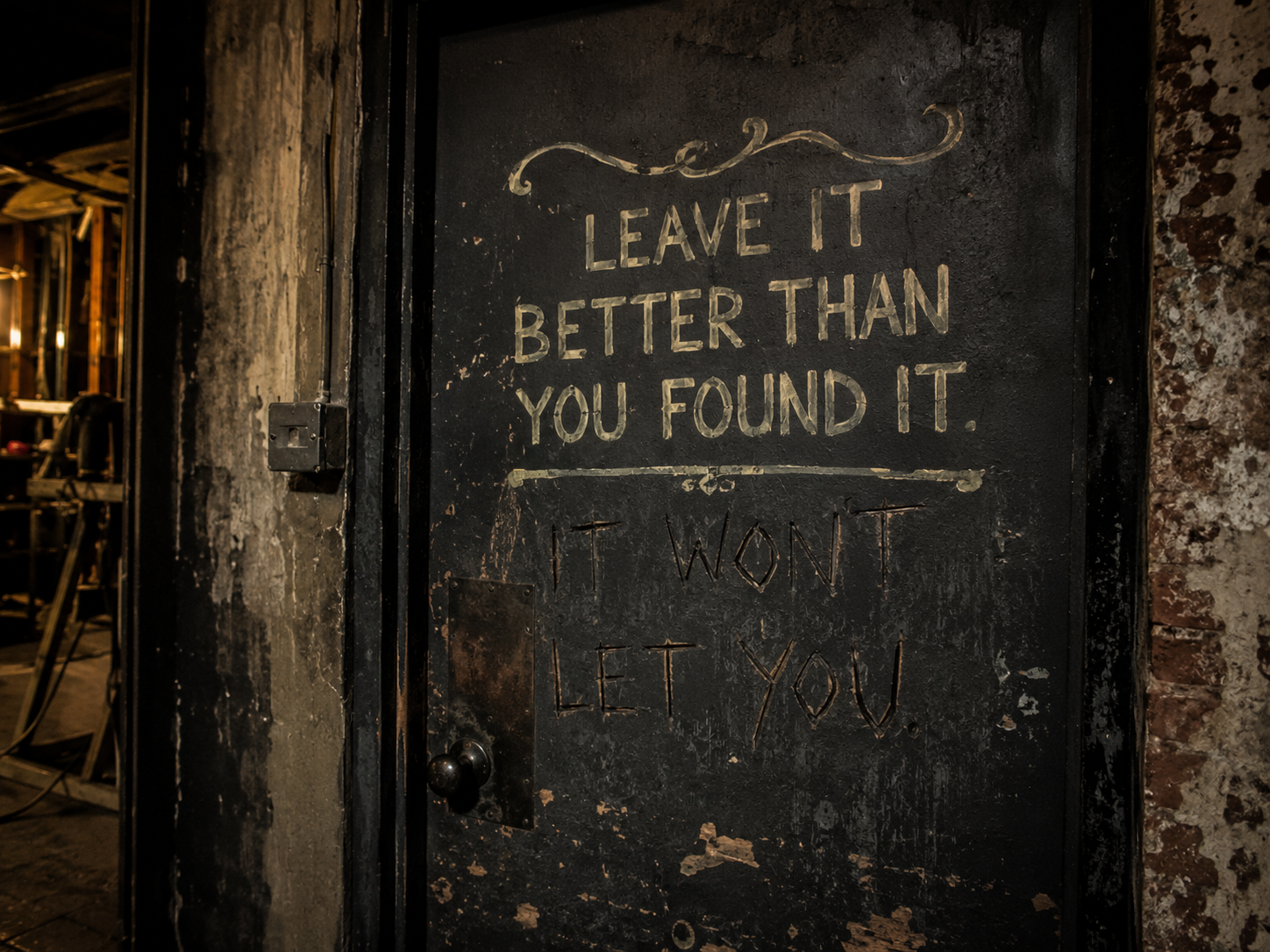
A hand-painted sign above the stage door read:
LEAVE IT BETTER THAN YOU FOUND IT.
Underneath, someone had scratched:
IT WON’T LET YOU.
“Charming,” Mel said.
Mel was the first to notice things other people missed. Not because they were paranoid, they said, but because being nonbinary in unfamiliar places trained you to read a room before the room read you wrong.
Ally handled the company schedule, the emergency contacts, the transportation grid, and the daily call board. She had three clipboards and the calm, terrifying efficiency of someone who could evacuate a burning building and still ask who took her pen.
“Dawg,” she told Jay on the first day, “if you change one rehearsal time without telling me, I will personally staple you to the call board.”
Jay put a hand over his heart. “That’s the romance of theater.”
They had worked together long enough that half their conversations no longer required words. Across rehearsal rooms, crowded lobbies, and production meetings that should have been emails, Jay and Ally could communicate entire paragraphs with one look.
Jay’s wide eyes meant: are you seeing this?
Ally’s slow blink meant: unfortunately.
Jay touching two fingers to his temple meant: I am about to make this worse for morale.
Ally pointing one pen at him meant: dawg, do not.
Grace was playing the lead in the season opener, a feverish little thriller called The Red House. She was warm, watchful, and had the kind of empathy that made people confess things to her by accident. Sabrina, assistant stage manager, carried cough drops, backup pencils, antacids, and the permanent expression of someone hearing a sound no one else had admitted to yet.
Celeste Vale was directing.
Celeste had the serene danger of a woman who could call something “a useful exploration” while setting a room on fire. She wore black linen, silver rings, and red lipstick that somehow survived coffee, panic, and eight-hour rehearsals. Her notes were brutal but elegant.
“Less fear,” she told Jay once. “More terror you are trying to sell at retail.”
Matt was choreographing the movement sequences, because even murder plays needed “clean transitions,” which he said constantly while everyone privately agreed he deserved consequences.
Adrienne played the neighbor.
She was talented. Everyone admitted that first, because with Adrienne you had to build a little fence around any criticism before you let it into the yard.
She was talented, but she was exhausting.
Adrienne did not ask questions so much as set traps with question marks at the end. She wanted every decision documented, every note repeated in front of witnesses, every schedule change framed as evidence that someone had been trying to exclude her specifically.
“If we’re all being honest,” she said on the third day, in the tone of someone about to make honesty everyone else’s problem, “it’s interesting that the emotional center of the show keeps being discussed when I’m not in the room.”
“You were at lunch,” Ally said.
Adrienne smiled. “Exactly.”
Jay glanced at Ally from across the rehearsal hall.
Are you seeing this?
Ally capped her pen.
Unfortunately.
Adrienne had also asked whether the entire invited dress could be moved because her aunt and two cousins could only come on Saturday.
“Saturday is opening,” Ally said.
“I’m aware.”
“So no.”
Adrienne’s face hardened. “I just think it says a lot about whose support systems this company values.”
“Dawg,” Ally said, not unkindly, “we are not moving opening night because your cousins have a conflict.”
Adrienne looked around the room as if waiting for someone to rescue her from the violence of a calendar.
No one did.
Larold ran the place.
No one knew his actual title. Technical director, caretaker, board president, ghost in residence. He was seventy-six, built like a broom handle, and moved through the theater with a ring of keys big enough to anchor a boat.
He also had the specific energy of a man who believed every problem could be solved with gaff tape, volunteer labor, and not telling the fire marshal until after closing weekend.
The Pines Playhouse did not replace things. It “got another season out of them.” Larold said this proudly. Extension cords were “still good if you knew how to coil them.” Platforms were “fine if actors stopped jumping so hard.” The ancient dimmer rack was “temperamental, not dangerous.” The costume loft stairs were “grandfathered in,” a phrase he used whenever he did not want to spend money, answer a question, or admit a staircase moved when stepped on.
Ally had noticed by lunch on the first day.
“Dawg,” she whispered to Jay while Larold explained that the emergency exit stuck only when it rained, “this building has a punch card at OSHA.”
Jay gave her the smallest side-eye.
Are you seeing this?
Ally’s slow blink answered.
Unfortunately.
Larold turned, as if he had heard them, and smiled without showing his teeth.
“Don’t go under the stage unless I’m with you,” Larold said during orientation.
Celeste smiled. “Because of safety?”
Larold looked at her. “Because of history.”
“That’s not a reason.”
“It’s the only reason that matters here.”
Celeste laughed as if Larold were a bit of local flavor placed there for atmosphere.
Larold did not laugh.
By tech week, the company had divided itself into the usual summer stock tribes: actors who complained, actors who complained dramatically, crew members who communicated only through headset sighs, and Jay, who somehow loved everyone.
He made coffee runs. He wrote opening night notes. He remembered who was vegetarian, who was sober, who needed quiet before places, who needed noise. When Sabrina panicked because the prop knife went missing, Jay sat with her on the loading dock until her breathing slowed.
“It’s just a knife,” he said gently.
Sabrina looked toward the black mouth of the stage door. “Nothing is just anything here.”
The storm arrived during final dress.
Rain battered the roof so hard that Matt had to shout counts over it.
“Five, six, seven, murder.”
“Dawg,” Ally said over headset, “if I hear that one more time, I’m writing it in the incident report.”
At 9:17, the first bulb burst.
It was one of the dressing room mirror bulbs. No one saw it happen. They only heard the sharp pop over the monitor, then Adrienne shouting that glass had nearly gone into her eye.
“It didn’t,” Matt said.
“That is not the point, Matt.”
“No, the point is usually located somewhere near reality.”
Adrienne turned to Celeste. “Are we hearing this? Are we documenting the hostility?”
Celeste closed her eyes for one second too long.
Jay caught Ally’s look from the wing.
Please intervene before someone is murdered socially.
Ally lifted one finger.
Already deciding who.
At 9:31, the prop table was wrong.
Sabrina found it first.
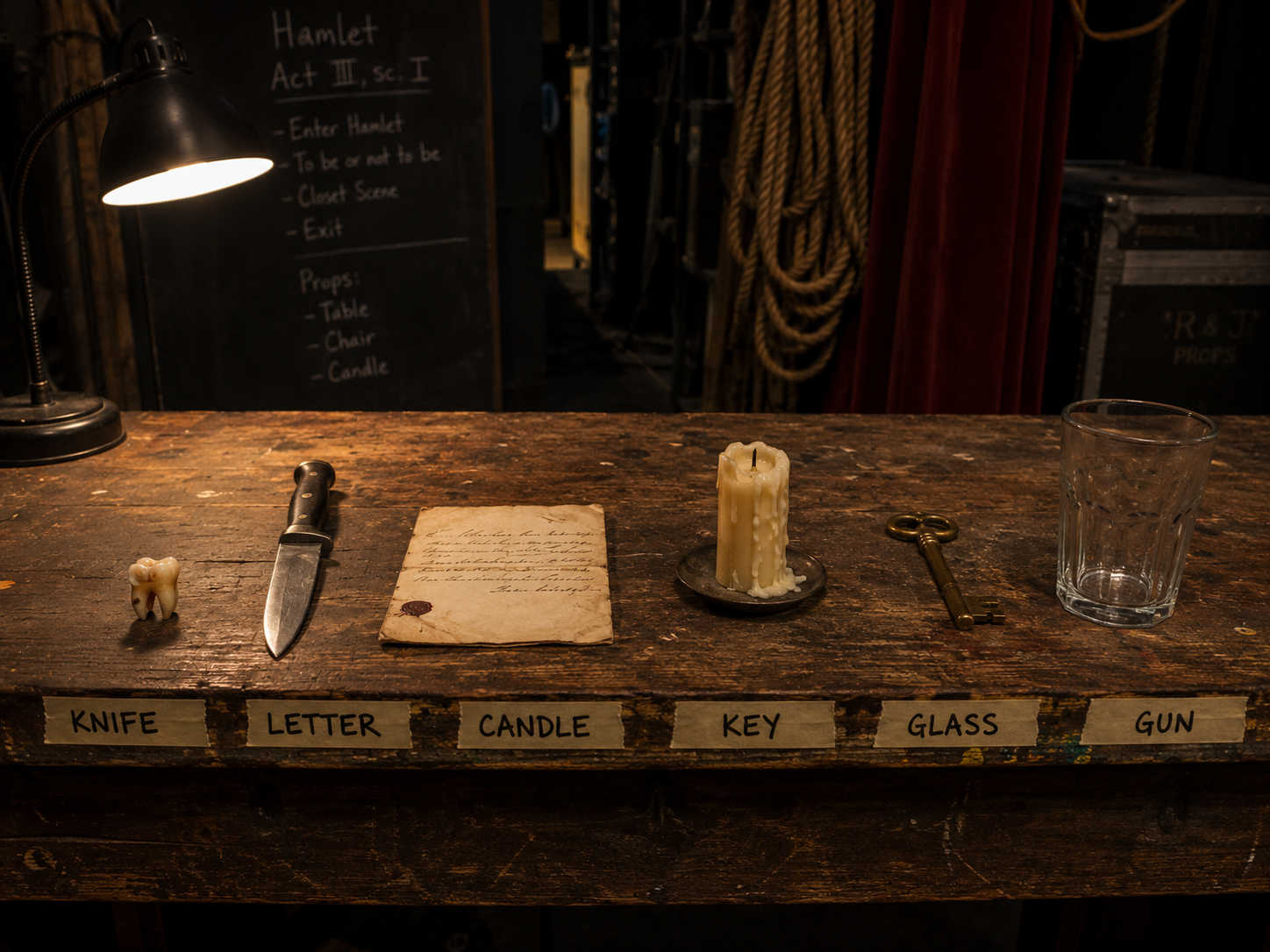
The labeled tape marks were still there. Knife. Letter. Candle. Key. Glass. Gun.
But every object had been shifted one place to the left.
The knife sat on the letter mark.
The letter sat on the candle mark.
The candle sat on the key mark.
The key sat on the glass mark.
The glass sat on the gun mark.
And where the knife should have been, there was a tooth.
A real one.
Yellowed at the root.
Sabrina stared at it until Grace gently moved her behind her own body.
“Who did that?” Ally asked.
No one answered.
Adrienne crossed her arms. “I mean, if this is someone’s idea of atmosphere, it’s inappropriate.”
“For once,” Mel said, “I agree with the sentence and not the delivery.”
Larold appeared at the edge of the stage.
He looked at the tooth.
Then he looked up into the grid.
“What?” Jay asked.
Larold did not answer.
At 9:43, the lights flickered.
At 9:51, the phones lost signal.
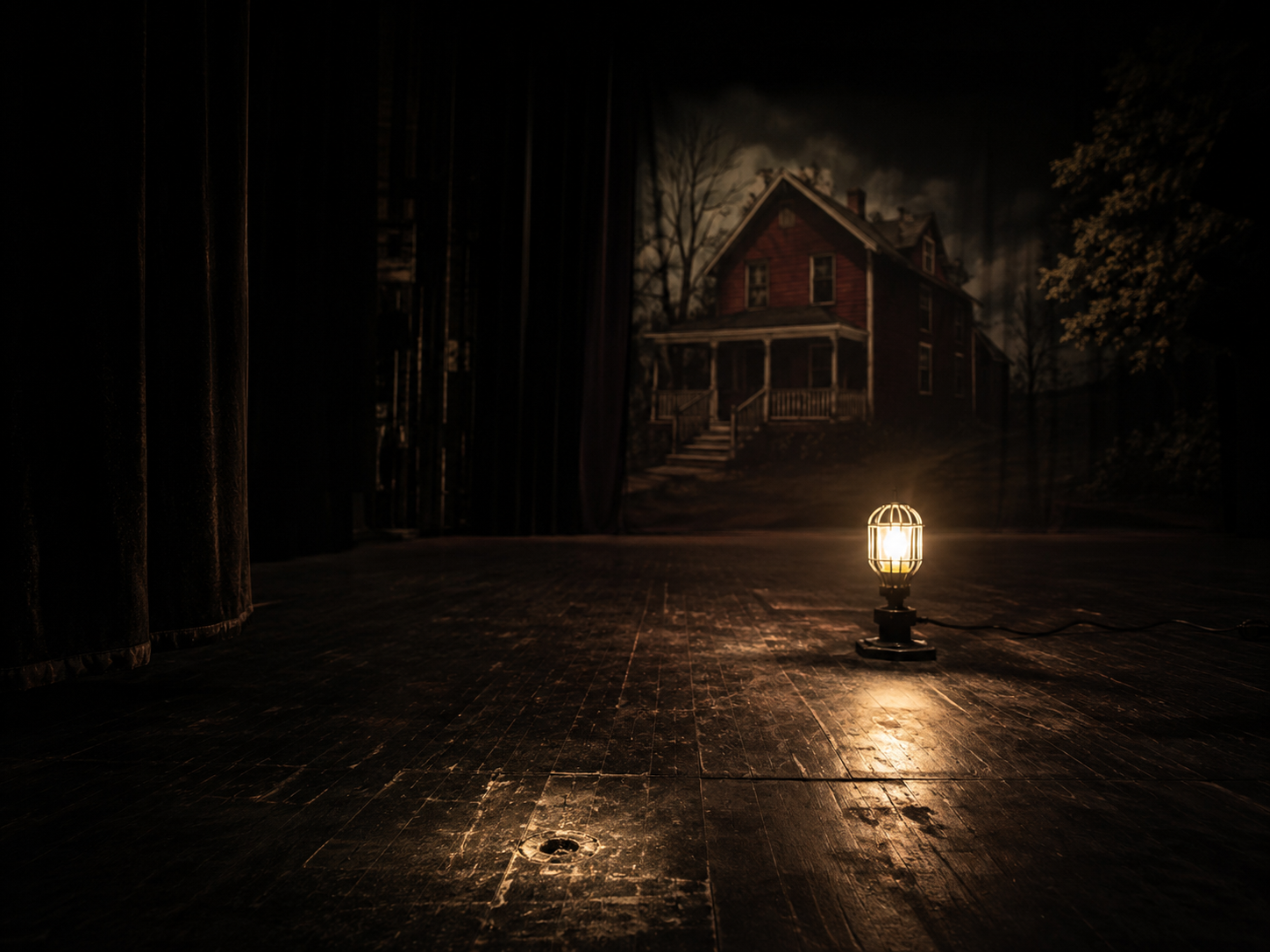
At 9:58, the ghost light moved.
Not much.
Just three feet downstage from where it had been.
Everyone saw it.
No one wanted to be the first to say so.
The bare bulb glowed softly at center stage, its cord coiled beneath it like something sleeping. It had been upstage left all evening. Sabrina had taped its cord herself, because Sabrina taped everything. The spike mark was still visible on the floor.
Empty.
“Maybe someone bumped it,” Matt said.
“From all the way over there?” Mel asked.
Matt looked annoyed. “I’m offering rational explanations.”
“Offer better ones.”
At 10:02, Larold came in from outside soaked to the bone and announced that the only road down the mountain had washed out.
“How washed out?” Celeste asked.
Larold removed his cap. Water dripped from the brim onto the stage floor.
“Gone.”
The room went quiet.
Ally stared at him. “When you say gone, do you mean actually gone, or do you mean Pines Playhouse gone, where something is technically still there if no inspector is looking at it?”
Larold did not smile.
“Actually gone.”
Celeste clapped once. “Okay. We stay calm. We sleep here tonight if we have to. We finish dress. We do not lose the work.”
Mel stared at her. “The road is gone.”
“The road will be there tomorrow.”
Larold shook his head. “Not all of it.”
Celeste turned to Ally. “Can you reorganize sleeping arrangements?”
Ally stared at her. “Dawg, we have a landslide, no cell service, and a building full of extension cords older than my grandmother. Yes, I can reorganize sleeping arrangements. That is not my first concern.”
Adrienne laughed once, sharp and humorless. “I do think it’s fascinating that some people are only now concerned about safety.”
Jay turned his head very slowly toward Ally.
Ally did not look at him, but her jaw shifted.
Jay knew that jaw.
That jaw meant: I am one sentence away from becoming unprofessional.
Grace moved closer to Sabrina.
The theater creaked around them.
Not from the storm.
The sound came from inside the walls.
A long wooden groan, like something old adjusting its posture.
Then the stage manager’s monitor crackled.
A voice whispered through the speaker.
“Thank you, five.”
Sabrina went white.
“That wasn’t me,” she said.
Ally reached for her headset. “Booth, say again.”
Static.
Then the same voice, closer:
“Thank you, five.”
Matt scoffed because he did not know what else to do with fear.
“It’s probably the storm crossing channels.”
“Crossing with who, dawg?” Ally said. “The trees?”
The monitor crackled again.
This time, the voice sang softly.
Not words.
A warmup.
“Mah, may, mee, moh, moo.”
The ghost light dimmed.
Then brightened.
Onstage, the red house set seemed to breathe.
The walls were flats. Painted wood and canvas. Everyone knew that. They had built them. They had stood behind them drinking coffee and complaining.
Still, the painted windows looked darker than before.
Still, the fake front door seemed less fake.
Then came the knock.
Three taps from inside the set.
Everyone froze.
Larold whispered, “No.”
The knock came again.
Three taps.
Adrienne stepped forward. “This is ridiculous.”
Grace grabbed her wrist. “Don’t.”
Adrienne yanked free. “Do not touch me.”
“Please,” Grace said.
Adrienne looked around the room, eyes bright with the thrill of being wronged. “Everyone saw that, right? She grabbed me.”
Jay said, “Adrienne, nobody is worried about that right now.”
“Well, that’s convenient for her.”
The knock came a third time.
Matt threw up his hands. “Fine. I’ll check it. Since apparently we’re all scared of plywood.”
“No,” Larold said.
Matt walked onto the set.
The ghost light flickered.
He crossed to the fake front door, turned back toward the group, and gave a small bow.
“See? Clean transition.”
He opened the door.
There was no scream.
That was worse.
The darkness behind the flat simply took him.
One second Matt stood there with his hand on the painted knob.
The next, he was pulled backward so fast his shoes stayed on the stage.
They sat there, empty, toes pointed toward the audience.
Sabrina screamed.
Jay ran forward, but Ally grabbed the back of his shirt.
“I'll kill you myself.”
“He’s in there.”
“Exactly.”
From behind the set came a wet, rhythmic sound.
Cutting.
Dragging.
A chair scraping.
Something heavy being arranged.
Then Matt screamed.
Once.
High and shocked.
The sound snapped off halfway through, like someone had closed a door on it.
The fake front door swung shut by itself.
For ten seconds, no one moved.
Then the backstage hallway lights came on.
One by one.
A trail.
Larold covered his face.
Mel whispered, “It wants us to follow.”
The dressing room monitor crackled.
The voice returned, cheerful now.
“Places for notes.”
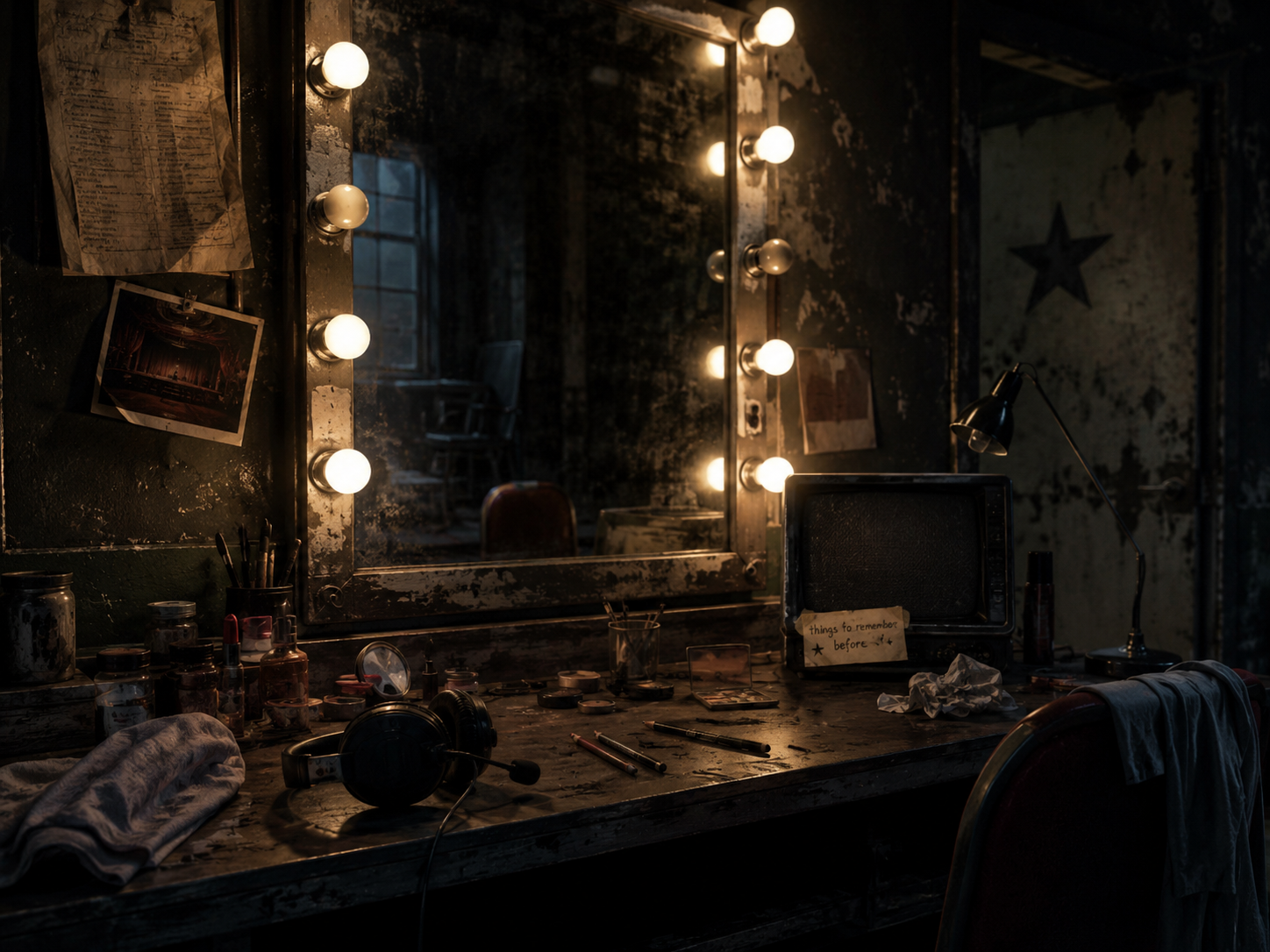
They found Matt in front of the mirror.
At first, he looked seated.
That was the mercy of distance.
His body had been strapped upright to the makeup chair with gaff tape wound so tightly around his chest and arms that his hands had swollen purple. His mouth was open. His tongue had been pulled out and pinned to the vanity with a costume needle.
The mirror in front of him was cracked.
Not from impact.
From inside.
A jagged circle had been cut out of the glass at face height, and through it someone had driven the missing prop knife, then a second knife, then a third, until Matt’s face had been opened from cheek to cheek in a wet red smile.
Blood had run down his neck and soaked into the collar of his rehearsal blacks.
On the mirror, written in lipstick:
CLEAN TRANSITION.
Sabrina made a sound like air leaving a tire.
Grace caught her before she hit the floor.
Jay backed into the wall, both hands over his mouth.
Celeste whispered, “This isn’t funny.”
No one answered, because no one had thought it was.
Larold stepped into the doorway. His face did not change enough.
Mel noticed.
“You knew something like this could happen.”
Larold looked at Matt’s body, then at the lipstick on the mirror.
“I knew the theater was hungry,” he said.
Celeste’s face hardened. “A person did this.”
Larold nodded slowly.
“Usually.”
They locked themselves in the house.
Not the company house. They could not reach it through the storm and trees. The theater house: auditorium, lobby, backstage, shop, dressing rooms, costume loft, booth, trap room below the stage.
Ally took inventory.
“Present: me, Jay, Grace, Sabrina, Mel, Celeste, Larold, Adrienne, Priya, Owen, Tess, and Kellan. Matt is dead. Road is out. Phones are dead. Landline?”
“Cut,” Larold said.
“Of course it is. Why wouldn’t it be?”
Celeste paced the lobby, drenched in stage light and denial. “We need to stay together.”
“For once,” Ally said, “I agree.”
Then the ghost light went out.
The ghost light was supposed to stay on whenever the stage was dark. A single bare bulb on a tall metal stand, burning center stage so no one fell into the pit and so, according to theater people who pretended not to believe things, the ghosts had enough light to perform.
When it went out, the darkness onstage looked solid.
Then the headset system spoke again.
“Places.”
Celeste froze.
The voice was not on any channel.
Larold took off his headset and held it away from his head.
The voice continued, soft and delighted.
“Places, please.”
Priya started crying. Kellan swore. Owen picked up a fire extinguisher like he planned to fight sound.
Adrienne pointed at Sabrina. “Is this coming from your board?”
Sabrina stared at her. “What?”
“You’re the assistant stage manager.”
“Adrienne,” Jay said carefully, “this is not the time.”
“It never is when someone else is responsible.”
Ally turned toward her. “Dawg, I need you to locate the emergency exit inside your personality and use it.”
The ghost light flickered back on.
Adrienne stood beneath it.
No one had seen her cross the stage.
One second she was beside them.
The next she was center, lit from below, blinking like someone waking in the wrong scene.
“Adrienne?” Jay called.
She looked at them, and for once, there was no accusation in her face.
Only fear.
Above her, the fly system groaned.
Larold screamed, “Move!”
A sandbag dropped from the grid.
It did not hit her head.
It hit her shoulder, driving her down onto one knee. She screamed. Another bag fell. Then another. They came fast, a brutal rain of canvas and weight.
Her arm bent backward with a crack. Her ribs caved. Her mouth opened, but the fourth sandbag landed on her face and flattened the scream into a wet slap.
The final bag dropped gently.
Almost politely.
When it rolled away, Adrienne’s head was turned toward the audience, one eye open, one gone, her jaw hanging wrong.
The ghost light brightened.
On the call board beside the stage, a fresh note appeared.
ACTOR’S NOTE: TOO MANY CHOICES.
Ally made a sound deep in her throat.
Not fear.
Rage.
“Okay, dawg,” she said to the dark stage. “You want blocking? Let’s fucking block.”
She organized them fast.
No one alone. No one backstage without a weapon. Barricade the stage doors. Find another exit through the shop. Larold knew a service hatch near the old loading ramp, sealed but maybe breakable.
They moved as a group.
That lasted six minutes.
In the costume loft, Tess disappeared between racks.
One moment she was behind Sabrina, whispering, “I hate this, I hate this, I hate this.”
The next, the racks began to move.
Costumes slid along the rails by themselves. Silk gowns. Military coats. Wedding dresses yellowed with age. Animal heads from forgotten children’s shows. The aisle closed like a throat.
“Tess?” Sabrina called.
A hand shot out between two fur coats.
Tess’s hand.
Jay grabbed it.
The racks jerked backward.
He pulled.
Something pulled harder.
Tess screamed from inside the costumes, a muffled tearing sound. Mel and Grace grabbed Jay’s waist. Ally slashed at the fabric with a box cutter. Fur split. Sequins scattered. A wedding dress turned red from the inside.
Then Tess came loose.
Only part of her.
Jay fell backward holding her arm from shoulder to fingertips, the rest of her gone behind the moving racks. The severed end steamed in the cold loft air.
Sabrina screamed until Grace pressed both hands over her ears and whispered, “Look at me. Look at me, not that. Stay here.”
Behind the racks, something chewed.
Larold crossed himself.
Mel stared at him. “You should start explaining.”
Larold’s voice was barely there. “In 1962, an actress disappeared during a matinee. Trap door opened. She fell. They covered it up. Kept the season running.”
Ally stared at him. “Of course they did.”
Larold swallowed.
“The board said closing would bankrupt us. Said one accident could not be allowed to destroy the institution. Said the theater had survived depressions and wars and bad seasons and it would survive this too.”
Mel’s face went cold. “So they buried her.”
Larold looked at the floor.
“They sealed the trap. Painted over the report. Paid her mother six hundred dollars and called it compassion.”
Jay’s voice was small. “And you knew?”
Larold closed his eyes.
“I was crew that day. Sixteen years old. I helped pull the nails. I helped mop the blood. I stayed because someone had to keep the place from falling apart.”
Ally’s voice sharpened. “No, dawg. You stayed because falling apart was expensive.”
Larold flinched.
The shop was their last chance.
They made it down the back stairs with Owen in front, fire extinguisher raised, Kellan behind him with a crowbar, everyone else packed tight enough to feel each other’s breathing.
The shop smelled like sawdust and wet paint.
Larold pointed to a metal door half-hidden behind flats. “Service hatch.”
Kellan and Ally shoved scenery aside.
A painted wall from an old farce toppled, revealing Priya nailed to the real wall behind it.
She was alive.
Barely.
Someone had driven long screws through her palms, her thighs, her shoulders. A cordless drill hung from a strap around her neck. Her eyes rolled toward them.
“Don’t,” she whispered.
Owen ran to her.
The floor gave way.
Not the whole floor.
Just the trap beneath him.
He dropped to his waist and stopped with a scream.
For a moment, they thought he was stuck.
Then the blades started.
They heard them before they saw them. A motor below the floor. Something old and eager turning fast.
Owen’s scream became animal.
Ally and Kellan grabbed his arms. Blood sprayed up from the trap in pulsing sheets, hot across their faces. Owen’s body jerked violently. The smell of meat and machine filled the shop.
“Pull him!” Jay shouted.
“We are!” Ally screamed.
They pulled.
Owen came up in pieces.
His legs were gone below the hips, shredded into red ribbons that slapped wetly against the edge of the trap before falling away. He looked down, saw what was missing, and died with a confused little breath, like he had forgotten a line.
Kellan vomited.
Priya began to laugh.
Not because it was funny.
Because the screws holding her to the wall were slowly turning.
The drill around her neck spun on its own.
One by one, the screws reversed out of the wood.
Priya slid down the wall in a red smear and collapsed.
The service hatch rattled.
Something knocked from the other side.
Three slow taps.
Grace whispered, “Don’t open it.”
Ally wiped blood from her eyes. “Dawg, we are running out of doors.”
Mel was looking up.
Above them, in the catwalk shadows, a figure crouched.
Human-shaped.
Wearing a costume mask from The Red House, a smooth white face with painted red cheeks. In one hand, it held a stage manager’s stopwatch. In the other, a hooked rigging knife.
It had been close the whole time.
Watching.
Not the theater.
A person.
Maybe.
The figure waved.
Then cut the rope beside its knee.
The wall of flats fell.
Kellan shoved Mel clear and vanished beneath painted doors, windows, furniture, fragments of fake rooms. A jagged brace went through his throat and punched out beneath his chin. He hung there on his knees, impaled upright, eyes wide, blood bubbling neatly down his chest.
The masked figure dropped from the catwalk and landed without a sound.
Larold stepped between it and the others.
“You don’t want them,” he said.
The mask tilted.
Larold’s hand closed around his key ring.
“It was me,” he said. “I kept it open. I kept feeding you. Accidents. Drifters. Men no one asked after. Anyone I could call cheaper than shutting down.”
Everyone stared at him.
Mel’s voice was ice. “Larold.”
“I’m sorry.”
The masked figure raised the rigging knife.
Larold did not move.
It cut him open from collarbone to stomach with one clean stroke.
Larold dropped his keys.
His insides spilled out in a heavy, steaming mass, hitting the shop floor with a sound like wet laundry. He fell to his knees, trying to hold himself together, and looked at Ally.
“Booth,” he gasped. “Fire curtain.”
Then he toppled forward into his own blood.
Ally grabbed the keys.
They ran for the booth.
The masked figure followed, not quickly, not slowly. Onstage, the ghost light rolled after them on its little wheels, clattering across the floor by itself.
The booth stairs were narrow.
Sabrina stumbled halfway up and froze.
“I can’t,” she sobbed. “I can’t, I can’t.”
Jay turned back immediately.
“Yes, you can. Hey. Look at me.”
“I hear it breathing.”
“I know.”
“It’s behind us.”
“I know.”
“I don’t want to die in a theater, Jay.”
His eyes filled. “Then don’t. One step. Then one more. We’re going to make Ally mad if we stop.”
From above, Ally shouted, “Dawg, I am already mad!”
Sabrina laughed once through the panic.
Then she moved.
In the booth, Ally found the fire curtain controls. Mel locked the door. Grace searched the wall for anything useful and found an old axe behind emergency glass.
Below them, the masked figure walked to center stage.
It looked up at the booth.
Then it removed the mask.
No one saw the face beneath clearly.
That was the worst part.
Each of them saw someone different.
Jay saw Matt, grinning through the cut mouth.
Sabrina saw Adrienne, one eye gone.
Grace saw someone from before this place, before this summer, before she had learned how many rooms could turn people into objects and still call it art.
Mel saw themselves.
Ally saw no one.
“Dawg,” Ally whispered, “absolutely not.”
She pulled the fire curtain lever.
Nothing happened.
The mechanism jammed.
The figure smiled with all their dead.
Grace handed Ally the axe.
Ally swung at the release chain.
Once.
Twice.
On the third hit, the chain snapped.
The fire curtain dropped.
A massive sheet of old asbestos and metal came roaring down from above the proscenium.
The figure tried to move.
Too late.
The curtain hit with a thunderclap and cut the stage in two.
For one second, there was silence.
Then blood began to seep under the bottom edge.
A lot of blood.
Too much for one body.
It spread across the stage in a slow, widening line, reflecting the ghost light.
Then the ghost light went out.
At dawn, the rescue crews found Ally, Jay, Sabrina, Grace, and Mel locked in the booth.
They found Matt in the dressing room.
Adrienne onstage.
Tess in the costume loft.
Owen in the trap.
Priya in the shop.
Kellan under the flats.
Larold in pieces near the service hatch.
They did not find the masked figure.
They did find the fire curtain down, rusted solid into the stage floor, as if it had been there for years.
The police asked the survivors many questions.
Ally answered most of them.
Jay answered some.
Sabrina answered none.
Grace sat wrapped in a blanket, staring at the theater doors. Mel held her hand and watched every person who came too close.
When an officer asked if they had any idea who could have done this, Ally laughed.
It was not a funny sound.
“Dawg,” she said, “you wouldn’t believe me if I gave you the full cast list.”
By noon, the road was clear enough for them to leave.
As they climbed into the ambulance, Jay looked back.
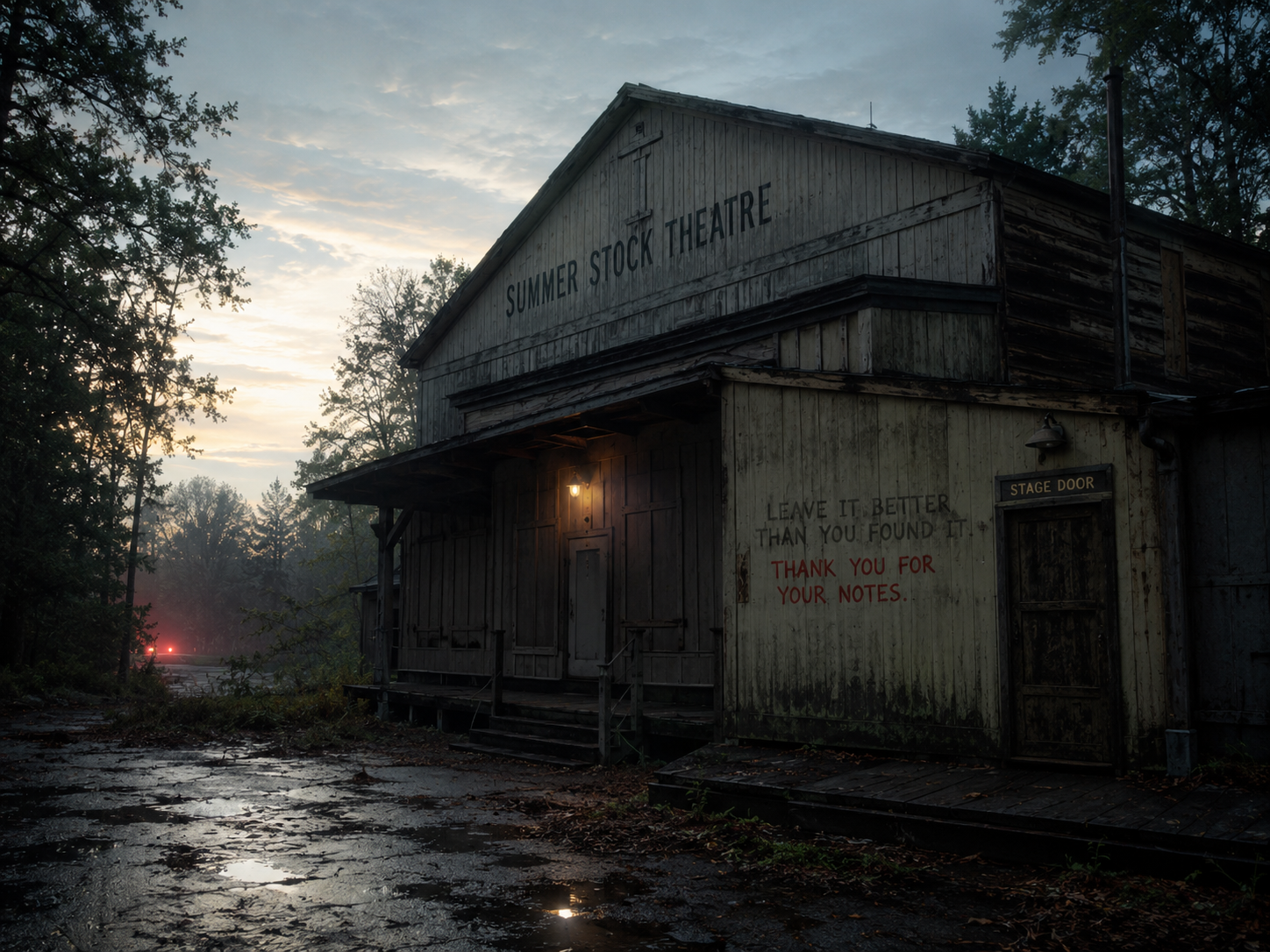
The Pines Playhouse sat in the morning light, damp and quiet, as if nothing had happened inside it except theater.
Above the stage door, the old sign still hung:
LEAVE IT BETTER THAN YOU FOUND IT.
Underneath, in fresh red paint, someone had added:
THANK YOU FOR YOUR NOTES.
About the Creator
Jason Hair-Wynn
Theatre artist, director, choreographer, and arts leader writing on accountability, equity, and culture in the performing arts, with a deep belief in storytelling, truth, and spaces rooted in care. And some travel content along the way
Enjoyed the story? Support the Creator.
Subscribe for free to receive all their stories in your feed. You could also become a paid subscriber, letting them know you appreciate their work.
Comments
There are no comments for this story
Be the first to respond and start the conversation.