supernatural
The hidden world of all things supernatural; a look inside witchcraft, spells, vexes, black magic and other spine-tingling supernatural phenomena.
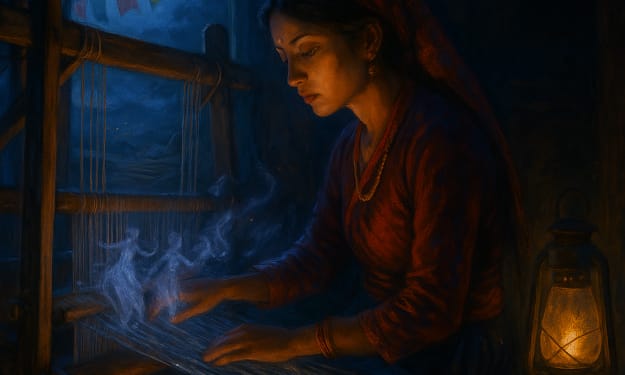
The Moonflower Shawl. AI-Generated.
Muna sat before her wooden loom in the pale glow of the full‑moon festival. Outside, the women of Khetpani village sang Teej songs in low, lilting harmonies, their anklets tinkling like distant bells. But inside her small hut, only the steady click‑clack of shuttle on thread broke the silence.
By Pravin Chapagain2 years ago in Horror
Watcher
He felt a cold sweat wash over him as his stomach twisted in a knott as he stared blankly at the tv. It had been over an hour since they got there, and they heard nothing more about his half-sister. Who was his dad's daughter from a previous marriage. The only one out of the two that Jean actually loved at all.
By Raphael Fontenelle2 years ago in Horror
The Night Food Floated onto The AIR:A Real possession Story. Content Warning.
This story occurred in Khulna about five years ago. It was a strange and scary thing that my family and I will never forget. One night, we saw a little girl crying on the side of the road. She was about 8 years old. Her name was Tara. She looked very tired and weak. She said she hadn't eaten in two or three days. She came from a nearby village and had no accommodation.
By Joyprokash Roy2 years ago in Horror
Between Sacred Stones and Silent Screams: The Haunted Soul of Wat Sisaket
The Ghostly Past of Wat Sisaket: Lao's Spiritual Mystery Deep in the center of Vientiane, Wat Sisaket is a legacy to Laos' violent past and spiritual heritage. Built in 1818 on the orders of King Anouvong (Sethathirath V), this temple is the oldest surviving Buddhist structure in the capital, having escaped destruction by a hair's breadth during the Siamese invasion of 1827. Its unusual Siamese-influenced design—featuring a five-tiered roof and a cloistered courtyard—likely spared it the same fate as neighboring temples, which were reduced to rubble. It is today revered not only for its history but also for its notoriety as one of the most haunted locations in Laos, where the specters of the past whisper along its dimly lit passages.
By Kyrol Mojikal2 years ago in Horror
The Hollow Ones
Whispers that weren't quite human were carried by the wind as it howled through the skeletal trees of Black Hollow. Claire tightened her coat, cursing herself for taking the shortcut through the woods. The old logging road had seemed like a good idea at dusk—shave twenty minutes off her hike back to town. But now, with the moon hidden behind thick clouds and the air thick with the scent of damp earth and something faintly rancid, she regretted every step.
By Mazharul Dihan2 years ago in Horror
Haunted Dolls: Stories of Horror and Mystery
Introduction : Dolls—Although they are innocent playmates of children, there are some that make you shiver just by looking at them. Their eyes seem so alive that they could speak at any moment! These dolls with their unwavering gaze are not only childhood memories, but also occupy a strange and sometimes frightening place in human culture. Among the countless dolls that have been made over the centuries, some have gained such notoriety—not for their perfect craftsmanship, but for the terrifying stories that surround them. There are stories of dolls spread across the world that are called haunted houses. Some say that they are inhabited by spirits, while others say that they are cursed. These haunted dolls are not only a cause of fear, but also take us to a dark world of curiosity and mystery. In this article, we will tell you the story of a fictional but terrifying doll, which will stir your imagination and you may not dare to sleep alone at night. So let's dive into the mysterious world of haunted dolls—where children's toys are no longer just toys. Why are dolls haunted? The idea of something strange inside a doll is not new. Since ancient times, dolls have been used in various cultures for spiritual and religious purposes, not just as toys. In ancient Egypt, dolls called ‘Shabti’ were made to serve the dead in the afterlife, which carried spiritual significance. In Africa and other indigenous societies, dolls were used as objects of worship, a means of communicating with the spirits of ancestors, and even as storytelling tools. From these came the belief that inanimate objects, especially human-shaped dolls, could possess supernatural beings. Around 1800, there was a widespread curiosity about ghosts and spirituality in Europe and America. Especially in the Victorian era, where people’s interest in death and the unknown was at its peak. During this time, dolls that looked like people became the center of various scary stories. Some claimed that the dolls moved on their own, while others heard them whisper or laugh strangely. These stories reflected society's fear of the unknown and interest in the supernatural, which blurred the boundaries between the ordinary and the supernatural. It was during this time that a legendary doll was born—Robert the Doll. In 1904, a young boy from Florida, America, named Robert Eugene Otto, received this doll as a gift. It is said that the doll was cursed by a Bahamian voodoo housekeeper. Since then, mysterious events began to occur in the Otto family—strange whispers, unexplained laughter, and the displacement of household items. The doll's name became a symbol of fear. Robert is still kept at the Fort East Martello Museum in Key West, Florida, where visitors believe that if Robert is disrespected, bad luck will follow. The doll, which was once a harmless toy or part of a ritual, is now a symbol of mystery and fear in the eyes of many. With a mix of history, culture, and imagination, they seem to spread the shadow of terror within reality. The Story of the Whispering Doll : Ravenbrook—a small town where misty forests and old stories are intertwined with strange mysteries. In a corner of that town, in a dusty antique shop, a young woman named Clara Thompson saw a strange doll. The doll was made of porcelain, with messy black hair, torn Victorian clothes, and a deep emptiness in her glass eyes. The doll seemed to be calling Clara—“Take me…” Clara loved collecting old things, so without hesitation, she bought the doll and left it in her house. At first, everything was normal, but gradually the doll’s presence began to spread a strange unease. As night fell, terrible things began to happen in the house. The doll’s head was changing its position—today it was turned to the right, tomorrow to the left. Books were suddenly falling, doors were creaking open, and Clara’s cat ran away hissing in front of the doll. But the most terrifying was Clara's dream—a shadowy figure, whose eyes were glowing red, holding the doll in her hand and lips moving, as if whispering something... Clara's name. Scared, Clara began to investigate the doll's past. While investigating, she learned that the doll had once belonged to a 19th-century seamstress named Abigail. Her only daughter, Eliza, had died in a tragic accident. Mad with grief, Abigail made a doll so that she could retain her daughter's memory. But it is said that, under the pressure of grief, she took refuge in black magic, and unknowingly imprisoned the girl's soul in the doll. The townspeople whispered that the doll was "obsessed"—the refuge of a spirit. Clara then sought the help of local paranormal researcher Marcus Reed. They held a séance in front of the doll, and the recorder caught the voice whispering Clara's name. The temperature in the room dropped, and the device detected strange electromagnetic signals. Marcus says, “It’s not just Eliza—there’s something else here. Something dark...” Later, in a secret compartment inside the doll, they find a locket, a faded picture, and a locket of hair. It turns out that this is Eliza. That night, Clara and Marcus perform a purification ritual—incense, prayers, and reading old books. The air becomes heavy, the doll’s eyes suddenly start to sparkle. After a loud scream, all is quiet. Now, looking at the doll, it feels peaceful. Clara feels that Eliza has finally been freed. The doll seems light, not dumb—she is silently giving thanks. But...When Clara goes to sleep, she sees that shadow again for a moment on the window glass—the doll in her hand, a familiar glowing light in her eyes. Then? Just silence. Why are stories like this scary? Dolls make us shiver—because they look like people, but they are not alive. This strange contradiction creates a kind of deep unease and fear in our minds, which psychologists explain as the "uncanny valley." When we hear dolls moving or whispering, we think—"This shouldn't be happening!" This feeling makes us question the limits of reality. Especially when children are at the center of these stories. Because we believe that children can feel or see something supernatural—and this idea creates additional fear in the minds of parents. Take the story of Clara, where a doll seemed to win her heart, driving her crazy. There are many stories where people say that dolls look at them, as if they are carrying some sadness or old memories. Skeptics say—all these are fantasies, things moving in the wind, mistakes of the ear. But for those who believe, dolls are not just dolls—they are carriers of an emotion, a fear, or an unresolved trauma from the past. An inanimate object then becomes a living symbol of fear that cannot be avoided. The trouble with the haunted doll : In the light of numerous experiences, it is seen that owning a haunted doll is not just a matter of curiosity—it is also risky. Such dolls often bring physical illness, mental instability, and misfortune. Many people like Clara are victims of this. Another, Candice Collins from America, has been suffering from terrible nightmares and health problems since buying a doll named ‘Norman’. She tries to protect herself by burning incense and sprinkling holy water—which shows how much people try to avoid such dolls. Paranormal experts warn—playing with such dolls can be dangerous. If you try to drive away the spirit incorrectly, it can attack the owner or someone around you. So just as Clara took the help of professional Marcus, professional advice is the safest way in such situations. And throwing away haunted dolls isn't easy—there have been many stories, like the Elsa doll in Houston, which found its way back home even after being thrown away! Simply put, keeping such a doll in your home is an invitation to unknown dangers. Last words/Conclusion : Stories of haunted dolls simultaneously terrify and fascinate us. From ancient ritual dolls to modern horror movies, these stories force us to delve into the depths of fear, belief, and imagination. The story of the Whispering Doll may be fictional, but it contains cursed objects, a tragic past, and battles with unseen forces—all the archetypal elements of haunted dolls. These dolls are folktales to some, delusions to others, and shadows of the real supernatural to others. But one thing is certain—looking into these dolls’ glass eyes brings a shadow of death, sorrow, and the unknown to us. Robert, Annabelle, or the Whispering Doll—they all remind us that the line between the ordinary and the extraordinary is actually very thin. So the next time you see a doll gathering dust in an antique shop, stop and think—who knows, maybe it will start whispering your name late at night.
By The Unknown Files2 years ago in Horror
The House That Ate the Wind
“Where the breeze once whispered secrets, now silence screams.” Chapter I. The Windmill Hill In the remote countryside of southern France, near a forgotten hamlet called Vieux-Corbeau, stands a crumbling house on a hill—one the locals only refer to in hushed tones as La Maison du Vent. The House of the Wind.
By Tales That Breathe at Night2 years ago in Horror