psychological
Mind games taken way too far; explore the disturbing genre of psychological thrillers that make us question our perception of sanity and reality.
No One Gets Out Alive
Introduction Adam Nevill’s No One Gets Out Alive (2014) is not your typical haunted house story. It is a relentless, suffocating nightmare that blends psychological terror, supernatural horror, and brutal realism into one of the most disturbing horror novels of the 21st century. Unlike traditional ghost stories, Nevill’s novel traps its protagonist—and the reader—in a claustrophobic hellscape where the horrors are both human and inhuman. This is not a tale of creaking floorboards and faint whispers; it is a visceral, sweat-drenched ordeal where survival seems impossible. In this deep dive, we explore: ✔ The plot and themes of No One Gets Out Alive ✔ Why it stands out in modern horror ✔ The real-life inspirations behind its terror ✔ How it compares to Nevill’s other works ✔ The 2021 Netflix adaptation—does it do the book justice?
By Silas Blackwoodabout a year ago in Horror
Carmilla
Carmilla: The Vampire Novel That Predated Dracula and Redefined Gothic Horror Introduction: Long before Dracula (1897) became the cornerstone of vampire literature, Sheridan Le Fanu’s Carmilla (1872) introduced the world to a seductive, enigmatic female vampire who would influence horror for centuries. This gothic novella, serialized in The Dark Blue magazine, is a chilling tale of obsession, forbidden desire, and supernatural horror. It not only predates Bram Stoker’s Dracula by 25 years but also presents one of the earliest—and most controversial—depictions of lesbian vampirism in literature.
By Silas Blackwoodabout a year ago in Horror
"Why We Crave Horror Movies"
"Why We Crave Horror Movies" – Stephen King (Originally in Playboy, 1981) Introduction In his provocative 1981 Playboy essay, Stephen King—the undisputed master of horror—delves into humanity’s obsession with fear, asking: Why do we pay to watch things that make us scream? Far from a simple genre analysis, "Why We Crave Horror Movies" explores the primal, psychological, and even civilizing functions of horror. King argues that these films act as a pressure valve for our darkest impulses, allowing us to indulge in taboo fantasies without real-world consequences. This article unpacks King’s theories, examines their validity through modern psychology, and reveals why—40+ years later—his essay remains the definitive take on horror’s enduring appeal. 1. Stephen King’s Central Argument: Horror as a Social Release King’s essay hinges on three core ideas: A. We Are All Mentally Ill King provocatively claims that everyone has latent insanity—violent thoughts, irrational fears, morbid curiosities. Horror movies let us safely express these repressed emotions. Example: Watching a zombie horde tear apart victims allows us to vicariously unleash aggression. B. Horror Reinforces Normality By showing monsters, killers, and the supernatural, horror films make viewers feel comparatively sane and moral. King compares it to public executions in medieval times—a communal ritual affirming societal boundaries. Example: After watching The Texas Chain Saw Massacre, even dysfunctional families seem harmonious. C. It’s Fun to Be a Little Bad King describes horror fans as "daring" the nightmare, like riding a rollercoaster. The thrill comes from controlled fear—knowing the terror isn’t real. Example: Jump scares trigger adrenaline rushes, mimicking primal "fight or flight" responses. 2. The Psychology Behind King’s Theories Modern science supports many of King’s observations: A. Catharsis Theory Aristotle’s idea of emotional purging aligns with King’s "pressure valve" concept. Studies show horror fans report reduced anxiety after watching scary films (Scrivner, 2021). B. Morbid Curiosity Evolutionary psychologists argue that fascination with danger is hardwired—it helps us prepare for threats. MRI scans reveal horror triggers the amygdala (fear center) and nucleus accumbens (reward system) simultaneously (*Hsu & King-Casas, 2019*). C. The "Benign Violation" Effect Comedy and horror both rely on subverting expectations safely. Slasher films let us laugh at gore because we know it’s fake (University of Chicago, 2017). 3. Counterarguments: When Horror Goes Too Far Not everyone agrees with King’s rosy assessment. Critics argue: A. Desensitization Risk Excessive exposure to violence may numb empathy (American Psychological Association). Example: The "torture porn" subgenre (e.g., Saw) arguably glorifies suffering. B. Exploitation Fears Horror often targets marginalized groups (e.g., women in "final girl" tropes). King’s own Misery and Carrie explore this duality. C. Personal Differences Not everyone enjoys fear—high neuroticism predicts horror avoidance (Journal of Personality, 2020). 4. King’s Legacy: How His Essay Predicted Modern Horror A. The Rise of "Elevated Horror" Films like Hereditary and Get Out merge terror with social commentary—just as King suggested horror reflects cultural anxieties. B. Horror as Community King described theaters as "laughing, screaming audiences" bonding over fear. Today, live-tweeting and Shudder communities serve the same role. C. The Streaming Era King joked about watching horror to feel "warm and safe." Now, 75% of viewers prefer scary movies at home (Netflix, 2023). 5. Why King’s Essay Still Matters Decades later, "Why We Crave Horror Movies" remains relevant because: ✔ It validates horror fans—what others call "guilty pleasures," King frames as psychological necessities. ✔ It anticipates trends—from viral creepypastas to A24’s art-house terror. ✔ It’s brutally honest—King admits we’re all a little twisted, and that’s okay. Conclusion: The Dark Mirror of Horror Stephen King’s essay reveals horror as a societal mirror—one that reflects our hidden fears, desires, and even our humanity. Whether for catharsis, rebellion, or sheer thrill, craving horror isn’t deviant… It’s profoundly human. "We’re all mentally ill," King wrote. "The only difference is that some people admit it." Do you agree with King? Does horror make you feel better—or worse? Let’s debate in the comments! (For more on horror psychology, read my deep dive into "The Uncanny Valley." Subscribe below!)
By Silas Blackwoodabout a year ago in Horror
Borley Rectory (1929)
Introduction Nestled in the quiet Essex countryside, Borley Rectory earned its reputation as "The Most Haunted House in England" after a series of terrifying paranormal events in the early 20th century. Built in 1863, the Gothic-style rectory became infamous in 1929 when The Daily Mirror published reports of ghostly apparitions, phantom footsteps, and unexplained phenomena witnessed by its inhabitants. But was Borley Rectory truly haunted? Or was it an elaborate hoax fueled by sensationalism? In this in-depth exploration, we uncover: ✔ The dark history of Borley Rectory ✔ Firsthand accounts of supernatural encounters ✔ Harry Price’s infamous investigation ✔ Theories—paranormal and scientific—behind the hauntings ✔ The legacy of England’s most notorious ghost story Chapter 1: The Sinister History of Borley Rectory The Cursed Land Long before the rectory was built, locals spoke of eerie happenings near Borley village. Legends included: A phantom coach driven by a headless horseman. A ghostly nun who wandered the grounds, supposedly murdered in the 13th century. Strange lights flickering in the woods at night. The Troubled Build (1863) When Rev. Henry Bull constructed Borley Rectory in 1863, odd occurrences began almost immediately: Unexplained knocking sounds in empty rooms. Servants reported shadowy figures moving through hallways. The Bulls’ children claimed to see a spectral nun peering through windows. The Foyster Family & Poltergeist Activity (1930–1935) The most intense hauntings occurred when Rev. Lionel Foyster, his wife Marianne, and their daughter moved in. Reported phenomena included: Objects flying across rooms. Messages scrawled on walls ("Marianne, please help get me out!"). Violent attacks—Marianne was once thrown from her bed. Chapter 2: Harry Price & The Infamous Investigation (1937–1938) Enter the Ghost Hunter Harry Price, a flamboyant paranormal investigator, took interest in Borley after reading about the Foysters’ ordeal. In 1937, he rented the rectory for a year-long investigation, documenting: Over 2,000 paranormal incidents, including phantom footsteps and apparitions. Automatic writing sessions where spirits allegedly communicated. A séance where a spirit claimed the rectory would burn down—which later happened. The Borley Rectory Fire (1939) On February 27, 1939, the abandoned rectory mysteriously caught fire. Witnesses reported: A shadowy figure seen in an upstairs window as flames spread. Unexplained sounds of bells ringing—though the church bells were removed. Ghostly faces captured in photographs of the ruins. Chapter 3: The Ghosts of Borley Rectory 1. The Phantom Nun Description: A veiled woman in black, seen walking near the rectory’s "Nun’s Walk." Legend: She was a French nun who fell in love with a monk; both were executed. 2. The Headless Coachman Description: A spectral carriage pulled by ghostly horses, heard but rarely seen. 3. The Spirit of Marie Lairre Harry Price claimed to contact her via séance—she allegedly confessed to being murdered in the rectory. 4. The Poltergeist Responsible for throwing objects, writing on walls, and violent attacks during the Foysters’ stay. Chapter 4: Skeptics vs. Believers The Case for a Hoax Marianne Foyster was later accused of fabricating events. Harry Price had a history of sensationalism; some believe he staged phenomena. Natural explanations: Rats, drafts, and creaky floorboards could explain some "hauntings." The Paranormal Evidence Multiple witnesses, including journalists and clergy, reported unexplainable events. The fire prophecy—was it coincidence or supernatural foresight? Modern ghost hunters still detect anomalies at the site. Chapter 5: Borley Rectory’s Legacy In Pop Culture Inspired books like The Haunting of Borley Rectory (1940). Featured in TV shows (Most Haunted) and documentaries. The Site Today The rectory was demolished, but the church and grounds remain. Visitors still report cold spots, shadow figures, and ghostly whispers. Conclusion: Fact or Folklore? Borley Rectory remains one of history’s greatest ghost stories. Whether a masterful hoax or a true paranormal hotspot, its legend endures.
By Silas Blackwoodabout a year ago in Horror
“The Bride Who Never Made It Home: The Haunting of the Zaječar Bridge”
In eastern Serbia, not far from the town of Zaječar, there’s an old, forgotten bridge crossing the Timok River. By day, it seems ordinary — rusty railings, overgrown surroundings, the sound of crickets and the occasional passing truck. But at night, the bridge changes. Locals avoid it after dark. Some even drive ten extra kilometers just to stay away.
By Beyond Knownabout a year ago in Horror
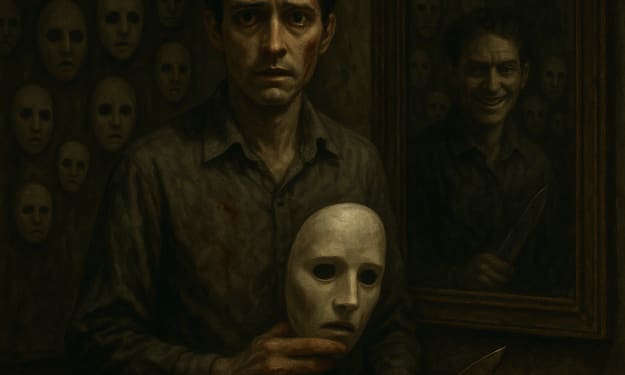
House of Masks. Honorable Mention in Out of the Dream Challenge. Top Story - June 2025.
I don’t remember beating him. Stabbing him. That’s what I keep telling them. The detective. The doctor. The woman with the clipboard and thick glasses who looks at me like I’m dead to her. I keep repeating it, hoping it’ll eventually mean something: “I don’t remember. I swear.”
By Steph Marieabout a year ago in Horror
SEASON 2: THE RECITATION
CHAPTER 6: THE THIRTEENTH AYAH The black liquid pooling from Saad’s throat wasn’t blood. It was thicker, darker, moving with purpose across the floorboards like spilled ink drawn by unseen fingers. Mehvish watched in paralyzed horror as it formed shapes....not Arabic, but older. Jagged. Cuneiform.
By Tales That Breathe at Nightabout a year ago in Horror
Nothing but Something
Here is the link to the challenge: “The room is unfamiliar. I don’t know how I got here.” I wrote that down and I knew that I had to because I had my red pen that always went with the reporter’s pad that said, “Reporter’s Pad” right on the front. It is the same red colour as the pen and I know that I can make notes now even if this is very strange and I do not like this place and there is no carpet here and I wonder if I am going to be in trouble because I did not show up for lunch and I am not hungry so should I worry.
By Kendall Defoe about a year ago in Horror
I'm Back!
My name is Jack McDougal, the great, great, great, (maybe one more great) nephew of Phineas McDougal, one of the country’s first robber barons. Unlike the Rockefellers, Carnegies, and Melons, Uncle Phineas outlived most of his money. At the time of his death, all that was left of his fortune was a Victorian style mansion on twenty acres of land in Greenfield, Massachusetts. It was the house Phineas was murdered in. He was hit over the head with an iron fireplace poker on October 31, 1879, Halloween. He was not a popular man!
By Mark Gagnonabout a year ago in Horror