psychological
Mind games taken way too far; explore the disturbing genre of psychological thrillers that make us question our perception of sanity and reality.
The World’s Most Haunted Diamond . AI-Generated.
The Hope Diamond’s origins trace back to 17th-century India. Deep inside the famous Kollur mine of Golconda, a large, violet-blue stone was unearthed. At first glance, it was breathtaking—over 115 carats of shimmering brilliance. But local whispers claimed it was stolen from a Hindu temple idol, taken from the very eye of a sacred deity. The legend says: disturbing a god’s jewel invites divine punishment. And soon, misfortune began to follow the stone wherever it traveled. The Curse Reaches France: In the 1660s, the diamond found its way into the hands of a French merchant, Jean-Baptiste Tavernier. He brought it to King Louis XIV of France, who fell in love with its brilliance. The king had the diamond recut into a smaller, yet even more dazzling stone, known then as the “French Blue.” But fortune did not smile for long. Tavernier, the merchant who first sold it, died in poverty, and some stories claim he was torn apart by wild dogs. King Louis XIV himself faced tragedy—his heirs dying young, his kingdom suffering. His descendant, King Louis XVI, and Queen Marie Antoinette, who both wore the diamond, met the guillotine during the French Revolution. Many came to believe that the diamond was no mere jewel, but a silent executioner. A Trail of Death and Misfortune: After disappearing during the chaos of the Revolution, the diamond resurfaced years later, this time in England. It passed from one owner to another, each facing ruin or tragedy. • A Dutch jeweler who handled the stone was brutally murdered. • A Russian prince who acquired it was mysteriously killed. • Wealthy owners saw their families destroyed by accidents, scandals, and early deaths. • Every transfer seemed to repeat the same chilling pattern: beauty followed by devastation. The Hope Family and the Diamond’s Name: In the 19th century, the diamond landed in the hands of Henry Philip Hope, a wealthy London banker. From him, the jewel took its current name—the Hope Diamond. But hope was far from what it brought. The Hope family fell into financial ruin. Generations who inherited the diamond faced bankruptcy, scandals, and broken lives. By now, the diamond’s reputation as a cursed object had spread across Europe. Writers and newspapers labeled it “the stone of misfortune,” a gem too dangerous to possess. The American Heiress and Tragedy: In the early 20th century, the Hope Diamond traveled across the Atlantic. A socialite named Evalyn Walsh McLean purchased it, dismissing the curse as mere superstition. For a time, she flaunted it proudly at parties, enjoying the envy it brought. But the curse did not spare her. Her daughter died of an overdose, her son was killed in a car crash, and her husband was declared insane. Evalyn herself fell into depression and financial ruin before her death. The once-glamorous jewel had once again drained joy from an entire family. The Smithsonian’s Darkest Treasure: After McLean’s death, the Hope Diamond was sold to settle debts. Eventually, famed jeweler Harry Winston donated it to the Smithsonian Museum in 1958. Ironically, the man who delivered the diamond by mail to the museum suffered a string of personal tragedies shortly after. Today, millions of visitors stare at the Hope Diamond, encased behind glass, glowing with an eerie blue aura. It is one of the most valuable and beautiful gems in the world—yet whispers of its curse still echo through its halls. Beauty or Death?: So what is the truth? Is the Hope Diamond truly cursed, or is it a chilling coincidence that so many who touched it met tragic ends? Skeptics argue that stories of the curse are exaggerated, woven to add mystery. But believers know one thing: every time a new hand held this jewel, fate turned cruel. The Hope Diamond remains both a treasure and a warning. A symbol of how beauty can seduce—but at a price. Even now, beneath the museum’s protective glass, one can’t help but wonder: does the diamond still wait for its next victim?
By Mr. Jackieabout a year ago in Horror
The Phone That Rang After My Sister’s Funeral
The day we buried my sister, the world felt empty. The sun was out, but to me the sky looked gray, heavy, and lifeless. My family and relatives slowly left the graveyard, whispering condolences and brushing away tears. I stayed behind, unable to move.
By Muhammad Kaleemullahabout a year ago in Horror
Evil sometimes wears a friendly face.”
The rain had been pounding for hours, turning the highway into a blur of slick asphalt and smeared headlights. My eyes stung from exhaustion, and the wipers screeched back and forth in a hopeless attempt to keep the windshield clear. That’s when I saw him—standing just past the guardrail, thumb stuck out, soaked to the bone.
By Muhammad Anas about a year ago in Horror
Twists Of Time And Mind
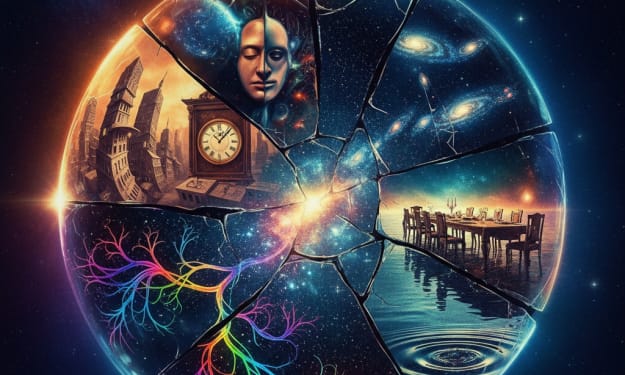
Twists of Time and Mind: Six Must-Watch Mind-Bending Movies Cinema has always been a window into human imagination, but few genres test the limits of thought like films about time, identity, and alternate realities. The following six movies – Enemy, Predestination, Mr. Nobody, Inception, The Butterfly Effect, and Coherence – offer unique journeys that bend logic, stretch perception, and keep viewers questioning long after the credits roll. Without giving away any spoilers, here’s a closer look at why each of these mind-bending films deserves your attention. Enemy (2013) Directed by Denis Villeneuve, Enemy is a haunting psychological thriller starring Jake Gyllenhaal in a dual role that leaves audiences puzzled in the best possible way. Based on José Saramago’s novel The Double, the film examines themes of identity, reality, and the hidden aspects of human nature. Villeneuve’s trademark atmospheric tension, combined with eerie visuals and Gyllenhaal’s masterful performance, ensures that Enemy lingers in your thoughts. It is a film that doesn’t hand out answers but rather invites you to interpret the labyrinth of its mystery. Predestination (2014) Few films tackle time travel with as much precision and originality as Predestination. Directed by the Spierig Brothers and starring Ethan Hawke alongside Sarah Snook, the movie is adapted from Robert Heinlein’s short story All You Zombies. At its heart, it is both a time-bending thriller and a deeply human drama. The film explores destiny, identity, and paradoxes in ways that are both mind-blowing and emotionally resonant. What makes Predestination stand out is not only its clever structure but also its strong performances, which elevate the narrative beyond a typical sci-fi puzzle. Mr. Nobody (2009) Directed by Jaco Van Dormael, Mr. Nobody is a visual and emotional feast. Jared Leto stars as Nemo Nobody, the last mortal in a future world where humans have achieved near immortality. The film navigates through multiple possible lives and choices Nemo might have made, weaving them into a kaleidoscope of narratives. Beautifully shot and philosophically rich, Mr. Nobody reflects on love, regret, and the infinite possibilities of existence. It’s a movie that asks viewers to consider the weight of every decision, making it both grand in scope and personal in feeling. Inception (2010) Christopher Nolan’s Inception has become a modern classic in the realm of mind-bending cinema. Starring Leonardo DiCaprio, Joseph Gordon-Levitt, Marion Cotillard, and Tom Hardy, the film dives into the dream world where ideas can be planted or stolen. With its breathtaking action sequences, layered narrative, and Hans Zimmer’s unforgettable score, Inception balances blockbuster spectacle with philosophical depth. It’s not just a heist movie but a meditation on memory, reality, and the human subconscious. A perfect example of high-concept filmmaking done right, Inception is as thrilling as it is thought-provoking. The Butterfly Effect (2004) Directed by Eric Bress and J. Mackye Gruber, The Butterfly Effect is a striking exploration of chaos theory and the consequences of altering the past. Starring Ashton Kutcher in one of his most serious roles, the film follows a young man who discovers he can revisit pivotal moments of his life. Every change, however, leads to unforeseen consequences. The film’s power lies in its emotional intensity and moral questions about fate, choice, and responsibility. Dark, unsettling, yet compelling, it challenges viewers to think about how even the smallest decision can ripple outward in unpredictable ways. Coherence (2013) James Ward Byrkit’s Coherence is an indie gem that proves a brilliant concept doesn’t require a massive budget. Taking place almost entirely during a dinner party, the story unfolds as a cosmic anomaly triggers bizarre events that test relationships and perceptions of reality. Shot with a largely improvised script and natural performances, Coherence creates tension through simplicity, delivering one of the most effective explorations of parallel realities ever put to screen. It’s intimate, eerie, and endlessly thought-provoking, leaving audiences questioning what they would do in the same situation. --- Final Thoughts Each of these films dares to challenge conventional storytelling, offering experiences that are as much puzzles as they are narratives. They explore identity, fate, and the fragile boundaries between reality and illusion. Whether it’s the surreal doppelgängers of Enemy, the intricate paradoxes of Predestination, or the dreamscapes of Inception, these movies prove that cinema is not just about entertainment but about expanding how we perceive the world. If you’re ready for films that will stay with you long after viewing, this list is the perfect place to start your journey into the realms of mind and time.
By Muhammad Shahramabout a year ago in Horror
Veil of Shadows — The Black Eyed Children: Modern Folklore’s Most Chilling Omen
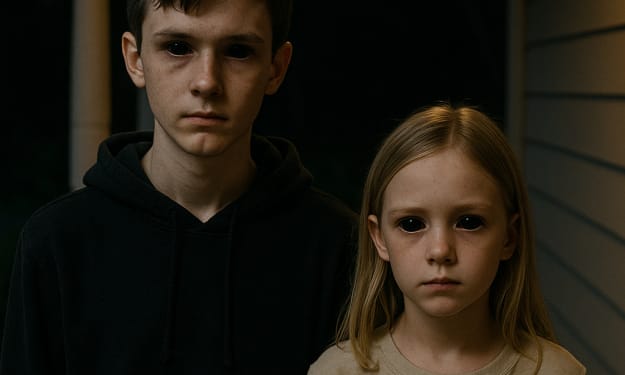
The Knock You Regret Answering Imagine it’s late... past midnight, past reason. The house is quiet except for the hum of the fridge and the shifting sighs of old wood. Then: a knock at the door. Not frantic, not timid. Just steady. You hesitate, but curiosity wins. Through the glass of the front door you see two kids, maybe twelve or thirteen. Pale faces. Hoodies. Their posture is still, a little too still.
By Veil of Shadowsabout a year ago in Horror
The Ghost Frequency. AI-Generated.
Arthur lived in the quiet, and that’s what made his job as a post-production audio editor perfect. His workspace was a black, soundproof cube deep within a downtown studio, where the air was always stale and the only light came from his three glowing monitors. It was 3 a.m., the city silent outside the building’s thick walls, and Arthur was meticulously cleaning an interview track.
By shakir hamidabout a year ago in Horror
🪞 The Mirror That Kept My Shadow
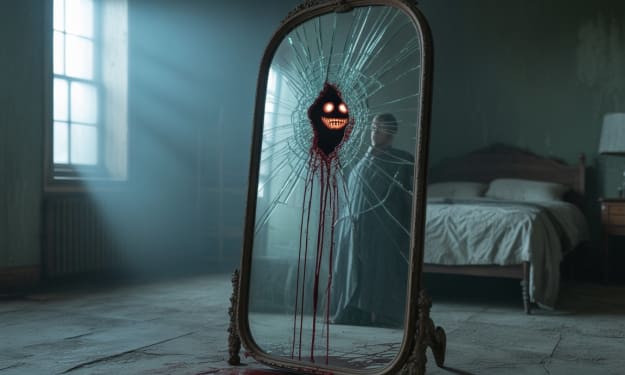
Ahmed had been restless for weeks. Starting over was never easy. Three years of marriage had collapsed in a storm of shouting, betrayal, and one final, bitter decision. He’d left the old apartment and taken a small, dusty flat across town—cheap, a little decrepit, but far away from the memories he was trying to bury.
By Shehzad Anjumabout a year ago in Horror
The Mighty Small Cat and His Little Hero
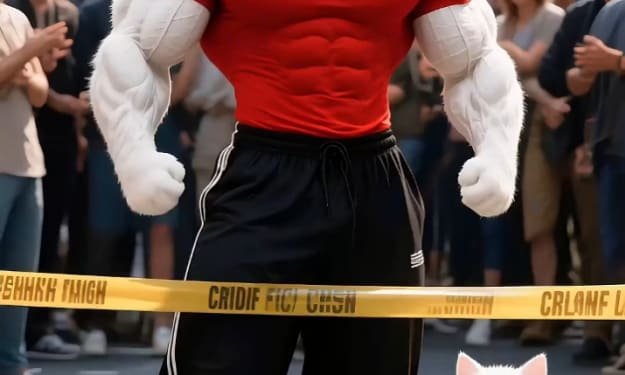
The Beginning of an Unusual Day In the heart of the bustling city, people stopped in their tracks as a sight unlike any other unfolded before them. A massive, muscular white cat stood in the middle of the street, towering above everyone. His bright red shirt stretched across his broad chest, and his snow-white fur gleamed under the sunlight. Beside him, much smaller yet equally remarkable, was his son—a tiny kitten dressed in a Spider-Man suit, staring up at his father with wide, determined eyes.
By Be The Bestabout a year ago in Horror
The Hunger Cap
Arlo found the beanie at a thrift store on Bleecker Street, tucked between moth-eaten sweaters and faded band t-shirts. It was unremarkable—charcoal gray wool with a simple ribbed pattern—but something about it called to him. Maybe it was the way it seemed to absorb the fluorescent light above, or how the elderly shopkeeper's eyes lingered on it with what looked like relief when Arlo placed it on the counter.
By Parsley Rose about a year ago in Horror
Regards, RIP. Content Warning.
Dearest Graham, By the time you read this, it will already be too late. For you. I have been wanting to write to you for a long time now. But so often, when I try to write what I wanted to say, I stumble over my words and then scrap the draft completely. You see, you were my everything for so long. I mean that very literally, as you damn well know. I had been isolated slowly and gradually from all of the people who loved and cared for me. That was your sly and calculated plan all along, wasn’t it?
By Paul Stewartabout a year ago in Horror
The Cat Who Knew Too Much
The Cat Who Knew Too Much Sometimes, the only witness to tragedy is a creature no one suspects. When Claire adopted Jasper, she thought she was rescuing a stray. The sleek black cat had been sitting outside the local shelter in the rain, staring through the fence like he was waiting for someone. His golden eyes seemed to meet hers with unsettling intelligence. From the first night, Claire knew Jasper was not an ordinary cat. He didn’t meow for food or attention. Instead, he sat by the window for hours, watching the street below as though expecting something. The first tragedy happened a week later. Claire woke up at midnight to find Jasper gone from his usual perch. She found him in the hallway, sitting completely still, ears pricked. Then she heard it—a scream. By the time Claire reached the street, a fire had broken out at the bakery across the road. The fire department arrived quickly, but the owner, a kind old man who gave out free bread on weekends, didn’t make it out alive. Jasper didn’t flinch through the chaos. He just watched. Claire brushed it off as coincidence until two weeks later. This time, Jasper scratched at the front door until she opened it. He darted out, and Claire followed him barefoot into the night. He led her to the park, where a small crowd had gathered. A teenage boy had drowned in the fountain—the same fountain that had been dry for months until a sudden rainstorm filled it earlier that day. By the third tragedy, Claire could no longer ignore the pattern. Jasper always knew. One rainy afternoon, she found him sitting on the windowsill, staring toward the old train tracks at the edge of town. His tail twitched. A chill ran down Claire’s spine. She grabbed her coat and followed him. At the tracks, she found no one—but hours later, news broke that a car had stalled on the crossing. The driver didn’t survive. Claire began to keep a notebook. Date. Place. What Jasper did. The pattern was too precise to dismiss. Every time he appeared restless or left the house, something terrible followed. One evening, after a particularly sleepless night, Claire decided to investigate further. She visited the town library and dug into local archives. What she found disturbed her. The bakery fire? Not the first of its kind—there had been three other unexplained fires in that block over the last 30 years. The park drowning? That fountain had a grim history—two other deaths by drowning decades apart. The train crossing? Known for "accidents" that seemed to happen at odd intervals, almost like clockwork. And there was one more thing. In every old photograph of these tragedies—at least the ones preserved in the newspaper archives—there was a black cat. Sometimes sitting on a fencepost, sometimes near a crowd of onlookers, sometimes barely a blur. But there. Always there. Claire’s hands shook as she turned page after page. Jasper was young, but this cat—this presence—had been here for decades. That night, Claire confronted him. She sat cross-legged on the floor, looking into his luminous eyes. “What are you?” she whispered. Jasper blinked slowly, then got up and padded into the kitchen. He stopped in front of the cellar door—an old, unused entry to the basement that Claire never bothered with. He pawed at it, then sat down. Heart pounding, Claire opened the door. The air smelled musty, like dust and old secrets. She descended slowly, her phone flashlight cutting through the darkness. The basement was empty except for one thing: a wooden box tucked in a corner. Inside were yellowed newspapers, photographs, and handwritten notes. They told the story of a family who once lived here—the original owners of the house. The notes belonged to a woman named Elise, who wrote of strange visions, of hearing voices warning her of death before it happened. In one entry, Elise wrote: “He comes before every tragedy. I used to think he was a curse, but now I know—he is a guide. He tries to warn me, to save them. But no one listens.” Claire sat back, heart thundering. Jasper wasn’t bringing death. He was warning her. The next night, Jasper became restless again. He meowed—truly meowed—for the first time since Claire adopted him, his voice sharp and urgent. Claire grabbed her coat and followed him into the rain. This time, he led her to the school on the edge of town. Smoke was already curling from a window. Claire called emergency services and banged on the doors until a janitor finally opened them. They managed to evacuate the building before the fire consumed it. For the first time, a tragedy had been stopped. When Claire returned home, Jasper leapt onto her lap and purred—a deep, rumbling sound that shook her to her core. The next morning, she opened her notebook and added a new line under “Pattern”: “Maybe he’s not here to witness tragedy. Maybe he’s here to prevent it.” And for the first time since the whispers began, Claire felt something like hope.
By Abdul Muhammad about a year ago in Horror