movie review
Movie reviews for horror fans; from gruesome bone-chillers to dark horror thrillers, a showcase for frightful films that seek to entertain and to terrify.
Mirror Earth
For centuries, astronomers and science fiction writers have pondered a tantalizing question: Does Earth have a twin? Not just another rocky planet in the habitable zone, but a true Mirror Earth—a world nearly identical in size, composition, and even climate to our own, potentially hosting life or even a parallel version of humanity.
By Silas Blackwoodabout a year ago in Horror
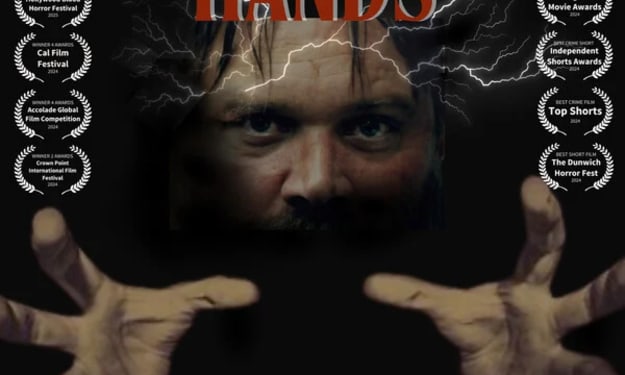
REVIEW - In Monster’s Hands (Directed by Christopher Sheffield)
With a run time of just under 21 minutes, In Monster’s Hands is a multi-award winning crime thriller (with over 60 wins, and over 20 nominations) which is based on the true story of John and Hazel Durnavich, a retired couple who lived in Phoenix, Arizona, and who one day in the fall of 1998 were brutally attacked in a terrifying and horrific home invasion.
By Fortean Film Festivalabout a year ago in Horror
Dead Signal
Introduction In the world of indie horror games, few titles have made as chilling an impact as Dead Signal. Developed by Fallen Leaf Studio, this found-footage-style psychological horror experience plunges players into a night of terror as they monitor security cameras, decode cryptic messages, and evade an unseen entity. Drawing comparisons to "Five Nights at Freddy's" and "No One Lives Under the Lighthouse," Dead Signal stands out with its realistic VHS aesthetic, immersive sound design, and nerve-wracking gameplay. This article explores the game’s premise, mechanics, lore, and why it has become a cult favorite among horror enthusiasts. 1. What Is Dead Signal? A. The Premise: A Nightshift from Hell You play as a security operator hired to monitor a remote facility via CCTV. Your job is simple: watch the cameras, report anomalies, and survive until 6 AM. But as the night progresses, something unnatural begins creeping into the feeds. B. The Found-Footage Aesthetic The game mimics 1990s VHS recordings, complete with static, distortion, and tracking errors. The grainy visuals and lo-fi sound design amplify the sense of isolation and dread. C. Gameplay Mechanics Camera Surveillance: Flip between different feeds to spot disturbances. Audio Monitoring: Listen for whispers, footsteps, or electronic interference. Signal Decryption: Use a spectrogram tool to decode hidden messages. Entity Encounters: When something appears, you must act fast—or die. 2. The Horror of Dead Signal: What Makes It So Scary? A. Psychological Tension Over Jump Scares Unlike many horror games, Dead Signal builds dread slowly. The fear comes from uncertainty—glimpses of movement, distorted voices, and something watching you back. B. The Unknown Entity The game never fully reveals what you’re up against. Theories range from ghosts, interdimensional beings, or even A.I. gone rogue. C. Realistic Immersion The 1980s/90s analog tech (CRT monitors, dial-up sounds) makes the horror feel plausible. Players report genuine paranoia after long sessions, as if they’re really being watched. 3. The Lore: Unraveling Dead Signal’s Mysteries A. The Blackwell Organization Hints suggest your employer, Blackwell, is involved in occult experiments. Hidden documents reference "Project ECHO," possibly related to paranormal broadcasting. B. The Numbers Station Connection The game features creepy radio transmissions reminiscent of real-world numbers stations. Some decoded messages hint at missing persons, government cover-ups, and a "signal from beyond." C. Multiple Endings & Hidden Secrets Choices affect the outcome—will you escape, go insane, or become part of the signal? Secret QR codes and spectrogram puzzles lead to deeper lore. 4. Why Dead Signal Stands Out in Indie Horror A. The Rise of Analog Horror Dead Signal taps into the "analog horror" trend (e.g., Local58, The Mandela Catalogue). The VHS distortion and cryptic broadcasts make it feel like a lost 90s horror tape. B. Minimalist Gameplay, Maximum Fear Unlike action-heavy horror games, Dead Signal makes staring at static terrifying. The lack of weapons or escape options leaves players feeling helpless. C. A Cult Following & Streamer Reactions Horror YouTubers like Markiplier and Gab Smolders have played it, screaming at every glitch. The game’s slow-burn scares make for perfect reaction content. 5. Is Dead Signal Based on Real Phenomena? A. Inspired by Real Horror Stories The concept echoes real-life "haunted frequency" legends (e.g., EVP recordings). The numbers station angle mirrors Cold War-era spy broadcasts. B. The "Security Guard Horror" Trope Games like Five Nights at Freddy’s popularized the "nightshift horror" genre. Dead Signal takes it further with psychological and cosmic horror elements. C. Could This Happen in Real Life? While no documented cases exist of entities coming through CCTV, the game plays on deep-seated fears of surveillance and the unknown. 6. Tips for Surviving Dead Signal A. Watch for Patterns The entity often appears in the same cameras first. Audio cues (whispers, static bursts) warn of its presence. B. Don’t Ignore the Spectrogram Some messages only appear as audio frequencies. Use a real-time spectrogram tool (or in-game decoder) to uncover secrets. C. Stay Calm—Panic Gets You Killed The game punishes frantic camera switching. Sometimes, not looking is the safest option. Conclusion: Should You Play Dead Signal? If you love slow-burn horror, cryptic lore, and the feeling of being watched, Dead Signal is a must-play. It’s a masterclass in atmospheric terror, proving that sometimes, the scariest thing is what you almost see. Warning: "The signal is always listening. Don’t let it find you."
By Silas Blackwoodabout a year ago in Horror
The Hollow Ones
Introduction: Unveiling the Mystery of the Hollow Ones In the shadowy realms of occultism and esoteric traditions, few concepts are as intriguing—and as misunderstood—as the Hollow Ones. These enigmatic entities appear across various mystical traditions, from Gnostic texts to modern Chaos Magic, often described as spiritual voids, empty vessels, or paradoxical beings that exist between states of being and non-being. Who—or what—are the Hollow Ones? Are they lost souls, metaphysical constructs, or something far more ancient and sinister? This article explores their origins, interpretations across different traditions, and their significance in contemporary occult practices. 1. Origins of the Hollow Ones: Tracing the Concept Through History A. Gnostic Roots: The Void and the Pleroma In Gnostic cosmology, the universe is divided between the Pleroma (divine fullness) and the Kenoma (cosmic emptiness). Some Gnostic texts describe "hollow" beings—entities that exist outside divine light, trapped in illusion. The Apocryphon of John references "shadowy spirits" that mimic true spiritual forms but lack substance. B. Kabbalistic Parallels: The Qlippoth In the Kabbalistic Tree of Life, the Qlippoth (shells) represent broken vessels of divine energy. These "hollow" shells are often associated with demonic or imbalanced forces. Some occultists view the Hollow Ones as modern reinterpretations of Qlippothic entities. C. Alchemical Symbolism: The Vacuum and the Vessel Alchemists spoke of the "vas naturae" (vessel of nature)—a container for transformation. The Hollow One could symbolize an unfilled crucible, waiting for spiritual alchemy to take place. 2. The Hollow Ones in Modern Occultism A. Thelema and Crowley’s Influence Aleister Crowley referenced "hollow men" in his writings, possibly inspired by T.S. Eliot’s poem. In The Book of Thoth, Crowley describes certain spirits as "empty yet filled with potential." B. Chaos Magic and the Hollow Ones as Archetypes Chaos magicians use the Hollow Ones as psychological constructs—voids that can be filled with intention. Some practitioners invoke them as blank slates for magical experimentation. C. Vampiric and Left-Hand Path Interpretations In vampiric occultism, Hollow Ones are sometimes seen as psychic parasites that feed on spiritual energy. Left-Hand Path traditions may view them as self-created voids, representing the annihilation of the ego. 3. Psychological and Philosophical Perspectives A. Carl Jung and the Shadow Self Jungian psychology interprets Hollow Ones as manifestations of the "shadow"—the unconscious void within. They symbolize spiritual emptiness, dissociation, or the "unlived life." B. Existentialism and the Absurd Philosophers like Jean-Paul Sartre and Albert Camus explored the concept of existential emptiness. The Hollow One could represent the human condition of seeking meaning in a void. C. Modern Mental Health Analogues Some relate Hollow Ones to dissociative disorders or spiritual malaise. The term "spiritual bypassing" (using mysticism to avoid psychological work) may apply. 4. The Hollow Ones in Pop Culture and Literature A. T.S. Eliot’s "The Hollow Men" (1925) Eliot’s poem describes "headpieces filled with straw"—a metaphor for soulless existence. Many occultists draw parallels between his imagery and esoteric Hollow Ones. B. Neil Gaiman’s "Sandman" Comics The character "The Hollow One" appears as a mysterious, empty entity in the Dreaming. Represents lost stories and forgotten myths. C. Role-Playing Games and Modern Fantasy "World of Darkness" RPGs feature Hollow Ones as a subculture of gothic, DIY magicians. Often portrayed as loners who embrace the void as a source of power. 5. Rituals and Magical Workings with the Hollow Ones A. Invoking the Hollow One (Chaos Magic Technique) Create a sigil representing emptiness. Enter a meditative void-state. "Fill" the Hollow One with a desired intention. B. Protective Measures Against Parasitic Hollow Ones Use iron, salt, or black mirrors to deflect energy drains. Practice grounding and aura reinforcement. C. The Hollow One as a Spiritual Mirror Some traditions use the concept for shadow work—facing one’s inner voids. Conclusion: Embracing the Void or Resisting It? The Hollow Ones remain one of occultism’s most ambiguous and versatile symbols. Whether seen as dangerous parasites, psychological mirrors, or magical tools, they force us to confront the voids within and around us. Final question: Are the Hollow Ones a warning… or an invitation?
By Silas Blackwoodabout a year ago in Horror
I Am Legend
I Am Legend: Richard Matheson’s Groundbreaking Vampire Apocalypse (1954) Introduction: Few novels have reshaped horror and science fiction as profoundly as Richard Matheson’s I Am Legend (1954). From The Last Man on Earth (1964) to I Am Legend (2007), starring Will Smith, this gripping tale of the last man on Earth fighting vampire-like creatures redefined post-apocalyptic fiction and influenced generations of writers. But beyond its pop culture legacy, I Am Legend is a psychological masterpiece, exploring loneliness, survival, and what it truly means to be "monstrous." In this in-depth look, we'll investigate: I Am Legend's themes and plot
By Silas Blackwoodabout a year ago in Horror
"Why We Crave Horror Movies"
"Why We Crave Horror Movies" – Stephen King (Originally in Playboy, 1981) Introduction In his provocative 1981 Playboy essay, Stephen King—the undisputed master of horror—delves into humanity’s obsession with fear, asking: Why do we pay to watch things that make us scream? Far from a simple genre analysis, "Why We Crave Horror Movies" explores the primal, psychological, and even civilizing functions of horror. King argues that these films act as a pressure valve for our darkest impulses, allowing us to indulge in taboo fantasies without real-world consequences. This article unpacks King’s theories, examines their validity through modern psychology, and reveals why—40+ years later—his essay remains the definitive take on horror’s enduring appeal. 1. Stephen King’s Central Argument: Horror as a Social Release King’s essay hinges on three core ideas: A. We Are All Mentally Ill King provocatively claims that everyone has latent insanity—violent thoughts, irrational fears, morbid curiosities. Horror movies let us safely express these repressed emotions. Example: Watching a zombie horde tear apart victims allows us to vicariously unleash aggression. B. Horror Reinforces Normality By showing monsters, killers, and the supernatural, horror films make viewers feel comparatively sane and moral. King compares it to public executions in medieval times—a communal ritual affirming societal boundaries. Example: After watching The Texas Chain Saw Massacre, even dysfunctional families seem harmonious. C. It’s Fun to Be a Little Bad King describes horror fans as "daring" the nightmare, like riding a rollercoaster. The thrill comes from controlled fear—knowing the terror isn’t real. Example: Jump scares trigger adrenaline rushes, mimicking primal "fight or flight" responses. 2. The Psychology Behind King’s Theories Modern science supports many of King’s observations: A. Catharsis Theory Aristotle’s idea of emotional purging aligns with King’s "pressure valve" concept. Studies show horror fans report reduced anxiety after watching scary films (Scrivner, 2021). B. Morbid Curiosity Evolutionary psychologists argue that fascination with danger is hardwired—it helps us prepare for threats. MRI scans reveal horror triggers the amygdala (fear center) and nucleus accumbens (reward system) simultaneously (*Hsu & King-Casas, 2019*). C. The "Benign Violation" Effect Comedy and horror both rely on subverting expectations safely. Slasher films let us laugh at gore because we know it’s fake (University of Chicago, 2017). 3. Counterarguments: When Horror Goes Too Far Not everyone agrees with King’s rosy assessment. Critics argue: A. Desensitization Risk Excessive exposure to violence may numb empathy (American Psychological Association). Example: The "torture porn" subgenre (e.g., Saw) arguably glorifies suffering. B. Exploitation Fears Horror often targets marginalized groups (e.g., women in "final girl" tropes). King’s own Misery and Carrie explore this duality. C. Personal Differences Not everyone enjoys fear—high neuroticism predicts horror avoidance (Journal of Personality, 2020). 4. King’s Legacy: How His Essay Predicted Modern Horror A. The Rise of "Elevated Horror" Films like Hereditary and Get Out merge terror with social commentary—just as King suggested horror reflects cultural anxieties. B. Horror as Community King described theaters as "laughing, screaming audiences" bonding over fear. Today, live-tweeting and Shudder communities serve the same role. C. The Streaming Era King joked about watching horror to feel "warm and safe." Now, 75% of viewers prefer scary movies at home (Netflix, 2023). 5. Why King’s Essay Still Matters Decades later, "Why We Crave Horror Movies" remains relevant because: ✔ It validates horror fans—what others call "guilty pleasures," King frames as psychological necessities. ✔ It anticipates trends—from viral creepypastas to A24’s art-house terror. ✔ It’s brutally honest—King admits we’re all a little twisted, and that’s okay. Conclusion: The Dark Mirror of Horror Stephen King’s essay reveals horror as a societal mirror—one that reflects our hidden fears, desires, and even our humanity. Whether for catharsis, rebellion, or sheer thrill, craving horror isn’t deviant… It’s profoundly human. "We’re all mentally ill," King wrote. "The only difference is that some people admit it." Do you agree with King? Does horror make you feel better—or worse? Let’s debate in the comments! (For more on horror psychology, read my deep dive into "The Uncanny Valley." Subscribe below!)
By Silas Blackwoodabout a year ago in Horror
Whispers in the Walls
The rain had begun before she even stepped out of the car. Elena gripped the steering wheel a moment longer, staring at the house that rose like a corpse from the edge of the woods. It had the look of something meant to be forgotten — rotting porch steps, shutters hanging loose like broken bones, and vines choking the chimney. The house had belonged to her grandfather, a man she’d never met, and one her mother refused to speak of.
By Muhammad Atifabout a year ago in Horror
Bring Her Back Review – A Haunting, Heartbreaking Horror from the Talk to Me Directors
Review: Bring Her Back Directed by Michael and Danny Phillippou Written by Michael and Danny Phillippou Starring Billy Barratt, Sora Wong, Sally Hawkins, Jonah Wren Phillips
By Sean Patrickabout a year ago in Horror
The Silent Melody of Redwood Lane
The house on Redwood Lane stood shrouded in the perpetual twilight of overgrown oaks, its silence a thick blanket woven from years of abandonment. Liam, a struggling composer seeking inspiration in forgotten spaces, found it irresistible. The real lure, however, wasn't the crumbling facade or the ghostly whispers the locals spoke of; it was the antique grand piano he’d spotted through a dusty window, its ebony finish gleaming like a promise of forgotten melodies. He bought the house for a song, the realtor practically throwing in the tarnished Steinway as a bonus. Back in the echoing emptiness, the piano became his sole focus. Its keys, yellowed with age, felt strangely alive beneath his touch. But when he played, the music that emerged was… discordant. Tangled notes, unresolved chords, and beneath them, a faint, almost subliminal hum, like a breath held too long. Then came the whispers. Faint at first, like the rustling of unseen silk, they seemed to emanate from the very wood of the piano. They were fragmented, unintelligible, but carried a distinct undercurrent of sadness, a lingering echo of sorrow. Liam, initially dismissing them as tricks of the old house, started recording his practice sessions. Upon playback, the whispers were undeniable, woven into the fabric of his playing, a silent counterpoint to his hesitant melodies. The whispers grew clearer, morphing into hushed fragments of speech, often laced with a choked sob or a desperate sigh. He began to recognize recurring phrases: “Not my fault…”, “He promised…”, “The cold… so cold…” They felt like snippets of a broken conversation, a tragic narrative pieced together from fractured memories. His sleep became haunted by melodies that weren’t his own, haunting refrains that seemed to seep from the piano into his subconscious. He dreamt of shadowy figures gathered around the instrument, their faces obscured by grief, their silent tears falling onto the gleaming keys. He felt their despair, their lingering anguish, as if their emotions had been absorbed into the very grain of the wood. Driven by a morbid curiosity, Liam delved into the history of the house. Redwood Lane had witnessed its share of tragedy. The original owner, a concert pianist named Eleanor Ainsworth, had vanished without a trace decades ago, leaving behind only the silent piano and a legacy of unfulfilled potential. Locals whispered of a broken heart, a lost love, and a final, unfinished symphony. Liam realized the whispers were Eleanor's, and perhaps others who had touched the instrument over the years, their emotional residue clinging to the wood like a persistent echo. The piano wasn't just an instrument; it was a vessel, a repository of unspoken grief. But the echoes weren’t just passive. The piano started influencing his waking hours. He’d find sheet music he didn't recognize scattered on its stand, the notes forming melancholic tunes he felt compelled to play. His own compositions took a darker turn, infused with the sadness and longing he felt emanating from the instrument. He was becoming a conduit, channeling the unresolved emotions trapped within the piano. Then, the cold. Patches of icy air would gather around the piano, even on warm days. The keys would depress on their own, producing dissonant chords that sent shivers down his spine. He saw fleeting reflections in the polished surface – a pale hand hovering over the keys, a tear-streaked face momentarily visible before vanishing. Eleanor was trying to communicate, her silent melody growing stronger, more insistent. He discovered Eleanor’s diary hidden within the piano bench. Its pages chronicled a passionate love affair, a betrayal, and a devastating accident that had claimed the life of her beloved just before their wedding. Her final entry ended mid-sentence, a single, unfinished musical staff etched at the bottom of the page. The cold, the whispers, the unfinished symphony – it all pointed to a profound, lingering sorrow, an artistic spirit forever trapped in a moment of heartbreak. Liam felt an overwhelming urge to complete her symphony, to give voice to her silent melody, to release her trapped emotions. As he began to work, composing the missing bars, the whispers intensified, no longer filled with just sadness, but with a sense of anticipation, of hope. The cold around the piano lessened, replaced by a strange warmth. On the night he finally played the completed symphony, a hauntingly beautiful piece filled with both despair and a fragile sense of resolution, the house fell utterly silent. The whispers ceased. The cold vanished. The piano seemed to glow with a soft, ethereal light. He felt a profound sense of peace settle in the room, a feeling of closure he knew wasn't just his own. The next morning, the piano stood silent, its keys still. But it no longer felt heavy with sorrow. It felt… empty. Eleanor’s presence, her silent melody, had finally found its resolution, released through the music. Liam continued to live in the house on Redwood Lane, the silence of the piano a constant reminder of the story it had held. He never heard the whispers again, but sometimes, when he played, he felt a fleeting sense of connection, a faint echo of Eleanor’s gratitude woven into his own melodies. The piano remained, a beautiful, silent testament to a life interrupted, a love lost, and a melody finally set free. The house was no longer haunted, but held the quiet resonance of a story that had found its ending — a silent melody that had finally been heard.
By Noman Afridiabout a year ago in Horror
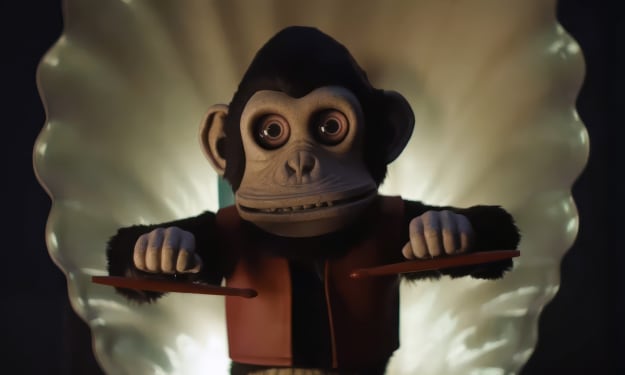
The Monkey. Content Warning. AI-Generated.
The Monkey The toy sat motionless on the shelf. It was the kind of monkey you’d find in a dusty attic: squat, metal-eyed, with chipped paint, a permanent grin, and tiny cymbals clutched in its grotesque little hands. No one in the family remembered buying it, and yet there it was, nestled between old photo albums in the basement of the Hadley house.
By Samu Zundaabout a year ago in Horror