halloween
Get into the Halloween spirit; all about trick or treating, spooky costumes, Halloween decorations and haunted houses for October 31st and all year round.
The Bermuda Triangle: The Atlantic’s Greatest Mystery. Content Warning.
Hidden in the vast blue expanse of the Atlantic Ocean lies one of the most mysterious regions on Earth — the Bermuda Triangle. This area, often called the “Devil’s Triangle,” has fascinated scientists, sailors, and conspiracy theorists for decades. Stretching between Miami (Florida), Bermuda, and San Juan (Puerto Rico), the Bermuda Triangle covers roughly 500,000 square miles of ocean where countless ships and aircraft have reportedly vanished without a trace. The Origins of the Legend The mystery of the Bermuda Triangle began to attract global attention in the mid-20th century. One of the earliest and most famous incidents occurred in 1945, when Flight 19 — a squadron of five U.S. Navy bombers — disappeared during a training mission. The pilots radioed in, reporting that their compasses were malfunctioning and that they were lost over the ocean. The rescue plane sent to find them also vanished, leaving behind no wreckage or survivors. Stories like these spread rapidly through the media, sparking the legend of a haunted oceanic zone where navigation fails, time distorts, and strange forces drag vessels into the deep. The term “Bermuda Triangle” itself was popularized in 1964 by journalist Vincent Gaddis, who wrote about the mysterious disappearances for Argosy Magazine. Unexplained Phenomena and Theories What makes the Bermuda Triangle so terrifying — and fascinating — is that no single explanation can fully account for all the reported events. Over the years, researchers and enthusiasts have proposed a variety of theories, ranging from scientific to supernatural. 1. Magnetic Anomalies: Some scientists believe the Triangle lies on a region where Earth’s magnetic field behaves unusually. This could cause compass readings to become unreliable, leading ships and aircraft dangerously off course. 2. Methane Gas Hydrates: Another popular theory suggests that methane gas bubbles trapped under the ocean floor could occasionally erupt, reducing water density and causing ships to sink suddenly without warning. 3. Human Error and Weather: Skeptics argue that most accidents are caused by human mistakes, storms, and rapid weather changes common in the region. The area is part of a major hurricane corridor, which could easily explain some of the mysterious disappearances. 4. Aliens and Time Portals: For believers in the paranormal, the Bermuda Triangle is more than a physical place — it’s a gateway to another dimension. Some claim UFOs use it as an entry point to Earth, while others believe it’s a portal in time and space that swallows anything unlucky enough to pass through. Famous Disappearances Over the decades, dozens of high-profile cases have been linked to the Triangle. Among them are: USS Cyclops (1918): A massive U.S. Navy cargo ship carrying 309 crew members vanished without a distress call. No wreckage was ever found. Star Tiger and Star Ariel (1948–1949): Two British airliners disappeared while flying near Bermuda in clear weather conditions. The Witchcraft (1967): A luxury yacht owned by Dan Burack disappeared just one mile off the coast of Miami. Burack had called the Coast Guard to report a minor issue, but by the time rescuers arrived, the yacht had completely vanished. Each of these cases adds to the Triangle’s dark reputation — a place where logic and science seem to fail. Scientific Investigations In recent decades, scientists have tried to demystify the Bermuda Triangle. Satellite data, modern GPS systems, and oceanic studies have found no consistent pattern of disappearances beyond statistical averages. The U.S. Coast Guard officially states that there is nothing supernatural about the region, and the number of incidents is proportionate to the amount of traffic passing through one of the world’s busiest shipping lanes. Yet, despite scientific explanations, the myth refuses to die. The Bermuda Triangle has been the subject of documentaries, books, movies, and endless online debates, fueling public fascination and fear. Cultural Legacy and Modern Mystery The Bermuda Triangle isn’t just an oceanic region — it’s a symbol of the unknown. It represents humanity’s enduring curiosity about what lies beyond our understanding. From Hollywood thrillers to YouTube conspiracy channels, the Triangle continues to inspire storytellers and investigators alike. Even with modern navigation and satellite tracking, strange incidents are still reported. Ships vanish, planes lose contact, and eerie lights are sighted dancing across the waves. Whether these are coincidences, natural phenomena, or something truly otherworldly, the legend of the Bermuda Triangle remains alive. Conclusion The Bermuda Triangle endures as one of the great unsolved mysteries of the modern world. Whether viewed through the lens of science or superstition, it captures our collective imagination — a place where the ocean guards its secrets fiercely. Beneath its shimmering surface, something ancient and unexplained seems to whisper: “Enter, if you dare.
By Haunted Secretsabout a year ago in Horror
Slender Man: The Digital Legend That Haunts the Internet. Content Warning.
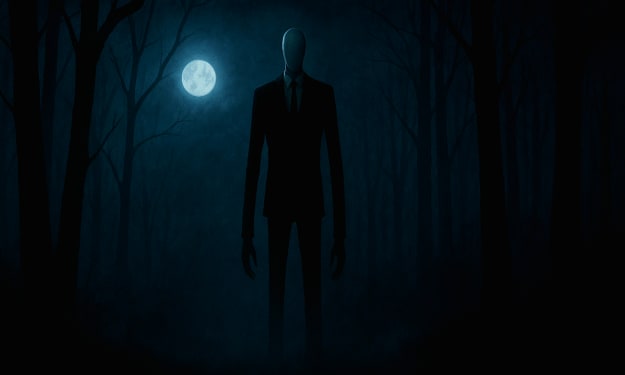
In the shadowy corners of the internet, where fiction and fear often blur, one figure has come to symbolize the dark side of digital folklore — Slender Man. Tall, faceless, and impossibly thin, dressed in a black suit and tie, he is a creation born not from ancient myth, but from the imagination of the internet age. Yet, despite his fictional origins, Slender Man has transcended screens and stories, embedding himself into modern culture — and even inspiring real-world tragedy. This is the story of how an image on a message board became one of the most chilling and influential urban legends in American history. The Birth of a Digital Monster Slender Man first appeared in June 2009 on the online forum Something Awful, during a contest where users were challenged to create creepy, photoshopped images. A user named Eric Knudsen, under the pseudonym Victor Surge, submitted two haunting black-and-white photos depicting a tall, thin man standing in the background behind children. Accompanying the images were eerie captions suggesting that the mysterious figure was responsible for the disappearance of several children. The combination of the photos and the story sparked the imagination of thousands. Within days, users across the internet began adding their own details — eyewitness accounts, supposed newspaper clippings, and diary entries — turning Slender Man into a collaborative myth. The Anatomy of Fear What made Slender Man so terrifying was not what was known about him — but what wasn’t. Described as an unnaturally tall humanoid, often said to have tentacle-like appendages, a featureless white face, and the ability to cause paranoia and hallucinations, Slender Man quickly became an icon of modern horror. He was said to stalk children, manipulate their minds, and lure them into the woods where they were never seen again. Some stories claimed he could appear anywhere, often near forests, abandoned buildings, or even through digital screens. His presence was marked by static interference, lost time, and an overwhelming sense of dread. This open-ended mythology allowed internet users to expand the story endlessly. Blogs, YouTube channels, and online forums filled with alleged sightings and survivor accounts — blurring the line between reality and fiction. The Slenderverse and Cultural Explosion As the legend grew, Slender Man became a cornerstone of what fans dubbed the “Slenderverse” — a collection of online horror stories, videos, and games inspired by the character. The most famous of these is the YouTube series Marble Hornets, launched in 2009. Presented as found footage, it follows a filmmaker who begins documenting strange occurrences after meeting a mysterious figure known as “The Operator” — clearly inspired by Slender Man. The series’ slow-burn tension, grainy aesthetic, and viral nature helped establish the creepypasta genre as a new form of digital storytelling. Soon after, video games like Slender: The Eight Pages (2012) brought the terror to players directly. The simple premise — collect eight pages scattered through a dark forest while avoiding Slender Man — proved terrifyingly effective. The game’s sound design, visual distortion, and sudden jump scares made it an internet sensation, turning Slender Man into a pop culture phenomenon. The Real-World Tragedy However, the Slender Man myth took a dark turn in 2014 when two 12-year-old girls from Wisconsin lured their friend into the woods and stabbed her nineteen times, claiming they did it to “please Slender Man.” The victim miraculously survived, but the case shocked the world. The incident highlighted the powerful influence of online myths on young minds and sparked national debates about the impact of internet horror on children, the line between fiction and obsession, and the responsibility of digital communities. Following the event, websites like Creepypasta Wiki issued statements reminding readers that Slender Man was entirely fictional — yet the damage had been done. The legend had stepped beyond the realm of imagination into the real world. The Psychology Behind the Legend Experts believe Slender Man’s enduring terror lies in psychological archetypes. His facelessness triggers a deep-seated fear of the unknown, while his impossible proportions evoke unease and helplessness. He embodies the fear of being watched, followed, or controlled — anxieties that mirror our own relationship with the digital world. Moreover, the collaborative nature of his story reflects how modern myths are created and spread. Instead of oral tradition, today’s legends evolve through memes, social media, and shared creativity, proving that the internet has become the new campfire around which we tell our scariest stories. Slender Man in Pop Culture Slender Man’s influence spread far beyond internet forums. He has inspired books, documentaries, and Hollywood films, including the 2018 movie Slender Man, as well as countless fan-made projects. His image has become a symbol of digital-age horror — clean, minimalist, yet deeply disturbing. Even after more than a decade, new stories, games, and art continue to explore his myth, ensuring that the Slender Man phenomenon remains alive in online culture. The Modern Boogeyman Slender Man represents a new kind of monster — one born not from folklore or superstition, but from pixels and imagination. He is the boogeyman of the internet generation, thriving on anonymity, viral storytelling, and our collective fear of what hides in the digital dark. His legacy is a reminder that myths evolve with technology. Where once we feared the dark forests, now we fear the shadows lurking behind our screens. Slender Man is not just a story — he’s a reflection of how the internet can create, shape, and sustain fear on a global scale. Conclusion More than a decade after his creation, Slender Man continues to haunt the imagination of millions. Though fictional, his legend serves as a cautionary tale about the power of the internet — to connect us, to entertain us, and sometimes, to terrify us. In a world where stories spread faster than truth, Slender Man stands as the perfect ghost of the digital age — a faceless symbol of fear, obsession, and the unknown.
By Haunted Secretsabout a year ago in Horror
Watching horror films can burn up to 200 calories, the same as a half-hour walk.. AI-Generated.
Thrills and Fitness: How Watching Horror Movies Can Torch Calories Like a Workout Picture this: you're plopped on the couch for a night of chills but are actually burning calories as if you hit the gym. That's right: watching horror movies can jack up your heart rate and burn as many as 200 calories in just an hour, which is the same burn you'd get from taking a half-hour walk. This secret workout comes from your body's natural fear response, turning passive viewing into active energy use.
By Story silver book about a year ago in Horror
Meat Lover's Curse
Jason wasn’t a fan of the pizzeria’s latest menu addition: the "Ultimate Meat Lover's Special." It was an over-the-top creation piled high with every type of meat imaginable—pepperoni, sausage, ham, bacon, meatballs, and some unidentifiable ground meat that the manager swore was a "secret blend." Customers loved it, but Jason hated the overwhelming, sickly-sweet smell that clung to the boxes.
By V-Ink Storiesabout a year ago in Horror
The Devil’s Highway: America’s Most Dangerous Road. Content Warning.
Stretching through the desolate deserts of the American Southwest lies a stretch of asphalt with a chilling reputation — Highway 666, ominously nicknamed “The Devil’s Highway.” Once known for its high death toll, eerie encounters, and unexplained accidents, this infamous road has become a magnet for thrill-seekers, ghost hunters, and travelers fascinated by the supernatural. Though its official name was changed to U.S. Route 491 in 2003, the legends surrounding Highway 666 still haunt the minds of those who dare to drive it after dark. A Road with a Sinister Number Originally established in 1926, Highway 666 ran through New Mexico, Colorado, and Utah, connecting small towns across the vast, empty landscape of the desert. The number alone — 666, long associated with the “Number of the Beast” from the Book of Revelation — gave the highway a cursed identity. Locals quickly began to refer to it as the Devil’s Highway, and the nickname stuck. Over the years, the road became infamous not just for its biblical number, but for the alarming number of accidents, disappearances, and ghostly phenomena reported along its length. A Record of Tragedy and Mystery For decades, Highway 666 had one of the highest fatality rates of any road in the United States. Drivers reported strange mechanical failures, sudden tire blowouts, and disorienting hallucinations that led to crashes. Even experienced truckers avoided it at night, claiming that something unnatural seemed to stalk the highway’s desolate stretches. Many survivors spoke of unseen forces, shadowy figures standing in the middle of the road, and phantom vehicles that appeared out of nowhere only to vanish seconds before impact. These strange occurrences earned the route a reputation as both a deadly and haunted road — one where danger seemed to come from beyond the physical world. The Phantom Hitchhiker and the Black Sedan Among the many legends tied to Highway 666, two stand out as the most chilling. The first is that of the Phantom Hitchhiker — a mysterious woman in white who is said to appear on the roadside at night, asking for a ride. Those who stop claim she suddenly disappears from their car without a sound. Others who pass her by report seeing her again miles ahead, standing in the exact same spot. The second legend tells of a menacing black sedan that races along the highway at incredible speed. Drivers say it appears in their rearview mirrors, its headlights blinding, before slamming into their cars — yet when they stop, there’s no damage and no vehicle to be found. Some describe seeing glowing red eyes through the windshield, as if the car itself were possessed. A Supernatural Hotspot Many paranormal investigators have visited Highway 666, calling it a hotspot of negative energy. Strange electromagnetic readings, sudden temperature drops, and glowing lights in the sky have all been documented. Some theorists suggest that the road’s path cuts through areas of ancient Native American land, stirring spiritual unrest. Others believe the number 666 itself — whether by coincidence or fate — cursed the highway from the start. Drivers have also reported ghostly animals, such as spectral coyotes or black dogs with glowing eyes, believed to be omens of death. These sightings, combined with the desolation of the landscape, have turned the highway into a legend of modern folklore. From Fear to Rebranding: Route 491 In 2003, due to public pressure and superstition, the highway was officially renamed U.S. Route 491. Officials hoped the new number would put an end to the road’s dark reputation — and surprisingly, accident rates did decline afterward. Still, locals insist that the spirits of the Devil’s Highway remain active, lurking just beyond the headlights of late-night travelers. Even under its new name, Route 491 continues to attract paranormal enthusiasts, ghost hunters, and curious tourists hoping to experience the road’s eerie energy for themselves. Why So Many Accidents? While supernatural explanations are part of the myth, real-world dangers also contributed to the road’s deadly reputation. Long stretches of straight, featureless desert make it easy for drivers to lose focus, and the scorching heat causes tire blowouts and mechanical failures. Wild animals crossing the highway and fatigue from long-distance driving add to the risk. However, those who’ve experienced strange occurrences insist that there’s more to the danger than human error. They claim that something about the land itself feels cursed — a dark presence that watches, waiting for those who travel alone. The Lasting Legend of the Devil’s Highway Today, the Devil’s Highway stands as one of America’s most legendary roads, blending fact, fear, and folklore. For some, it’s a reminder of how easily human imagination can turn coincidence into myth. For others, it’s proof that evil can linger in unexpected places — even on a sunlit highway through the desert. Every year, new drivers report strange experiences: headlights that follow them for miles, phantom figures on the roadside, and eerie voices over the radio. Whether psychological or supernatural, these encounters ensure that the legend of Highway 666 will never die. Conclusion Highway 666 — or Route 491 — is more than just a road. It’s a symbol of fear, fate, and the unknown. It reminds us how easily an ordinary journey can turn into a nightmare, and how the line between coincidence and curse can blur on the open road. For those who drive it, the Devil’s Highway offers a chilling lesson: sometimes, the most dangerous paths are not haunted by ghosts, but by the stories we leave behind.
By Haunted Secretsabout a year ago in Horror
Terrifying Alien Beings: The Dark Side of Extraterrestrial Encounters. Content Warning.
For decades, humanity has gazed at the stars wondering if we are truly alone in the universe. The idea of extraterrestrial life has inspired scientists, filmmakers, and dreamers alike. But beyond the hopeful visions of peaceful visitors lies a darker, more unsettling possibility — terrifying alien beings whose motives are far from friendly. From alleged abductions and government cover-ups to chilling eyewitness accounts, these stories of alien encounters paint a haunting picture of what might lurk beyond the night sky. --- The Mystery of Alien Life The search for alien life has long fascinated astronomers and ordinary people alike. With billions of galaxies and countless planets, the odds suggest we cannot be alone. Yet, while science seeks microbial life on Mars or distant exoplanets, some claim that intelligent — and frightening — beings have already visited Earth. Across cultures and generations, reports of strange creatures, flying discs, and unexplained lights have fueled speculation that we are being watched — or even hunted — by entities not of this world. --- The Greys: Cold, Emotionless Visitors Perhaps the most infamous of all alien species are the Greys — small, humanoid figures with pale skin, large black eyes, and emotionless expressions. They are often described in alien abduction accounts, most famously in the 1961 Betty and Barney Hill case, where a couple claimed to have been taken aboard a UFO and subjected to terrifying medical experiments. Witnesses often describe the Greys as telepathic, communicating without words, and moving in eerie, synchronized motions. Their purpose remains unclear — some believe they are scientists conducting experiments, while others fear they are harvesters of human DNA, part of a secret hybridization program that blurs the line between human and alien. --- Reptilian Overlords: The Shape-Shifting Theory Even more disturbing are the accounts of Reptilian aliens, described as towering, scaly beings with glowing eyes and a sinister presence. Conspiracy theories claim that these creatures disguise themselves as humans, infiltrating positions of power in government and media. Though mainstream science dismisses such ideas, thousands of people worldwide insist they’ve seen reptilian eyes flicker behind human faces or encountered strange beings that exude an aura of dominance and malice. Whether literal or symbolic, the concept of Reptilian aliens reflects humanity’s deepest fear — the idea that something inhuman controls our world from the shadows. --- The Nordic Aliens: Angels or Manipulators? Not all alleged alien visitors are described as monstrous. The so-called Nordic aliens, tall and fair-haired with radiant blue eyes, are said to resemble idealized humans. But their beauty masks a mysterious agenda. Some claim these beings are benevolent watchers, trying to guide humanity toward peace and enlightenment. Others argue they are deceptive entities, manipulating emotions and faith to influence human behavior. Witnesses often describe encounters filled with a sense of awe, calm — and subtle dread. The Nordics may represent a more psychological form of terror, one that questions whether humanity can truly trust beings claiming to be our saviors. --- Alien Abductions: The Darkest Encounters Few phenomena are as chilling as the accounts of alien abductions. Victims describe being paralyzed in their sleep, floating weightlessly through walls or ceilings, and awakening aboard cold, metallic spacecraft. There, under the gaze of the Greys, they endure painful procedures involving needles, implants, and strange instruments. Some abductees claim to return with scars, missing time, or implanted devices, while others suffer from lifelong trauma. Psychologists debate whether these experiences are dreams, hallucinations, or evidence of a terrifying truth — that humanity is not in control of its own fate. --- Government Secrets and Area 51 Adding to the fear is the long history of government secrecy surrounding UFOs. The mysterious Area 51 in Nevada has been at the center of alien speculation for decades. Alleged insiders and whistleblowers claim the U.S. military recovered crashed alien craft and biological entities, keeping them hidden from the public. In recent years, official UFO reports and declassified videos have reignited public interest. Even the Pentagon admits that “unidentified aerial phenomena” (UAPs) exist — objects defying the laws of physics and technology. The question remains: are these advanced human inventions, or proof of something far more terrifying? --- Extraterrestrial Horror in Popular Culture Hollywood has long explored the darker side of alien life. Films like Alien, The Fourth Kind, and Signs tap into our deepest fears — the idea that otherworldly beings might not come in peace. The portrayal of hostile extraterrestrials invading Earth or experimenting on humans reflects a primal fear of the unknown: that humanity’s insignificance in the universe makes us easy prey. Even science fiction writers like H.G. Wells, in The War of the Worlds, imagined alien conquerors wiping out civilization — not out of malice, but indifference. To the cosmos, we may be nothing more than insects beneath an alien gaze. --- The Unsettling Truth While many scientists dismiss alien abduction accounts as psychological phenomena, others remain open-minded. The universe is vast, and humanity has only explored a fraction of it. If intelligent life exists elsewhere, its form, motives, and morality might be beyond human comprehension. Whether real or imagined, tales of terrifying aliens reveal as much about us as they do about the stars — our fears, our hopes, and our struggle to understand the unknown. --- Conclusion From cold-eyed Greys to monstrous Reptilians, the legends of terrifying alien beings continue to captivate and disturb. Whether they are interstellar visitors, government experiments, or creations of the human mind, they reflect a truth that transcends fiction — we fear what we cannot control or comprehend. Perhaps the most terrifying thought of all is not that aliens are coming, but that they’ve been here all along — watching, studying, and waiting for the moment to reveal themselves.
By Haunted Secretsabout a year ago in Horror