footage
Footage so horrific, you wish it'd stayed hidden; discover found footage depicting horror in real-life, from eerie forest encounters to cemetery dwellers to paranormal activity and more.
The Blind Mother and Her Shining Dreams
The Blind Mother and Her Shining Dreams Noor Bibi was born in a quiet village with nothing in her hands but a heart full of courage — and no sight in her eyes. She had been blind since birth. She never saw color, never saw her own reflection, never saw the blue sky — but what she did see was far greater: she saw dreams. Not the kind that come at night — but the kind you build from pain, from prayer, from deep inside the soul. --- When her husband passed away while their only son, Amaan, was just two years old, everyone told her to remarry. “You’re blind. You need a man to take care of you.” But she only smiled. > “I may not see the world,” she said, “but I can build one.” She raised Amaan with her hands, her voice, her touch — every moment guided by feeling, by faith. She never let him feel that he had a mother who couldn’t see. She memorized every step in the house, counted every coin by touch, and even cooked his favorite meals by scent and sound. --- While other mothers admired their children’s clothes or school drawings, Noor Bibi admired his silence, his sighs, his footsteps. She could feel when he was happy and when he was sad — even when he tried to hide it. As he grew, Amaan became her eyes, and she became his wings. Every night before bed, she would place her hand on his forehead and whisper: > “One day, you will shine, beta. You’ll stand before the world, and the world will bow before your light.” --- Years passed. Amaan studied hard. Noor worked even harder — stitching clothes in dim candlelight, fasting often so he could eat more. And finally, Amaan got a scholarship to study in the city. Noor cried tears she couldn’t see. > “I cannot walk with you, my son. But my prayers will reach wherever you go.” --- He left. She waited. Days turned into months. At first, he called. Then, messages became rare. Eventually… silence. She would sit by the window, fingers tracing the air, trying to imagine his voice again. She still cooked his favorite dishes, still kept his bed neat — just in case he returned. The village mocked her. > “He’s a big man now,” they said. “He won’t come back to a blind old woman.” But she kept smiling. > “He will. I know it.” --- Then one day, the village radio announced that a man named Amaan had won a national award for innovation. His photo was on the front page of every newspaper. People ran to Noor Bibi with the news. They read out the article. Her face lit up. She held the paper like it was gold. > “That’s my son,” she whispered. “I knew he’d shine.” She asked someone to write a letter to him. > “Tell him I heard the news. Tell him his mother is proud. Tell him I don’t need a medal… just a hug.” The letter was never answered. --- Two years later, a black car arrived in the village. A tall, well-dressed man stepped out — sunglasses, shiny shoes, a leather briefcase. It was Amaan. The villagers gathered. He told them he was only here to sell the old house and arrange legal matters. When asked about his mother, he smiled nervously. > “She passed away,” he said. “Years ago.” Silence spread like poison. “She’s alive,” someone whispered. “She lives in the corner house. She waited for you every day.” Amaan’s face froze. He walked to the house — and there she was, sitting on the floor, fingers weaving threads, humming softly. --- “Who’s there?” she asked. He couldn’t answer. Couldn’t move. Her blind eyes turned toward him. > “Amaan? Is that you?” He ran. That night, Noor Bibi died — her heart finally giving up. But her face wore a smile. She didn’t need an apology. She had heard his breath, felt his silence — and knew he had come. --- The house was never sold. The villagers buried her beneath her favorite tree — and placed a plaque that read: > “She saw with her heart. She dreamed with her soul.” And sometimes, on stormy nights, people say they see a blind woman standing by the window — still waiting, still smiling, still shining.
By Noman Afridiabout a year ago in Horror
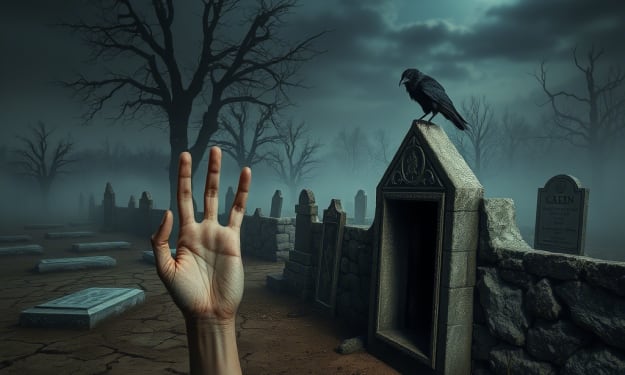
The Hand That Reached From the Grave
The Hand That Reached From the Grave In a quiet village nestled among Pakistan’s ancient hills, there lived an old man named Saeen Murad. Known for his silence and strength, he worked as a grave digger at the local cemetery. For years, he had dug hundreds of graves — without fear, without question. But the day he was asked to prepare a grave beside an old, crumbling wall changed everything. --- The graveyard was older than memory. Some graves had names, others only stones. And in the farthest corner stood a ruined enclosure — once a family tomb, now forgotten. One afternoon, the village cleric asked Saeen Murad to dig a fresh grave for a traveler who had died mysteriously in the mosque. The only space left was near the ruined wall. Murad nodded and began. He struck the earth with his shovel. The soil was unusually hard, dry despite the recent rain. As he dug deeper, he noticed pieces of old bricks mixed with the dirt. Then — the shovel hit something soft. --- He knelt and brushed the dirt away with his hands. It looked like a piece of thick rope at first. But as more soil cleared, it took the shape of a hand — a human hand, decayed but not skeletal, with nails that looked freshly trimmed. Murad froze. The hand wasn’t buried downward — it was reaching outward from inside the grave wall. Before he could think, the fingers twitched. He jumped back, dropping his shovel. His breathing turned sharp. He stared in disbelief as the hand moved again — slow, pained, like waking from a long nightmare. --- He ran to the cleric and gasped, “There’s something alive inside the wall!” Others gathered, skeptical but curious. By the time they returned, the hand was still. Cold. Lifeless again. A younger man dared to touch it. Cold as stone. Yet the hand didn’t look like a relic. It had veins, faint color, and one silver ring on the middle finger — engraved with letters that no one could read. --- The elders whispered. Some said it was a cursed soul, buried alive centuries ago. Others spoke of a sorcerer who had once lived in the village and vanished mysteriously. The cleric decided they would not dig further. “Seal it again,” he ordered. “Some graves are not meant to be disturbed.” Reluctantly, they poured soil back, covering the hand. But Murad couldn’t sleep that night. --- At midnight, he heard knocks — soft but steady — outside his mud-brick home. Three knocks. Silence. Three more. When he opened the door, no one was there. But on the ground… were muddy fingerprints. The same size as the hand in the grave. --- The next day, a boy from the village went missing. Then, a woman claimed to have seen a man with no eyes standing near the cemetery wall at dusk. And then — Murad’s dreams began. Every night, he saw the hand crawling through tunnels underground. It reached toward him, always closer, always hungrier. In the dream, the hand finally gripped his leg. He woke with a bruise on the same spot. --- He returned alone to the grave site. Using a small pick, he quietly chipped at the wall that had hidden the hand. Beneath it, a hollow chamber revealed bones scattered in ritual patterns, symbols etched in ash, and in the center — a corpse sitting upright, its eyes missing, and both hands gone. The corpse's mouth was wide open, as if frozen mid-scream. Murad stumbled back. And the hand… it was no longer in the wall. --- That night, the entire village heard a loud cracking sound from the graveyard. By morning, the ancient wall had collapsed — the chamber exposed. But inside, there were no bones. Just a single note, written in black dust: > “He woke me. You buried me again. Now I walk among you.” --- Murad fell ill. He whispered strange languages in his sleep. He scratched his arms raw, saying “Get the hand off me!” again and again. Then one morning, he disappeared — his bed cold, his footprints leading toward the cemetery. Some say his soul was taken. Others claim he still digs — in a realm between the living and the dead — forever cursed by the hand he should never have uncovered. --- But if you walk near the old wall on moonless nights... you might still see a hand reach out. Waiting for another Murad. Another mistake.
By Noman Afridiabout a year ago in Horror
The Mirror That Refused to Show My Reflection
The Mirror That Refused to Show My Reflection I found the mirror at a yard sale on the outskirts of a small town in Vermont. It wasn’t anything special at first glance—a tall, narrow antique frame with vine-like carvings and a cracked backing. The woman selling it looked too eager to part with it, almost relieved. I thought maybe I was getting a good deal. I was wrong.
By Ali Asad Ullahabout a year ago in Horror
Voices in the Walls
Voices in the Walls Based on true events When my wife and I first moved into the farmhouse, it felt like a dream. A quiet, two-story home just outside of town, surrounded by wheat fields, thick woods, and silence—real silence, the kind you only get far away from the city. It had an old-world charm: squeaky floorboards, crooked shutters, and the smell of wood and dust that only time can create.
By Ali Asad Ullahabout a year ago in Horror
The Whisper Game
Okay, so imagine I’m sitting next to you on a rainy night, and I tell you this: “There’s a game kids in Japan used to play. You summon a ghost by whispering her name. If you do it wrong... she whispers back.” And now, let me tell you what happened to Ami, my friend’s cousin from Osaka. This isn’t just a story. This is a warning. 🎌 The Dare Ami was 14—fun, loud, and always looking for trouble. She lived in Osaka, Japan, and went to a super old all-girls school with a creepy history. One day after class, her friends dared her to play something called The Whisper Game, also known as Kuchisake Hime’s Calling. Here’s how the game works: Go into a school bathroom—specifically, the third stall. Turn off the lights. Say “Kuchisake Hime” three times. Then whisper: “Do you want to play with me?” Wait. If you hear nothing, you’re safe. If you hear whispering back… run. Fast. Sounds silly, right? But every school kid knew the rule: Never answer her back. She wants you to talk. Because once you talk to her... she knows your voice. And once she knows your voice… she can follow it. 🚽 The Third Stall So of course, Ami had to do it. She laughed, grabbed her phone, and went into the old school bathroom after dark. Her friends waited outside, nervous but excited. The school was already empty. The halls were quiet. The air felt thick. Ami walked into the third stall, turned off the lights, and said: “Kuchisake Hime. Kuchisake Hime. Kuchisake Hime.” “Do you want to play with me?” She held her breath. Nothing. She was about to open the door when she heard it— A whisper. Right behind her ear. “Yessssss…” She screamed, ran out, laughing and shaking. Her friends were half-scared, half-impressed. They thought it was just a prank. But later that night, Ami started hearing whispering in her own house. 🏠 The Whisper Follows At first, she thought it was wind. Then she thought maybe it was the TV. But the whispers were always saying her name. “Ami… come play… Ami…” She’d walk past mirrors and see a flash of red cloth. Or she’d hear breathing under her bed. One night, while brushing her teeth, she looked up— And her reflection smiled before she did. Her mom thought she was tired. Told her to get more sleep. But Ami stopped sleeping altogether. She kept her lights on. Played loud music. But the whispering only got louder. Then, on the seventh night… She got a message. On her bedroom mirror. Written in fog, even though it wasn’t cold: "Do you still want to play?" 📖 The Legend Terrified, Ami started researching the legend of Kuchisake Hime—aka the Slit-Mouthed Woman. Hundreds of years ago, she was a woman who wore a red kimono and a white mask. People said she was beautiful—until someone sliced her mouth open from ear to ear. Now, she wanders around asking: “Am I pretty?” If you say yes, she removes her mask and shows her torn face. Then she kills you. But the Whisper Game is a modern version of her curse. It’s how she finds new voices—ones she can copy. Because when you play the game, she hears your voice. Then she whispers it back to trick you. And when you reply? You’re hers. 📸 The Disappearance Ami’s friends thought she was just pretending to be scared. Until she stopped coming to school. Her mom said she barely left her room. She talked less and less. And then— One night, Ami’s bedroom light went off at exactly 2:33 a.m. Her mom ran in. The window was open. The curtains were blowing in the wind. But Ami was gone. No signs of struggle. No footprints. No messages. Just her mirror… …with one word written on it: "Yes." 🧣 Where Is She Now? Some people say she ran away. But her friends? They know the truth. Sometimes when they walk home late at night, they hear soft whispering behind them. Sometimes it says: “Do you want to play?” And if they ever say anything back—anything at all— even a whisper… They start hearing their own name in the shadows. One girl even saw a figure in the reflection of a train window. Wearing a red scarf. The face? Was Ami’s. But her mouth was ripped open. And she was still whispering. ☠️ The Real Rule People say the Whisper Game is banned now in most schools in Japan. Teachers destroy any copies of the instructions. Students whisper about it in secret. But here’s the real rule no one tells you: If you’ve heard about the game… she already knows you. So remember—if you hear a voice late at night calling your name, and it sounds just like you… Don’t answer. Because once you do, You’ll never stop hearing her again.
By Silas Blackwoodabout a year ago in Horror
The Best Horror Books of All Time – The House That Eats You
Okay, sit tight, this is a true what-did-I-just-read kind of horror story. So—there’s this stylish, confident young woman named Noemí Taboada. She lives in Mexico City in the 1950s. Think rich dresses, parties, jazz music—super glamorous, right? One day, her family gets a weird letter from her cousin Catalina, who had married some English guy and moved far away to a creepy house in the mountains called High Place. The letter wasn’t normal. Catalina was rambling, scared, and said things like: “There’s something wrong with the house… It whispers to me… they want to take my body…” Creepy much? Naturally, Noemí’s dad is like, “Go check on her. You’re smart. You don’t take nonsense from anyone.” So Noemí—dressed to the nines and thinking it’ll be a quick visit—heads off into the foggy mountains. And that’s where everything starts going wrong. Welcome to High Place High Place is nothing like her life in the city. It’s a cold, grey, rotting mansion on top of a hill, surrounded by fog, mushrooms, and silence. It feels dead… but like it’s still watching you. The family Catalina married into—the Doyles—are weird. Like, REALLY weird. Virgil (Catalina’s husband) is handsome but creepy. You know that type who smiles too much and stands too close? Florence (the aunt) acts like a strict nun. She has tons of rules. No noise. No late dinners. No talking about the past. Howard (the old man) is the creepiest of them all. Pale, old, and obsessed with eugenics (which is just a fancy, messed-up way of saying he thinks some people are “better” than others). The only semi-normal one is Francis, a shy, sickly guy who likes nature and seems kind—but also kind of trapped. The place smells like rot. There’s mold in the walls. The walls breathe sometimes. Noemí starts getting nightmares almost immediately. And not just spooky dreams. We’re talking full-on visions of blood, gold, worms crawling under skin, and strange people whispering in her ears while she sleeps. The house isn’t just haunted. It’s alive. The House Has a Memory As Noemí tries to help Catalina, she realizes something’s seriously wrong with everyone in this house. Catalina is drugged. The doctor won’t help. And when she tries to leave? Everyone suddenly says Catalina is “too ill” to travel. It’s like the house is holding them hostage. And then—Noemí starts seeing things while she’s awake. She hears walls whispering. She sees visions of the past—people getting murdered, buried, absorbed by the ground. She even sleepwalks into creepy parts of the house she’s never seen before. She asks Francis what’s going on, and that’s when he finally cracks: “The house is made of mushrooms.” Wait. What? Yes. Mushrooms. There’s a type of glowing fungus growing all through the house. Under the floors. Inside the walls. It connects everything—people, memories, even dreams. The Doyles have been breeding it for generations. They’ve used it to live longer. To trap people’s minds. To create visions. It’s like psychic, mind-controlling mold. The house doesn’t just remember the past… it keeps people inside it. Like Catalina. Like Francis. Like maybe soon… Noemí. The Awful Truth You know Howard, the creepy old man? He’s not just some old grandpa. He’s over a hundred years old. Maybe more. He’s using the mushroom’s weird powers to stay alive—by jumping into other people’s bodies. And now, guess who they want next? Noemí. Because she’s strong. Smart. Healthy. The perfect “new vessel.” That’s why they’ve been poisoning her, haunting her, trying to weaken her mind. The house is trying to grow into her. But Noemí is no fool. She fakes being under their spell. She finds a way to talk to Catalina without the family noticing. Together, they make a plan. The Final Escape They find out the main root of the fungus—the source of the Doyles’ power—is beneath the house in a secret cave. It’s ancient. It's pulsing. And in the center lies a corpse— Agnes Doyle—the first woman who discovered the fungus. She’s still alive, sort of. Her body is barely human anymore. But her brain? Still working. The family has been feeding her. Keeping her alive. She’s the reason for all the nightmares. All the pain. All the whispers. So Noemí and Catalina go full final boss fight mode. They burn it. The root. The corpse. The entire house. The fire spreads. The Doyles scream. The fungus dies. And so does the horrible spell holding everything together. Noemí, Catalina, and Francis escape the burning mansion just in time. High Place is gone. Forever. Or so they hope. logue: But What If It’s Not Over? They go back to Mexico City. Catalina starts healing. Francis tries to live a normal life. But Noemí? She dreams about mushrooms sometimes. And once—just once—she hears a whisper in her sleep: “I remember you.”
By Silas Blackwoodabout a year ago in Horror
The Red Eyes at Midnight
“The Red Eyes at Midnight” by Ali Asad Ullah There are moments in life that don’t just haunt your memory—they consume it. For me, it was the red eyes. I saw them when I was sixteen, and I’ve never been the same since. I grew up in a small, remote village surrounded by endless wheat fields and dense forests. Our home was modest, and the nights were so quiet and dark that you could hear your own heartbeat. There were no streetlights, no passing cars, just the thick presence of nature and shadows. And stories. My grandmother, a deeply spiritual woman, used to tell me tales of djinns, cursed places, and the one legend that chilled me the most—the red eyes that appeared at midnight.
By Ali Asad Ullahabout a year ago in Horror
"I Found a Hidden Room in My House"
I Found a Hidden Room in My House I never expected to inherit anything from my great-uncle. He was the kind of relative you heard about only at funerals—quiet, distant, strange. When he passed away in 2022, I received a letter from his lawyer informing me that I’d inherited his house. No explanation, just a key and an address scribbled on thick parchment.
By Ali Asad Ullahabout a year ago in Horror
My Favorite Short Scary Stories
My Favorite Short Scary Stories By: Zoea Marland, Class 12 There’s nothing I enjoy more than a good scary story—the adrenaline rush, the sudden chill down your spine, and that irresistible suspense that makes your heart race. If you know me, you know that I live for eerie tales, especially the kind you share during a late-night sleepover, flashlight in hand and blankets pulled up to your chin.
By Ali Asad Ullahabout a year ago in Horror
Season 2 : The Hollowing: How a Village’s Children Became Vessels for Something Older
Chapter 9: The Child Who Could Not Dream April 6th, 1982 – 3:03 AM The orphanage slept. Every window now blacked out, as though reality itself had stopped reflecting. The clocks had ceased ticking, and in every room .... even in the staff quarters .... mouths twitched silently in shared torment.
By Tales That Breathe at Nightabout a year ago in Horror