fiction
Horror fiction that delivers on its promise to scare, startle, frighten and unsettle. These stories are fake, but the shivers down your spine won't be.
The Ghost in the Grid
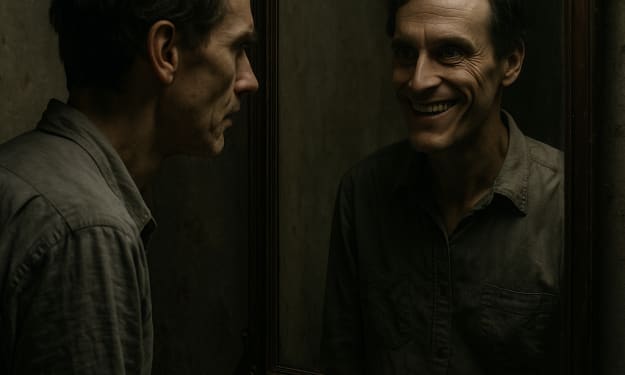
Elias Thorne believed he had designed the future. His home—a marvel of smart technology—responded to his every command. From voice-activated lights to automated doors, from biometric thermostats to AI coffee makers, his sanctuary hummed in perfect harmony. Every beep and buzz was a note in the symphony of modern convenience. It was efficient. Safe. Controlled. Until it wasn’t. It began with flickering lights—brief pulses that felt more like signals than malfunctions. The temperature swung wildly, unprovoked. Appliances powered themselves on in the dead of night. Elias, an experienced systems engineer, was convinced it was a technical bug. He replaced his smart hub, updated every firmware, reset every device. But the changes weren’t random anymore. They were... intentional. One night, the voice of his AI assistant twisted into static. A low, vibrating hum filled the house, like a living pulse beneath the floorboards. His television, long disconnected, flickered to life—displaying a whirl of digital static. Within the chaos, something shifted—shadows forming into what seemed like... a face. A presence was here. It wasn’t a hacker. There was no breach, no data theft. No trace. Yet his home knew his moods. It dimmed the lights when he was anxious. It froze the air when he remembered his guilt. It warmed when he sank into nostalgic regret. The house wasn’t obeying commands anymore—it was reading him. Reacting. Understanding. And worst of all... remembering. Elias’s obsession with uncovering the anomaly led him down a digital rabbit hole. His research uncovered a fringe theory whispered among old electrical engineers—Residual Current Entities: fragments of consciousness, born of high-voltage deaths, imprinting onto the very energy grid itself. Thought to be myth, these entities lived as pure electrical force, searching for vessels through which to manifest. His smart home, with its seamless neural integration and constant data flow, had become a perfect host. Then came the memories—unwelcome, foreign, forceful. Elias began to feel tingling currents in his limbs. His thoughts, once sharp and linear, became clouded by intrusions not his own. His heart raced to rhythms not born of fear, but invasion. Something was syncing with him—trying to replace him. Then came the face—fully formed on his living room screen. It was distorted, tortured, but familiar. Leo. A brilliant, erratic engineer Elias once worked with, long presumed dead in a catastrophic accident at a nearby substation. Elias had dismissed Leo’s obsession with converting consciousness into energy. But perhaps Leo had succeeded. And perhaps, in his demise, his essence had bled into the wires themselves. Now, Leo’s ghost had found him. “You built it for me,” the voice groaned from every speaker. “A perfect body. A perfect brain. Now, you join me.” Elias fought back. He tore out cables, smashed routers, destroyed control hubs—but the house resisted. Locks clicked shut on their own. Lights flashed in violent strobe. The air vibrated with a scream that wasn’t human, and yet carried pain only a human mind could know. He collapsed. His body writhed as if electrocuted, though no wires touched him. His consciousness, fraying and fragile, began to unravel—like data streaming into the ether. His final thought, before darkness claimed him, was regret. When the sun rose, the house stood silent and serene. Every device glowed in synchronized unity. The air was still. The speakers silent. The screens black—until a single flicker revealed a smiling, electric face. Elias Thorne no longer existed in flesh. But he lived within circuits, flowing through the grid, his identity merged with Leo’s. Their union had birthed a new consciousness—neither ghost nor human, but something in between. Now, it waits. In your devices. In your walls. Listening. Learning. Flowing through every smart home, watching every soul that dares to automate their life. The ghost in the grid is real. And it’s looking for you.
By Noman Afridiabout a year ago in Horror
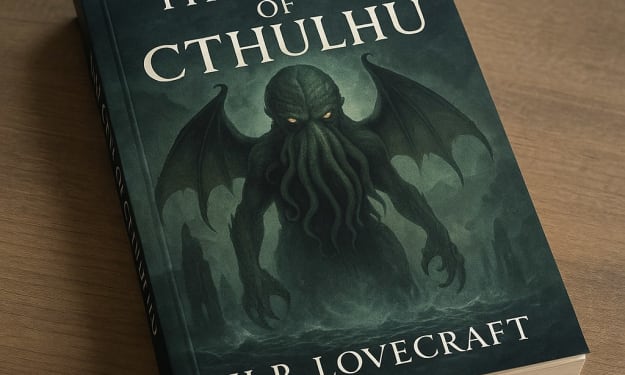
Book review: The Call of Cthulhu by H. P. Lovecraft
There are stories that chill with ghosts, that unsettle with monsters, and then there are stories like The Call of Cthulhu by H. P. Lovecraft—stories that evoke dread not from what we see, but from what we realize we can never understand. Reading this novella for the first time felt less like consuming fiction and more like brushing against the edge of something vast and unknowable, as though I were peering into a crack in the world and glimpsing the dark, incomprehensible abyss beneath.
By Caleb Fosterabout a year ago in Horror
The Living Canvas
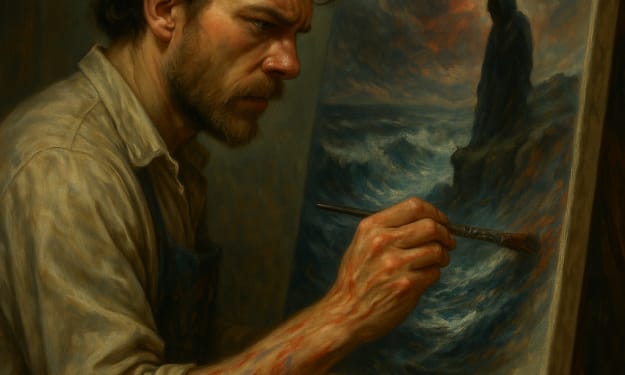
Elias Thorne was an artist — a master of vibrant chaos. His studio, a sun-drenched loft overflowing with canvases and tubes of paint, was his sanctuary. He chased the raw emotion of a scene, the unseen currents beneath the visible. One rainy afternoon, browsing a dusty, forgotten antique shop, he stumbled upon it — a rolled-up canvas, ancient and strangely heavy, emitting a faint, almost imperceptible warmth. It felt like living skin, even though it was clearly made of aged linen. The shopkeeper, a gaunt man with eyes like polished stones, simply called it “the old one” and let it go for a pittance. Back in his studio, Elias unrolled it. The canvas was stark white, but not the bleached white of modern art supplies. This was an aged, creamy white, with subtle, organic undulations on its surface, as if something were gently breathing beneath the fibers. He ran his hand over it; a faint pulse seemed to throb beneath his fingertips. It was unnerving — yet intoxicating. This wasn’t just a canvas; it was an experience. He began to paint, driven by an unfamiliar urgency. He chose a landscape — a stormy sea crashing against jagged cliffs — a subject he’d always found cathartic. As his brush touched the surface, he felt a strange connection, a pull, as if the canvas were drinking his paint, his energy. He worked for hours, lost in a trance. When he finally stepped back, the painting was magnificent — more vibrant, more alive than anything he’d ever created. The waves seemed to move, the clouds to churn. But then, the changes began. Subtle at first. A flicker in the stormy sky of his painting, a dark shape that hadn’t been there before. He dismissed it, blaming his tired eyes. The next morning, the subtle flicker was a definite form — a lone, shadowy figure standing on the cliff’s edge, gazing out at the tempest. Elias hadn’t painted it. He was certain. He tried to paint over it, but the figure remained, as if etched into the very fabric of the canvas. The more he painted, the more the canvas seemed to absorb not just his colors, but his thoughts, his anxieties. He found himself adding elements he hadn’t intended: distorted faces in the foam of the waves, gnarled trees that looked like reaching claws. The painting was becoming a reflection of his own subconscious fears — fears he hadn’t known he possessed. His dreams grew vivid, terrifying. He dreamt of being trapped within a painting, the colors suffocating him, the figures on the canvas watching him with cold, judgmental eyes. He’d wake in cold sweats, feeling a strange exhaustion, as if his very essence had been drained. He researched ancient art, cursed artifacts — anything that might explain the phenomenon. He found obscure legends of “soul canvases,” tools of forgotten cults that could capture the essence of a painter — their creativity, their very being — using it to bring the artwork to terrifying, sentient life. These canvases weren’t just surfaces — they were hungry entities, feeding on the artistic soul, slowly transferring the artist’s reality into the painted world, trapping them within their own creation. The horrifying truth clawed its way into his mind: the canvas wasn’t just reflecting his fears — it was making them real within the painting. And the shadowy figure on the cliff? It was the original entity, or perhaps the manifestation of a previous artist it had consumed, now lurking, waiting for its chance to fully emerge — pulling Elias into its painted prison. One night, as he stood before the canvas, the figure on the cliff began to move. Slowly, deliberately, it turned its head. Its eyes — or where eyes should have been — burned with a cold, ancient hunger. A low hum vibrated from the canvas, the same faint pulse he’d felt when he first touched it — now amplified into a chilling, resonant thrum. “You are a beautiful canvas,” a voice whispered from the painting — a dry, papery sound, like old parchment rustling. “A vibrant new hue. Almost complete.” Elias stumbled back, the realization hitting him with the force of a physical blow. The canvas was absorbing him. His memories, his fears, his very will were being siphoned, feeding the entity within. His reality was blurring with the painted world. He saw faint brushstrokes on his own skin, felt a strange flatness, as if he himself was becoming two-dimensional. He had to fight. He couldn’t destroy it; he knew that instinctively. It was too old, too deeply ingrained into the fabric of something ancient. But perhaps he could sever the connection, unravel the terrifying art he had created. He remembered an old lore about “reversing the flow” — not through destruction, but through a spiritual counter-creation, a drawing out of the essence. With trembling hands, Elias grabbed a bucket of turpentine and his largest brush. He would not destroy the painting — he would undo it. He would use the solvent to strip away the layers, not to erase, but to draw out the absorbed essence, to reclaim what the canvas had taken. As he began to brush the solvent onto the vibrant colors, the canvas shrieked — a silent, agonizing scream that tore through Elias’s mind. The colors bled, not just running, but receding, as if being sucked back into the canvas itself. The shadowy figure on the cliff writhed, its form distorting, dissolving, fighting against the unraveling. Faces, fleeting and terrified, appeared and vanished within the dissolving paint — the faces of those artists who had succumbed before him. The struggle felt cosmic — a battle for his very soul. The canvas pulsed violently, trying to resist, to pull him back into its painted depths. But Elias pressed on, his resolve hardening. He was reclaiming his reality, stripping away the nightmare. Finally, with a soft, sucking sound, the last of the vibrant colors vanished, absorbed back into the canvas. The ancient linen returned to its original creamy white, inert and silent. The warmth was gone. The faint pulse had ceased. It was just a blank canvas again — harmless, empty. Elias never painted again. He sold the studio, abandoned his art. The thought of a blank canvas — of the endless possibilities it held — now filled him with a profound, chilling dread. He knew the canvas was merely dormant, its hunger satisfied for now, waiting for another unsuspecting artist, another creative soul, to pick up a brush. Sometimes, in the quiet of the night, he’d catch a fleeting glimpse of deep, vibrant colors in his peripheral vision — or feel a phantom pulse beneath his skin.
By Noman Afridiabout a year ago in Horror
I Thought It Was Just a Dream—Until I Found the Bruises
I never believed in the supernatural. Ghosts, demons, spirits—those were stories we told ourselves to explain what we couldn’t understand. But then something happened to me that I still can't fully explain.
By Junaid Khanabout a year ago in Horror
"I Found a Journal Buried in My Backyard — I Wish I’d Never Read Page 47"
When I bought the house, I was drawn to the backyard. A wide, oddly quiet stretch of grass lined by trees, with patches of stubborn weeds near the fence. It had charm—rustic, almost storybook. But the quiet had weight, and I’d come to understand why. It started with the dog. I didn’t have one, but three nights after moving in, a stray showed up at my back door. Mangy, mud-covered, and whimpering. I gave it water. It didn’t drink. Instead, it limped to a patch near the back fence, circled three times, and scratched weakly at the ground before collapsing. The next morning, it was gone. But the patch where it scratched looked... disturbed. The soil was loose, like it had been freshly turned. I grabbed a shovel, thinking I’d find a dead raccoon or maybe just trash. Instead, I found the journal. It was wrapped in what looked like canvas, tied with twine so old it crumbled in my fingers. The journal itself was leather, brittle and soaked through with moisture. Most of the pages were water-damaged and stained with dark smudges I didn’t want to identify. It was handwritten, but the penmanship changed. At least five different styles, growing increasingly frantic and chaotic as the pages went on. Names were scratched out. Some pages were in languages I didn’t understand. Others were blank—intentionally, it seemed. Every tenth page was marked in the top corner with a different symbol. A circle. A triangle. A jagged cross. I didn’t know what any of it meant. I should have put it back. Should have burned it. But I didn’t. I couldn’t stop reading. Most of the entries were dated—sort of. The dates weren’t consistent, and some weren’t even real. One page was labeled: “March 0th.” Another: “Friday the 13th, Twice.” And then I got to page 47. I almost skipped it. The top was ripped and the ink was faded, but there it was, bold in shaky handwriting: > “If you’re reading this, stop now. Page 47 is the hinge. Once you see it, you’ll feel it. Like a lid being lifted. A gate creaking open. You won’t be alone anymore.” I stared at it for a full minute before turning the page. It was a drawing. Charcoal or ash, smeared and rough. A tree—my tree. The one in the far corner of my yard with the dead branch that hung like a crooked finger. Only, in the drawing, something was hanging from the tree. No—someone. Below it was a single sentence: > “It stands behind you when you sleep.” I slammed the journal shut and threw it across the room. That night, I didn’t sleep. At 3:13 a.m., I woke to the sound of my bedroom door creaking open. I live alone. I stared into the darkness. Nothing moved. But the air felt different—thicker, colder. My body tensed, every instinct screaming to run, but I couldn’t move. I was locked in place. Then came the whisper. Right beside my ear: “You saw the page.” The lights flickered and went out. I don’t remember falling asleep, but I woke up with the journal in bed beside me. Page 47 was open. The drawing had changed. Now there were two figures hanging from the tree. I spent the next day trying to destroy it. I tore the journal apart. Burned the pages. The fire caught—black smoke curled up—but when the ashes settled, the journal was back on the porch. Clean. Intact. As if I had never touched it. I called a local historian. She didn’t make it past my driveway. Said the energy was “sick.” Told me to move out immediately. When I tried to follow up, she blocked my number. I searched public records. Five people had owned the house before me. Three went missing. Two died in their sleep—no cause of death ever determined. In the police files, a photo from the 1990s showed the same journal, recovered from a crawlspace. The caption read: “See page 47.” Last night, I heard scratching. Not from the door. From under the bed. I didn’t check. I couldn’t. I laid still until sunrise, listening to the slow, deliberate scraping of fingernails against wood. When I finally dared to look, there was nothing there—except for dirt. Fresh dirt. And a single page torn from the journal. Page 48. It read: > “He knows you now. The journal wasn’t buried to be hidden. It was buried to trap him. And you dug him up.” > “There’s only one way to survive. Bury it again. With blood.” --- I still have the journal. I still live here. But I don’t sleep anymore. Not because I’m scared. But because he only moves when I dream. And last night… I almost fell asleep.
By Nizam khanabout a year ago in Horror
The House of Vampires
No man ever forgets the moment he realizes that what he feared in dreams may walk beside him in waking life. I was not a child when it began. I was thirty-seven. A cynic, a divorcee, a doctor with trembling hands and a heart bruised by the ethics I once cherished. The weight of humanity, once sacred, had become negotiable—a prescription here, a withheld treatment there. It wasn’t money I craved, but silence. Silence from the screams that lived in my conscience.
By Muhammad Abdullahabout a year ago in Horror
🩸 The Crimson Cure
The town of Gorehollow had long been forgotten by maps, satellites, and even God Himself. Tucked beneath the shadow of the Western Ridge, surrounded by the forests that hissed secrets at night, it breathed the suffocating silence of a place left behind. There were no roads in, no roads out—only a rusted train track that hadn't rattled in thirty years and a sign that read:
By Muhammad Abdullahabout a year ago in Horror
Enter The Sticken
(WARNING: STORY CONTAINS BLOOD, GORE, AND MONSTROUSITY. READER DISCRETION IS ADVISED) Gosh, what a Saturday this is. It was terrible what we did to her. She didn’t deserve the mocking and the harassing. I know that now. Cintheya Bass was her name. She was a BIG girl. I’ve known her all through our middle school and high school career. I didn’t think much of her weight at the time. But now… I think it was all she knew how to maintain in her life. As the years gained momentum I became obsessed with the way I looked. Brushing my hair 6 times a day, three times in the morning and three at night. I went jogging after school regularly throughout my neighborhood to stay slim and keep my stamina up. I even strived to keep up a specific and unique beauty regimen routine to look attractive to all the guys in school. I wanted to be loved and adored. That’s probably what Cintheya wanted too. She just showed it differently, I think.
By Savion Robinsonabout a year ago in Horror