fiction
Horror fiction that delivers on its promise to scare, startle, frighten and unsettle. These stories are fake, but the shivers down your spine won't be.
The House That Remembers
The old Whitmore house had been abandoned for decades, its windows boarded and gardens overrun with ivy. Cracked stone steps led to a warped wooden door, and the chimney stood like a sentinel against the gray Eldridge sky. Locals had long avoided the place, speaking of it only in hushed tones. They said the house had a memory. That it never forgave.
By Danyal Hashmiabout a year ago in Horror
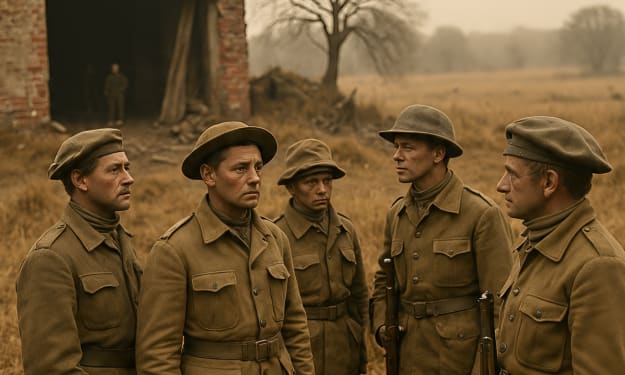
World War I: The Great War That Redrew the World
World War I, often called the Great War, was unlike any conflict the world had ever seen before. Beginning in 1914 and lasting until 1918, it involved the major powers of the world and forever altered the political, social, and cultural landscape of the 20th century. The war’s causes were complex, but the spark that ignited this devastating conflict was a single, tragic event — the assassination of Archduke Franz Ferdinand of Austria-Hungary. What followed was a brutal, global struggle that would lead to the collapse of empires, the birth of new nations, and lay the groundwork for the second great war just decades later. The Web of Alliances and Rising Tensions Europe at the start of the 20th century was a continent bristling with tension. Powerful empires — the Austro-Hungarian, German, Russian, and Ottoman Empires — vied for influence and territory. Nationalism, imperial ambitions, and military build-ups created an unstable environment. Countries formed complicated alliances designed to protect each other if war broke out. Two major groups had emerged by 1914: The Allied Powers, led by France, the United Kingdom, and Russia. The Central Powers, led by Germany, Austria-Hungary, and the Ottoman Empire. Italy, initially neutral, would later join the Allies, while the United States remained neutral until 1917. The Spark: Assassination of Archduke Franz Ferdinand On June 28, 1914, Archduke Franz Ferdinand, heir to the Austro-Hungarian throne, was assassinated in Sarajevo by Gavrilo Princip, a Bosnian Serb nationalist. This single act sent shockwaves across Europe. Austria-Hungary, blaming Serbia, issued an ultimatum with harsh demands. When Serbia’s response failed to satisfy Austria-Hungary, war was declared. Due to the tangled system of alliances, what might have been a localized conflict escalated rapidly. Within weeks, Germany declared war on Russia and France, and Britain declared war on Germany. The world was at war. The Horrors of Trench Warfare The Western Front — stretching across Belgium and northern France — soon turned into a deadly stalemate. Both sides dug in, creating a vast network of trenches that became home to millions of soldiers. The conditions were horrific: mud, rats, disease, constant shelling, and the ever-present threat of death. Battles such as the Somme and Verdun epitomized the brutality, with hundreds of thousands of casualties on both sides for gains of mere miles. Technology and the Changing Face of War World War I was the first “modern” war, using advanced technology that increased the scale of destruction: Machine guns made mass infantry charges deadly. Poison gas, introduced by the Germans, caused agonizing injuries. Tanks debuted to try breaking the trench stalemate. Airplanes were used for reconnaissance and combat. Submarines (U-boats) threatened naval dominance and supply lines. These innovations changed warfare forever but came at an enormous human cost. The Eastern Front and Other Theaters While the Western Front grabbed much attention, fierce fighting also occurred in Eastern Europe, where Russia faced off against Germany and Austria-Hungary. The Russian army suffered devastating losses, and by 1917, internal unrest led to the Russian Revolution and Russia’s withdrawal from the war. In the Middle East, the Ottoman Empire fought the Allies, with battles like Gallipoli becoming legendary for courage and sacrifice. The United States Enters the War Initially, the United States stayed neutral, eager to avoid European conflicts. However, unrestricted submarine warfare by Germany, which sank civilian ships including those with American passengers, and the revelation of the Zimmerman Telegram — in which Germany encouraged Mexico to attack the U.S. — pushed America to join the Allies in 1917. American involvement provided a critical boost in manpower and resources, helping to tip the balance. The War Ends and Its Aftermath By late 1918, the Central Powers were exhausted. Germany faced economic hardship, food shortages, and growing unrest at home. Allied offensives pushed the German forces back, and on November 11, 1918, an armistice was signed, bringing an end to the fighting. The Treaty of Versailles, signed in 1919, formally ended the war but imposed harsh penalties on Germany, including massive reparations, territorial losses, and military restrictions. These terms sowed seeds of resentment and economic hardship, setting the stage for World War II. The Legacy of World War I World War I was a turning point in history. It led to the collapse of several empires — Austro-Hungarian, Ottoman, Russian, and German — and redrew borders across Europe and the Middle East. New countries emerged, and nationalist movements gained momentum. The human cost was staggering — more than 16 million deaths and millions more wounded. Societies grappled with grief and the psychological scars of war, while veterans returned to a world forever changed. The war also spurred social and political changes, including shifts in gender roles as women took on new roles during the conflict. Conclusion: Remembering the Great War World War I’s profound impact is still felt today. It was a conflict that reshaped nations and defined the modern era. The lessons of the Great War — the devastating cost of nationalism, the dangers of entangled alliances, and the horrors of modern warfare — continue to remind us of the importance of peace and diplomacy.
By Ismail khan about a year ago in Horror
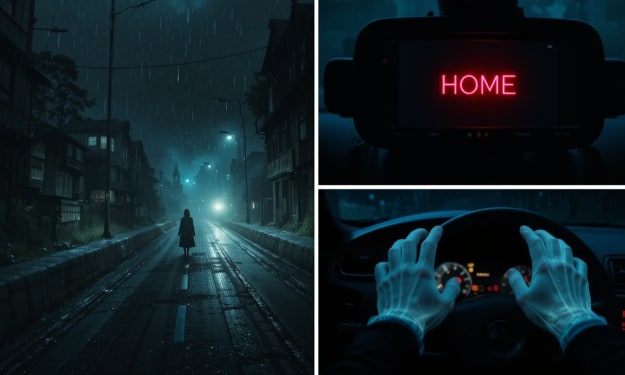
My Mother’s Voice Is in My GPS
My Mother’s Voice Is in My GPS I’d had the new navigation system installed because the old one had started glitching. It was nothing serious—just delays, the occasional frozen screen—but after my mother passed away three months ago, I wanted everything in my life to be as smooth as possible. Grief makes you impatient with little frustrations.
By waseem khanabout a year ago in Horror
Skin of the City
Skin of the City Cities have skin. You might not notice it at first, but if you walk long enough, if you let the streets breathe against you, you’ll feel it. It’s in the cracked paint of forgotten doorways, the sunburned billboards, the graffitied brick walls that wear stories like tattoos. The city’s skin is never still it sweats in the summer heat, shivers under winter’s frost, and peels when the seasons change.
By James Williamabout a year ago in Horror
The Library of Unwritten Streams
Sasha had been streaming on Twitch for two years, with little to show for it besides a few loyal followers and a collection of half-finished playthroughs. So when a new user, “Archivist_00,” dropped into her chat one night and whispered, “You’ve been invited to The Library,” she assumed it was a joke. But the link they posted led to a login page that looked oddly like Twitch—except the logo was a black book instead of a purple chat bubble. Against her better judgment, she clicked.
By Musawir Shahabout a year ago in Horror
"The Last Shift — 15 Minutes of Pure Terror (True-Style Horror Story)"
It was a stormy Friday night when Daniel locked up the small convenience store on the edge of town. The place always felt different after dark—too quiet, too empty, like the walls were listening.
By Naimat ullahabout a year ago in Horror
When the Mirror Forgets Your Face
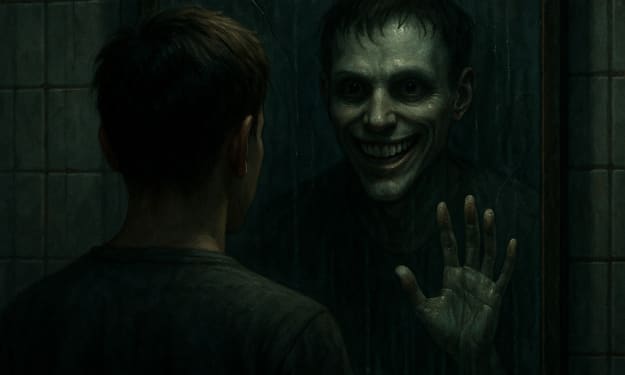
The first time the mirror forgot me, I thought it was a trick of the light. I’d come home from a long shift at the bookstore, my hair damp from a sudden autumn storm, my bones carrying the heaviness of rain. The apartment was dark except for the faint orange streetlight bleeding through the kitchen blinds. I didn’t bother turning anything on—just headed to the bathroom, kicked the door shut, and reached for the sink. When I looked up, the glass didn’t show me. No faint outline. No glint in the eye. Just a depthless, solid black. I leaned closer, waiting for the hall light to catch the curve of my cheek or the shine of my wet hair. Instead, the darkness moved. It rippled, as though the mirror’s surface was water and something beneath it had stirred. A pale blur emerged—not a face, exactly, but something that could be mistaken for one in the wrong light. My chest tightened. The bathroom light snapped on with a pop as I hit the switch. My reflection returned instantly, blinking back at me, lips parted in the same half-terrified way. I told myself I’d imagined it. That I’d been staring too long into shadows and given them permission to become something else. --- The second time was worse. Two nights later, I caught the thing smiling at me from inside the glass. It wasn’t my smile. I was brushing my teeth, watching my own hands work automatically, when the reflection hesitated. Just a flicker—barely a second. My mouth on the other side of the mirror twitched upward in a slow, crooked grin, even though I was standing still. I dropped the toothbrush. The grin widened, too wide, until the lips looked ready to split. And then it stopped, returning to perfect mimicry, as if nothing had happened. That night, I covered the mirror with an old sheet. --- Three days later, I woke to a dripping sound. It was steady and deliberate, like the kind of leaky faucet that waits until the house is silent to announce itself. I padded barefoot to the bathroom. The sheet was gone. The mirror stood uncovered, its edges beaded with moisture that trickled down to the sink. The air smelled like pond water—stagnant, metallic. Something was pressing against the inside of the glass. It was a hand—skin white and wrinkled, nails cracked and rimmed in black. It left long, wet streaks as it dragged its fingers down, slow enough that I could hear the squeak of skin on glass. My breath fogged the surface. I don’t know why I spoke, but I did. “What are you?” The glass pulsed, a ripple radiating outward as though my words had been dropped into it like a stone. And then the thing leaned closer, until only the faint blur of its face filled the mirror. Its features were wrong—soft where they should be sharp, blurred where they should be clear. I could barely make out the eyes, but I knew they were fixed on me. Its mouth moved. The sound came from mine. “You were supposed to be me.” --- I woke on the bathroom floor. The mirror was dry, reflecting only my own wide-eyed face. But the smell of pond water clung to the air, and my skin prickled with the memory of cold glass. I should have smashed it then. Instead, I left the bathroom and closed the door. The next morning, the mirror was gone. Not broken. Not stolen. Gone. The wall where it had hung was bare plaster, smooth and unblemished, as if no mirror had ever been there. I tried to breathe, to convince myself it was over. But that night, I caught my reflection in the dark screen of my television—and it didn’t blink when I did. --- Now, every reflective surface feels wrong. The back of a spoon shows my mouth moving half a beat late. My phone’s selfie camera sometimes freezes while I’m still smiling, holding an expression I’m no longer making. Storefront windows flicker with shapes standing just behind my shoulder. I don’t know what the thing is. I don’t know if it’s one thing or many. I only know it’s watching, learning, practicing. And I think—no, I’m sure—it’s getting better at being me. If you ever notice your reflection acting strangely, look away. Don’t let it know you’ve seen the difference. Because once it realizes you’ve noticed… …it will try to take your place.
By Sahir E Shafqatabout a year ago in Horror
The Day I Quit My Job Without a Plan
I didn’t plan it. I didn’t even think about it for more than a few seconds. One moment I was staring at my computer screen, pretending to work, and the next, I was typing my resignation letter. No job offer waiting, no backup plan, no neat little safety net — just a sudden, unshakable certainty that I couldn’t stay another day. Some choices are made with careful strategy. This one was made with a pounding heart and sweaty palms.
By Enric Millyabout a year ago in Horror
The House That Remembers
The House That Remembers When Claire’s grandmother died, she left her an old Victorian house on the edge of town — the kind of place that made strangers stop and stare. Faded blue shutters, tall arched windows, a wraparound porch that creaked with every step.
By Muhammad aliabout a year ago in Horror