book reviews
Book reviews for horror fans; weather a sleepless night with literary accounts of hauntings, possessions, zombies, vampires and beyond.
The Ghost in the Grid
Elias Thorne believed he had designed the future. His home—a marvel of smart technology—responded to his every command. From voice-activated lights to automated doors, from biometric thermostats to AI coffee makers, his sanctuary hummed in perfect harmony. Every beep and buzz was a note in the symphony of modern convenience. It was efficient. Safe. Controlled. Until it wasn’t. It began with flickering lights—brief pulses that felt more like signals than malfunctions. The temperature swung wildly, unprovoked. Appliances powered themselves on in the dead of night. Elias, an experienced systems engineer, was convinced it was a technical bug. He replaced his smart hub, updated every firmware, reset every device. But the changes weren’t random anymore. They were... intentional. One night, the voice of his AI assistant twisted into static. A low, vibrating hum filled the house, like a living pulse beneath the floorboards. His television, long disconnected, flickered to life—displaying a whirl of digital static. Within the chaos, something shifted—shadows forming into what seemed like... a face. A presence was here. It wasn’t a hacker. There was no breach, no data theft. No trace. Yet his home knew his moods. It dimmed the lights when he was anxious. It froze the air when he remembered his guilt. It warmed when he sank into nostalgic regret. The house wasn’t obeying commands anymore—it was reading him. Reacting. Understanding. And worst of all... remembering. Elias’s obsession with uncovering the anomaly led him down a digital rabbit hole. His research uncovered a fringe theory whispered among old electrical engineers—Residual Current Entities: fragments of consciousness, born of high-voltage deaths, imprinting onto the very energy grid itself. Thought to be myth, these entities lived as pure electrical force, searching for vessels through which to manifest. His smart home, with its seamless neural integration and constant data flow, had become a perfect host. Then came the memories—unwelcome, foreign, forceful. Elias began to feel tingling currents in his limbs. His thoughts, once sharp and linear, became clouded by intrusions not his own. His heart raced to rhythms not born of fear, but invasion. Something was syncing with him—trying to replace him. Then came the face—fully formed on his living room screen. It was distorted, tortured, but familiar. Leo. A brilliant, erratic engineer Elias once worked with, long presumed dead in a catastrophic accident at a nearby substation. Elias had dismissed Leo’s obsession with converting consciousness into energy. But perhaps Leo had succeeded. And perhaps, in his demise, his essence had bled into the wires themselves. Now, Leo’s ghost had found him. “You built it for me,” the voice groaned from every speaker. “A perfect body. A perfect brain. Now, you join me.” Elias fought back. He tore out cables, smashed routers, destroyed control hubs—but the house resisted. Locks clicked shut on their own. Lights flashed in violent strobe. The air vibrated with a scream that wasn’t human, and yet carried pain only a human mind could know. He collapsed. His body writhed as if electrocuted, though no wires touched him. His consciousness, fraying and fragile, began to unravel—like data streaming into the ether. His final thought, before darkness claimed him, was regret. When the sun rose, the house stood silent and serene. Every device glowed in synchronized unity. The air was still. The speakers silent. The screens black—until a single flicker revealed a smiling, electric face. Elias Thorne no longer existed in flesh. But he lived within circuits, flowing through the grid, his identity merged with Leo’s. Their union had birthed a new consciousness—neither ghost nor human, but something in between. Now, it waits. In your devices. In your walls. Listening. Learning. Flowing through every smart home, watching every soul that dares to automate their life. The ghost in the grid is real. And it’s looking for you.
By Noman Afridiabout a year ago in Horror
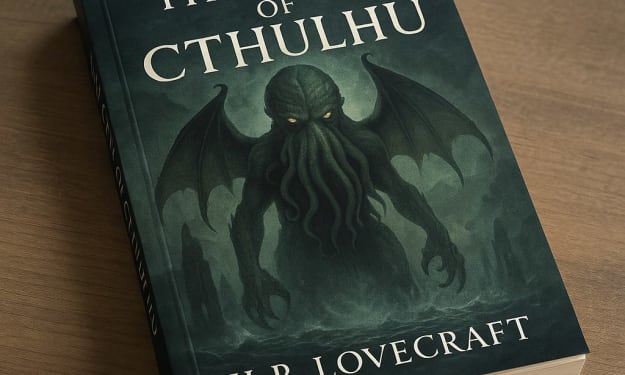
Book review: The Call of Cthulhu by H. P. Lovecraft
There are stories that chill with ghosts, that unsettle with monsters, and then there are stories like The Call of Cthulhu by H. P. Lovecraft—stories that evoke dread not from what we see, but from what we realize we can never understand. Reading this novella for the first time felt less like consuming fiction and more like brushing against the edge of something vast and unknowable, as though I were peering into a crack in the world and glimpsing the dark, incomprehensible abyss beneath.
By Caleb Fosterabout a year ago in Horror
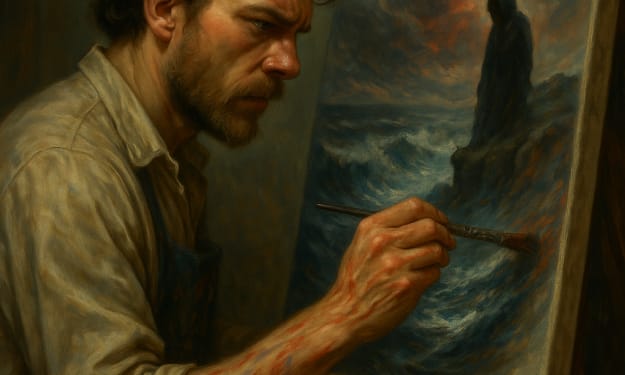
The Living Canvas
Elias Thorne was an artist — a master of vibrant chaos. His studio, a sun-drenched loft overflowing with canvases and tubes of paint, was his sanctuary. He chased the raw emotion of a scene, the unseen currents beneath the visible. One rainy afternoon, browsing a dusty, forgotten antique shop, he stumbled upon it — a rolled-up canvas, ancient and strangely heavy, emitting a faint, almost imperceptible warmth. It felt like living skin, even though it was clearly made of aged linen. The shopkeeper, a gaunt man with eyes like polished stones, simply called it “the old one” and let it go for a pittance. Back in his studio, Elias unrolled it. The canvas was stark white, but not the bleached white of modern art supplies. This was an aged, creamy white, with subtle, organic undulations on its surface, as if something were gently breathing beneath the fibers. He ran his hand over it; a faint pulse seemed to throb beneath his fingertips. It was unnerving — yet intoxicating. This wasn’t just a canvas; it was an experience. He began to paint, driven by an unfamiliar urgency. He chose a landscape — a stormy sea crashing against jagged cliffs — a subject he’d always found cathartic. As his brush touched the surface, he felt a strange connection, a pull, as if the canvas were drinking his paint, his energy. He worked for hours, lost in a trance. When he finally stepped back, the painting was magnificent — more vibrant, more alive than anything he’d ever created. The waves seemed to move, the clouds to churn. But then, the changes began. Subtle at first. A flicker in the stormy sky of his painting, a dark shape that hadn’t been there before. He dismissed it, blaming his tired eyes. The next morning, the subtle flicker was a definite form — a lone, shadowy figure standing on the cliff’s edge, gazing out at the tempest. Elias hadn’t painted it. He was certain. He tried to paint over it, but the figure remained, as if etched into the very fabric of the canvas. The more he painted, the more the canvas seemed to absorb not just his colors, but his thoughts, his anxieties. He found himself adding elements he hadn’t intended: distorted faces in the foam of the waves, gnarled trees that looked like reaching claws. The painting was becoming a reflection of his own subconscious fears — fears he hadn’t known he possessed. His dreams grew vivid, terrifying. He dreamt of being trapped within a painting, the colors suffocating him, the figures on the canvas watching him with cold, judgmental eyes. He’d wake in cold sweats, feeling a strange exhaustion, as if his very essence had been drained. He researched ancient art, cursed artifacts — anything that might explain the phenomenon. He found obscure legends of “soul canvases,” tools of forgotten cults that could capture the essence of a painter — their creativity, their very being — using it to bring the artwork to terrifying, sentient life. These canvases weren’t just surfaces — they were hungry entities, feeding on the artistic soul, slowly transferring the artist’s reality into the painted world, trapping them within their own creation. The horrifying truth clawed its way into his mind: the canvas wasn’t just reflecting his fears — it was making them real within the painting. And the shadowy figure on the cliff? It was the original entity, or perhaps the manifestation of a previous artist it had consumed, now lurking, waiting for its chance to fully emerge — pulling Elias into its painted prison. One night, as he stood before the canvas, the figure on the cliff began to move. Slowly, deliberately, it turned its head. Its eyes — or where eyes should have been — burned with a cold, ancient hunger. A low hum vibrated from the canvas, the same faint pulse he’d felt when he first touched it — now amplified into a chilling, resonant thrum. “You are a beautiful canvas,” a voice whispered from the painting — a dry, papery sound, like old parchment rustling. “A vibrant new hue. Almost complete.” Elias stumbled back, the realization hitting him with the force of a physical blow. The canvas was absorbing him. His memories, his fears, his very will were being siphoned, feeding the entity within. His reality was blurring with the painted world. He saw faint brushstrokes on his own skin, felt a strange flatness, as if he himself was becoming two-dimensional. He had to fight. He couldn’t destroy it; he knew that instinctively. It was too old, too deeply ingrained into the fabric of something ancient. But perhaps he could sever the connection, unravel the terrifying art he had created. He remembered an old lore about “reversing the flow” — not through destruction, but through a spiritual counter-creation, a drawing out of the essence. With trembling hands, Elias grabbed a bucket of turpentine and his largest brush. He would not destroy the painting — he would undo it. He would use the solvent to strip away the layers, not to erase, but to draw out the absorbed essence, to reclaim what the canvas had taken. As he began to brush the solvent onto the vibrant colors, the canvas shrieked — a silent, agonizing scream that tore through Elias’s mind. The colors bled, not just running, but receding, as if being sucked back into the canvas itself. The shadowy figure on the cliff writhed, its form distorting, dissolving, fighting against the unraveling. Faces, fleeting and terrified, appeared and vanished within the dissolving paint — the faces of those artists who had succumbed before him. The struggle felt cosmic — a battle for his very soul. The canvas pulsed violently, trying to resist, to pull him back into its painted depths. But Elias pressed on, his resolve hardening. He was reclaiming his reality, stripping away the nightmare. Finally, with a soft, sucking sound, the last of the vibrant colors vanished, absorbed back into the canvas. The ancient linen returned to its original creamy white, inert and silent. The warmth was gone. The faint pulse had ceased. It was just a blank canvas again — harmless, empty. Elias never painted again. He sold the studio, abandoned his art. The thought of a blank canvas — of the endless possibilities it held — now filled him with a profound, chilling dread. He knew the canvas was merely dormant, its hunger satisfied for now, waiting for another unsuspecting artist, another creative soul, to pick up a brush. Sometimes, in the quiet of the night, he’d catch a fleeting glimpse of deep, vibrant colors in his peripheral vision — or feel a phantom pulse beneath his skin.
By Noman Afridiabout a year ago in Horror
The Echo of the Unsent
The phone was a steal. Not the latest model, but a pristine, unlocked iPhone X. I snagged it for a song from a pawn shop downtown, thinking I’d finally upgrade from my cracked relic. It felt good in my hand, smooth and familiar. A clean slate, I thought. I was dead wrong. It started subtly, as these things always do. A phantom notification buzz in my pocket, even when no message arrived. Dismissible at first, just a quirk of a used device. But then came the messages. They’d pop up on my screen, not as new texts, but as unsent drafts in my messaging app. Brief, fragmented, always from an unknown sender. The first one was just a string of emojis: a broken heart, a weeping face, a black cloud. I’d delete it, only for it to reappear hours later. Then came the words: "He left... alone." Another, "Can't breathe… so cold." I figured it was a data glitch, some lingering cache from the previous owner. Maybe a prank. But the messages became more frequent, more vivid. They weren't just random words; they were raw, unfiltered bursts of emotion. Fear. Despair. A profound sense of abandonment. I tried factory resetting the phone. Wiped everything. Still, the unsent messages resurfaced, stubbornly clinging to the digital ether of the device. Then, the photos. My camera roll started showing images I hadn’t taken. Dark, blurry shots of unfamiliar rooms, distorted reflections in glass, and once, a fleeting glimpse of a pale, terrified face looking directly into the lens. These weren't photos I'd ever seen before, yet they were marked with timestamps from my phone, taken in the dead of night, while the phone lay dormant on my nightstand. A cold dread began to creep in. This wasn't a bug. This was a digital echo. The previous owner’s last, desperate communications, forever trapped within the phone, unable to be sent, yet refusing to be deleted. And they were trying to tell me something. I began to research. The pawn shop owner was tight-lipped about the phone’s origin, just muttering about "a quick sale, no questions asked." I found a Reddit thread, buried deep in a forgotten corner of the internet, about "ghost data" – digital remnants clinging to devices, sometimes manifesting in strange ways. But nothing as specific, as personal, as this. The messages continued, forming a fragmented narrative. "He took it... the research..." "They won't believe me... trapped here..." "It's not human... the hum..." The language was frantic, the tone increasingly terrified. The photos became clearer too, revealing glimpses of a cluttered apartment, strange electronic equipment, and always, in the periphery, a deep, unsettling darkness. I realized with a chilling certainty: the previous owner hadn't just used this phone; they had poured their final, terrifying moments into it. Their last confession. Their last cry for help. And they hadn't disappeared; they had been "taken," as the messages hinted, perhaps by whatever "He" was, or the "hum." The real terror began when the unsent messages started appearing on my own accounts. A draft email in my personal inbox, not from me, but eerily echoing the previous owner's despair. A fragmented message in my social media DMs, written in my style, but detailing a fear I hadn't voiced, a secret I hadn't admitted. The digital echo wasn't just confined to the phone anymore; it was spreading, hijacking my own online presence, weaving itself into my digital identity. It was as if the entity, or whatever had claimed the previous owner, was now using my digital footprint as its next vessel. It wasn't just receiving messages; it was sending them, using me as a conduit. Panic flared. I had to stop it. This wasn't a ghost haunting a house; it was a digital entity haunting my life, threatening to expose my deepest fears, to turn my own online presence against me. The unsent messages weren't just cries for help; they were a warning. And now, a threat. I started a desperate digital exorcism. I unplugged everything, severed all connections. I bought a Faraday cage, wrapping the phone in layers of aluminum foil and copper mesh, hoping to block whatever signal or resonance it was emitting. I went offline, cutting myself off from the digital world that had become so terrifyingly porous. The silence was deafening. No phantom buzzes. No unsent messages. For days, I felt a fragile sense of victory. But then, one night, alone in my dark room, I saw it. My laptop, which had been off and unplugged, flickered to life. The screen glowed faintly, and on it, a single, blank messaging app. And in the draft field, appearing word by agonizing word, was a new unsent message. My own words. A secret thought I had never dared to voice, a deep, buried fear. And beneath it, a new line, chillingly familiar: "He knows you know. He's here." The previous owner hadn't been fully consumed. A fragment of their consciousness, perhaps, had tried to warn me, had become an unwilling accomplice to whatever entity had transcended the digital realm. And now, by taking their phone, I had inherited their burden, their ghost in the machine. I never fully recovered. I destroyed the phone, smashed it to pieces, but the chilling knowledge remained. The digital world was not just a network of information; it was a fabric, and somewhere, within its vast, unseen threads, something could still be lurking, something that could read your unsent messages, something that could step out of the screen and claim you. I still avoid old electronics, and every time my phone buzzes unexpectedly, I feel a cold dread. Because I know that some messages are never truly deleted, and some echoes, once heard, can never be silenced.
By Noman Afridiabout a year ago in Horror
Night Teeth: Volume IV
The Bloody Evolution of a Cult Vampire Saga The Night Teeth series has carved its name into the modern vampire genre with its sleek visuals, neon-noir aesthetic, and high-octane action. Now, with Volume IV, the franchise takes a darker, deeper dive into its mythos—blending urban horror, crime thriller elements, and a fresh wave of undead intrigue. This article explores everything we know (and theorize) about Night Teeth: Volume IV, from its plot leaks, returning characters, stylistic shifts, and how it fits into the growing vampire renaissance in film and TV. • What Is Night Teeth? A Quick Recap
By Silas Blackwoodabout a year ago in Horror
Best Horror Books 2025 - The Library of Lost Flesh
Deep within the labyrinthine vaults of esoteric lore and medical oddities lies a concept both grotesque and mesmerizing—The Library of Lost Flesh. This mythical (or perhaps horrifyingly real) archive is said to house the physical remains of forgotten souls, preserved specimens of extinct diseases, and the anatomical curiosities of those erased from history.
By Silas Blackwoodabout a year ago in Horror
The Voynich Manuscript
Introduction The Voynich Manuscript is one of the most enigmatic documents ever discovered—a 240-page book filled with bizarre illustrations, unknown plant species, and an undeciphered script that has baffled cryptographers, linguists, and historians for over a century. Named after the Polish book dealer Wilfrid Voynich, who acquired it in 1912, this medieval manuscript has resisted all attempts at translation, earning it the title of "the world's most mysterious book." Is it an alchemical treatise, an elaborate hoax, or a lost language? Despite advances in artificial intelligence and codebreaking, the Voynich Manuscript remains an unsolved puzzle. This article explores its history, contents, major theories, and ongoing efforts to crack its secrets. 1. Discovery & Provenance: Where Did the Manuscript Come From? A. Early History (15th–17th Century) Carbon-dated to between 1404–1438 (early 15th century). First confirmed owner: Emperor Rudolf II of Bohemia (1552–1612), who allegedly purchased it for 600 gold ducats, believing it was the work of Roger Bacon, a 13th-century Franciscan friar and alchemist. Later passed through the hands of alchemists, Jesuits, and rare book collectors. B. Wilfrid Voynich’s Acquisition (1912) Polish book dealer Wilfrid Voynich found it in a Jesuit library in Italy. He spent years trying to decode it, publicizing it as a "lost scientific work." After his death, it was donated to Yale University’s Beinecke Rare Book & Manuscript Library, where it remains today. C. Physical Characteristics 240 vellum pages, with some missing. Written in brown ink with colorful illustrations. Shows signs of multiple scribes, suggesting it was a collaborative effort. 2. The Manuscript’s Bizarre Contents The book is divided into six mysterious sections, each with unique illustrations: A. Herbal Section (Botanical Drawings) Features unidentified plants, some resembling known species but with fantastical additions. No clear connection to real-world botany. B. Astronomical Section (Cosmic Diagrams) Circular diagrams with stars, suns, and zodiac symbols. Some believe it represents medieval cosmology or astrology. C. Biological Section (Nude Female Figures) Depictions of small naked women bathing in interconnected tubes. Possibly related to alchemy, fertility rituals, or anatomy. D. Pharmaceutical Section (Jars & Roots) Drawings of medical containers and plant roots. Could be an early pharmacopoeia—but no known remedies match. E. Recipes Section (Short Text Paragraphs) Dense blocks of undeciphered script, possibly instructions or spells. F. Missing Pages & Mysterious Additions Some pages appear torn or erased. A few faint marginal notes in Latin script (possibly added later). 3. The Unbreakable Code: Attempts to Decipher the Text A. Characteristics of the Script 20–30 unique letters, some resembling Latin, others completely alien. No obvious punctuation or spacing. Statistical analysis shows patterns similar to real languages, suggesting it’s not random gibberish. B. Failed Decipherment Attempts World War II codebreakers (including CIA & NSA cryptanalysts) failed. Linguists tried matching it to known languages (Hebrew, Arabic, Chinese)—no success. AI & machine learning (2018 study suggested it might be Hebrew encoded; later debunked). C. The Most Plausible Theories Encrypted Language (a cipher hiding a real text). Constructed Language (an invented script, like Tolkien’s Elvish). Hoax (an elaborate Renaissance-era forgery). Glossolalia ("automatic writing" from a trance state). 4. The Hoax Debate: Could It Be Fake? A. Arguments for a Hoax Some believe Edward Kelley (a known forger and alchemist) created it to scam Emperor Rudolf II. The text lacks obvious meaning, which could indicate nonsense. Carbon dating only confirms the vellum, not the ink or authorship. B. Arguments Against a Hoax Statistical analysis shows linguistic patterns. The effort required to create such a detailed fake seems excessive. No known forger of the time had the skill to produce such a complex work. 5. Recent Breakthroughs & Ongoing Research A. 2020 Study: Natural Language Processing (NLP) Analysis Researchers used AI to detect Hebrew-like word structures, but no full translation emerged. B. 2021 Theory: Proto-Romance Language One scholar claimed it was a lost medieval Romance dialect, but this was widely criticized. C. Current Approaches Multispectral imaging (to uncover hidden text). Advanced computational linguistics (searching for syntactic patterns). Collaborative crowdsourcing (amateurs & experts working together). 6. Cultural Impact & Legacy A. In Popular Culture Featured in TV shows (The X-Files, Ancient Aliens). Inspired video games (Assassin’s Creed, The Witcher). Subject of documentaries and novels. B. Why It Still Fascinates Us Represents the limits of human knowledge. A medieval "black box"—something from the past we can’t yet understand. Symbolizes the thrill of unsolved mysteries. Conclusion: Will We Ever Solve It? The Voynich Manuscript remains a holy grail of cryptography. While some believe it’s an uncrackable hoax, others think the right breakthrough is just around the corner. Until then, it stands as a testament to human curiosity—a puzzle that has defied the brightest minds for 600 years. Will you be the one to finally decode it?
By Silas Blackwoodabout a year ago in Horror
Borley Rectory (1929)
Introduction Nestled in the quiet Essex countryside, Borley Rectory earned its reputation as "The Most Haunted House in England" after a series of terrifying paranormal events in the early 20th century. Built in 1863, the Gothic-style rectory became infamous in 1929 when The Daily Mirror published reports of ghostly apparitions, phantom footsteps, and unexplained phenomena witnessed by its inhabitants. But was Borley Rectory truly haunted? Or was it an elaborate hoax fueled by sensationalism? In this in-depth exploration, we uncover: ✔ The dark history of Borley Rectory ✔ Firsthand accounts of supernatural encounters ✔ Harry Price’s infamous investigation ✔ Theories—paranormal and scientific—behind the hauntings ✔ The legacy of England’s most notorious ghost story Chapter 1: The Sinister History of Borley Rectory The Cursed Land Long before the rectory was built, locals spoke of eerie happenings near Borley village. Legends included: A phantom coach driven by a headless horseman. A ghostly nun who wandered the grounds, supposedly murdered in the 13th century. Strange lights flickering in the woods at night. The Troubled Build (1863) When Rev. Henry Bull constructed Borley Rectory in 1863, odd occurrences began almost immediately: Unexplained knocking sounds in empty rooms. Servants reported shadowy figures moving through hallways. The Bulls’ children claimed to see a spectral nun peering through windows. The Foyster Family & Poltergeist Activity (1930–1935) The most intense hauntings occurred when Rev. Lionel Foyster, his wife Marianne, and their daughter moved in. Reported phenomena included: Objects flying across rooms. Messages scrawled on walls ("Marianne, please help get me out!"). Violent attacks—Marianne was once thrown from her bed. Chapter 2: Harry Price & The Infamous Investigation (1937–1938) Enter the Ghost Hunter Harry Price, a flamboyant paranormal investigator, took interest in Borley after reading about the Foysters’ ordeal. In 1937, he rented the rectory for a year-long investigation, documenting: Over 2,000 paranormal incidents, including phantom footsteps and apparitions. Automatic writing sessions where spirits allegedly communicated. A séance where a spirit claimed the rectory would burn down—which later happened. The Borley Rectory Fire (1939) On February 27, 1939, the abandoned rectory mysteriously caught fire. Witnesses reported: A shadowy figure seen in an upstairs window as flames spread. Unexplained sounds of bells ringing—though the church bells were removed. Ghostly faces captured in photographs of the ruins. Chapter 3: The Ghosts of Borley Rectory 1. The Phantom Nun Description: A veiled woman in black, seen walking near the rectory’s "Nun’s Walk." Legend: She was a French nun who fell in love with a monk; both were executed. 2. The Headless Coachman Description: A spectral carriage pulled by ghostly horses, heard but rarely seen. 3. The Spirit of Marie Lairre Harry Price claimed to contact her via séance—she allegedly confessed to being murdered in the rectory. 4. The Poltergeist Responsible for throwing objects, writing on walls, and violent attacks during the Foysters’ stay. Chapter 4: Skeptics vs. Believers The Case for a Hoax Marianne Foyster was later accused of fabricating events. Harry Price had a history of sensationalism; some believe he staged phenomena. Natural explanations: Rats, drafts, and creaky floorboards could explain some "hauntings." The Paranormal Evidence Multiple witnesses, including journalists and clergy, reported unexplainable events. The fire prophecy—was it coincidence or supernatural foresight? Modern ghost hunters still detect anomalies at the site. Chapter 5: Borley Rectory’s Legacy In Pop Culture Inspired books like The Haunting of Borley Rectory (1940). Featured in TV shows (Most Haunted) and documentaries. The Site Today The rectory was demolished, but the church and grounds remain. Visitors still report cold spots, shadow figures, and ghostly whispers. Conclusion: Fact or Folklore? Borley Rectory remains one of history’s greatest ghost stories. Whether a masterful hoax or a true paranormal hotspot, its legend endures.
By Silas Blackwoodabout a year ago in Horror
The Best Horror Books of All Time – Frankenstein
Introduction: Published in 1818, Frankenstein; or, The Modern Prometheus is not just a Gothic horror novel—it’s the foundation of science fiction and a profound exploration of human ambition, isolation, and monstrosity. Written by Mary Shelley at just 18 years old, the novel has endured for over 200 years, inspiring countless adaptations, debates, and philosophical discussions.
By Silas Blackwoodabout a year ago in Horror