

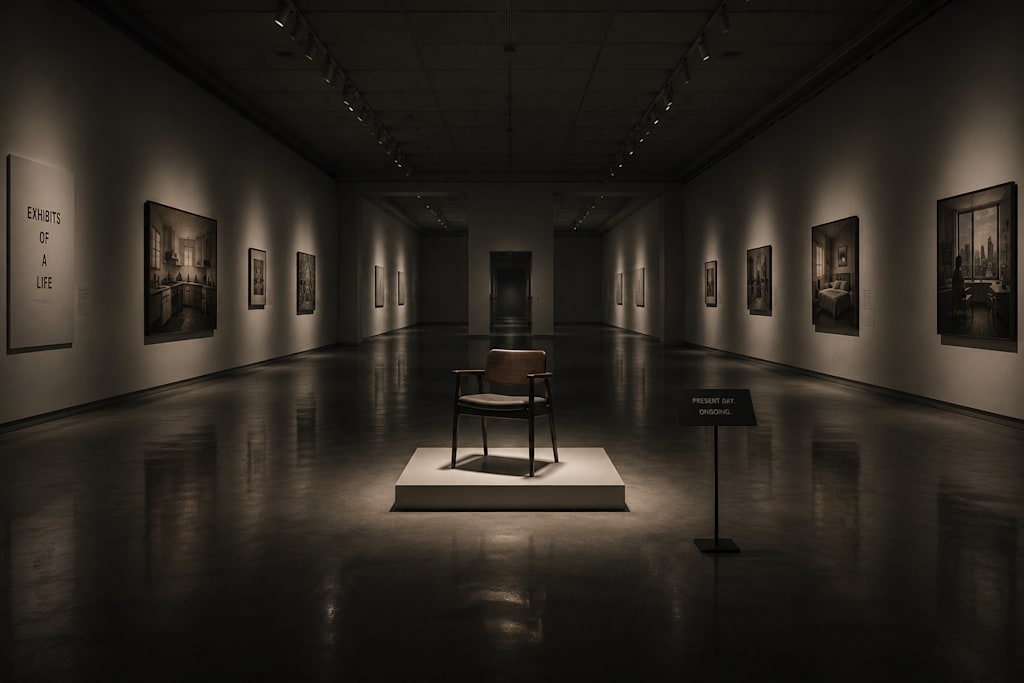
The museum had no entrance I could remember walking through.
That is how it goes in dreams. You are simply placed. One moment nothing, and the next you are standing on polished concrete beneath a ceiling that vaults too high to see clearly, and the air carries the smell of climate control and something underneath it, something like old paper or rooms that have been closed for a very long time.
I walked into the first gallery because there was nowhere else to go.
The exhibit in the center of the room was a kitchen table. Four chairs. A window backdrop painted to suggest afternoon light. On the table sat a half-finished jigsaw puzzle, a mug with a cartoon rabbit on it, a stack of paperback novels. A small placard on a stand beside it read: DOMESTIC INTERIOR, LATE SPRING. PRIVATE COLLECTION.
I stood in front of it and did not move.
That was my mother's table. The grain of it was right. The way one leg had always run shorter than the others, fixed for years with a folded piece of cardboard underneath until someone finally repaired it properly. But the mug was wrong. She had kept that mug until it chipped, and the chip would have been on the left side of the handle, and the mug in the exhibit was pristine, unblemished. The puzzle was wrong too. She did puzzles only in winter, never spring, and the particular puzzle on display here, a lighthouse on a New England coast, was not one I recognized from any winter of my life.
Almost right. Not quite.
"This piece dates from the narrator's early childhood," said a voice behind me.
I turned. A woman in a navy blazer stood at the entrance to the gallery with a loose cluster of visitors around her. She had a lanyard, a pleasant and composed face, the easy manner of someone accustomed to speaking in rooms like this one. She was gesturing toward my mother's table as she spoke.
"Note the puzzle," she continued. "An activity associated with patience and solitude. The family was close but not demonstrative. Warmth expressed through proximity rather than language."
I said, "That's not right."
Nobody looked at me.
"The mug was a gift," the docent said. "Its significance lies not in the object itself but in how long it was kept. Objects held past their usefulness tell us something about the nature of attachment."
I said it again, louder. The group was nodding. A man near the back was writing in a small notepad. I stepped forward until I was close enough to see the weave of the docent's blazer and she did not glance at me once, not a flicker, not a hesitation.
I followed them into the next room.
This gallery was larger. Several exhibits arranged along the walls under focused warm light. A single bed with a blue comforter. A desk with a lamp and a stack of textbooks. A corkboard above the desk covered in papers. I recognized the handwriting on the papers before I could read the words.
I walked to the corkboard while the docent spoke behind me.
"The adolescent years. Characterized by withdrawal and a high degree of interior life. Note the corkboard: the subject organized thoughts visually, a need to externalize what could not yet be spoken."
The papers were in my handwriting. The shape of the letters was mine, the particular slant and the way I have always closed my lowercase e. But the words were wrong. Lists I had never written. Phrases I didn't recognize. One sheet bore a date I knew precisely, a specific winter from my sixteenth year, and beneath the date were sentences describing what I might plausibly have felt that winter without being what I actually felt. A reconstruction. The outline of a person with someone else's interior.
I unpinned one of the sheets and held it.
The docent kept speaking. The group moved on. I stood holding the paper that was mine and was not mine and not one person turned or paused or registered that anything had changed.
I pinned the paper back. I followed them.
The rooms deepened. The exhibits grew more recent. A first apartment: the secondhand sofa whose cushions never sat quite level, the print I'd hung above it, the mild disorder of a life in early formation. But the print on the wall was not the one I had owned. It was close, similar in palette and tone, the kind of thing I might plausibly have chosen, but not the one I had carried up three flights of stairs on a Sunday afternoon and spent an hour getting level. And on the windowsill there was a photograph. A person I had never seen, positioned there as if they had always been part of that apartment, as if removing them would leave a visible gap.
"This period," the docent said, "saw significant change. New relationships. A sense of possibility threaded through persistent uncertainty. Note the photograph. An important connection."
"I don't know that person," I said.
The group leaned in to study the photograph.
I placed myself directly in the docent's eyeline. I stood close enough to see exactly where her gaze moved: across the exhibit, across the visitors, across the clean managed space of the room. Her eyes passed over the place where I was standing with the same mild professional attention she gave the furniture.
"Excuse me," I said.
She smiled at the group and gestured toward the corridor at the back of the room.
The final gallery was at the end of a long hallway. The lighting shifted as I walked, growing warmer and more amber, and the air changed too, heavier somehow, and I slowed without deciding to because something ahead felt wrong in a way I had no words for yet.
The room held a single exhibit.
A chair. My reading chair from my apartment, the one beside the window, with the worn patch on the left armrest where my hand always rests. Positioned alone under a spotlight, the way important objects are displayed when nothing else should compete with them. A placard beside it read: PRESENT DAY. ONGOING.
The chair was empty.
I stood in the doorway and did not go in. The tour group filed around me without friction, like water around a stone. The docent took her position beside the exhibit and regarded the empty chair with an expression I could not read, something between professional calm and something older and quieter beneath it.
"The subject," she said, "is still being curated."
She looked up then. Not at me. At the room in general, the walls, the upper corners, the quality of the light falling across the empty chair. But for a moment her gaze crossed the place where I was standing and I felt it the way you feel a draft from a window you were certain was shut, briefly and without warmth, and then it moved on.
"We do not yet know how this one ends," she said.
The lights went down.
I woke up.
The chair beneath me was not mine. An office chair, wheeled, the cushion compressed from long use. A desk in front of me with a computer already on, a staff calendar open on the screen. Morning light came through a window to my left. The air in the room smelled of climate control and something older underneath it, old paper, closed rooms.
I looked down.
A lanyard around my neck. The museum's logo at the top and below it, in small clean print, my name. Below my name, a title: COLLECTIONS ASSISTANT.
From somewhere beyond the closed office door came the sounds of the building opening for the day. Locks turning. Lights coming on in sequence down a corridor. The particular shift in acoustics that happens when a large quiet space begins preparing to receive visitors.
I put my hand on the mouse and did not move it.
On the calendar my name appeared in several slots throughout the coming week. A recurring event, every Saturday morning, read: DOCENT TRAINING, 10AM.
I sat at the desk that was apparently mine and tried to remember applying for this position, interviewing, being handed the lanyard, learning where this office was. I tried to locate a single memory of arriving here on any previous morning. There was nothing. Not a gap exactly, not an absence I could point to, only the smooth unbroken surface of a life in which this had seemingly always been true.
Down the hall a door opened. Footsteps on polished concrete, unhurried and familiar with the space. A voice carrying easily through the quiet, warm and practiced and composed: "Good morning. We open in twenty minutes."
I recognized the voice.
I sat very still and looked at my name on the lanyard and did not answer.
Outside the office window the first visitors of the day were already gathering at the entrance. Coats on, faces turned toward the doors, waiting patiently to be let inside.
About the Creator
Aarsh Malik
Poet and storyteller who believes in the quiet power of words.
My first book, QUIET FLAME
Enjoyed the story? Support the Creator.
Subscribe for free to receive all their stories in your feed. You could also become a paid subscriber, letting them know you appreciate their work.
Comments
There are no comments for this story
Be the first to respond and start the conversation.