
Stay Until Morning
Fear was only the beginning of what the lodge wanted from them

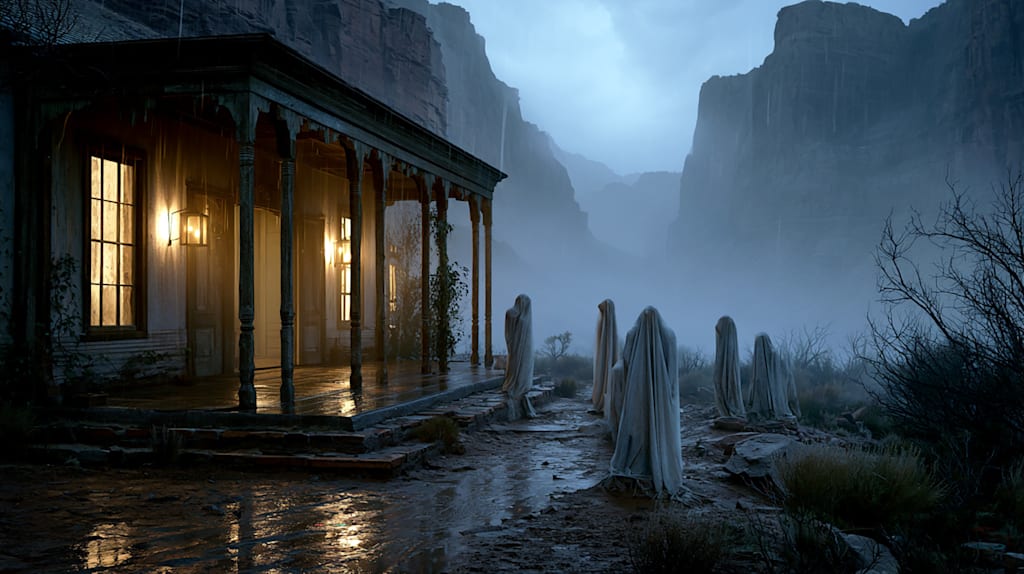
By the time the road washed out, everyone at Red Hollow Lodge had already begun pretending they were not afraid of one another.
There were six of them at the retreat, not counting Mara Vale, who owned the lodge and moved through it with the quiet authority of someone who had inherited more than property. She was thin, silver-haired, and watchful, with a voice that never rose above courtesy. When she greeted each guest, she held their hand a second too long.
“Isolation helps the work,” she said at dinner. People run out of distractions.”
No one laughed, though several of them smiled.
The lodge stood at the far end of a canyon road north of Sedona, where the red cliffs narrowed, and the desert seemed to fold in on itself. It had once been a guest ranch, then an artist colony, then nothing for many years. Mara had reopened it as a retreat for those who wanted silence, discipline, and what the brochure called “creative honesty.”
Caleb Dane had come because his last three novels had been praised and forgotten in the same season. Elise Marrow, a painter half his age, had come because her galleries were asking questions she did not want to answer. Dr. Leon Voss, a therapist with gentle hands and a ruined marriage, had come to write a book about grief. Talia Bright, who called herself a spiritual teacher online, had come with two suitcases and no visible humility. Owen Pierce, a photographer losing his sight, had come because someone else had paid.
Anna Reed had come because she had nowhere else to place her fear.
She did not say this during introductions. She said she was between projects. Everyone understood the lie and let it stand.
The storm arrived after dinner.
At first, it was only wind moving through the junipers, making the old chimes outside the dining room tremble against one another. Then rain struck the windows hard enough to silence conversation. By nine o’clock, the lights flickered. By ten, the generator coughed itself awake beneath the floorboards.
Mara listened to it for a moment and said, “It should hold.”
Anna noticed the wording immediately.
At midnight, Caleb found the drawing.
It had been slipped beneath his door while the others were gathered in the parlor, drinking Mara’s bitter tea and pretending not to hear the weather tearing at the roof. The paper was heavy, expensive, and damp at one edge.
On it was a charcoal sketch of Caleb asleep.
Not a quick likeness. Not a suggestion. Every detail had been handled with care: the slack mouth, the hand curled near his throat, the faint crease between his eyes. Beside his pillow, drawn with equal tenderness, lay a long, narrow knife.
Caleb brought it downstairs and tried to make a joke of it.
No one helped him.
Mara studied the drawing without touching it.
“Who made this?” Caleb asked.
The generator hummed beneath them. Rain streamed down the windows hard enough to distort the canyon lights.
Elise looked at Owen. Owen looked toward the hallway. Talia whispered something about projections and inner violence, then stopped when Caleb turned on her.
“Who made this?”
No one answered.
Anna watched Mara’s face. There was no surprise there. Concern, perhaps. A measured sadness. But not surprise.
Then the generator failed.
For three seconds, the lodge vanished.
Someone gasped. Someone cursed. In the darkness, a chair scraped backward across the floor.
Mara quickly found the candles.
One by one, small flames appeared around the parlor. Their light made everyone look older. The candlelight flattened the room, pushing the photographs closer to the edge of attention.: painters standing before easels, writers gathered on the porch, musicians holding cups of coffee in both hands. All of them smiling into the same canyon light.
“Road’s gone,” Owen said.
He stood near the front window, one hand braced against the frame.
“What do you mean?” Leon asked.
“The wash. I saw headlights down there before the power went. Then nothing.” Owen leaned closer to the glass. “There’s water across the road. A lot of it.”
Mara nodded.
“It happens during hard rain. We stay inside until morning.”
The words should have reassured them.
They did not.
At one-fifteen, Elise disappeared.
At first, they assumed she had gone to her room. She had been quiet since the drawing appeared, sitting with her arms wrapped around herself, the candlelight catching on the wet shine in her eyes. When Talia went upstairs to check on her and returned without color in her face, the pretending ended.
Elise’s door was open.
Her room was empty.
On the bed lay three canvases from her portfolio, cut from their stretchers and arranged like skins. Across the wall above them, in black paint, someone had written:
MAKE SOMETHING TRUE.
Caleb wanted to search outside. Leon said no one should leave the lodge. Owen asked where Mara kept the gun.
“I don’t keep one,” Mara said.
Caleb laughed once, a hard little sound. “Of course you don’t.”
They searched the lodge in pairs.
Anna went with Owen because he asked, and because she trusted fear more than certainty. They moved through the back hallway with one candle between them. The lodge seemed larger in the dark, its rooms multiplying in ways that did not match the daylight map in Anna’s mind. A studio opened where she remembered a storage closet. A locked door stood at the end of a passage she did not recall seeing before.
From somewhere above them came a soft dragging sound.
Owen stopped.
“You hear that?”
Anna nodded.
It came again. Slow. Measured. Wood against wood.
“Owen?”
His face tightened. “That’s from the attic.”
“There’s an attic?”
“There’s always an attic.”
It was not funny, but Anna almost smiled. The body will reach for ordinary things until the last possible second.
They found the attic stairs behind a narrow door near the kitchen. Mara arrived before they opened it.
“No,” she said.
Owen turned. “Why?”
“It isn’t safe.”
“Neither is the rest of the house.”
Mara held the candle between them. Her face looked carved from wax.
“Some rooms are best left alone.”
Then Elise screamed.
The sound came from outside.
Not far away. Not distant enough.
Everyone reached the porch at once except Mara, who followed slowly, as though arriving at a conclusion she had always expected. Rain swept sideways under the roof. The canyon beyond the lodge was black, except when lightning revealed the wash below, swollen and violent.
“Elise!” Caleb shouted.
For a moment, there was only rain.
Then they saw her.
She stood at the far edge of the sculpture yard, barefoot in the mud, her white nightshirt clinging to her body. Around her, half a dozen sheet-covered sculptures stirred in the wind like figures waiting for permission to move.
“Elise,” Leon called gently. “Come back inside.”
She lifted one arm.
Not toward them.
Toward the largest sculpture.
The sheet slid down.
Beneath it was not sculpture.
It was a man.
Or what had been arranged to resemble one.
An old mannequin, perhaps. A bundled form. Wire and cloth. Anna could not make sense of it at first. Then lightning opened the sky again, and she saw the face.
It was Caleb’s.
Not his real face, but a mask of it, molded and painted with dreadful care. The mouth had been cut open in a scream.
Caleb made a sound like an animal struck in the chest.
Elise turned toward the porch.
“I didn’t do it,” she said.
Then something behind her moved.
Anna saw only a shape within the rain. A dark coat. A pale hand. The thin upward glint of metal.
Elise was pulled backward into the storm.
No one moved.
That was the worst part. For one complete breath, they all stood frozen while her scream broke and vanished among the rocks.
Caleb ran first.
Leon tried to stop him and failed. Owen grabbed a lantern from the porch. Anna followed because staying behind with the photographs and candles felt worse.
They found Elise ten minutes later beside the dry fountain.
She was alive.
Her left hand had been pinned to the wooden rim with a sculptor’s chisel.
Leon vomited in the mud.
Caleb dropped beside her, sobbing apologies that made no sense. Elise stared through him.
“I saw his face,” she whispered.
“Whose face?” Anna asked.
Elise’s lips trembled.
“Mine.”
They carried her inside. Mara wrapped the hand, tied the bleeding, and worked with a competence that unsettled Anna more than panic would have. Talia sat in the corner murmuring prayers to an audience she no longer seemed sure was listening.
At two-thirty, they found the old photographs.
Owen discovered them in Mara’s office behind a loose panel in the desk. There were dozens. Retreat groups from years past. Artists. Writers. Dancers. Smiling strangers in sunlit poses.
On the back of each photograph, one person had been circled.
In red.
Some names had dates beneath them.
Some had only one word.
CONFESSED.
BROKE.
STAYED.
Caleb held up the newest photo.
It had been taken that afternoon.
All six of them stood on the porch, smiling politely, the canyon bright behind them.
Anna did not remember anyone taking it.
Her own face had been circled.
The word beneath her name had been written in fresh red ink.
WITNESSED.
“What is this?” Caleb demanded.
Mara stood in the doorway.
No one had heard her approach.
“This place has always asked things of people,” she said.
Caleb moved toward her, but Owen caught his arm.
Mara looked almost sorrowful.
“You came here because something in each of you was already splitting. I only gave it room.”
“You stabbed Elise,” Leon said.
“No.”
“Then who did?”
Mara turned her head slightly, listening.
Above them, the dragging sound began again.
This time it was heavier.
This time it was coming down.
Talia started to cry.
The attic door opened by itself.
A ladder of darkness descended into the hall.
For a moment, nothing emerged. Then something dropped onto the floor with a wet slap.
A canvas roll.
It unfurled slowly across the boards.
Inside was a painting of Talia.
Not the luminous, open-faced woman from her videos. This version was small and frightened, kneeling beneath a ring light while a hundred unseen hands reached toward her from the dark.
Talia covered her mouth.
“No,” she said. “No, no, no.”
From the stairs above came a whisper.
“Stay a while.”
The candles went out together.
In the dark, someone screamed.
When Anna found light again, Talia was gone.
Only her phone remained in the hallway, screen cracked, still recording.
On it, her face appeared for half a second, washed green by night vision. Her eyes were enormous. Behind her stood a figure wearing Caleb’s painted mask.
Then the screen went black.
Caleb backed away from them.
“Why my face?” he said. “Why does it keep using my face?”
No one answered.
That was when Anna understood the trick.
“It isn’t using your face,” she said.
Everyone turned to her.
She looked at Mara. “It uses what will break us fastest.”
Mara’s expression shifted.
Only slightly.
Enough.
Anna felt something inside her settle into place. Fear was still there, but it had shape now, and shaped fear could be carried.
“You know what it is,” Anna said.
Mara lowered her eyes.
“My mother started the retreats. She believed art was a kind of confession. That no one made anything true until they were stripped of defense.”
“And this?” Owen said. “This is art?”
Mara looked toward the ceiling.
“This is what stayed after she died.”
The lodge groaned in the wind.
Caleb laughed softly. “You’re insane.”
Mara looked at him with sudden tenderness.
“No. I am careful.”
The figure came for Leon next.
He had gone to the kitchen for towels, though afterward none of them could remember asking him to. Perhaps he needed a task. Perhaps the mind, cornered by terror, will invent errands to avoid the truth.
They heard him speaking before they heard him scream.
“I’m sorry,” he said from the kitchen. “I’m sorry. I didn’t know what else to do.”
Anna ran toward him, Owen behind her.
Leon stood at the sink, facing the dark window. In the glass, reflected behind him, was a woman with wet hair and a broken mouth.
His ex-wife, Anna guessed, though she did not know how she knew.
Leon lifted the carving knife from the counter.
Owen shouted.
Anna reached him first.
The blade cut across her forearm as she grabbed his wrist. Pain flashed white, immediate and clean. Leon seemed to wake at the sight of her blood.
Then the window shattered inward.
Hands reached through the broken glass and pulled him out into the rain.
Owen fired the flare gun.
The red light struck the yard and burned there, hissing in the mud.
For one blazing second, Anna saw everything.
Talia’s suitcase open beneath the porch.
Elise unconscious near the fireplace.
Mara standing calmly by the stairs.
And beyond the window, at the edge of the wash, figures wearing faces that did not belong to them.
Whatever moved beyond the window no longer felt singular.
Human was becoming difficult to assume.
Something that had learned the shape of guilt and wore it badly.
“Run,” Owen said.
They did not run toward the road. There was no road. They ran through the studio wing, past covered easels and clay forms and mirrors turned to the wall. Mara followed, not chasing them, simply moving in the same direction, as though all paths in the lodge belonged to her.
Caleb was gone by then.
Anna realized it only when they reached the sculpture room and found his shoes placed neatly beside the door.
Inside, a single work light flickered over the central platform.
Caleb sat beneath it, tied to a chair with strips of canvas. His mouth was gagged. His eyes begged them not to come closer.
Above him hung six knives from thin wire, each one turning slowly in the stale air.
Owen cursed and moved forward.
Anna caught his sleeve.
“No.”
A floorboard creaked behind them.
Mara stood in the doorway.
“Most people spend their lives avoiding fear,” she said. “Then wonder why nothing they create feels alive.”
Owen raised the flare gun again.
Mara smiled sadly.
“It’s empty.”
From the ceiling came a soft metallic ping.
One wire snapped.
The first knife fell.
It struck the platform beside Caleb’s foot.
He screamed through the gag.
Anna looked at the mechanism above him, then at the candle burning near the far wall, then at Mara’s hands.
Her hands remained perfectly steady.
“You set the rooms,” Anna said. “The drawings. The paintings. The masks.”
Mara did not deny it.
“But something else comes when people believe enough.”
Mara’s eyes brightened.
Mara’s expression softened.
“You finally understand.”
Anna stepped toward the candle.
Mara’s expression changed.
“No.”
Anna picked it up.
The flame leaned wildly in the draft.
Behind Mara, the hallway darkened. Not because the light faded, but because something in the dark had turned its attention toward them.
Owen understood.
“Anna.”
She held the candle higher.
Mara whispered, “Don’t feed it.”
Anna smiled then, though there was no joy in it.
“So there are rules.”
She threw the candle into the curtains.
The old fabric caught at once.
Fire climbed fast, finding varnished wood, dry paper, turpentine, canvas. Firelight surged across the studio walls.
Mara screamed—not in fear of death, Anna thought, but in outrage. Something in the hallway withdrew from the sudden blaze. It had been fed by little flames, stolen flames, fearful offerings. This was different. This was too much light at once, too much heat, too much destruction without secrecy.
Owen cut Caleb loose with one of the fallen knives.
They ran.
Behind them, the lodge began to burn.
The hallway writhed with faces. Talia. Leon. Caleb. Anna’s mother. A child Anna had once seen step into a street while she stood frozen on the curb, too far away to save him and too ashamed ever to speak of it.
The face turned toward her.
Witnessed.
Anna almost stopped.
Owen grabbed her good arm and pulled her through the front door into rain and firelight.
They found Elise on the porch and dragged her between them. Caleb stumbled after, weeping, one shoe gone, his face blackened with smoke.
At the edge of the wash, they turned.
Red Hollow Lodge burning unevenly against the cliffs, beams collapsing inward one room at a time. Mara stood inside the doorway, her hair lifting in the heat, one hand pressed to the frame. Behind her, something taller than the house leaned down, wearing no face at all.
By dawn, the rain had stopped.
The road was still gone. Leon and Talia were not found. Neither was Mara.
When the rescue helicopter came after noon, the deputy asked Anna how the fire started.
She looked at the black bones of the lodge, at the red mud drying under the hard Arizona sun, at Caleb rocking silently beside the ambulance, at Elise staring at her bandaged hand as though it belonged to someone else.
Then she looked toward the canyon.
For one brief moment, in the shadow beneath the far cliff, she thought she saw a woman standing very still.
Waiting.
Anna turned back to the deputy.
“Lightning,” she said.
He wrote it down.
That night, in the hospital, she woke to the smell of smoke.
On the tray beside her bed lay a charcoal sketch.
It showed her standing at the edge of the burning lodge, one candle in her hand and darkness stood behind her with the stillness of something waiting to be fed.
Beneath the drawing, in red ink, someone had written:
STAYED.
About the Creator
Rick Allen
Rick Allen reinvented himself not once, but twice. His work explores stillness, transformation, and the quiet beauty found in paying close attention.
Enjoyed the story? Support the Creator.
Subscribe for free to receive all their stories in your feed.
Comments
There are no comments for this story
Be the first to respond and start the conversation.