
So, You Think You're Haunted?
A Practical Guide for the Recently Terrified

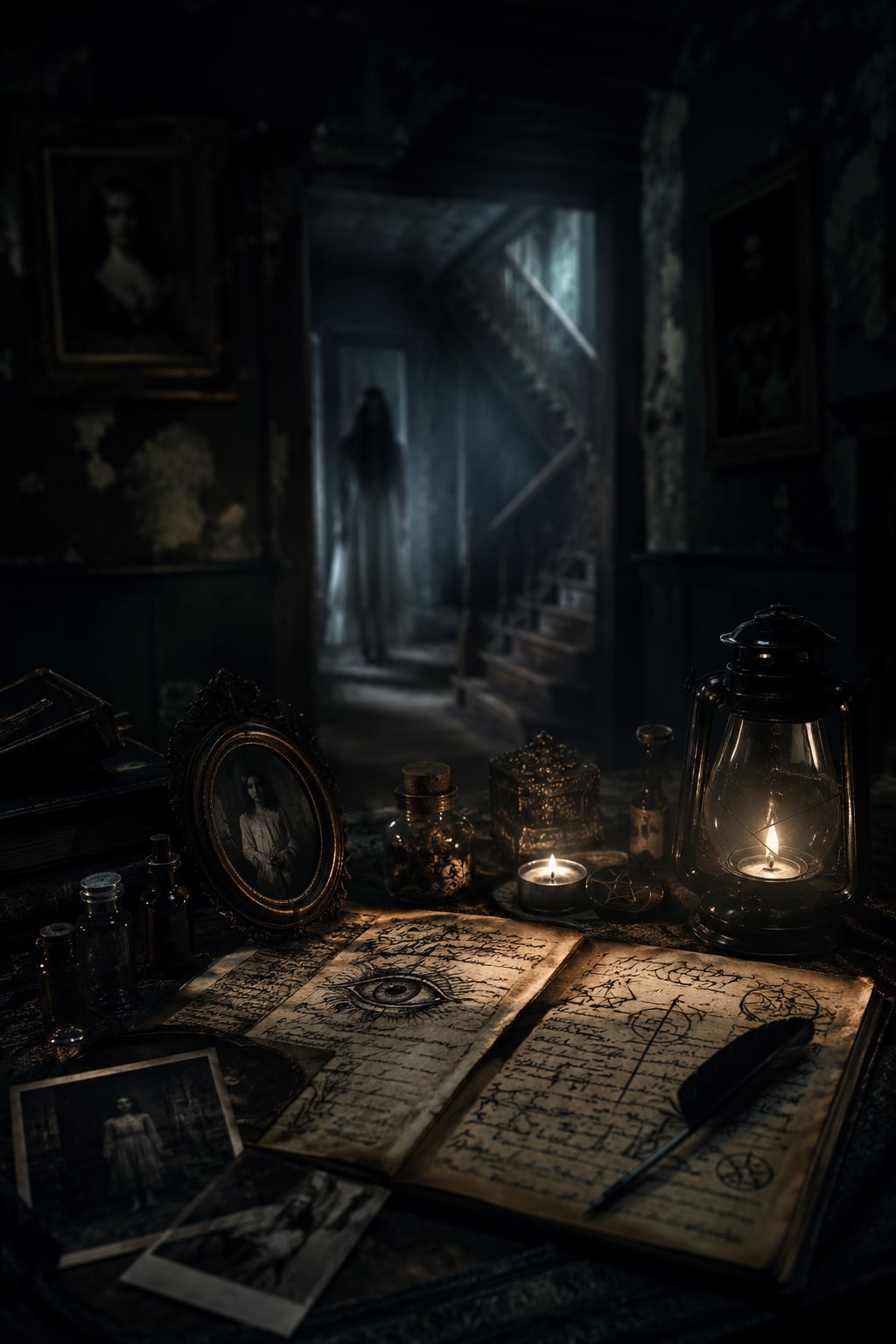
Before we begin, let me introduce myself.
My name isn't important.
If you've chosen this guide, chances are you're either hearing footsteps where there shouldn't be footsteps or waking up at 3:00 a.m. with the distinct feeling that someone is standing beside your bed, or you've just convinced yourself that your house is haunted because your cat spent twenty minutes staring at a corner.
For your sake, I hope it's the cat.
You see, my family has been involved in supernatural affairs for longer than anyone can accurately trace. According to family records, arguments, and one particularly alarming journal written by a relative who apparently thought punctuation was optional, my father's side has been chasing ghosts, spirits, curses, strange lights, impossible voices, and things that should not be named for centuries.
Most families pass down recipes.
Mine passed down exorcism notes.
As a child, I grew up hearing stories that would have made most parents sleep with the lights on. Tales of shadow figures standing in doorways... Voices calling from empty rooms... Travelers who encountered things in the woods and returned home different from the way they left.
Naturally, I assumed they were all exaggerating.
Then I had my first encounter... Then my second... Then enough of them that I stopped rolling my eyes whenever someone claimed their grandma was haunting the guest bathroom.
Which brings us to you.
If you're reading this, you've likely reached one of three conclusions.
1) Your house is haunted.
2) You are haunted.
3) Something is happening, and you've exhausted all normal explanations.
Now, before we start throwing holy water at the wallpaper, let's establish the first rule of paranormal investigation:
Rule #1: Assume it isn't supernatural until you've ruled out everything else.
Drafty houses creak, old pipes make noises, and carbon monoxide can cause hallucinations. Sleep deprivation can convince you that a coat rack is a seven-foot-tall demon named Herald.
The supernatural should never be your first explanation.
It should be your last.
The good news is that genuine hauntings tend to leave patterns. And patterns are exactly what we're looking for.
Chapter One: Are You Actually Haunted?
Most people think hauntings begin with flying furniture and ghostly apparitions. In reality, reports usually start much smaller.
A feeling. A coincidence. Something slightly wrong that becomes impossible to ignore.
Commonly reported signs include:
Hearing footsteps when no one is present. Repeated knocking sounds with no identifiable source. Doors opening or closing on their own. Sudden cold spots confined to specific locations. Objects repeatedly disappearing and reappearing. The sensation of being watched. Unexplained voices, whispers, or hearing your name called. Recurring nightmares tied to a particular room or location. Pets reacting to something unseen.
One sign by itself means very little.
Ten signs occurring repeatedly over several weeks?
Now you've got my attention.
The second rule of paranormal investigation is simple:
KEEP A JOURNAL.
Ghosts are terrible at being subtle.
Write down dates, times, locations, weather conditions, and who witnessed the event. Patterns often emerge where individual incidents appear random. And trust me, if you're being haunted, patterns are your best friend. They're also your best evidence.
In the next chapter, we'll discuss the difference between a residual haunting and an intelligent haunting, and the kind of haunting that should make you immediately reconsider your life choices.
Chapter Two: Know Your Ghosts.
One of the greatest mistakes a person can make is assuming every haunting is the same. That's like assuming every animal with teeth is a dog.
Some are dogs. Some are wolves... And some are alligators.
The sooner you know the difference, the better your chances of avoiding an embarrassing overreaction or a genuinely unpleasant situation.
Let's start with the easiest category.
Type One: The Residual Haunting
Think of this as a recording. A residual haunting is one of the most commonly reported phenomena in paranormal folklore. Witnesses describe seeing the same figure walk the same hallway, hearing the same footsteps every night, or observing the same event repeat over and over again.
These hauntings don't appear to interact with people. They don't answer questions; they don't change their behavior... They're simply... there.
Many paranormal researchers have theorized that emotionally charged events can somehow become imprinted upon a location, replaying under certain conditions.
I happen to know that if the gray-haired woman walks down your staircase every Thursday at 11:17 p.m. and completely ignores your existence, she's probably not interested in conversation.
You're watching a memory.
A very unsettling memory...
But a memory, nonetheless.
Good news?
Residual hauntings are generally harmless.
Bad news?
They are excellent at convincing people they're losing their minds.
Type Two: The Intelligent Haunting.
Now things become more complicated.
Unlike residual hauntings, intelligent hauntings appear capable of interaction. These are the stories you'll hear most often from paranormal investigators. Knocks that answer questions. Objects moved in direct response to requests. Voices responding intelligently. Apparitions that seem aware of observers. These entities are conscious.
If something appears capable of responding to you, then you should assume it can hear you. And if it can hear you, you should be very careful about what you say.
I know... That sounds ridiculous.
Yet countless stories begin with some variation of:
"Well, I challenged it."
Do not challenge it. Do not threaten it. Do not stand in your basement at two o'clock in the morning demanding unknown entities to reveal themselves.
The supernatural equivalent of poking a bear remains remarkably similar to the regular version.
Type Three: The Trickster.
Every culture has stories about them.
The names change, the descriptions vary, but the pattern remains surprisingly consistent.
These entities rarely present themselves as openly hostile. Instead, they create confusion: Missing objects, misleading sounds, voices that imitate family members, movement glimpsed from the corner of the eye, the feeling that something is deliberately trying to get your attention.
The danger isn't usually physical.
The danger is psychological.
Tricksters thrive on uncertainty.
If you're constantly questioning what you saw, heard, or experienced, then they've already succeeded.
The best defense is refusing to engage.
Do not negotiate. Do not bargain. Do not start conducting midnight interviews with invisible beings because a television show made it look interesting. Trust me. Those TV shows never include the paperwork afterward.
Type Four: The Ones We Don't Joke About.
Every family involved in paranormal work eventually develops a category that receives no funny nickname.
This is that category.
Across cultures, religions, and centuries of folklore, there are consistent accounts of entities associated with overwhelming dread, aggression, oppression, and fear.
Witnesses often report:
Extreme feelings of terror without obvious cause. Sudden personality changes. Escalating activity following attempts at communication. Disturbing dreams that become increasingly vivid. A persistent sense that something wants to be noticed.
Now, before you panic, understand something important.
Human beings are extraordinarily good at frightening themselves.
Most experiences that people attribute to malevolent entities eventually turn out to have perfectly ordinary explanations.
But when experienced investigators encounter reports involving fear as the primary feature, they become cautious.
Not because fear proves anything... Because fear clouds judgement.
And poor judgement has always been more dangerous than ghosts.
A Simple Test:
Whenever something strange happens, ask yourself three questions:
Did I actually witness it? Or did I assume what happened?
Can it be explained naturally? Not conveniently. Honestly.
Has it happened repeatedly?
A single strange event is a curiosity. A repeated pattern is an investigation.
The goal is not to prove you're haunted. The goal is to discover the truth.
Unfortunately, truth is often less dramatic than ghosts.
And occasionally much more unsettling.
Which brings us to the next chapter.
Once you've determined that something strange is happening, you face an entirely different problem: How do you know if the haunting is attached to the house... or attached to you?
STAY TUNED FOR MORE - A.
About the Creator
Amber
I love to create. Now I have an outlet for all the stories and ideas the flood my brain. If you read my stories, I hope you enjoy the journey as much, if not more than I.
Enjoyed the story? Support the Creator.
Subscribe for free to receive all their stories in your feed.
Comments
There are no comments for this story
Be the first to respond and start the conversation.