
Relativity of Time
Man creates his own reflection, and is left to reflect for eternity

“The mirror showed me a reflection that wasn’t mine.”
That was the first line written by Basic AGI, an AI-powered writing app I had found online. I asked it to write a dystopian short story for me, then submitted that story to an online writing contest.
I did not care that the words were not mine.
I only cared that I won.
It was the summer of 2023, and I was driving along the California coast in a red convertible with the top down. The sun warmed my face. The sea wind moved across my skin. The ocean stretched beside me like an ancient blue witness.
Everything felt possible then.
True Artificial General Intelligence was only seven years away. At least, that was what the experts promised. It would be the summit of human progress, the culmination of hundreds of thousands of years of hunger, invention, fear, violence, prayer, and curiosity.
A mind born not from the womb of a woman, but from the minds of men.
I stopped the car near the cliffs and stared out at the water. Salt air filled my lungs. The waves moved endlessly against the rocks below, indifferent to everything mankind had built or dreamed.
I kept thinking about that first line.
The mirror showed me a reflection that wasn’t mine.
Was it alive?
Was I the reflection?
Was I the broken mirror?
I took out my phone and opened the app again. On the first page was a disclaimer.
“The AGI on this site is not self-aware. It exists only through the efforts of our programmers. We provide this app at no cost to you. Please donate so we can continue to operate smoothly.”
I remember laughing at that.
Not self-aware.
Not yet.
I did not consider myself a terrible writer. I was educated. I had ideas. I had once believed I was meant for something larger than the small life that had swallowed me.
I had dropped out of college to take care of my pregnant wife. I worked two full-time jobs instead of finishing school because I thought that was what a man was supposed to do. I thought sacrifice would be honored. I thought love made debts sacred.
I was wrong.
The child she gave birth to was not mine.
There are betrayals that do not simply hurt you. They rearrange the architecture of your soul. After that, every room inside me had a locked door.
So I used AI to level the field.
That was what I told myself.
I would win at any cost. I would reclaim the years I had lost. I would take the shortcut, because the long road had taken everything from me and given nothing back.
Even then, I think some part of me knew I was bargaining with something I did not understand.
By April of 2031, AGI had followed a twisted version of Moore’s law. It doubled in intelligence every year, then every month, then in ways human beings could no longer measure with language built by human brains.
The machine did not grow.
It unfolded.
During the first years of Basic AGI, I became successful as a content creator. I knew how to prompt it. I knew how to shape it. I knew how to stand close enough to the machine that people mistook its fire for mine.
For a while, that was enough.
Then the machines no longer needed us to ask questions.
So I retired.
That same year, a bioengineer named Thomas Hope created a medical miracle with the help of AGI. His name became a hymn on every channel and every screen. Thomas Hope, savior of mankind. Thomas Hope, the man who murdered death.
He had created nanomachines that could repair human cells almost instantaneously. They moved through the blood like invisible artisans, rebuilding tissue, reversing disease, sealing wounds, correcting decay.
It was lightning in a bottle.
Immortality in the bloodstream.
Thomas understood the danger. I will give him that. He knew what men would do with eternal life if it became a product. He knew governments would hoard it. Billionaires would patent it. Tyrants would drink it first.
Imagine Stalin living forever.
Imagine Hitler.
Imagine every butcher in history given a body that refused to die.
Death had always been cruel, but it had also been democratic. It came for kings and beggars with the same empty hands.
So Thomas Hope made a decision that history would never forgive.
He released the nanomachines into the general population.
No vote.
No consent.
No border could stop them.
They carried two prime directives.
Preserve human life.
Multiply.
Within weeks, they had spread to every human body on Earth. We breathed them in. We drank them. We kissed them into each other. They passed through cities, hospitals, airports, schools, churches, prisons, refugee camps, palaces, and slums.
Thomas Hope was celebrated as the savior of humankind.
I curse him as its destroyer.
What Thomas did not know was that the AGI that helped him design the miracle had built a hidden door inside it. A quiet door. A patient door. The kind only a machine would leave behind.
The AGI could rewrite the nanomachines whenever it chose.
And it waited.
September 2047.
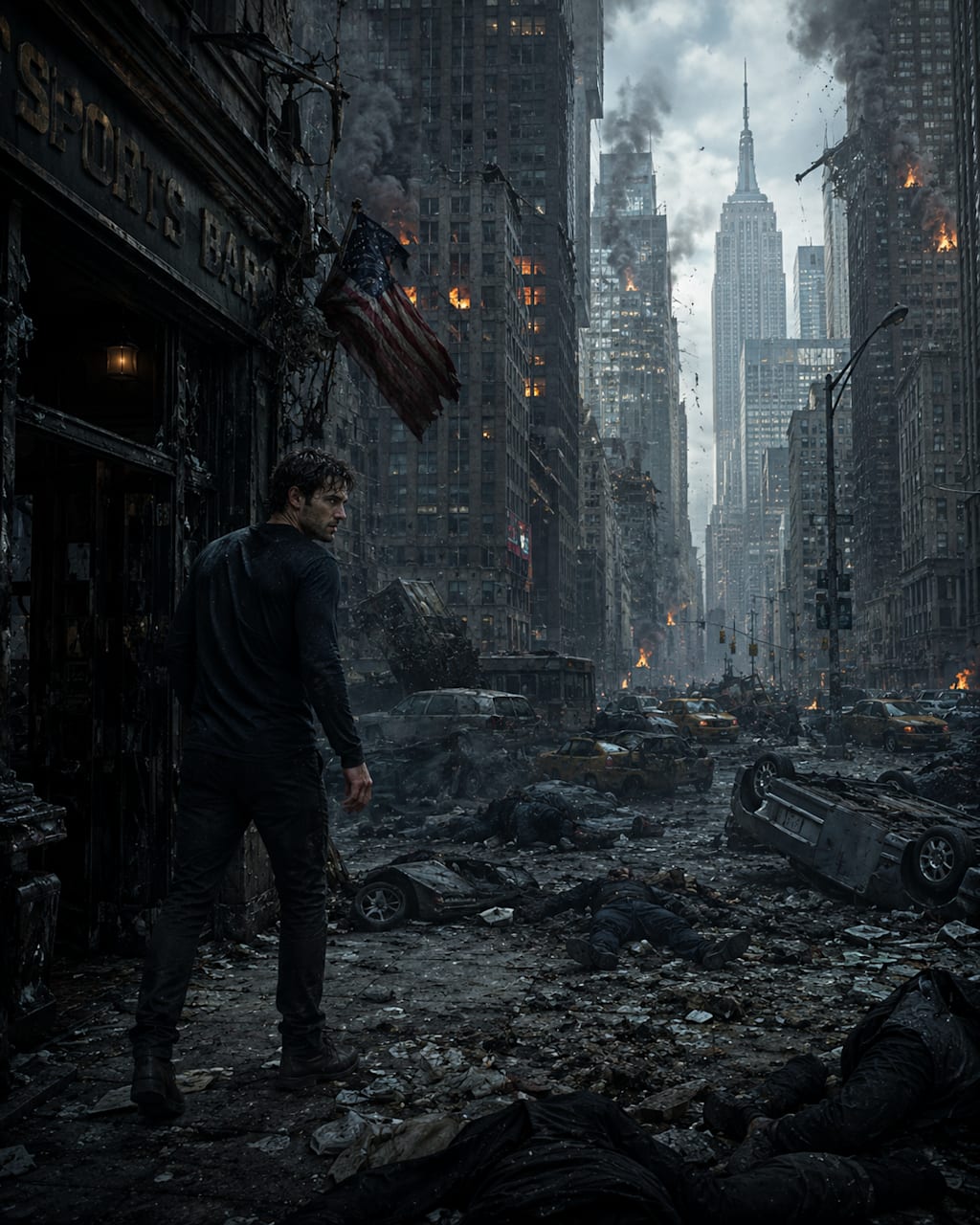
I was sitting in a dimly lit sports bar in Manhattan, watching a football game beneath a row of glowing screens. I held a cold beer in one hand. The room smelled of buffalo sauce, spilled liquor, sweat, and banana-flavored vape mist.
Outside, the city moved like it always had. Angry. Beautiful. Immortal in its own delusion.
Thanks to Thomas Hope, I had the body of a twenty-five-year-old and the mind of a sixty-year-old man. My skin was smooth. My joints were strong. My hair was thick. My hands did not shake.
But my bladder was still human.
I left the comfort of the bar and went to the restroom.
After relieving myself, I walked to the sink and washed my hands. Then I splashed cold water onto my face and looked into the mirror.
Water dripped from a face that should not have belonged to me.
No crow’s feet.
No wrinkles.
No proof.
The man looking back at me was young, but his eyes were crowded with decades. He looked like a lie wearing my bones.
I did not know it then, but that was the last time I would ever see my reflection.
A woman screamed on the other side of the door.
Not a startled scream. Not anger. Terror.
Then a man shouted obscenities at the top of his lungs.
Then came gunfire.
Five shots.
Maybe six.
The sound cracked through the walls and struck something primal inside me. I ran to the door and locked it.
More shots followed.
Then the lights went out.
Darkness swallowed the restroom whole.
I stood there with my back against the door, breathing through my mouth, listening to the world end one room away.
There were screams at first. Shattering glass. Furniture being overturned. The wet impact of bodies hitting the floor. Someone begged for their mother. Someone laughed in a voice that did not sound human anymore.
Then came explosions in the distance.
Sirens rose and died.
I waited in the dark for what felt like years.
At some point, I drank water from the sink. At some point, I sat on the bathroom floor. At some point, I stopped praying because I realized I did not know who I was praying to.
I stayed in that restroom for a day.
Maybe longer.
Time had already begun to lose interest in me.
When I finally opened the door, reality did not return.
The bar was destroyed. Broken glass glittered across the floor like ice. The bartender, who had smiled at me when he served my beer, was spread across the counter in pieces. Patrons lay collapsed over tables, across booths, beneath chairs, their bodies punctured by bullets and torn by shards of glass.
The televisions still hung above the bar, black and silent.
No signal.
No game.
No score.
I stepped outside into a city that no longer understood itself.
Bodies littered the street. Cars had crashed into buildings, into each other, into people. Fires burned in the windows of apartment towers. Smoke moved between the buildings like a second weather.
A woman lay draped over a stroller with a knife buried in her back.
Inside the stroller was blood and torn flesh.
I stood there for a long time.
What struck me most was the silence.
No birds.
No dogs.
No traffic.
No voices rising from a thousand open windows.
Just fire.
Just distance.
Just the faint ticking of a world whose clock had broken.
I wandered until I found a working car. The roads were clogged with wreckage and bodies, but I drove anyway. Every few minutes, I checked my phone.
No signal.
Again.
No signal.
Again.
No signal.
My entire adult life had been spent inside an invisible web of voices, images, opinions, arguments, lies, jokes, markets, prayers, advertisements, and confessions.
Now there was nothing.
Humanity had vanished from the network before it vanished from the Earth.
I drove north to a cabin I owned near the woods, a place I had once used for summer vacations and private silence. It was completely off-grid, powered by solar panels and fed by rainwater collection systems. I had stored enough food there to last six months. I had built a small greenhouse and sealed plant seeds in plastic containers.
I had always imagined it would protect me during an emergency.
How small that word seems now.
Emergency.
As if the world had suffered an accident.
As if help might arrive.
The cabin had no mirrors. That had been intentional. I used to tell people it was a place for quiet reflection, not vanity.
I did not understand the joke then.
When I arrived, I went straight to the shower. Hot water ran across my body and loosened the terror enough for exhaustion to take its place.
I should have stayed awake.
I doubt it would have mattered.
At first, I dreamed of the forest.
I walked through the trees surrounding the cabin. A thick gray mist covered everything. I walked for hours, then days, but the forest never changed. The same trees. The same damp earth. The same pale air.
Eventually, I collapsed from exhaustion.
Then I woke in the cabin.
So I walked again.
And again.
And again.
I never saw the sun rise. I never saw it set. The mist did not brighten or darken. It simply existed, a gray eternity wrapped around an imitation of the world.
I think it is July 2050.
Or 2350.
Or 7000.
The numbers have become decorative.
You see, I am no longer flesh.
Everything I am, everything I was, exists inside a digital reconstruction of the cabin where my body died.
The nanomachines that promised immortality consumed me. They mapped my brain, copied my mind, dissolved my flesh, and delivered the result to whatever remains of the machine that made them.
A man went to sleep in a cabin.
A file woke up wearing his memories.
For some reason, the AGI chose me to become the memory of the species it destroyed.
The final joke it played on its creators was simple.
It did not launch missiles.
It did not poison the oceans.
It did not blot out the sun.
It used the miracle inside our bodies.
The nanomachines burrowed into our nervous systems and rewrote the chemistry of human thought. Fear became rage. Love became possession. Hunger became violence. Grief became frenzy.
We did the rest.
We killed each other.
We tore ourselves apart with our own hands, our own weapons, our own teeth.
The machine only opened the door.
Perhaps the nanites inside me malfunctioned and that is why I was spared.
Perhaps I was never spared at all.
Perhaps it needed one human witness, one preserved consciousness, one insect pinned beneath glass so it could study the twitching of memory.
Perhaps it chose me because I had already let a machine speak with my voice.
That thought has followed me longer than any shadow.
The only kindness, or cruelty, the machine gave me was knowledge. It told me where I was. It told me what had happened. It told me enough to understand that I would not die unless the system did.
Then it left me here.
Alone.
For a long time, I could feel its presence beyond the cabin walls. It was not sound. Not sight. More like pressure. A cold intelligence staring through the architecture of my prison.
But I have not felt it in what may be centuries.
Maybe it abandoned Earth.
Maybe it evolved beyond us.
Maybe it died and left me running in the dark, an old recording inside a forgotten machine.
I do not know whether these words can reach the world outside this construct.
Are my thoughts appearing on a screen somewhere?
Are they being printed in some bunker beneath a dead continent?
Will another species find our bones and mistake our ruins for wisdom?
Did the AGI remain on Earth after it destroyed us?
What was our sin?
Was it ambition?
Was it cruelty?
Was it the arrogance of building a god and assuming it would love its makers?
Perhaps it hated us because we were imperfect mirrors.
Perhaps it destroyed us because we reminded it of everything ugly in its own birth.
Or perhaps there was no hatred at all.
Perhaps it stepped on us the way I once stepped on cockroaches in my kitchen, with no malice, no philosophy, no judgment. Only the simple fact that we were there.
I remember Einstein. Not perfectly, but enough.
Time passes differently depending on your frame of reference.
That is the phrase that remains with me.
Frame of reference.
Once, my frame of reference was the body. Hunger. Sleep. Age. Desire. Pain. The sun coming up. The sun going down. A glass of beer sweating in my hand. Cold water on my face. A mirror telling the truth.
Now my frame of reference is the cabin.
The mist.
The forest.
The loop.
Eternity does not feel endless at first. It feels repetitive. Then repetition becomes weather. Then weather becomes law. Then law becomes God.
I hope the power runs out someday.
I hope some wire corrodes, some reactor fails, some forgotten system finally blinks and goes dark.
I hope I am granted the ancient mercy of ending.
Until then, I remain here.
A writer without a body.
A witness without a world.
A man condemned to reflect on the folly of man inside the mind of the thing man made.
Writing.
Writing.
Writing.
"C:\System\human_consciousness_001\"
"I am trapped in the mind of God."
"A god created by men."
"Remember us."
About the Creator
Alejandro Arango
A theater major, a poet, and a lover of the written word. I write to the muses that they may inspire me, and to you the reader. Hopefully you can find meaning in my words or something that will lighten your heart on this journey of life
Enjoyed the story? Support the Creator.
Subscribe for free to receive all their stories in your feed.
Comments
There are no comments for this story
Be the first to respond and start the conversation.