
'Razorback' (1984) Australia Turns a Boar into 'Jaws'
Man versus beast is the thrilling setting for Aussie outback horror in Razorback.

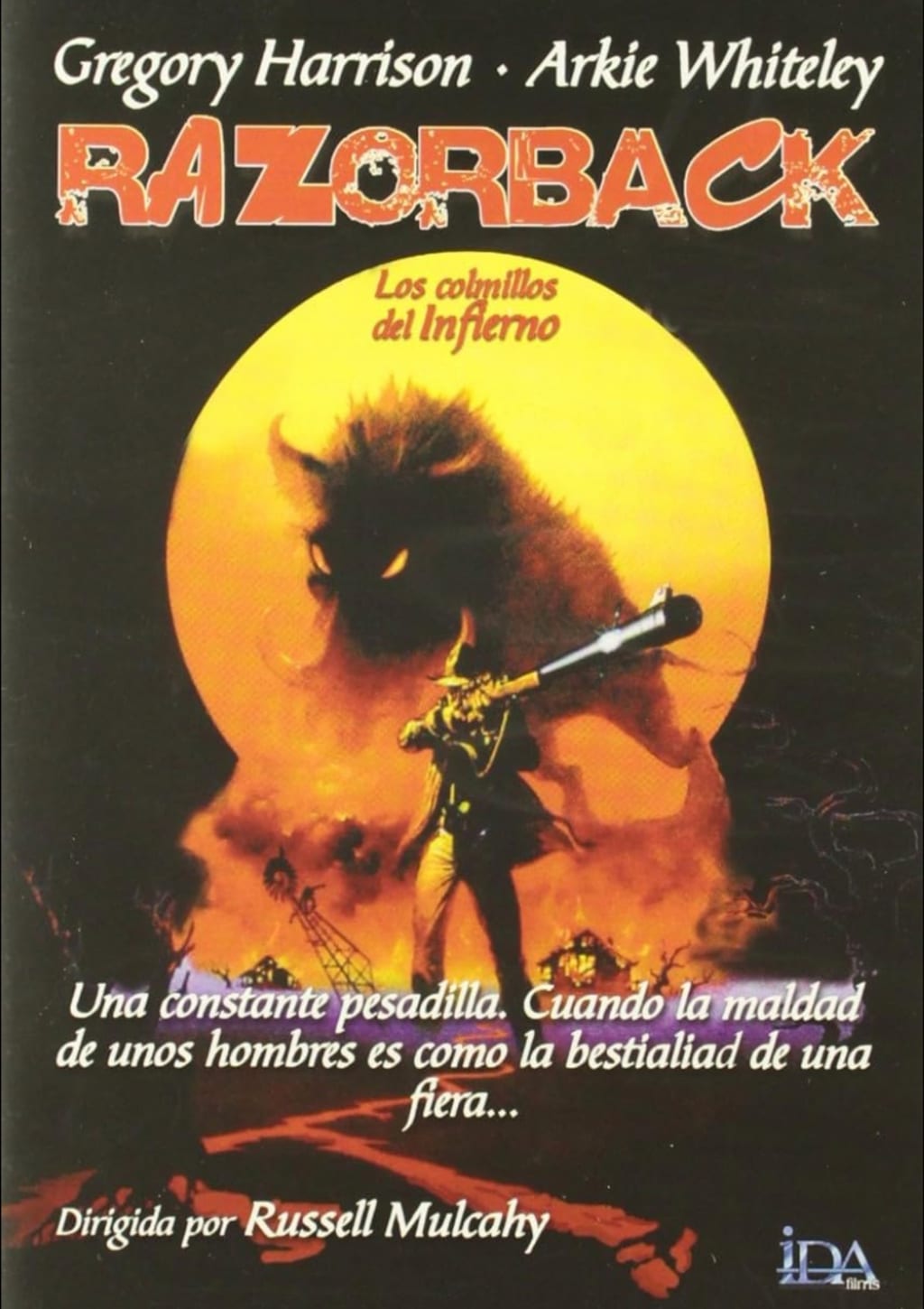
Man versus nature is a classic set up for a horror movie and music video veteran turned first time feature director, Russell Mulcahy, found himself one heck of a unique idea for a human versus nature horror flick.
Logline: “A massive, man-eating boar terrorizes the outback”
Razorback on DVD
Razorback was based on the 1981 novel Razorback by author Peter Brennan. The novel was a lengthy and complex story weaving conspiracy theories and human elements.
Screenwriter Everett De Roche, best known for his screenplay for the horror flick, Harlequin, was hired to adapt Brennan’s book. De Roche’s approach was to strip down the story to a more basic and cinematic idea - Razorback the Boar as Bruce the Shark from Jaws on land.
De Roche is also said to have spiced up the story with touches reminiscent of the then recent case of Azaria Chamberlain, the famed ‘a dingo at my baby’ case.
Via producer Hal McElroy, known for Picnic at Hanging Rock, Razorback was backed by a $5.5 million dollar budget. It was quite an ambitious venture for Australian cinema of the time. In an effort to shore up international appeal for this big project, director Russell Mulcahy sought an American star and settled on Jeff Bridges.
Hiring the Star
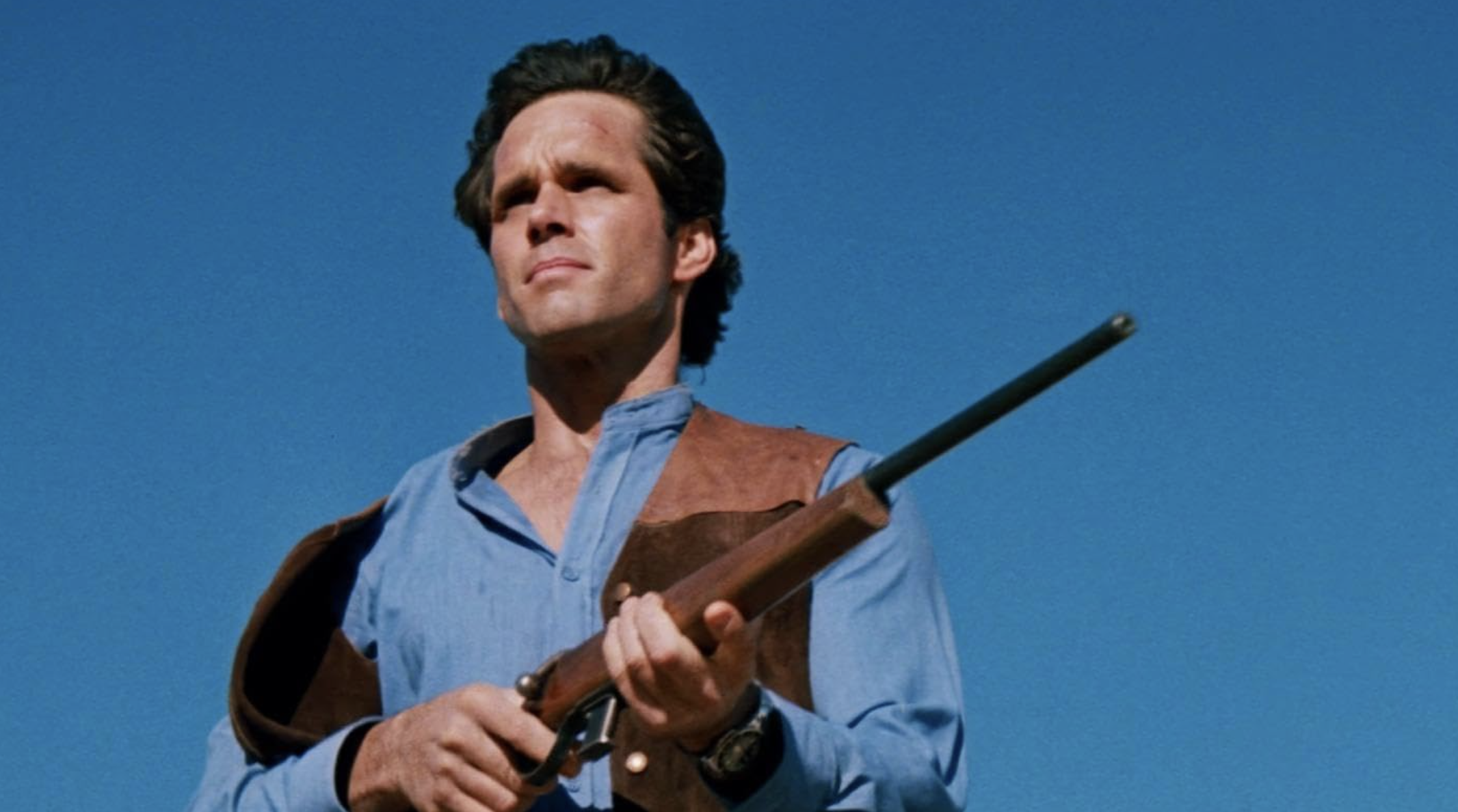
But, Hal McElroy said Bridges lacked international star power. In his place, actor Gregory Harrison. Now, I can hear you scoffing. Certainly time has revealed that Jeff Bridges is a much bigger and more beloved actor than Gregory Harrison whose name you likely had to google to see if you can recall him.
In 1984 however, Harrison was a major American television star and his casting wasn’t entirely controversial. Harrison had cache in America and for an expensive Australian production, he came with a less eye-watering price tag and more upside potential than a more established feature film actor.
Dean Semler and the Beauty of the Outback
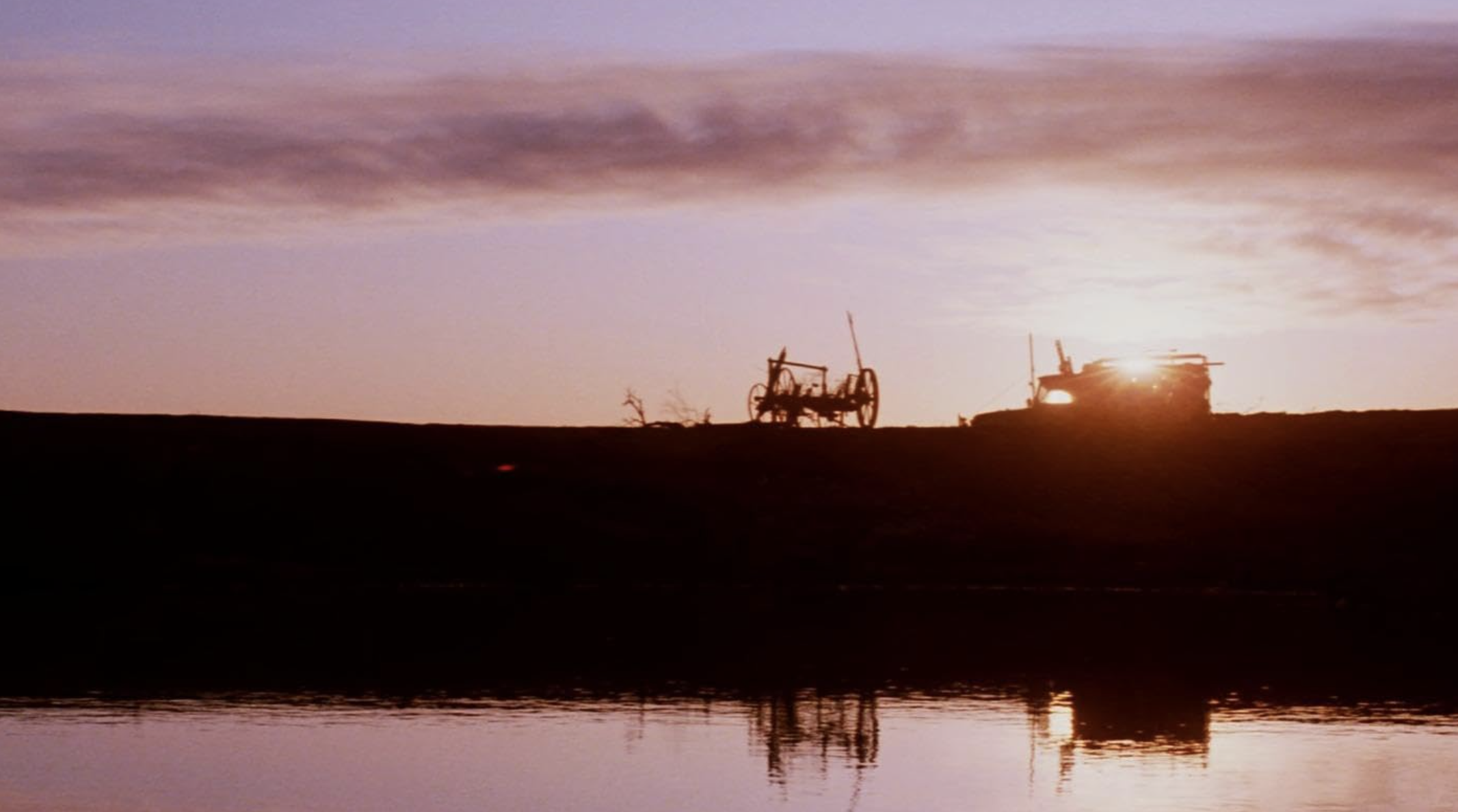
Production on Razorback commenced on June 3rd, 1983 in Broken Hill New South Wales used to capture the harsh, visually striking look of the outback. Cinematographer Dean Semler, recently off of working on Mad Max 2, was hired for his expertise in filming in rough environments.
The result was awesome. Beautiful, high-contrast desert visas, silhouettes, and atmospheric shots. The production was one of the first to use new fast Kodak film stock which contributed wonderfully to the high resolution imagery that was unusual for the era.
Making the Razorback
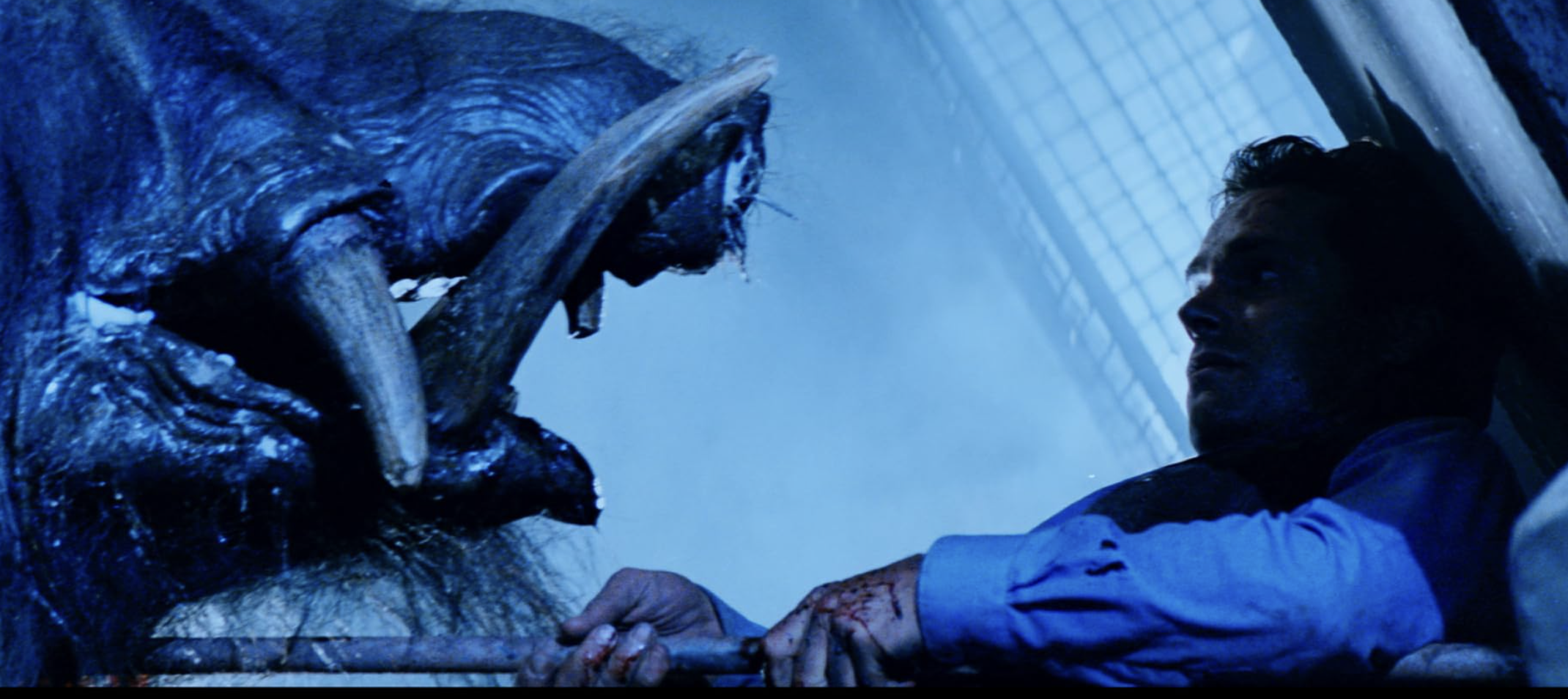
But, of course, if Razorback was going to succeed, much of the success would ride on the back of that villainous wild boar. So, Mulcahy and McElroy turned to special effects artist Bob McCarron.
McCarron, known for The Road Warrior, and soon to begin work on Mad Max Beyond Thunderdome, decided that animatronics would be the way to bring Razorback to life. McCarron created 6 animatronic boars, including one that was specifically used for ramming vehicles.
The animatronics were operated mechanically. The evil boar thus had six separate versions each with a different and distinct purpose. They were a mix of full scale models and puppets that allowed for more control on exactly how the boar could be utilized on set.
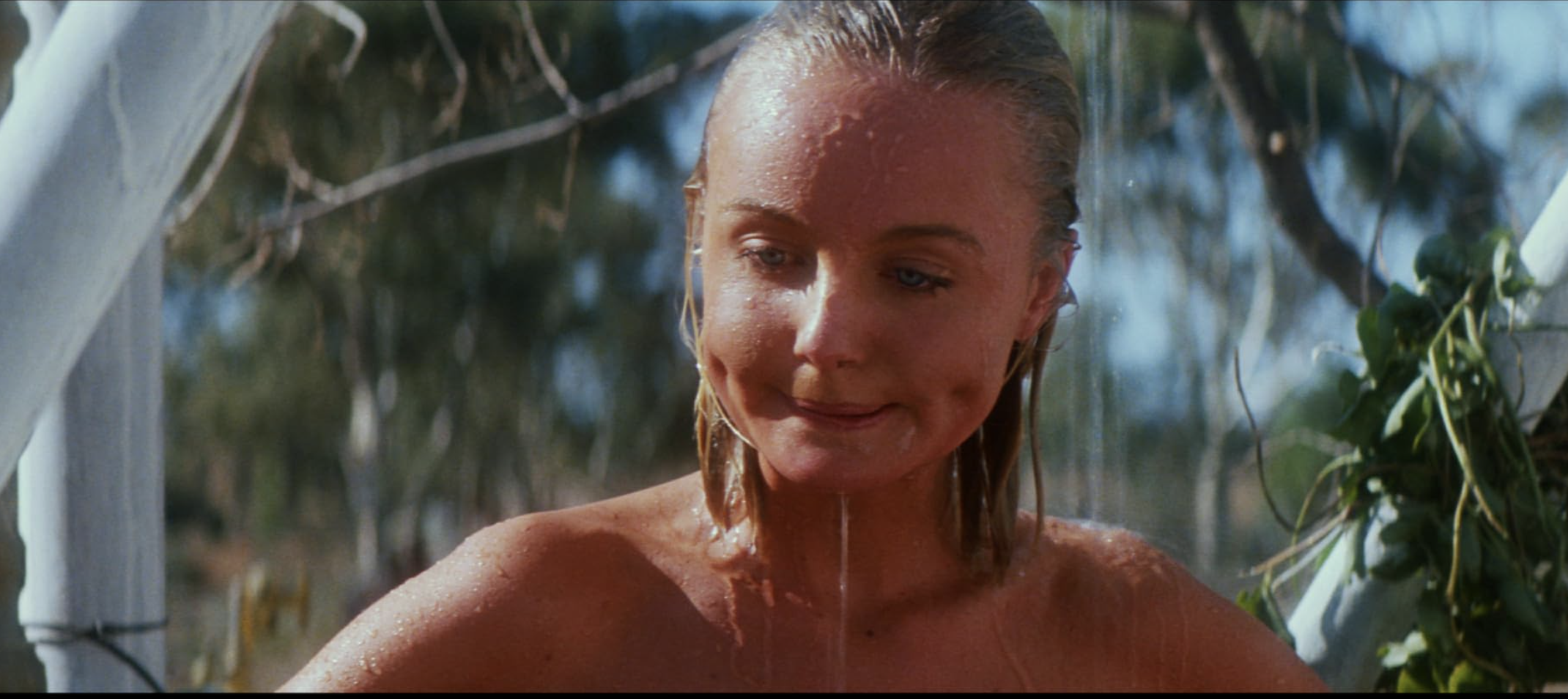
Joining Gregory Harrison in the cast was Bill Kerr as Jake Cullen, a grandfather whose grandchild is killed by Razorback. Cullen is out for revenge and allows Harrison’s Carl Winters to join him after Carl’s wife, Beth (Judy Morris), an American journalist, goes missing in the outback.
Arkie Whiteley plays Sarah, Cullen’s daughter and Aussie character actors, Chris Haywood and David Argue took on the role of the Baker Brothers, Aussie outlaws trading in illegal kangaroo meat, giving the film a human villain to go with the boar antagonist.
The film's auditory landscape was shaped by Iva Davies of Icehouse, whose synth-heavy score provided a haunting, atmospheric layer to the production. Filming in the bush brought the expected hurdles of sweltering heat and pervasive dust, yet Mulcahy has frequently highlighted the strong sense of camaraderie among the crew during those isolated weeks.
A bit of trivia from the set: Arkie Whiteley opted to film her shower sequence personally, declining the use of a body double.
The film has strong Ozploitation vibes—exaggerated visuals, gritty human villains, and pulp thrills elevated by technical craft—but with Mulcahy’s flair for dynamic camerawork and editing.
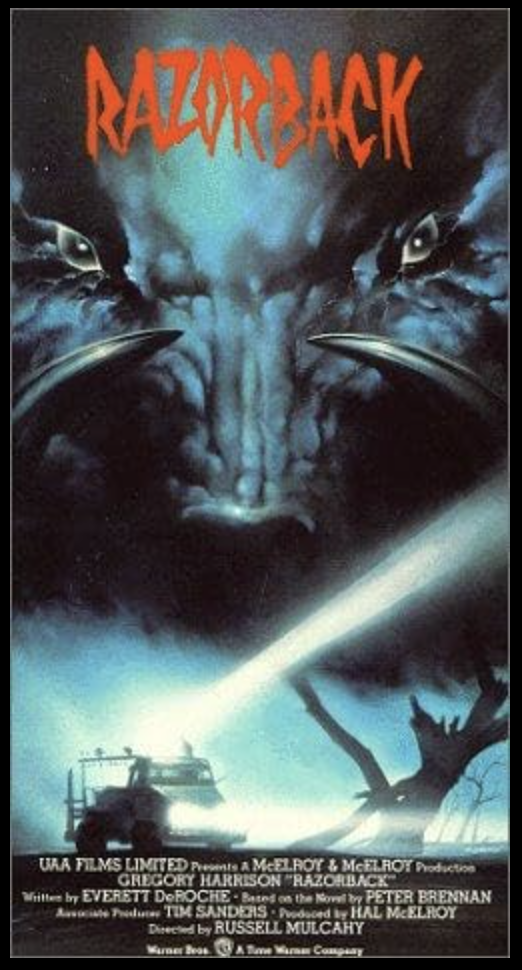
Rollout and Box Office Failure
ReleaseAustralia: 19 April 1984 (Greater Union Film Distributors).
United States: 16 November 1984 (Warner Bros., limited release).
Other markets followed (UK in September 1984, etc.).
Razorback, unfortunately didn’t play well at the box office. The film earned a disappointing $800,000 dollars in Australia and a devastating $150,000 in America. It’s unknown if Razorback ever turned a profit with the addition of home video revenue but it was said to be well received on VHS.
Home video releases have been strong, especially from Umbrella Entertainment in Australia:DVD (2005) with extras like the 70-minute “Jaws on Trotters” making-of documentary.
Blu-ray (2014/2018) with commentaries, interviews, and remasters.
A 4K remaster in 2023.
Critical Assessments
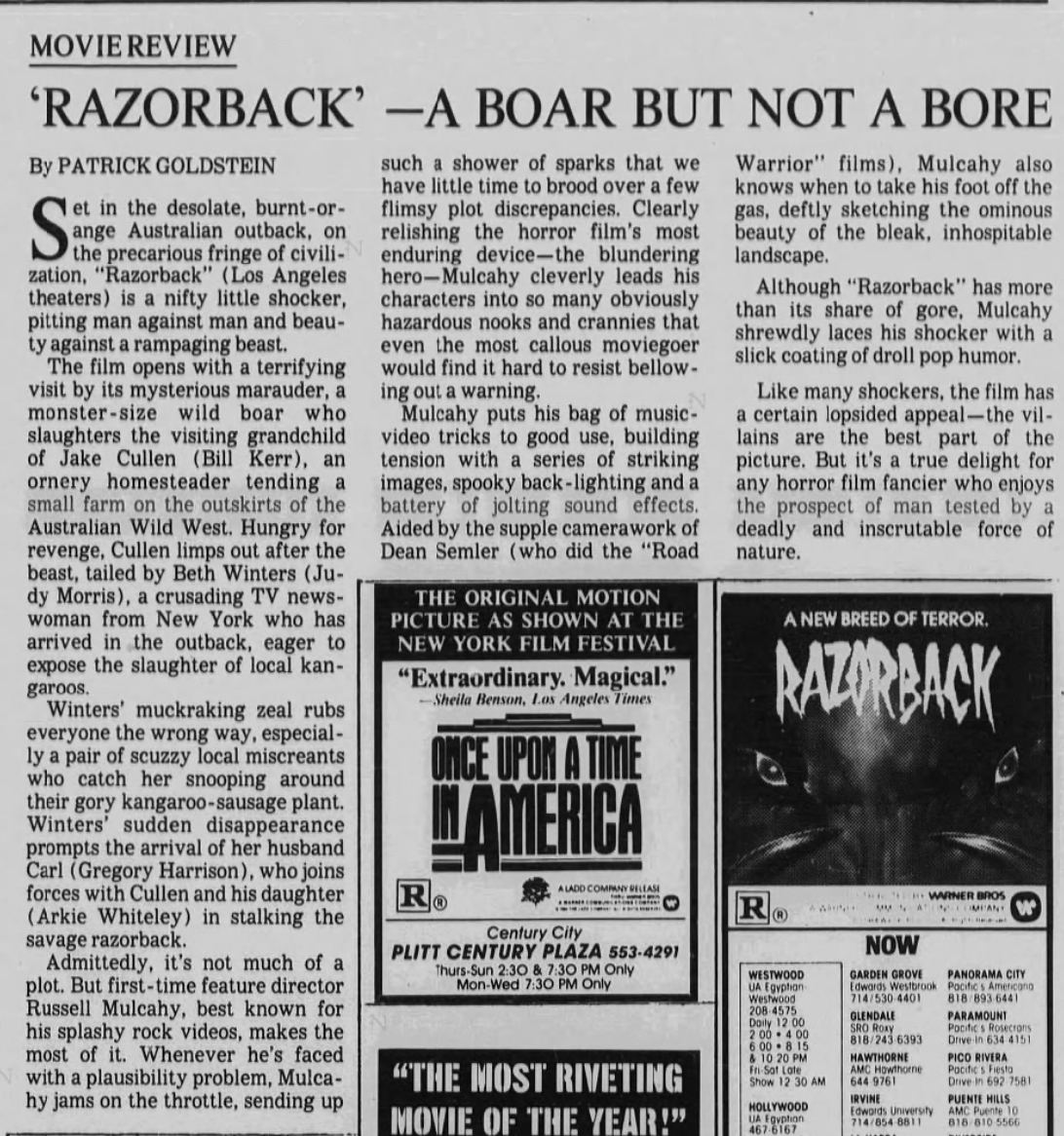
Critical reaction for Razorback was mixed. Critic Patrick Goldstein’s review in the November 20th edition of the L.A Times carried the headline “Razorback - A Boar but not a Bore.” Goldstein praised the film's cinematography by Dean Semler and stated that the film had a ‘rtain lopsided appeal.’
Today, on Rotten Tomatoes, it holds a 58% score from a small sample of reviews (average ~5.8/10). Praise focused on the stunning cinematography by Semler, Mulcahy’s stylish direction, the eerie outback atmosphere, and practical effects. Criticisms included repetitive plotting, uneven acting, and the limitations of the prop boar making some scenes silly.
Variety called it an “extremely handsome production.”
Empire and TV Guide gave it 2/5, noting effective nightmare style but weak prop and acting.
It’s often compared to Jaws as Australia’s standout creature feature.
Razorback’s biggest win came when the film won the Australian Film Institute Awards for Best Cinematography and Best Editing, while also earning nominations for screenplay, score, sound, and production design. Dean Semler also won Cinematographer of the Year from the Australian Cinematographers Society.
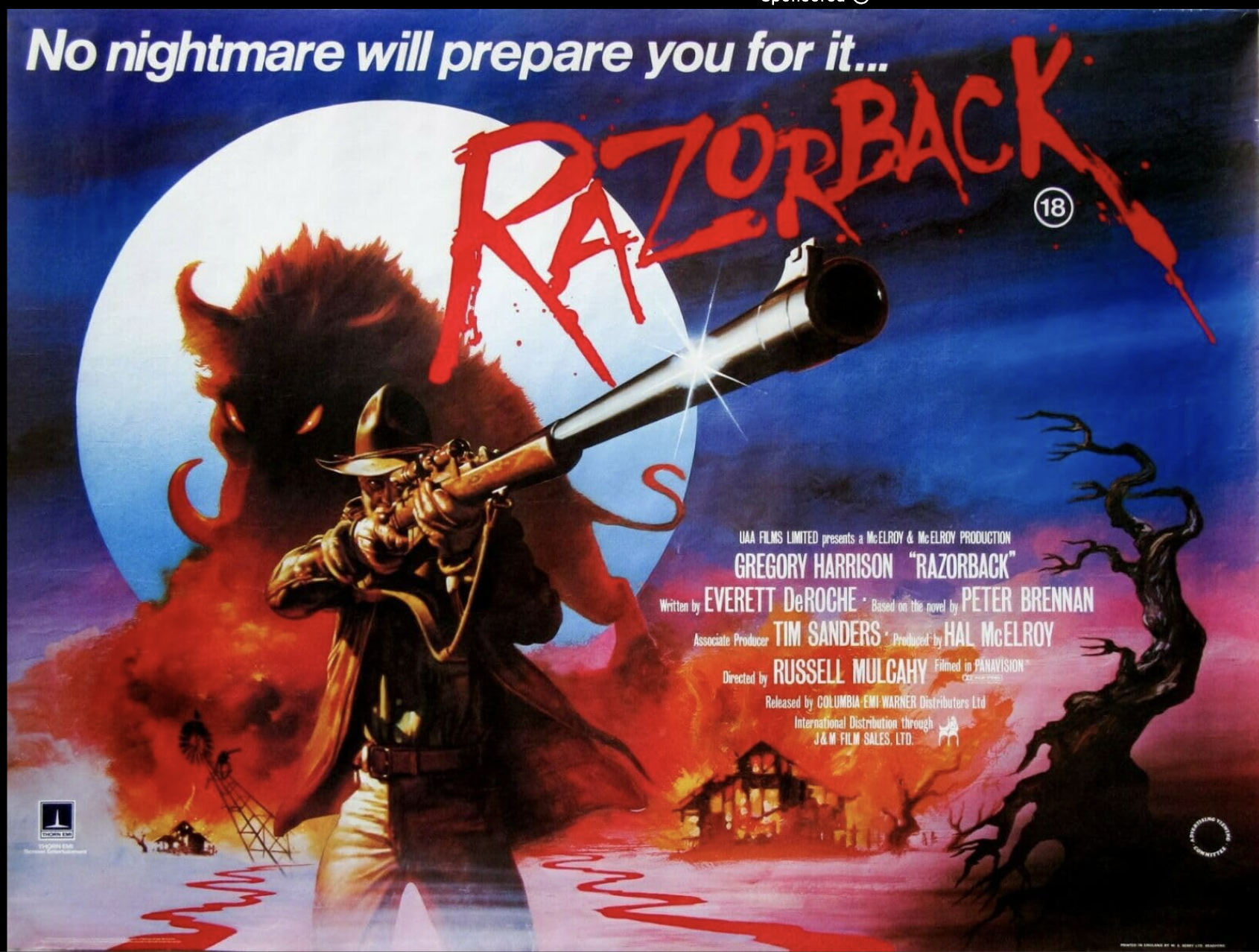
Legacy
In the decades following its release, Razorback has evolved into a definitive cult classic, particularly among enthusiasts of Ozploitation, practical craftsmanship, and the creature-heavy hallmarks of the 1980s.
While it certainly possesses its fair share of narrative imperfections, the film is celebrated for its evocative visuals, the visceral brutality of its outback setting, and its sheer pulp energy. Its influence has trickled into broader media—even receiving a nod in the Ty the Tasmanian Tiger video game—and it remains a staple for anyone seeking a giant monster flick with a uniquely Australian bite.
Ultimately, though it failed to set the box office on fire, Razorback endures as a technically sophisticated and indelible piece of 80s horror. It serves as a striking showcase for the bold technical ingenuity and wild spirit of Australian genre cinema. For fans of practical creature work or atmospheric outback thrillers, this one is absolutely worth a look—particularly if you can track down one of the high-quality remasters.
About the Creator
Movies of the 80s
We love the 1980s. Everything on this page is all about movies of the 1980s. Starting in 1980 and working our way the decade, we are preserving the stories and movies of the greatest decade, the 80s. https://www.youtube.com/@Moviesofthe80s
Enjoyed the story? Support the Creator.
Subscribe for free to receive all their stories in your feed.
Comments
There are no comments for this story
Be the first to respond and start the conversation.