
There was just one test to take. No need to measure aptitudes or abilities. The baseline requirement was a minimum of two years of doctoral studies and a thesis that showed readiness to work in two disciplines. There were few enough of those who would sign up for this project. So it was just a standard Meyers-Briggs test, the plain version that organizations use for team building. 4 axes designed to forecast interaction and co-operation of a team. 40 or so simple questions. The outcomes? On a scale of 1-10, how much of an extravert are you? Or if not, how much of an introvert on the same scale? Same with the other qualities. E for extravert, I for introvert; T if you approach questions mainly by thinking (again 1-10), otherwise F if by feeling. S for sensing, and on the other side N for intuiting. J for judging versus P for perceiving. Not the subtlest way to parse people, but worth doing to sort us into groups. Over the next three months of working together, how would different personalities interact? Would they get along? This way we could be sorted into pods, each one with a variety of Meyers-Briggs profiles, I guessed.
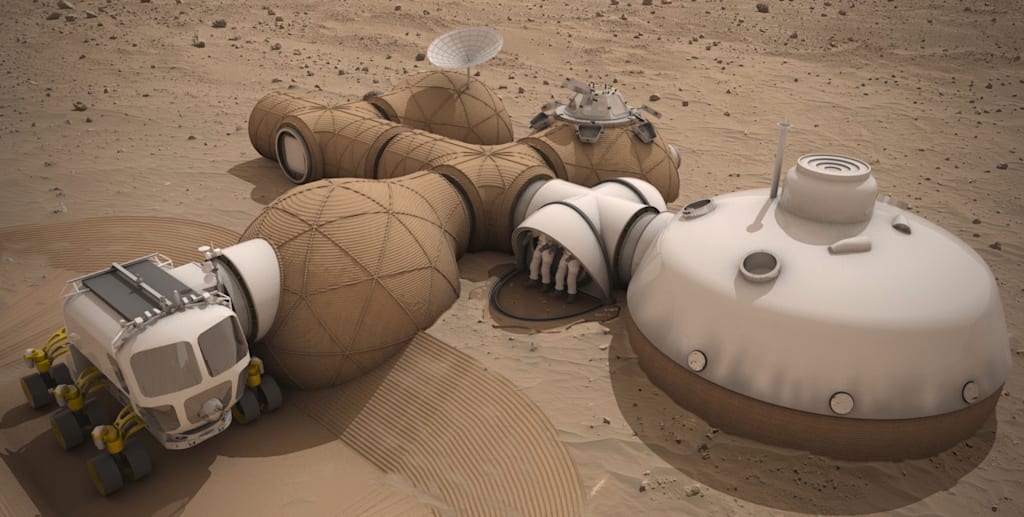
Oh the project? Right. A simulation of living and working in the soon-to-be operational human colony on Mars, which was planned for three groups of sixteen interdisciplinary scientists who would be sent back to Earth once every three months. Our simulation was held in the winter in Greenland, a reasonable approximation of the Martian environment, our commitment to stay the three months without once leaving. We were to be the guinea pigs for the real thing.
We were 48 grad students, all encouraged to make progress on our thesis work, because the real colony would have researchers pursuing various tasks. 48 people, split into 3 pods of 16, each with a dorm and a dining area. No cell-phone service, no Starlink. Radio communication from the Mars colony to Earth and back would take up to 44 minutes. Our base had one radio for emergencies, with an electronic delay of 22 minutes on each side. Nothing was left to chance. One pod even had an artificial ‘light-gravity floor’ to simulate Martian gravity. The base had its own greenhouses, and an advance team had done the task of planting them. It would be a meatless three months.
Two MD PhDs were with us, in case of medical emergency that they could handle. We were all fitted with a new kind of defibrillator, a little medical device placed surgically just under the skin, the kind that patients with arrhythmia have. They monitored us all physiologically for the experiment. Sensible. Every program member’s heart rate would be surveilled remotely. We were paid extra for this minor surgery, which, otherwise, we would not have needed.
Why did I sign up, you ask? Well the money was good, for a grad student in philosophy very good. And I had just broken up with my girlfriend of 5 years. I proposed, she said, well, what she answered was a little more definitive than no. And I’m behind in my dissertation. So three months well paid, a change of pace, time to concentrate on my thesis plus the light duties of the project (harvesting, tidying, taking turns at cooking, logging observations) seemed like just what I needed. In short, a radical change of scenery and a very good amount of what the Beverley Hillbillies called ‘Venician avocado,’ greenbacks.
Like Mars, Greenland is partly covered with a thin sheet of ice. The NASA competition to design the Mars Habitat came up with an ‘ice house,’ because ice was readily available, but when it came down to the project, they decided on a thin, durable carbon kind of cardboard that they could make with a 3D printer. Practical, and durable enough for us. Our project was being run by an independent business, arms length from the entities planning the missions (NASA, SpaceX).
6:00 p.m. 6:00 p.m.
Our group assembled at the international military base in Thule. From there we were flown to ‘Mars’ in ‘Hercs.’ I sat beside Steve, the group leader, who was to be my bunk-mate on Mars. Steve was quite an extravert, E-8 in fact, so someone had paired him with my I-3 result. “I’ll take the top bunk, you’re too tall for that,” Steve ventured in the first minute. “Did you look at the roster? We’ve got 18 boys and 30 girls,” he added helpfully. “I’m N-5,” he added. “I’ll bet you’re like me, coming off a breakup and glad to have the money.” Clearly N-5 was right. Steve was intuitive. He continued. “She caught me cheating. Some chicks are not cool with that. Say you’re not a judgmental J are you?”
“No, I’m Perceiving 9,” I explained. Clearly they had put opposites together. He nodded pleasantly. “There are more women than men in grad school,” I noted.
“Best thing about grad school,” Steve agreed, “along with pursuing the subjects you like. What’s your thesis on?”
“How do AI Agents know right from wrong?” I answered.
Steve whistled. “Well you will be highly employable,” he complimented. So you have degrees in philosophy for the ethics, and, I’m guessing, mathematics for the AI.
“Right on, N-5,” I answered, feeling in good humor with this character. “What about you?”
“Chemical biology and physical chemistry,” he explained. “Molecular interactions in a low-gravity environment.”
“Well Steve, I would say you’ve come to the right place.”
“That’s for sure,” he chuckled. A 5 to 3 gender ratio in my favor and a chance to do some scientific field work too. Say I have a thought for you. Check out that girl on the duffle bag. Swedish, name’s Inge, human physiology and the psychology of exotic environments. Exotic, get it? Too tall for me, but all that verticality would fit you well. And she’s in our pod. Just sayin’.”
Inge was a buxom brunette. I felt my neurons firing. Steve nodded sagely with satisfaction. Inge noticed.
Steve asked a question on his mind, “So if an AI agent is programmed by humans, how could it go off the rails morally? How could it do things that are wrong?”
“My grandmother lived alone on a farm and she had a German shepherd,” I explained. “She kept chickens, and they went on her front yard. She didn’t want that, so she looked the dog in the eye and said, ‘Keep those chickens off the yard.’”
“How did that work?” Steve asked.
“Too well,” I answered. The dog put his jaw bone on the ground to hear better. As soon as a chicken ventured onto the yard he heard it and he killed it. Grandma had chicken for dinner every night until there were none left.”
8:00 p.m. 8:00 p.m.
The buildings were small, but functional. We were given a cold supper for the first night. We had been cleared for substance abuse, so wine was on the menu, an off-dry Riesling. We grouped within our pod for dinner seated around a long acrylic boat table. Inge sat with me. “I saw you talking with Steven,” she began. “He’s an extravert. I’m an extravert. Two extraverts can’t be intimate. They both talk too much. You’re not an extravert.”
“No,” I admitted, “I’m I-3.”
She smiled. “Did you break up with someone and that’s why you’re here?” she asked, not unkindly. I nodded. “What did you quarrel over?” she asked.
“We fought over AI,” I explained. “I study it, she wanted nothing to do with it.”
“She left you over AI?” Inge asked, incredulous.
“Yes, but how do you know she’s the one who broke it off?” I asked.
“Well, you’re cute, you’re quiet, discreet, kind, I think. I believe she broke it off, but that is a stupid reason.” She looked at me kindly. “Please excuse me, I’m bringing up bad memories, and I know better than that. Let’s go for a walk. I want to try the light gravity floor. Are you up for that?”
8:15 p.m. 8:15 p.m.
The facility was on the second floor, right above us. We climbed the metal staircase to find a large, empty room, leaving the laughter of the winers and diners below us. There was a control box. The handle was set at 100 on the dial. “Hmmn,” Inge pondered. “100 must be the force of gravity on Earth. 100 percent of that. So the off position. What percentage of Earth’s gravity is the gravity on Mars?”
I happened to know that. “38 percent of Earth’s gravity.”
“Okay,” she remarked, and moved the handle. “Oh, you’re right. There’s an M marked right beside the 38.”
There was an electrical hum, and a low rumble. My spine straightened. “How are they doing this?” I asked.
“Who knows,” Inge answered. I heard it was a breakthrough by one of the Swedish teams. Most of the scientific teams and management are Swedish.”
I jumped vertically, like a basketball player. I could feel other effects as well.
“Oh, I hadn’t thought about that. You’re getting big, really big. Let me see! I’m a physiologist.” Without another word she undid my pants and pulled them down. “Oh it’s huge!” she enthused. And it was.
“Oh what if I stimulate you a bit?” she asked. “Don’t worry. I’m a physiologist. I want to see how far this effect goes!” And without waiting she planted a kiss on me, with tongue. The member grew further. She touched me. Still further. “Oh, we must NOT waste this,” she decided. I have a condom. She threw off her clothes, wearing only a watch. And deftly she put the condom on me and pulled my hand to her breast, kissing me passionately. “Don’t rush,” she ordered. “Enjoy the sensations.”
I drew her close, felt the warmth of her body on my boiling blood, massaged her gently. I was putty in her fondling hands. I do not know how long we embraced, but suddenly a metallic voice sounded from the speaker in the ceiling. I could not understand. It sounded like German. “Quick,” she said, “we have to find the others.”
Turning the gravity back to normal, I dressed and ran down the stairs rapidly.
9:10 p.m. 9:57 p.m.
Downstairs our team had been joined by three people from the next pod over. “Pass the Riesling,” the comparative literature scholar at the end of the table demanded. Someone’s drinking my share!” The bottle was passed hand to hand.
Inge interrupted. “Listen everybody, something’s off.”
Heads swung around. “What do you mean?” the logician asked.
“That message. You must have heard it. In Swedish.”
“There was no message,” the literature scholar objected.
“We heard it,” I interjected.
“It said subjects 7 through 13, 18, 21, and 37 through 48 successfully neutralized.”
“You sure?” The logician asked. “Is your Swedish that good?”
“It’s my mother tongue,” she replied acidly.
“Well,” the literature scholar rejoined, “I’m number 13, and if I was neutralized, as you say, I didn’t notice.”
A noisy discussion ensued.
I turned to Steve. “There are two more pods, right? Why don’t I check on one and you check on the other, just to make sure everything’s okay.” Steve agreed, we split up, and left to look in on the others. I went to Pod 1, at the east end of the complex. Happy sounds greeted me at the door, joking, and drinking. Some of the men were trying to impress the ladies.
“Did you just hear a message?” I asked. “A metal sounding voice speaking Swedish?”
One man snorted, unable to contain himself. “What kind of wine did they give your pod? There’s been no message. Satisfied, I returned to the dinner table at my own pod. They were all arguing with Inge, some of them asking how much she had imbibed, others wondering what we two had been doing. Her pale complexion had reddened considerably. Steve was not back yet.
9:50 p.m. 10:37 p.m.
Suddenly there was the beeping of a roomful of monitors, going off all at once, then confused gasps, then screams, then stunned silence, followed by shouting in the hallway and the footsteps of people running to our room. Inge was sobbing uncontrollably. “I told you,” she said. “I told you what the voice said.
“What just happened?” a woman from Pod 3 shouted. “Half of our pod just got electrocuted.”
“Where’s Steve?” I asked.
“Don’t ask me,” she said. “I haven’t seen him since we arrived here.” We soon had a count of casualties: 21 dead plus one missing (Steve). And what’s all this about a message?”
“Get to the radio right away,” I insisted. “It has a built-in delay.”
“I tried,” someone said. “It’s not even connected.”
“At that moment the metallic voice repeated, still sounding to me like German. “What exactly did the voice say?” one of the people from Pod 1 asked Inge.
She translated the message into English. There was a confused silence. “It is the same message word for word,” she said. “I have an eidetic memory.
“You heard the first message too?” I was asked. I nodded.
The astrophysicist turned to Inge. “You’re wearing a watch. What time is it?” Inge answered. “Your watch is about 45 minutes fast”, the astrophysicist observed. “Why is that?”
Inge shook her head. “That’s impossible. I set it in Thule.”
“And you,” the astrophysicist turned to me.
My watch agreed with Inge’s.
“Did you turn on the artificial low gravity?” she asked. We nodded. “Then you were in our future. Low gravity makes time speed up. You heard the message in what would have been our future. You heard it before we did. The room was shocked.
“Where is Steve?” I repeated.
“I saw him go down a corridor towards the outside of the complex.”
“If he left, how could he cope with the cold?” I objected.
“He must be in on the plan,” the logician spoke. “The organizers left him a way off the base. Some transportation.”
“Where are the two surgeons?” someone asked. We’ve got to get these defibrillators removed.”
“They’re both dead,” someone answered.
“Then we’ll cut them out ourselves with kitchen knives.”
The logician interrupted. “No, whoever or whatever this is, they are watching. If we attempt to take them out, they will activate the voltage again.” He turned to me and Inge. “You two go upstairs again. Turn on the low gravity. As low as you can. Knowing what’s coming is our best chance.”
Nervously we climbed the stairs, and threw the switch for low gravity. We had no thought of fun and games. I watched Inge to make sure she did not go into shock. I hoped she was watching me for the same symptoms. At length, we heard the same metal voice, again sounding like German to me. “What did it say?” I asked Inge.
“I’m so sorry,” she said.
About the Creator
Paul A. Merkley
Mental traveller. Idealist. Try to be low-key but sometimes hothead. Curious George. "Ardent desire is the squire of the heart." Love Tolkien, Cinephile. Awards ASCAP, Royal Society. Music as Brain Fitness: www.musicandmemoryjunction.com
Enjoyed the story? Support the Creator.
Subscribe for free to receive all their stories in your feed. You could also become a paid subscriber, letting them know you appreciate their work.
Comments
There are no comments for this story
Be the first to respond and start the conversation.