
He spent most of the next morning sitting at his kitchen table telling himself he wasn't going back.
Then he packed a bag, put on better shoes, and drove to Holloway House.
Better shoes was something. He'd figured that out — rubber soles, soft step, quiet on the hallway floors. He also brought a thermos, a headlamp with new batteries, and a small Bluetooth speaker he'd found in a drawer that barely worked anymore. He had an idea about Silas.
Security room first. He always did security room first now. Monitors: Mabel upstairs in her circuit, moving the same path she always moved, slow and heavy and exactly the same. Silas at the top of the shaft, dark shape visible through the cage door on camera six. Not moving. Waiting up there, the way he waited, that flat patience that was worse somehow than if he'd been active.
And the Child in the waiting room. Same chair. Same position. Looking at the door.
He glanced sideways at the dark monitor to his right, reflex, and caught the Twin in the reflection — standing just behind his shoulder, looking at the monitors with him. He looked directly at the screen. Nothing there. He looked sideways again. Gone.
He put the Bluetooth speaker near the east wing elevator panel, connected his phone, started a white noise track — low, steady, the kind of sound that comes from inside a shaft. Let it run. On camera six, Silas tilted. Oriented. Stayed near the sound.
Good. He'd stay up there chasing it.
Sufyan went to the basement.
He kept the headlamp low on his way down. Soft soles, slow steps, hand on the wall to keep his balance on the stairs. He'd learned to move quietly. He'd learned a lot of things in this building that he wished he'd been able to learn somewhere else.
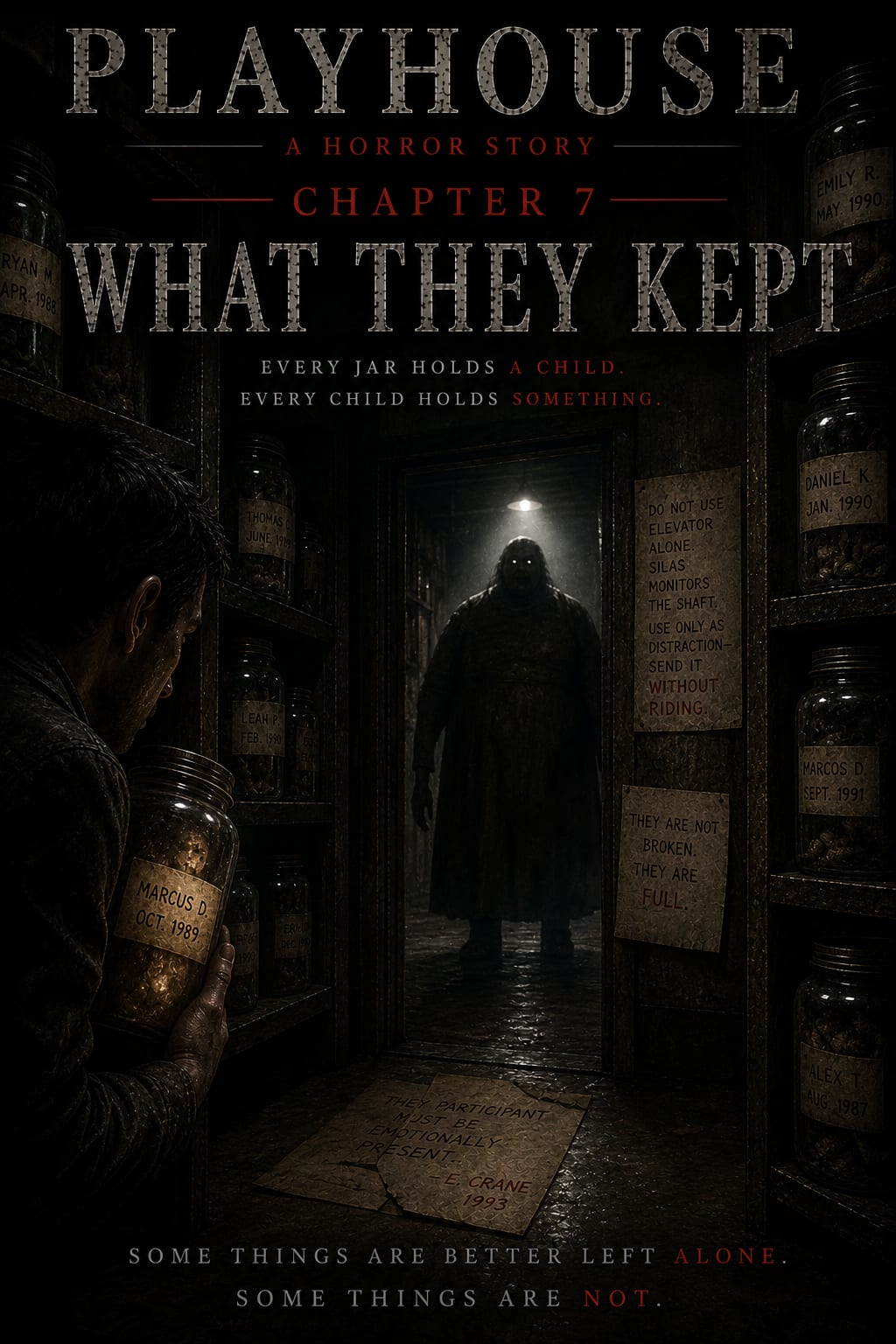
The jar room.
Three hundred and sixty-seven jars, he'd counted on the second visit. He'd corrected himself — four hundred and twelve. He'd been off on the first count and hadn't wanted to be off, so he'd counted again.
He sat on the floor, back against the shelves. Thermos beside him. He picked up the first jar.
RYAN M. — APRIL 1988.
Warmth in his hands. That pulse of something alive. And then a flash — brief, specific — of a child's first-day fear. The particular fear of being somewhere new when you're small and don't understand the rules yet. Not knowing if this is safe, not knowing what safe looks like here. It was sharp and real and it was gone in two seconds.
He held the jar a moment longer. Just to acknowledge it. Then he put it back, carefully, back in its exact spot, and picked up the next.
He didn't rush. He'd figured out quickly that rushing was wrong. These were real kids who had felt real things and needed somewhere to put them, and treating them like inventory would be wrong. So he went slow. One at a time. Paid attention.
Some were fear. Clean, specific, situational fear.
Some were grief, the slow kind, the kind that had nowhere to go.
One was pure anger — a child's anger, quick and hot and completely justified, the anger of something very small being treated unfairly by something very large that didn't care. He felt it and felt the fairness of it and put the jar down.
One was loneliness that had no specific cause attached to it. Just the ambient ache of being different without knowing why, being in a room full of people and feeling far from all of them. That one sat in him for a while after he put it down.
One was relief.
He stopped at that one. MARCUS D. — OCTOBER 1989. Warmth, and then: a kid who came here scared and was heard and is leaving lighter. The specific relief of having put something down somewhere safe and trusting it would be held.
He sat with that one longer than the others.
Around the tenth or eleventh jar he heard something in the hallway outside.
He turned his headlamp off. Complete dark.
Footsteps. Heavy. Slow. Not the mechanical sound of the elevator, not the building settling. Footsteps. Coming down the basement stairs.
He stood up between two shelving units and pressed himself against the shelves. He didn't move anything. Not his hands, not his feet, not his head. He breathed through his nose in the smallest amounts he could manage and he waited.
Mabel.
She hadn't come to the basement before. He'd assumed she stayed upstairs. He'd been wrong. He filed that away in the cold part of his brain that was keeping track of things while the rest of him was focused on not making a sound.
The footsteps came down the hallway. Getting closer. And now that she was close — really close — he could hear the other sounds she made. A low, constant sound, almost below hearing, almost felt rather than heard. And her footsteps weren't just heavy, they were textured, each one landing with a slight unevenness that shouldn't have been there, like something about her weight distribution was wrong.
She came right to the jar room door.
Stopped.
He stood in the dark two feet from the door and didn't breathe.
She was very large. He knew that from the cameras. From here, with just a thin wall between them, he understood large differently. The way she filled the doorway wasn't just physical — it was the sense of something enormous and very old and very full being very close to you while you stood in the dark and couldn't move.
She was listening.
He'd been quiet. He was certain he'd been quiet. He'd been quiet from the moment he heard her on the stairs. But she was still standing there. Still.
One minute.
He counted in his head because his brain needed something to do. Sixty seconds. Seventy. Ninety.
Two minutes.
She made a sound. Not a word, not a creak of the building. A low sound, coming from inside her, like a building settling, like pressure equalizing, like a jar that had been sealed for too long and was now venting slightly. Just that once.
Then the footsteps moved again. Away from the door. Back down the hallway. Up the stairs.
He waited another full minute before he turned the headlamp on.
His heart was doing something violent and fast and his legs had the wrong kind of feeling in them, that hollow shaky feeling that comes after your body has been ready to run for a very long time and didn't get to run. He breathed through it. He sat down on the floor. He gave himself three minutes and not one more.
Then he picked up the next jar.
By the end of the session he'd gotten through roughly a third of them. His legs ached from the floor, his back was stiff, and his head had that specific cleared-out feeling — like something that had been taking up space was gone. Not his space. Theirs. He'd been a conduit for it, briefly. He didn't have a better way to describe it.
He went back up. Turned the speaker off. On camera six, Silas reoriented and retreated to the top of the shaft.
He went to the waiting room. The Child was in its chair.
He sat across from it. Poured coffee from the thermos.
"One of the jars was just relief," he said. "A kid feeling better." He drank. "It's in there with all the rest. I wasn't expecting that."
The Child looked at him.
"I keep thinking about what this place was," he said. "Not what it became. What it actually was, when it was working. Kids coming in and being heard." He looked at the shelves through the doorway, the ones visible from here. "All of that is in those jars too. Not just the bad stuff."
He stood up.
"Two more sessions, maybe three. Then the jars are done."
He left.
On the way to his car he looked back at the building through the front window out of habit. The mural. Four figures. He counted them. All there.
He nodded at them. He was aware that was a strange thing to do.
He got in his car and sat there for a second before starting it.
His phone showed one new message. The therapist confirming Thursday.
He'd forgotten about Thursday for most of this day. That was new. Something else had filled the space.
About the Creator
Enjoyed the story? Support the Creator.
Subscribe for free to receive all their stories in your feed.
Comments
There are no comments for this story
Be the first to respond and start the conversation.