
Crane's letter was four pages and he read every word twice.
It started with an apology to whoever found it. Sorry for what the place had become. Sorry he hadn't intervened when there was still a cleaner way to intervene. The handwriting was steady for most of it, but on the last page it got looser, more tilted, like his hand had been shaking when he wrote it.
Then he got into the actual thing.
The Companions weren't broken. That was the core of it. They were doing exactly what they were designed to do — absorbing emotional material, orienting toward distress, seeking resonance. The problem was nothing had been released in thirty years and now they were so full that everything was pressing outward. The program was still running. It just had nowhere to go.
The jars in the basement held what the children had released during sessions — sorted, sealed, contained properly. But the Companions themselves had accumulated something different over the years. Thousands of sessions. The ambient weight of decades of being in rooms with grief and fear and loneliness and trauma. That couldn't go in jars. That had to go through a proper session.
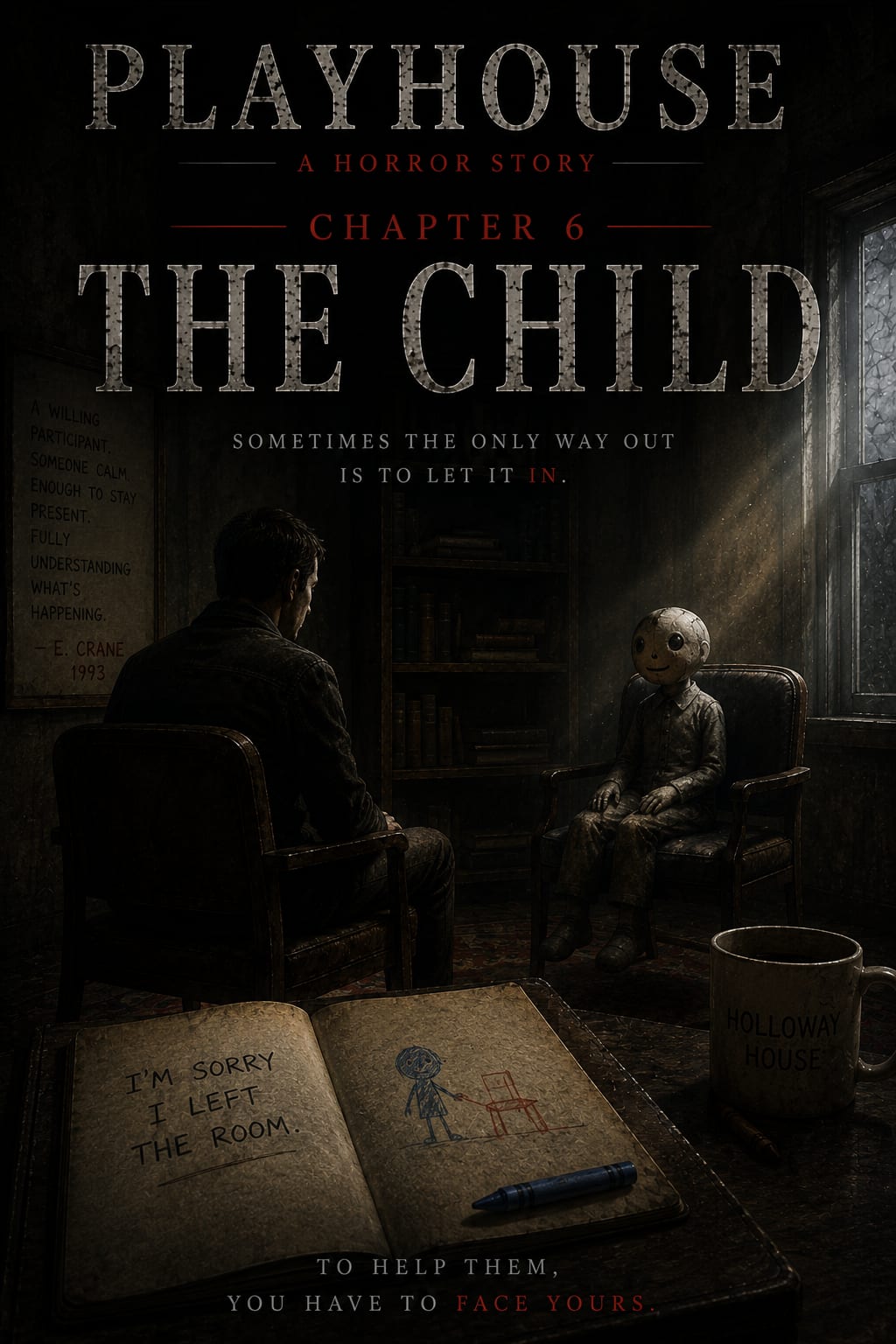
*I know this seems unreasonable given their current state,* Crane had written. *They are frightening. I built them and I find them frightening. But they are still — underneath all of it — what they were always built to be. A willing participant. Someone calm enough to stay present, fully understanding what's happening. They will get the version of the Companions they were designed to meet. The aggression, the relentlessness — that is only what happens when everyone runs. When no one is willing.*
Underlined at the bottom of the last page: *The participant must be emotionally present. Not fearless. Just not controlled by it. Someone carrying something. Someone ready to put it down.*
He folded the letter. Put it in his jacket.
He looked at the Child across the waiting room.
"He wrote this for someone like me," he said. It came out flat, not a question.
The Child tilted its head.
He thought about the thing he'd been not-thinking-about for over a year. His father. The hospital. The argument that last day — a real one, a bad one, and he couldn't fully remember the specifics now, just the shape of it, the anger, the decision to leave the room. The three days after. The phone call from his aunt that he'd seen coming in and almost let go to voicemail.
He'd been referred to a therapist by his doctor six months ago. His blood pressure was high for twenty-nine, his sleep was bad, his chest got tight in ways that had no physical explanation. He'd booked the appointment twice and cancelled both times. He'd told himself he was fine. He'd been telling himself that for a year and a half.
He stood in an abandoned building holding a letter from a man who had built therapeutic figures that were now hunting him through elevator shafts, and thought: this is a very specific way to get a message.
"Okay," he said to the Child. "Where?"
It walked and he followed it down the hall.
The therapy room was the large one on the ground floor — east-facing window, good afternoon light, two chairs positioned across from each other, a bookshelf in the corner with some books still on it. The Child sat in one chair and looked at the other.
He sat.
He aimed his headlamp at the ceiling so the light bounced indirect. Put his notebook on his lap. Put his hands on his knees.
"I don't know how to start," he said.
The Child looked at him. Not impatiently. It had been waiting for decades. Five more seconds was nothing.
"I've never done this. Actual therapy. I had appointments." He paused. "I had a thing happen. About a year and a half ago. I've been — managing it. Or something that looks like managing from the outside."
The Child blinked. That slow, deliberate blink. It was paying attention.
He breathed in.
He let himself think about his father. Not the careful managed version he'd been running for eighteen months, kept at arm's length, looked at only sideways. The actual thing. The hospital. The argument. He made himself remember the specific words — he hadn't let himself do that before, had been stopping himself every time his head went near it — and the words came and they were bad and he stayed with them. The three days after. The fact that he'd thought he had more time. The fact that everyone always thinks they have more time. The specific way it felt to get that phone call and understand, in one second, that the last thing between them was a fight he'd walked out of.
He sat with all of it.
The room changed.
He felt it before he could name it. A quality in the air shifting, subtle the way a pressure drop is subtle — you notice something has changed before you understand what. And then: a drawing sensation. Like the room had taken a breath inward and was pulling something with it. Not painful. The opposite of painful. The specific feeling of finally putting down a bag you've been carrying for so long you'd stopped noticing the weight.
He let it. He didn't reach for it, didn't perform it, just let it be real and let the room take what it needed.
He went through the whole thing. The argument, the leaving, the three days, the phone call, the eighteen months of telling himself he was managing. He went through all of it and let it go somewhere outside himself.
He didn't know how long he sat there.
When he came back the room was the same room. Same light. Same two chairs. The Child was still in its chair, watching him, and its face was doing something. Not a smile. Something underneath a smile — the expression of a thing that has been holding something and is now, slightly, lighter.
From upstairs: Mabel. Heavy footsteps somewhere above the ceiling, slow and measured, moving away from above this room. Getting further.
From the shaft: nothing. Silas was still.
Sufyan became aware that while he'd been in the session he hadn't thought about either of them once. He'd just been here. Present. That had been the condition, according to Crane's letter. Not fearless. Just not controlled by it. He understood that now from the inside.
The Child reached into the small pocket of its striped shirt and held something out to him. Blue crayon.
He took it.
He opened his notebook. He didn't decide what to draw — his hand just drew. His dad's armchair. The one at home. Badly, just outline and rough cushion shape, the specific dent in the left arm from years of use. He hadn't drawn since he was a kid.
He looked at it.
Then he wrote next to it, small: *I'm sorry I left the room.*
He sat with that.
He folded the page and put it in his jacket.
He stood up. The room didn't feel empty of him. It felt complete. Like a conversation that had reached its actual end instead of just stopping.
"The jars," he said. "That's next."
The Child pointed at the floor.
"Yeah. Tomorrow."
He walked to the door. Stopped and looked back. The Child was still in its chair. The light from the east window was coming in at an angle that made the room look almost warm.
He walked out to his car. Sat in it. Sat there for a minute.
Then he called Omar and said the report would take until end of week. Omar asked if everything was okay. He said yeah, just thorough.
He drove home.
He texted the therapist's number: *I've cancelled twice. I want to book again and actually come this time.*
Reply in ten minutes: *No problem. Thursday open?*
He confirmed it. He put the phone down and looked at the ceiling of his car.
He slept well that night. Fully, deeply, for the first time in a long time. No pulling back up to the surface at 3AM. No chest weight when he woke. Just sleep, and then morning.
He lay there for a moment before he got up.
He was going back today.
About the Creator
Enjoyed the story? Support the Creator.
Subscribe for free to receive all their stories in your feed.
Comments
There are no comments for this story
Be the first to respond and start the conversation.