
The Child didn't react when he came in. It was looking at the door and then he pulled a chair over and sat down across from it and it looked at him. Like he was expected.
Up close it was different from the camera. On the monitor it was just a small shape in a chair. Up close — the face. Features that were simplified in a way that shouldn't have worked but somehow made it harder to look at, not easier. Round eyes that were both simple and deeply not empty. A mouth that didn't move but still communicated things. The material of its face had aged in a way he'd never seen material age before, something between fabric and plastic, and the wear wasn't random — it ran along expression lines, like it had been making a lot of the same face over a very long time.
He opened his notebook. He wrote down questions not because he expected it to read them but because writing helped him think and right now his thinking needed help.
It watched his pen.
He held the notebook up. It looked at the page, then slid off the chair — careful, the deliberate careful of a small thing getting down from something high — and went to the bookshelf and came back with a book. Old picture book. Cover worn completely blank.
It held the book open to him.
Simple soft illustrations. A small round figure going from child to child, collecting things that were too heavy for them to hold — a stone, a dark cloud, a sealed jar. The bag got heavier as the pages went on. By the end the figure was just sitting in a corner, barely upright, the bag too full to carry anymore but still holding it.
He looked at the last page.
"That's what happened to all of you," he said. "You're full."
The Child looked at him. That slow blink.
He put the book down and thought. The Companions had been absorbing emotional material for decades — everything children couldn't carry, they pulled it in and held it. But the sessions stopped. No one was offering anything. Nothing was being processed or released. And now they were past full, pushing outward, the program still running with nowhere to go. That was what the aggression was. Not malice. Pressure.
He was starting to form a sentence about this when the Child pointed at him and then at the floor. The basement.
He was about to answer when he caught movement in the window glass behind him. The Twin — reflected there, standing in the hall right outside the room, one too-long arm raised, pointing upward. Urgent. More urgent than he'd seen it be.
He looked at the ceiling.
The elevator motor engaged. The grinding, pulling sound of the mechanism starting up. Coming down.
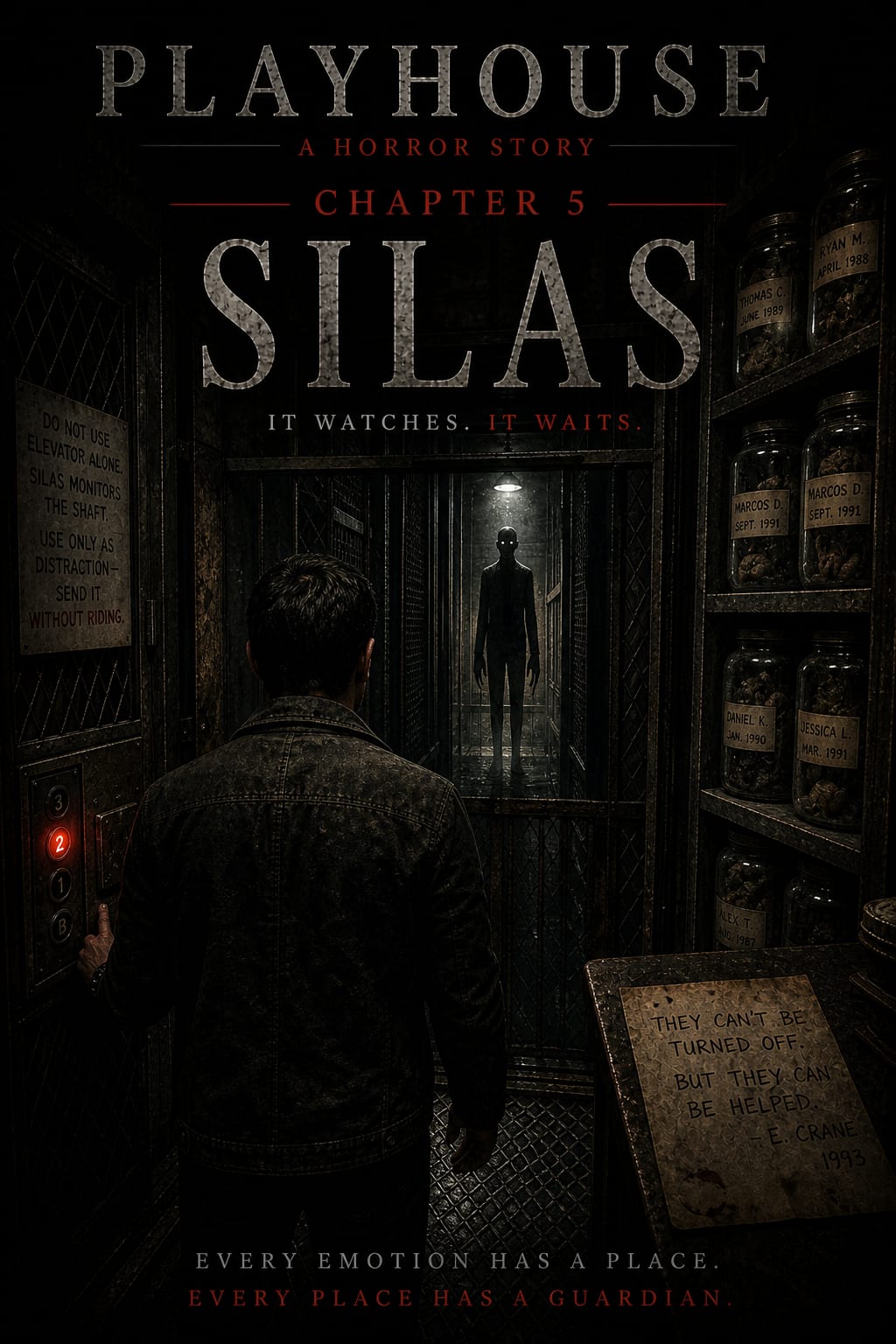
He moved. East wing elevator panel on the ground floor, second floor button. He pressed it hard. Motor reversed. Elevator went up. He got to the stairs and went to the basement while Silas was occupied.
Down the stairs, around the corner, through the half-invisible door in the water-stained wall.
The jar room. He'd been back twice and it still stopped him every time he came in. The shelves went all the way to the ceiling and every inch was glass — hundreds and hundreds of jars, each one labeled in the same careful handwriting. RYAN M. — APRIL 1988. THOMAS C. — JUNE 1989. MARCOS D. — SEPTEMBER 1991. He'd estimated about four hundred the first time. He'd stopped estimating.
He picked up the nearest jar. RYAN M. — APRIL 1988.
Warm in his hand. Not room-temperature warm. Actually warm, the warmth of something alive. And for a second, barely a second, something passed through him — a specific flash of a child's fear, the kind you only get when you're somewhere new and you don't know the rules yet and you don't know if you're safe. He felt it and it left.
He put the jar back. He stood there.
Four hundred names. Four hundred kids. Thirty years in sealed glass.
The elevator was coming down again. Silas had given up on the second floor.
He moved. East wing, second floor button, elevator reversed. Stairs back up. Security room, monitors, sit down, breathe.
Camera six: Silas at the second floor, visible through the cage door, standing in the hallway outside the elevator. Just standing. Facing the cage.
He was far enough on camera six that Sufyan could see him properly for the first time. He was tall. Very tall, taller than the doorframe should allow, which meant either Silas was bending somehow or the doorframe was wider than it looked on the monitor. The posture was wrong — too straight, rigid, the arms not quite hanging the way arms hang. And the eyes. Even on the grainy security feed, from this far away, the eyes were pale in a way that registered as wrong. Not the color. The way they caught the light from the shaft. Flat and caught and patient.
He'd been sending the elevator up every time. It kept working. But Silas would eventually come down the stairs. He had stairs. He wasn't limited to the shaft.
Sufyan looked at the elevator on the monitors. Thought about the note on the annotated map: *Send it without riding.*
Which meant someone had tried riding it. And the fact that the note existed meant whoever tried riding it had survived long enough to write the warning.
He sat with that.
The question was: what was in there? Not in the shaft — he knew what was in the shaft. But in the elevator itself. The cage. Somewhere between floors, alone with whatever was descending from above. Was there something to find or was it just about surviving?
He didn't know why he got up. His body just made the decision and his brain caught up a second later, watching himself walk to the elevator, watching himself press the call button, watching the cage door rattle open.
He got in.
He pressed 2.
The motor engaged. That grinding protest of old machinery, the cables vibrating, the cage lurching once before it settled into its upward pull. The floor dropped away below the mesh cage floor. Concrete shaft walls on both sides, close, close enough to touch if he reached out. The overhead light in the cage was one bare bulb, the bulb loose in its socket, flickering slightly with the movement.
Between floors: total dark except his headlamp. Just the walls moving past outside the cage.
It stopped.
No warning, no slowing-down, no shimmy before stopping. Full stop. His body kept going for one terrible moment — that lurch of momentum — and then he was just standing in a motionless cage in the dark.
He pressed 2. Nothing.
He pressed G. Nothing.
He pressed 1. Nothing.
He pressed the emergency button. Nothing.
And then, from above:
A sound.
Something moving in the shaft. Deliberate movement — not mechanical, not cables settling, not the building contracting. Something using the shaft. Moving downward. Coming toward the cage.
His headlamp aimed up but the shaft above the cage was dark and close and all he could see was the cable disappearing upward and the shaft walls and then dark.
The sound kept coming. Something scraping concrete with each movement. Something that moved by reaching and lowering itself rather than walking. Coming down the shaft walls. Getting closer.
He grabbed the manual release lever on the inside of the cage door. His hands were shaking and he missed the first time, which cost him probably a full second, and then he had it, yanked it, the door swung inward. Above the opening: the first-floor landing, one foot up. He grabbed the edge with both hands and pulled. His shoulders screamed. He got his knees onto the landing, got one foot up, shoved himself forward and got both feet on the floor and spun around and pushed the cage door closed behind him.
The sound in the shaft was directly at cage level.
He stood against the wall with his back flat against it and watched the cage door. His chest was heaving. His hands were shaking and this time they didn't stop for a while. He just stood there, back against the wall, watching the cage door, waiting.
From inside the shaft: something arriving where the cage had been. A pause. Then retreating. Slowly. Back upward.
He stayed against the wall until the shaft was silent.
Then he breathed. Properly. He gave himself thirty seconds for that and not one more.
He looked at the elevator cage.
The back panel was warped at one corner. He'd have missed it if he wasn't standing here, pressed against the wall, staring at the cage from one foot away. Wooden panel, bottom-right corner, pulling away from the wall. A gap.
He went to the cage — he did not get inside, he stayed on the landing with one foot against the cage door to keep it from swinging shut — and reached in and got his fingers into the gap and pulled.
The panel came away. Behind it: a recess in the shaft wall. Small. And inside it, a folded envelope, yellowed, dry.
He took it, stepped back, let the cage door close.
He opened the envelope standing in the east wing hallway with his back against the wall. Four pages, dense handwriting, barely leaving margins.
He read the whole thing against the wall. He didn't move until he was done.
By the last page he understood what had to happen. He understood the jars. He understood the sessions. He understood why it needed to be a real person sitting voluntarily in a room and offering something genuinely real.
He also understood, in a way that sat heavy in his chest, that he was carrying exactly what Crane was describing. That he had been carrying it for eighteen months. That he'd been carrying it here, into this building, every day since the door first locked behind him.
He folded the letter and put it in his jacket.
He stood in the east wing hallway for a long time.
Then he went to find the Child.
About the Creator
Enjoyed the story? Support the Creator.
Subscribe for free to receive all their stories in your feed.
Comments
There are no comments for this story
Be the first to respond and start the conversation.