

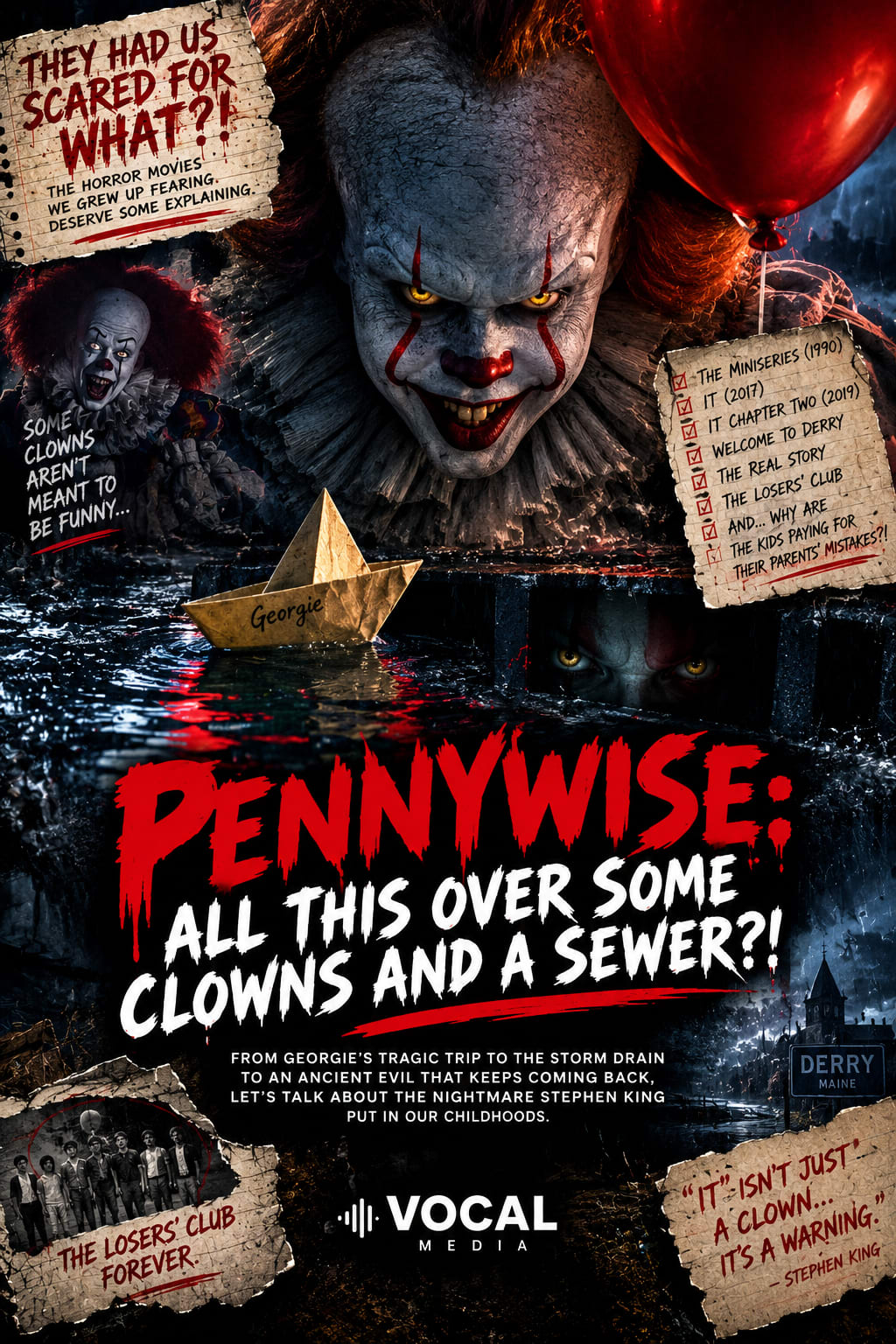
Welcome to THEY HAD US SCARED FOR WHAT?!, my horror retrospective where we're taking a trip back through the horror movies, iconic villains, and terrifying stories that had us checking under the bed, sleeping with the lights on, and questioning every damn noise we heard in the house. We're revisiting these classics, breaking down the stories, exploring the villains' motives, remembering the twists, and asking the questions we probably should have asked a long time ago. We're talking about what made these movies frightening, what made their characters unforgettable, and whether some of these villains were genuinely terrifying or just had everybody stressed out for absolutely no reason! 😂 This isn't just a trip down memory lane; it's a chance to revisit the movies that shaped horror, see how they hold up today, and have a little fun while we're at it. Because sometimes, looking back at the things that scared the hell out of us, all we can do is shake our heads and ask ourselves one question: THEY HAD US SCARED FOR WHAT?!
In this installment, we're talking about Pennywise The Damn Clown!
From Georgie’s tragic trip to the storm drain to an ancient evil that keeps coming back, let’s talk about the nightmare Stephen King put in our childhoods.
THEY HAD US SCARED FOR WHAT?!
HORROR RETROSPECTIVE
Let me tell y’all something.
When I was younger, I thought IT was about a little boy named Georgie, a storm drain, a creepy-ass clown, and his older brother trying to figure out what happened to him.
That was the basic story I remembered.
Georgie goes outside with his little paper boat. It rains. The boat ends up in a storm drain. A clown appears. Georgie makes one very unfortunate decision to entertain a conversation with a stranger living in the damn sewer.
And the rest is horror history.
But as I got older, I realized that Stephen King had given us something much bigger than a clown with questionable housing arrangements.
This wasn't just a story about a monster eating children. It was about childhood trauma, friendship, bullying, racism, abuse, memory, fear, and a town so deeply infected by evil that people could witness terrible things happening around them and still carry on with their lives.
And THAT is where IT becomes more than just a scary clown story.
Now, before anybody gets the wrong idea, let me make something clear: Stephen King is one of my favorite authors, and this article is not about disrespecting his work. Quite the opposite. We're going to give the man his flowers while examining what happened when his massive, complicated novel was adapted for television and film.
Because, baby, Pennywise is not simply a clown who decided to set up shop in a sewer.
That clown is just one of the faces of something far more terrifying.
And we have a whole lot to discuss.
FIRST, LET'S TALK ABOUT STEPHEN KING'S IT
Stephen King's novel IT was published in 1986.
The story takes place primarily in Derry, Maine, a fictional town with a history of disturbing events, missing children, violence, and inexplicable tragedy.
At the center of it all is an ancient, supernatural entity that returns to prey on the town at roughly 27-year intervals.
One of its most recognizable forms is Pennywise the Dancing Clown.
Why a clown?
Because the creature can take forms connected to its victims' fears. A clown is an especially effective disguise when the creature wants to attract children, gain their trust, or get close enough to terrify them.
Think about it.
Clowns are supposed to entertain children. They're supposed to make them laugh.
Pennywise takes something that should be harmless and turns it into a nightmare.
That is one hell of a concept.
And King doesn't stop there. His story explores how fear can shape childhood, how adults fail to protect children, and how the things people experience when they're young can follow them into adulthood.
The novel is enormous, with multiple characters, interwoven timelines, and a mythology much more complicated than the movies can fully explain.
So when we talk about the adaptations, we need to remember something important: we are looking at different screen versions of King's story, not a simple series of sequels in which Pennywise gets a new movie every few years.
That distinction matters.
Because if you're sitting there wondering whether there were a bunch of direct Pennywise 2, Pennywise 3, and Pennywise Goes to the Mall movies, the answer is no.
Thankfully, nobody sent this clown to the shopping center.
At least, not in the major adaptations we're discussing.
1. IT (1990): THE CLOWN WHO INTRODUCED HIMSELF TO OUR CHILDHOOD
Let's start with the version many of us remember.
The 1990 television miniseries starred Tim Curry as Pennywise.
And let me tell you something about Tim Curry.
That man did not need a modern computer-generated monster to make Pennywise terrifying.
He had the makeup, the smile, the voice, and the ability to make an ordinary conversation feel deeply uncomfortable.
Sometimes, the scariest thing a monster can do is act like there's absolutely nothing wrong with it.
That's what Curry understood.
GEORGIE AND THE STORM DRAIN
The story begins with Georgie Denbrough, a young boy who goes outside on a rainy day with a paper boat made by his older brother, Bill.
Georgie loses the boat when it flows into a storm drain.
Inside that drain is Pennywise.
The clown speaks to Georgie, acts friendly, and offers him the boat.
Georgie approaches.
And that encounter becomes one of the most recognizable opening sequences in horror history.
But here's the part that matters beyond the shock of the scene: Georgie is an innocent child.
He isn't looking for trouble. He's not investigating some haunted building. He's not trying to prove he's the bravest kid in town.
He's playing outside in the rain.
He's a little boy who encounters something he cannot possibly understand.
And the fact that Pennywise can present himself as a friendly figure makes the situation even more disturbing.
The monster knows how to get close to children.
It doesn't need to chase them down the street when it can convince them to come closer.
BILL DENBROUGH: THE BROTHER WHO COULDN'T LET GO
Georgie's older brother is Bill Denbrough, a boy who stutters and carries enormous guilt over his younger brother's disappearance and death.
Bill is one of the central characters in the story.
And this is where IT becomes more than a monster movie.
Bill's struggle isn't just about defeating Pennywise. He's trying to process grief and confront the fear that he couldn't protect someone he loved.
His stutter is part of his characterization, but it isn't what makes him weak or strong. Bill's courage comes from facing his fear even when he doesn't know whether he can win.
As the story develops, Bill joins a group of children who become known as the Losers' Club.
And that group is the heart of the story.
THE LOSERS' CLUB
The Losers' Club consists of children who are outsiders for different reasons.
There's Bill, grieving Georgie and struggling with his stutter.
There's Beverly Marsh, who faces cruelty and an abusive home life.
There's Ben Hanscom, who is bullied and often feels isolated.
There's Eddie Kaspbrak, whose mother has made fear and illness a major part of his life.
There's Richie Tozier, who uses humor and constant talking to cope with uncomfortable situations.
There's Stanley Uris, who struggles to make sense of things that seem impossible.
And there's Mike Hanlon, whose experiences and knowledge help connect the group to Derry's history.
Together, these children discover that something is wrong with their town.
Children are disappearing. Terrible events keep happening. People are dying.
And Pennywise is connected to it all.
The children begin to understand that the creature can exploit their individual fears, which means confronting it requires more than running away.
They must learn to trust one another.
That friendship is one of the most important parts of King's story. These children are vulnerable, but together they can face something that would overwhelm them individually.
SO WHY DON'T THE ADULTS FIX THE PROBLEM?
Excellent question.
Because Derry has a serious problem.
The town has a long history of violence and tragedy, yet the people living there often fail to recognize—or refuse to confront—the evil surrounding them.
The adults aren't all literally incapable of seeing what's happening, but the story repeatedly shows how people ignore warning signs, normalize cruelty, and fail to protect children.
That makes Pennywise's presence even more frightening.
The monster is dangerous, but so is the environment that allows its evil to continue.
The Losers' Club cannot simply wait for a responsible adult to arrive and fix everything.
They have to confront the problem themselves.
And they are children.
Let that sink in.
These kids are dealing with bullies, family problems, grief, and the ordinary challenges of growing up. Now they have to face an ancient supernatural creature, too.
Somebody in Derry needs to call a town meeting.
Actually, never mind. Half the town would probably pretend they didn't hear the announcement.
THE FIRST CONFRONTATION
The children eventually confront Pennywise and manage to drive it back.
They make a promise that if the creature ever returns, they will come back to Derry and face it again.
Then life moves forward.
The children grow up, leave town, and begin building adult lives.
But the story isn't finished.
Because Pennywise doesn't operate according to an ordinary human lifespan.
And Derry has not seen the last of it.
The 1990 miniseries tells the story across two television installments, moving between the characters' childhood experiences and their return as adults.
That's important because the story was never meant to be only about what happened to Georgie.
Georgie's death starts the nightmare.
The Losers' Club's struggle against Pennywise is the much larger story.
And Tim Curry's portrayal helped make Pennywise one of the most recognizable horror villains of his era.
For many viewers, Curry will always be the clown who made them suspicious of storm drains.
I don't care how much it rains. That boat can stay in the street.
2. IT (2017): SAME NIGHTMARE, NEW GENERATION
Fast-forward to 2017.
Director Andy Muschietti brought IT back to theaters with Bill Skarsgård as Pennywise.
And this time, the story focused primarily on the Losers' Club as children.
The movie became a major horror hit, introducing King's story to a new generation while giving longtime fans a different interpretation of the creature.
The premise remained familiar.
Georgie disappears.
Bill struggles with the loss.
Children in Derry experience frightening encounters.
The Losers' Club begins to investigate.
And Pennywise keeps finding ways to exploit their fears.
But the film's approach to horror was different from the 1990 miniseries.
BILL SKARSGÅRD'S PENNYWISE
Tim Curry's Pennywise often used a conversational, almost playful manner to make the character unsettling.
Bill Skarsgård's version leaned more heavily into the creature's unnatural appearance and movements.
His Pennywise could look almost human one moment and deeply wrong the next.
The smile was wider. The movements were stranger. The expressions could change in ways that made the audience question what they were looking at.
And the creature's behavior could shift from playful to threatening with very little warning.
The two actors brought different strengths to the role.
Curry's performance made Pennywise feel like a sinister entertainer who knew exactly how to manipulate a child.
Skarsgård's performance emphasized that the clown was merely a disguise for something that did not belong in the human world.
Neither performance needs to erase the other.
They are different interpretations of the same character.
And that is a good thing.
A remake should give us a reason to revisit a familiar story, not simply reproduce every scene with a different cast.
THE LOSERS' CLUB GETS A MODERN THEATRICAL STORY
The 2017 film develops the children as a group of outsiders who find friendship in one another.
They face bullying, family dysfunction, and fears that Pennywise uses against them.
The movie also gives more room to the group's relationships and individual personalities.
Their friendship becomes a source of strength, but it doesn't magically make them fearless.
They are still children.
They are still frightened.
And they still have no reasonable expectation that they should be able to fight an ancient supernatural entity.
That's what makes their struggle compelling.
They don't win because they're secretly superheroes.
They learn to confront the thing that has been controlling them through fear.
The film ends with the Losers' Club confronting Pennywise and forcing the creature to retreat.
They make a pact to return if it ever comes back.
Sound familiar?
It should.
That's the bridge to the next chapter.
3. IT CHAPTER TWO (2019): THE LOSERS GROW UP, BUT THE CLOWN HASN'T RETIRED
Now we're getting to the part you remembered about the children growing up and returning.
IT Chapter Two picks up with the surviving members of the Losers' Club as adults.
Nearly three decades have passed since their childhood confrontation with Pennywise.
Most of them have left Derry and built lives elsewhere.
But Mike Hanlon stayed behind.
And Mike remembers what the others have largely forgotten.
When Pennywise returns, Mike contacts the old group and reminds them of the promise they made as children.
They must come back to Derry.
They must face the creature again.
And they must try to finish what they started.
WHY DID THEY FORGET?
One of the unsettling elements of King's story is the relationship between Derry and memory.
The characters' childhood experiences become difficult to recall after they leave town.
Their memories are incomplete, and their connections to the events of their childhood fade.
But their experiences haven't simply become irrelevant.
The past is still affecting them.
As adults, the Losers have to confront not only Pennywise but also the people they became after leaving Derry.
Their childhood fears did not disappear just because they got older.
Some of them have carried the effects of their experiences into their adult relationships, careers, and personal lives.
That is one of the story's strongest ideas.
You can leave the place where something terrible happened.
You can change your surroundings.
You can try to forget.
But leaving the past behind is not always the same as resolving it.
THE ADULT LOSERS
The adult Losers return to Derry, and the film shows how their childhood experiences shaped their lives.
Bill is a successful writer who still carries guilt over Georgie.
Beverly has to confront the effects of the abuse she experienced growing up.
Eddie continues to struggle with fears that have followed him into adulthood.
Richie still uses humor to protect himself.
Ben has changed significantly since childhood, but he still carries emotional scars.
Stanley is overwhelmed by the thought of facing Pennywise again.
And Mike has spent years trying to understand the creature and prepare for its return.
Their reunion is not a simple victory lap.
They aren't a group of fearless adults returning to finish an easy job.
They are people who must confront the worst experiences of their lives.
And the creature knows it.
PENNYWISE ISN'T JUST TRYING TO SCARE THEM
Pennywise feeds on fear, and the Losers' individual fears give the creature ways to manipulate them.
It uses their memories and vulnerabilities to make them doubt themselves.
It wants them frightened, isolated, and divided.
That is why the group's friendship remains so important.
The creature is powerful, but it has a weakness: the Losers can resist its influence when they stand together and refuse to give it the control it wants.
The adults must rediscover the courage they found as children.
But this time, they have to confront the consequences of years of avoidance, forgotten memories, and unresolved trauma.
THE FINAL CONFRONTATION
The Losers' Club attempts to carry out a ritual intended to destroy Pennywise.
The plan becomes more complicated than they expected, and they ultimately have to confront the creature directly.
Their final battle is not simply a matter of overpowering a monster.
They must reject the fear Pennywise uses against them.
They must stop treating the creature as an unstoppable force.
And they must rely on one another.
The ending brings their childhood promise to its conclusion, although not without loss.
The important point is that IT Chapter Two is a direct sequel to the 2017 film, completing the story that began with the Losers' Club as children.
It is not a sequel to the 1990 miniseries.
The 1990 version and the 2017–2019 films are separate adaptations of the same source material.
So if you watched Tim Curry's Pennywise and later watched Bill Skarsgård's Pennywise, you weren't watching one continuous movie timeline.
You were watching different screen versions of Stephen King's story.
And that brings us to a question worth asking.
WAIT A MINUTE. HOW MANY PENNYWISE MOVIES ARE THERE?
This is where the franchise terminology can get confusing.
Unlike Jason Voorhees or Freddy Krueger, Pennywise does not have a long sequence of theatrical movies in which the same version of the character returns for installment after installment.
The major screen adaptations are organized differently.
Let's break them down.
THE 1990 VERSION
IT (1990) is a television miniseries that adapts the story of the Losers' Club as children and adults.
Tim Curry plays Pennywise.
It tells the story in two installments, but those installments form one miniseries—not two separate theatrical sequels.
THE 2017 FILM
IT (2017), also known as IT Chapter One in connection with the two-film adaptation, focuses primarily on the Losers' Club as children.
Bill Skarsgård plays Pennywise.
It begins a new adaptation of the story.
THE 2019 FILM
IT Chapter Two (2019) continues the 2017 film's story by bringing the Losers' Club back to Derry as adults.
It completes that two-film adaptation.
THE PREQUEL SERIES
The story has also expanded into television with IT: Welcome to Derry, a prequel series connected to the 2017 and 2019 films.
Rather than simply moving forward into another sequel, the series explores Derry's history and the events surrounding the creature before the main films.
So, no, there isn't a long line of theatrical IT sequels in which Pennywise keeps finding a new group of children every couple of years.
There is the 1990 miniseries, the two-part theatrical adaptation from 2017 and 2019, and a television prequel expanding the newer film continuity.
Stephen King created a story that could be revisited through different adaptations and expanded in different directions.
That is not the same thing as making the exact same sequel over and over again.
And honestly, the mythology is complicated enough without pretending every adaptation belongs to one giant timeline.
SO WHAT THE HELL IS PENNYWISE, REALLY?
Here is where Stephen King's imagination deserves some serious respect.
Pennywise is not simply a human serial killer wearing a clown costume.
The clown is one form taken by an ancient entity.
The creature can manifest as other frightening things, drawing on the fears of its victims.
Its nature is far stranger than the familiar red hair, white face, and colorful costume suggest.
The movies give us glimpses of that larger mythology, but they do not explain every aspect of King's novel in the same depth.
And that is understandable.
A novel can spend hundreds of pages exploring a fictional town, its history, the inner lives of its characters, and the supernatural forces connected to it.
A movie has to communicate those ideas through scenes, dialogue, performances, and images.
Some details get simplified.
Some elements change.
Some parts of the source material are left out.
But the central idea remains powerful: Pennywise represents an ancient evil that knows how to exploit the things people fear most.
The clown is the bait.
The fear is the weapon.
And Derry is the hunting ground.
Now THAT is a horror concept.
WHY DOES THE TOWN OF DERRY KEEP LETTING THIS HAPPEN?
I know Derry is fictional, but somebody needs to investigate the municipal government.
How many children have to disappear before people start asking serious questions?
How many disturbing incidents can happen before somebody says, "You know what? Maybe this town has a problem"?
And why does the evil keep finding opportunities to operate?
The answer is not simply that every adult in Derry is stupid.
King's story is more complicated than that.
Derry is a community shaped by denial, cruelty, and a long history of violence. The supernatural presence influences the town, but the human failures matter, too.
People look away.
They dismiss what they don't understand.
They fail to protect vulnerable people.
And that creates an environment in which the creature can continue to thrive.
The horror works because Pennywise's evil is not entirely separate from the human world.
The monster is supernatural, but the cruelty surrounding it is recognizable.
Children experience bullying and abuse.
Adults ignore warning signs.
Communities protect their reputations rather than confronting terrible truths.
That is part of what makes IT so disturbing.
The creature may be ancient, but the conditions that allow suffering to continue are painfully familiar.
And that is why the story still has something to say beyond the clown itself.
LET'S TALK ABOUT THE LOSERS' CLUB, BECAUSE THEY DESERVE THEIR FLOWERS, TOO
It would be easy to make this entire article about Pennywise.
After all, the clown is the recognizable image.
The makeup sells the posters.
The smile sells the nightmares.
But the Losers' Club is the reason the story works.
These children are not a random collection of victims waiting for the next scary scene.
They have personalities, insecurities, family histories, friendships, and conflicts.
They experience fear differently.
They respond to trauma differently.
And they learn to rely on one another.
Their friendship is not just a convenient plot device that allows them to defeat the monster.
It is one of the central themes of the story.
Pennywise wants to isolate them because fear makes them vulnerable.
Their connection gives them a way to resist that fear.
As children, they find companionship in a world that often treats them badly.
As adults, they must recover that connection to confront the past.
And that is what makes their story emotionally satisfying.
The monster is terrifying, but the relationships give the horror meaning.
Without the Losers' Club, IT would be a very different story.
It would be a clown doing creepy things in a small town.
With the Losers' Club, it becomes a story about growing up, surviving painful experiences, and finding the courage to face what you once thought would destroy you.
THE REAL DIFFERENCE BETWEEN PENNYWISE AND JASON OR FREDDY
This is why Pennywise deserves his own place in our horror retrospective.
Jason Voorhees is largely associated with a physical threat: a seemingly unstoppable killer pursuing victims.
Freddy Krueger turns sleep and dreams into sources of danger.
Pennywise is different.
Pennywise can take the form of the thing you fear.
The creature's power is connected to the minds of its victims, which allows the horror to become intensely personal.
For one child, the fear may be connected to family.
For another, it may involve guilt, isolation, or a traumatic experience.
Pennywise doesn't need to frighten everyone in exactly the same way.
It can tailor the nightmare to the person standing in front of it.
That is an especially effective premise because fear is not universal in its details.
What terrifies one person might not terrify another.
And the monster understands how to use those differences.
That makes Pennywise more than a clown with supernatural abilities.
It makes the creature a manifestation of the things people struggle to confront.
And it gives the story a psychological dimension that distinguishes it from many traditional slasher films.
DID THE NEW MOVIES RESPECT STEPHEN KING'S STORY?
This is where I want to be fair.
An adaptation does not have to reproduce every page of a novel to respect the original work.
The 1990 miniseries, the 2017 film, and IT Chapter Two each approach the material differently.
Tim Curry's Pennywise has a theatrical, unsettling quality.
Bill Skarsgård's Pennywise emphasizes the creature's unnatural appearance and behavior.
The 2017 film places the childhood story at the center of its narrative.
The 2019 sequel gives the adult characters their own extended confrontation with the past.
Each version makes choices about what to emphasize and what to leave out.
And because King's novel is so expansive, there will always be readers who prefer certain elements of the book over the adaptations.
That is a perfectly reasonable discussion to have.
But the core of the story remains recognizable: a group of children confronts an evil that has haunted their town, and years later they must face it again.
The horror is tied to friendship, memory, fear, and the consequences of leaving painful experiences unresolved.
Those themes are central to why the story has endured.
And as a writer, I appreciate that.
Stephen King didn't just give us a frightening character.
He gave us a world in which that character could mean something.
That is a different level of storytelling.
MY FINAL VERDICT: THE CLOWN WAS NEVER THE WHOLE STORY
Looking back, I understand why IT stayed with so many of us.
When you're young, you remember the images that scare you.
You remember Georgie and the storm drain.
You remember Bill trying to understand what happened to his brother.
You remember the creepy clown appearing where he absolutely should not be.
And you remember the idea that something terrible might be hiding in a place you thought was ordinary.
But when you revisit the story as an adult, you see more.
You see the Losers' Club struggling with experiences no child should have to endure.
You see how the characters carry their fears into adulthood.
You see a town that repeatedly fails to confront its own darkness.
And you see how friendship becomes a source of strength against something that wants to keep everyone afraid.
That is the difference between a memorable monster and a memorable story.
Pennywise is iconic, but Stephen King's achievement goes beyond the makeup, the teeth, and the sewer.
He created a story about childhood, fear, trauma, friendship, and the things communities refuse to acknowledge.
And he made an ordinary clown costume feel like a warning.
So, yes, Georgie and that damn storm drain introduced many of us to the nightmare.
But the real story was always bigger than that.
And I will give Stephen King his flowers for it.
Because when you can make generations of readers and moviegoers suspicious of a clown, a sewer, a paper boat, and a perfectly ordinary rainy day, you have done something special.
Now, with all due respect to the man who wrote the book, I have one final question:
WHY THE HELL IS THERE A CLOWN IN THE SEWER, AND WHY DOES EVERYBODY IN DERRY KEEP ACTING LIKE THIS TOWN IS A PERFECTLY NORMAL PLACE TO RAISE CHILDREN?!
Somebody get those kids out of Derry.
And somebody please take the storm drains off the list of acceptable places to play.
---
NEXT UP IN THE SERIES: GHOSTFACE
We've talked about Jason, the man who wouldn't stay dead; Freddy, the nightmare who won't let anybody sleep; and Pennywise, the ancient evil hiding behind a clown's smile.
Now it's time to deal with a different kind of horror.
Because Ghostface doesn't need to be an ancient entity, a supernatural dream demon, or an unstoppable force.
Ghostface just needs a phone, a creepy voice, and somebody who thinks answering an unknown number is a good idea.
NEXT: SCREAM: HOW MANY DAMN GHOSTFACES ARE THERE?!
The horror retrospective continues.
About the Creator
Dakota Denise
Every story I publish is real lived, witnessed, survived, by myself or from others who trusted me to tell the story. Enjoy 😊
Enjoyed the story? Support the Creator.
Subscribe for free to receive all their stories in your feed. You could also become a paid subscriber, letting them know you appreciate their work.
Comments
There are no comments for this story
Be the first to respond and start the conversation.