
"Obsession": A Horror Film Tuned to the Frequency of Online Resentment
A Story Told From the Wrong Angle

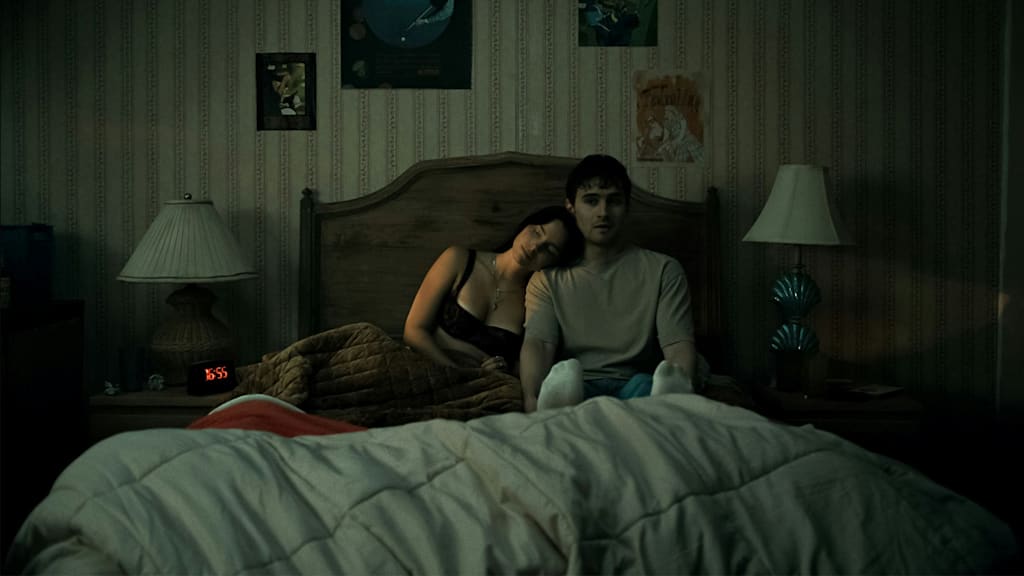
Some movies feel deliberately ripped from current events, built scene by scene to comment on whatever happens to be dominating the news cycle. Others work differently. They function less like mirrors and more like conductors, drawing in the static charge of online culture and discharging it through genre filmmaking without ever announcing what they're doing. Curry Barker's "Obsession" belongs firmly in this second category, and that indirectness is part of what makes it effective.
At just 26 and fresh off a career as a YouTube creator, Barker delivers his sophomore feature: a horror movie that bottles up the simmering gender resentment found across 2020s internet culture and turns it into something closer to a lurid, old-school morality fable, the kind of pulpy cautionary tale that used to circulate in cheap horror anthologies. It's unlikely Barker set out to make a direct reference to that tradition; his instincts seem to come less from genre history and more from years spent absorbing and reflecting the internet's particular brand of mean-spirited humor. But the resemblance is there anyway, which says something about how durable that old morality-tale structure remains even when filtered through a completely different cultural moment.
A Wish That Goes Wrong
At the story's center is Bear (Michael Johnston), whose full name, Baron, gets shortened to something less imposing — fitting for a character defined by his timidity rather than any real authority. Bear works at a small, family-run record shop alongside Nikki (Inde Navarrette), a childhood friend he's been quietly in love with for years without ever saying so. He's the textbook version of the so-called "nice guy": deferential, careful never to overstep, and convinced that his restraint is a virtue rather than a strategy. Confessing his feelings risks unraveling everything around him: the friendship itself, the day-to-day comfort of working together, and the broader social fabric he shares with two close friends, Ian (Cooper Tomlinson) and Sarah (Megan Lawless). Ian, sensing exactly where this is headed, tells him flatly to keep quiet, at least until after their regular trivia night together. Bear, predictably, can't manage that kind of restraint for long.
Up to this point, the film stays in fairly grounded, even gentle territory, the sort of low-stakes romantic tension you'd expect from a coming-of-age dramedy rather than a horror film. That changes the moment Bear gets exactly what he's been wishing for. From here, Barker shows almost no mercy toward his characters, dropping them into increasingly nightmarish circumstances and then observing, with an almost clinical detachment, as they come apart under the strain. The mechanism behind it all is deliberately mundane: a cheap novelty item picked up at a gift shop, the kind of trinket nobody would expect to actually work. Bear makes an offhand wish on it, asking that Nikki love him more than anything else in the world, and the wish appears to take hold almost instantly. But the version of Nikki who comes back to him afterward isn't the sharp, sarcastic person he's known his entire life. She's been replaced by someone else wearing her face.
When Love Becomes a Curse
This new version of Nikki announces her wrongness immediately and physically: her eyes lose focus, her speech fractures into halting, broken fragments, and she's prone to sudden fits of screaming, as though she's just clawed her way out of a nightmare she can't fully escape. Her moods swing without warning toward violence, sometimes turned on herself, sometimes on the people around her. None of this seems to bother her devotion to Bear, though. She remains fixated on him, loving him with the same intensity he wished for, regardless of the chaos surrounding that love. And once Bear learns that the actual Nikki has been displaced somewhere genuinely horrific while this altered version stays warm and affectionate beside him, he makes his choice: he keeps her anyway.
It's a selfish, morally indefensible decision, and one the film refuses to let him off the hook for. Whatever unseen forces engineered this transformation in the first place seem just as determined to make Bear answer for what he's done, and the back half of the movie becomes an extended reckoning, tightening around him scene by scene. Barker isn't interested in letting the audience root for Bear's redemption arc so much as watching him squirm under consequences entirely of his own making.
Crucially, Barker doesn't limit the suffering to characters who arguably deserve it. Plenty of collateral damage gets spread around to people who never made any wish at all, a clear nod to the kind of unflinching emotional cruelty popularized by filmmakers like Ari Aster, where horror functions less as a release valve and more as a sustained, uncomfortable squeeze. The visuals get genuinely disturbing at points, and viewers with pets at home might feel a sudden urge to check on them once the credits roll. The violence pushes well past what's typical for the genre, too. Reports suggest the filmmakers had to trim certain sequences just to avoid a restrictive NC-17 rating, including one bludgeoning scene that arrives with almost no warning. Between the gore and the relentless emotional bleakness, "Obsession" doesn't hold much back, and it's clearly not trying to.
Style Over Scares
Rather than building toward conventional jump scares — the slow creep down a hallway, the sudden bang on the soundtrack — Barker structures the film around an unsteady, off-balance rhythm that unsettles audiences through editing and pacing rather than cheap shock cuts. Scenes don't always resolve the way genre convention suggests they should, and that unpredictability becomes its own source of dread. That instinct likely traces back to Barker's roots as a YouTube creator who edits his own work, a hands-on approach not unlike fellow internet-to-film director Kane Parsons, whose "Backrooms" series made a similar leap from online content to feature filmmaking. Barker also comes out of a sketch comedy background, and that sensibility never fully disappears once the horror elements take over. If anything, the humor sharpens as the story darkens, landing punchlines that feel meaner and stranger the further the plot spirals away from anything resembling normal life. It's an unusual combination, comedy and dread escalating in tandem rather than one giving way to the other, and it's arguably the film's most distinctive formal choice.
A Story Told From the Wrong Angle
Where the film stumbles most is in how it handles what's actually happening to Nikki throughout her possession, a sustained ordeal that's both psychologically and sexually violating in ways the script never fully sits with. Because the entire narrative is filtered through Bear's perspective, and Bear is someone who treats Nikki more like a prize to be claimed than a person with her own inner life, the film risks replicating the exact blind spot it seems to be critiquing. Her suffering becomes backdrop, texture for his arc rather than a story in its own right, and that imbalance is hard to ignore even as the rest of the film works.
About the Creator
write with shan
🌍 Discovering the world through words.
👻 Horror & Mystery Stories
🔬 Science & History Articles
📈 Trading Knowledge
🎬 Movie Reviews & Analysis
New content every week.
Enjoyed the story? Support the Creator.
Subscribe for free to receive all their stories in your feed.
Comments
There are no comments for this story
Be the first to respond and start the conversation.