
"Come on, Johnson. We don't have enough time before Colonel Willis sees us. We need to get as far away from the line and the trenches as we can."
I knew he was right, but that didn't help the paralysing fear that was making my trenchfoot-affected limbs heavier and more rigid. Mud sucking at the bottom of my boots just made them feel even heavier. The duckboards had failed me, and now in the wilderness, I didn't have them to rely on.
Timmy, Beckett and our self-appointed leader, Charles Mack, made up the rest of our group of deserters. Mack was a Scot by heritage, a north-eastern Englishman by birth. He was the most surprising member of our group. While the rest of us were scared half to death and scarred the other half by what we had already witnessed since being stationed in France, near Ypres, Mack was, by and large, a well-thought-of soldier. Not to say he relished warfare, but he didn't shrink back from it quite as much.
I didn't want to go back. No matter how much my body wanted to seize up. Beckett and I had discussed the potential and the real horror of the firing squad. Beckett didn't seem as unfazed by the prospect.
The trenches were hell on earth, where death had become a formality. And on the days when death didn't take another of our regiment too soon, there was still the threat of death and the constant sound of gunfire, shooting, and screaming.
Rolling in dirt was something we got used to, but it had lost all sense of wide-eyed wonderment and earthiness from the days when my brother and I used to build forts and cave systems in the dirt.
This dirt was not just soil. It was sullied, poisoned, and tainted by shit, vomit, and blood. And then there were the rats to contend with. Not friendly little countryside rodents, but ugly, disease-ridden rats.
Constant bombardment had left cratered earth around the battlefield. There was no real honour in war.
At times, we didn't even have a clear plan of action or ritual for memorialising the dead. If possible, they were buried where they fell or unceremoniously pushed out of the trench.
It must have been just past ten, and under the chaos-veiled darkness, we were making our escape.
We had heard talk of a dilapidated farmhouse far enough away from the onslaught that we could stay there while we worked out our next moves.
As Mack understood it, the Military Police posted where we were had lost a few key members.
Still, the real dread of being caught didn't die out.
Despite now running carefully from the line, the horrifying cacophony of mankind at its worst still played out as a chilling soundtrack to our escape and a constant reminder of why we were fleeing.
While it was by no means a huge step up from barracks and trench life, we were relieved not to have bodies to step over and buckets filled with human excrement and the other indignities of turn-of-the-century warfare.
We all entered our new abode and found spots to call our own. The rooms were more or less nonexistent because, like much of the local area, the farmhouse had been ransacked and suffered devastation from battles and insurgents.
Although the building itself was a reminder of our situation, the battle, though miles away now, still echoed through the forestation surrounding our hideaway.
My heart actually settled to a dull repetitive thud, and the heavy toll of our escape gripped us all in different ways. Johnson slept, Beckett slugged the cheap illicit alcohol he had swiped before we headed out, and Mack became our vigilant lookout. He ran regular checks on all potential weak points and blind spots. He even set up snares for anyone who got close enough.
It was not long before the comforting embrace of sleep welcomed me into its arms.
I dreamed of sweet relief and a childhood field my brothers, friends and I used to frequent. Back then, war was play and fun, free of the harshest realities. Heroism and a sense of purpose drove our delinquent strategizing.
That sweet time was shattered by dark shadows stained crimson, memories of pooling blood and bullet-ripped bodies.
Then a sharpness shattered that nightmare, rousing me to the very real nightmare standing over me.
A group of Military Police stood above me. As my vision became clearer, I could see the rest of our group restrained and being led out.
All except Beckett.
He seemed calmer than you'd expect someone who had just been given a death sentence to be.
"Get up, you traitorous bastard!"
Reluctantly, I got to my feet, knowing that more than returning to hell, I was returning to the part of hell specifically designed for traitorous bastards.
The walk of shame past our brothers in arms, who spat and swore, kicked and yelled in our faces, wasn't exactly a walk in the park.
But it was nothing compared to our purpose-built containment unit and the long wait for dawn.
My nerves had become cruelly familiar with the distant sounds of war our hideaway had offered us, so within seconds of being back at the front again, the artillery rounds shook me to my core.
We were bundled into the small unit with barely enough room to stretch, let alone anything else.
Back also came the smell and emotional weight of ongoing war.
It took me a few minutes to realise Johnson, Mack and I were locked away without Beckett.
He had ratted us out, which he took great delight in explaining through the thin walls of the battleground detention facility.
Once inside that darkened cell, our understanding of time began failing. Hours became minutes and vice versa.
War is horrifying when you jump over the edge onto the battleground. But simply hearing it unfold without having any input either way, trapped inside a unit erected in hours, somehow felt worse.
Then, as night fell, the light vanished from the cracks in the door and from the gap between the bottom of the unit and the ground.
Fear of the dark is often considered irrational and the stuff of infancy. One should have grown free of it by the time they are overseas in Ypres.
That was not the case.
I would challenge anyone to survive a night in a locked but hardly sturdy prison surrounded by flying bullets and the might of British forces, their allies, and the enemy.
We were shoulder to shoulder in the cramped unit, backs pressed against damp timber walls.
Sleep was as useless as it had been behind the front line when you know you're going to be shot at first light.
Death and destruction continued beyond our shield. At first nothing was very different.
Until we heard a horrifying scream and then a moment of silence.
Not just dulled gunfire on the horizon.
Complete absence of sound.
Then another shriek followed by an explosion.
Then silence again.
For how long, it would be hard to determine. Less than an hour and more than a minute is the best estimate I can give.
Then tapping.
Tapping on the unit walls.
Johnson was the first to respond.
"Probably just dust, settle down man!"
Mack nodded, but the wobble beneath the word dust suggested the soldier with nerves of steel had finally met his breaking point.
"I'm with Johnson... it can't just be dust. We're in the middle of a ruddy warzone," Mack muttered.
"That Beckett. The rat. I hope a stray bullet found his heart and put him on a one-way trip six feet under."
I tried to ignore everything until—
"Raymond... Raymond, are you there? It's Beckett. Some shit has gone down. They're coming. Oh God, they're coming."
His voice trembled through the wood like he was pressed right against the other side of the wall.
Silence fell once we heard a bayonet slice through a throat.
Then came the marching.
Boots in perfect rhythm, yet no voices accompanied them. No shouted orders. No clatter of equipment. Just marching.
"I'm sorry."
Those were the last words we heard from Beckett.
Then the irregular tapping transformed into more consistent, persistent tapping that became banging.
Then the dents appeared.
Even Mack was rattled in unison with Johnson and me.
All four walls rattled simultaneously before silence fell again.
The handle on the door to our prison was tried slowly.
Then—
Voices drifted as whispers on the breeze before a shot rang out and busted the lock from the door.
Lights flashed, distorting the shadows that pulled us out into the breaking dawn light. The sound of mud sucking at their boots carried a rhythmic dread.
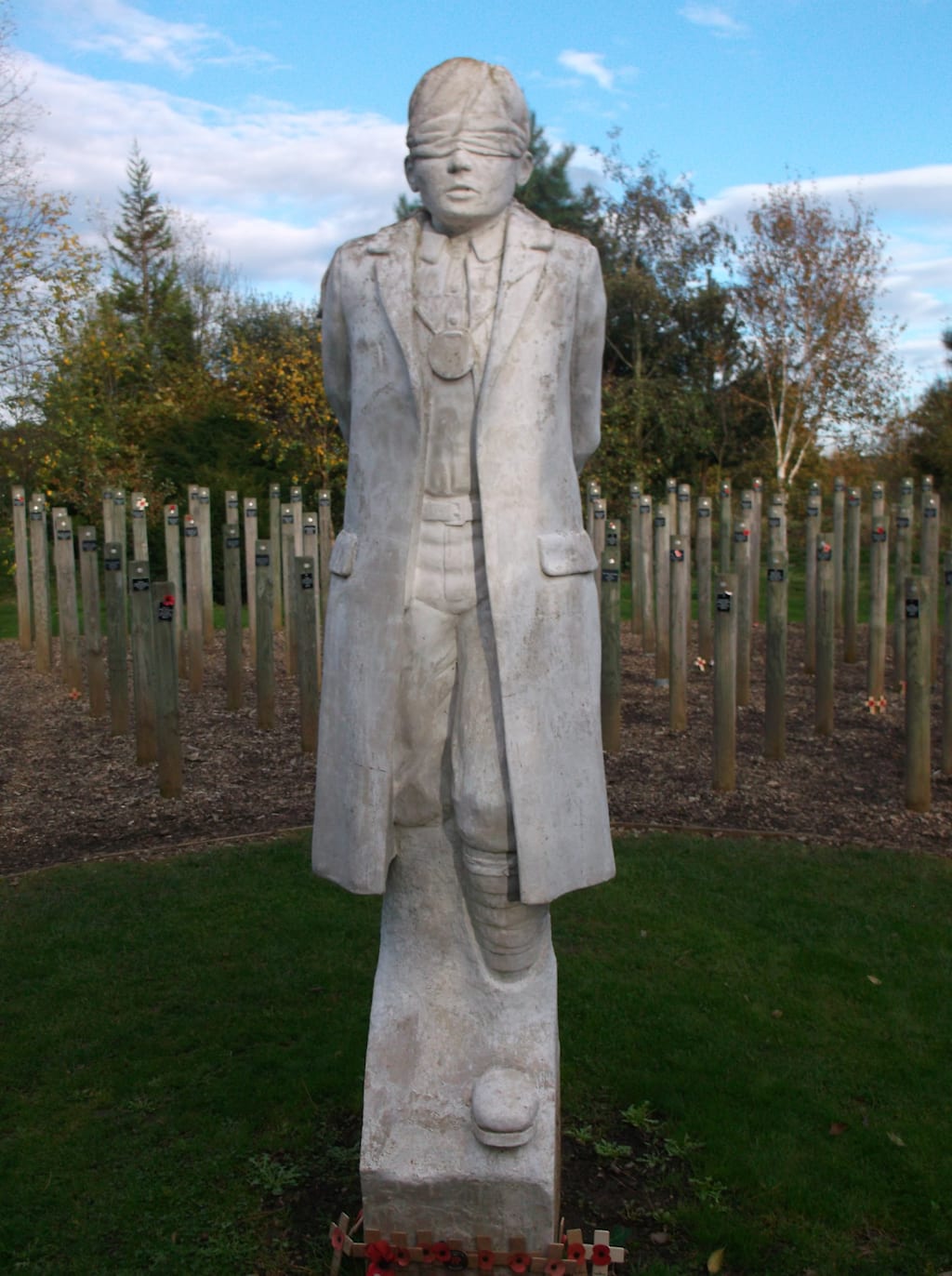
We were kicked to our knees and forced into a line facing the trenches.
Bodies littered the mud behind the German soldiers. British. German. Impossible to tell where one side ended, and the other began.
As the officer in charge of our captors blocked the glare of the rising sun, I realised our army lay dead throughout the trenches and across the battlefield.
The stench of cordite, blood, and churned mud drifted across the battlefield.
He looked at each of us with piercing eyes devoid of humanity. Strong hands gripped the backs of our necks.
The officer stopped in front of Johnson first and whispered:
"Stirb."
Then a single round was fired through the back of Johnson's head.
His lifeless body collapsed forward onto the officer's boots, and he kicked him aside like rubbish.
Next, the officer stood before Mack.
Again, he whispered:
"Stirb."
Again, a shot tore through the back of his head.
His body crumpled forward into the mud.
I looked up as my head was yanked back.
The last thing I heard was:
"Stirb."
About the Creator
Paul Stewart
Award-Winning Writer, Poet, Scottish-Italian, Subversive.
The Accidental Poet - Poetry Collection out now!
Streams and Scratches in My Mind coming soon!
Enjoyed the story? Support the Creator.
Subscribe for free to receive all their stories in your feed. You could also become a paid subscriber, letting them know you appreciate their work.
Comments
There are no comments for this story
Be the first to respond and start the conversation.