
New Nacogdoches
By J. Gossoo | An Ode to McCarthy


Forksdale is behind us, and dusk is falling when we reach the boundary of Lower Nicola, and steer our mounts into the moon-silvered field off the highway's shoulder. I’d passed the 97C turnoff once in the 20’s, cruising home from a forestry gig in Lillooet (this was back when the mines were still coughing up red ore). My brother'd cowboyed for Douglas Lake Ranch, then; I’d stop off to see him on the road home to Kamloops. Tk̓emlúps, where the rivers meet. Like Forksdale, where the rivers fork, but less colonial.
Our destination is Craigmont Mine, a defunct site 25 kilometres up the 97C west of Guichon Creek. Guichon, Shulus, Nicola, Quilchena. The names in these parts taste old as the earth and rich as springwater.
We dismount one after the other: Donovan, Tess, Sammy, then me. The Fisher Clan Reunion, 2038! Like those godawful family vacation tees. Our horseback-camping-trip-reunion was Donovan's idea, the sentimental eldest brother-turned-father figure. He wanted to get the band back together for one last hurrah (no, dad’s funeral last year didn’t count). He and Tess had provided the horses and tack. Not every Fisher sibling could afford an acreage, but we were fruit of the same rez: good with horses, dogs, guns and firelighting.
Donnie hammers a stake into the soil for our mounts. Sam and I, the youngest, tether and unsaddle the horses, fill feed bags, pass out provisions and bedrolls. Tess handles sleeping arrangements; Donnie, the fire. We fall into forgotten rhythms from childhood, the four of us forming a hive of orderly activity in that sea of silver grass. No evening birds in these skies; the heavens have been abandoned with the land.
Late. Lying with my back to Tess and my eye to the slit at the bottom of our tent flap. The hills here crouch low in every direction you look. Some are hunkered nearer than others: monoliths with the jutting shoulder blades and humped spines of Ice Age predators, black against the sky full of its dead, still-burning stars.
Planet's got less than three decades of fuel left in 'er. That fact's starting to show on folks' faces. I want us all to get comfy on horseback again, before shit hits the solar-powered fan. And I'd like to memorize your faces before we all piss off to our corners of the province for another ten years.
Morning. Off early after elk jerky and stale bannock. A two-hour ride down the 97C 'til we reach a rusting roadside marker: Cr--gm-nt M-n-. Someone's shot out the vowels.
Donnie leads the four of us single-file off the buckled asphalt into the trees, conifers with iron-grey needles and faded kilometre signs nailed to their trunks.
"How long's it been abandoned?” Tess's voice reverberates flatly in our close-treed path.
"Craigmont's copper ran dry in '82. Still got some iron out of it 'til 2014. There was a revival effort in the late 20's, but," Donnie chuckles, "Here we are." His hand strays to his rifle strap. A bolt-action Remington bobs against his back, the walnut stock gleaming like it'd been polished yesterday (it probably had). Sammy carries dad's old Winchester, a coal-black relic whose presence on his person makes me nervous. Samuel, with his myriad diagnoses and prescriptions— Adderall, Valium, Lexapro, Lithium— drugs in short supply these days, like our fossil fuels. Tess should be the one with the Winchester, I think. She knows about responsibility better than any of us.
After a half-hour of uphill riding, the service road spills us onto a manmade plain studded with dilapidated structures.
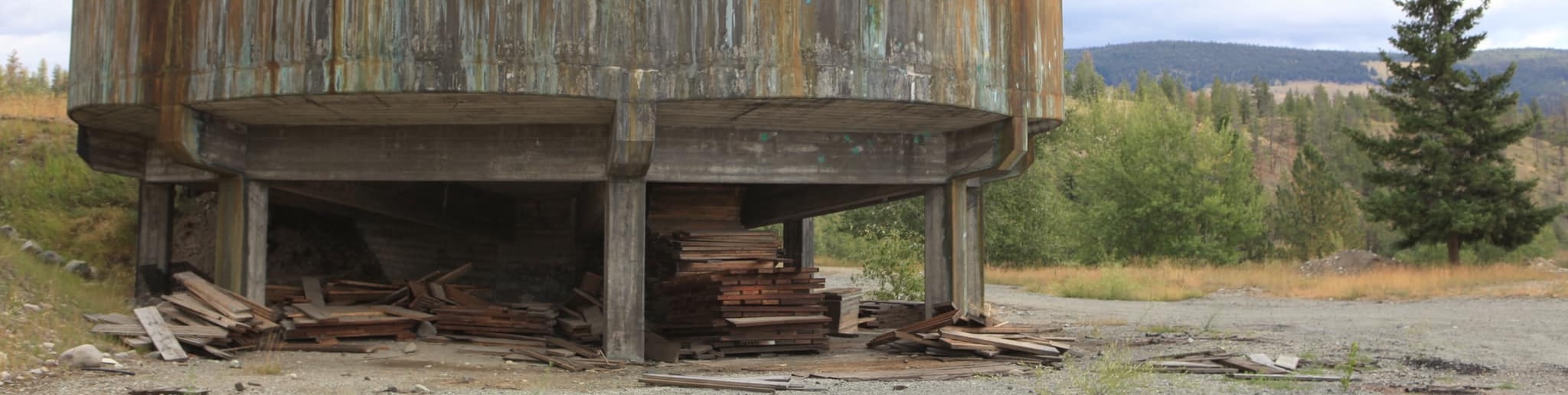
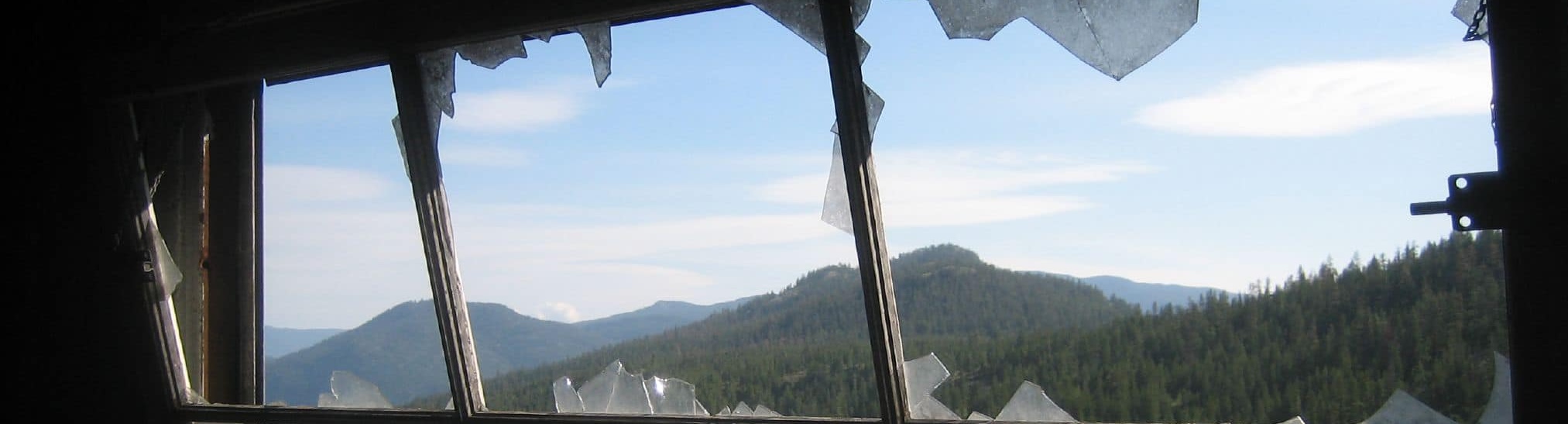
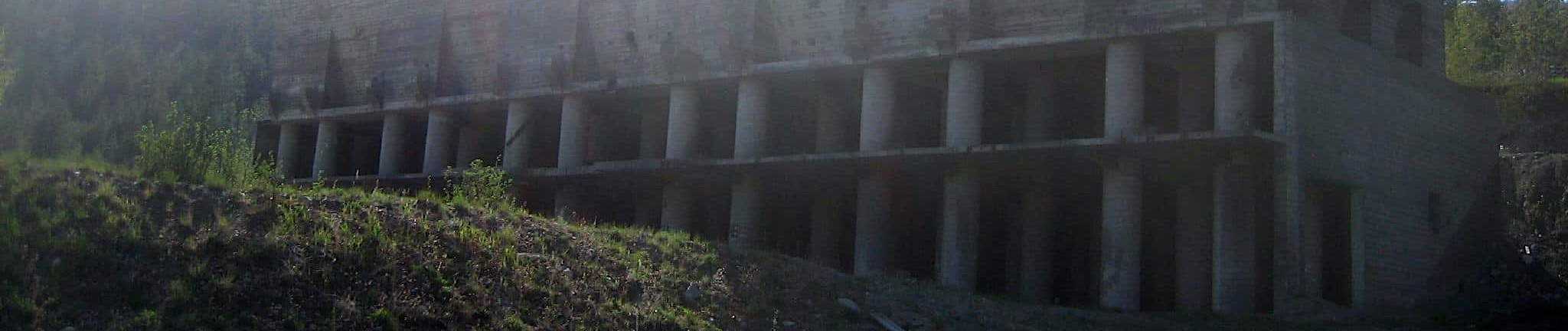
What remains of Craigmont's architecture looks extraterrestrial amid the evergreens and buckskin hills: skeletal, rusted scaffolding, grids of shattered windows exposing dusky interiors, colossal four-legged drums like squat water towers (washing tanks, Donnie explains later), crane hooks huge as ship's anchors, a massive, coffin-shaped structure resting atop concrete pillars (Donnie: ore bin), everything built by and for an extinct race of giants.
"Creepy." Tess.
"Cool." Sam.
I'm thinking about our horses, who've had one solid slug from a stagnant pond in the last twelve hours. "We need to find wat”—
Eyes stilling over the shape sprawled before the washing tank. Its fur is dusted chalk-white, the colour of the gravel it was killed on days ago.
"A horse," Sammy says flatly.
"A wild horse." There's an unsettling tautness to Tess's voice, like an overtuned guitar string right before it snaps. "Learned about them in grade four. Herds were roaming these hills before anyone'd found copper."
Indeed, the dead, dun, soot-muzzled stallion is no runaway farm horse. It'd been a powerful animal in life; in death, it has become a Thing, like rotted lumber which must be cast from the sound wood before its decay spreads.
Donnie swings down to kneel by the sunken head. The lower jaw lies a foot away from the snout, attached by mummified strands of flesh and tendon. I notice cursorily that its molars are missing.
"New Nack-awg..." Sammy squints up at the wall of the washing tank behind the horse. The letters there are faded, but not faded enough to be very old.
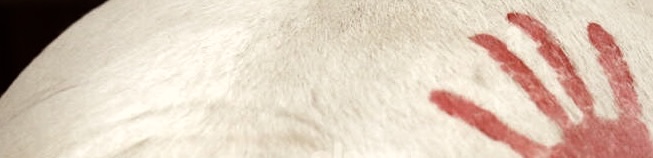
"Nac-uh-doshe-ez," Donnie pronounces, following Sam's gaze. "New Nacogdoches." The finger-painted letters are the brown of copper dust, or of blood left to dry in the sun.
Evening. Unrolling our sleeping mats between the ore bin's pillared aisles. Our horses are lashed two to a column, each having drunk their fill from a silty little stream Sam had found. Their muzzles are buried in feed sacks. Grain, at least, is not expected to run out so long as humanity can keep the last honeybee species alive.
After the wild horse, Tess had taken her stand at the ore bin: she would set up camp and see to supper and the horses, but there was bad juju out there, and she would not venture further. Don had recited the facts: you took the weekend off, came all the way up here, we never see you, Ava's gonna want proof you were here. But Tess was unmoved, and Sam was undeterred. He'd sacrificed his weekend for a midlife adventure, and, by God, he was going to get it. We'd left Tess with Don's Remington and a walkie. Sam, as jazzed as I'd seen him since his acid-tripping days, had led us out onto the shadeless mine site.
Eternal child that he was, Samuel had insisted on commemorative photographs of our brotherly bonding: Don giving him a leg up through what was left of the tailing plant's window; me, headlocked in the crook of his arm over the cement jaw crusher; Sam, again, moonwalking down the circuit conveyor belt, where he scavenged some hunks of magnetite for his stepkids.
By late noon, when our snarling stomachs finally vetoed further exploration, we'd filled our pockets and two of Sam's disposable cameras. Still, he'd dragged his heels back to camp— we hadn't found the open-pit mine, whose underground tunnel networks had featured alluringly in our grandfather's stories and albums.
Back at the ore bin, Tess had assembled our bedrolls and knelt, heating beans and venison over a tidy fire. She'd raised her face wordlessly at our approach, and I'd seen the consternation carved on her brow. Later, when the four of us were gathered in a hushed circle eating beans from enamel mugs, she'd looked at Don. "It's Spanish, right?"
Don, glancing sideways at her: "It's the name of a Mexican border-town in East Texas."
“Why would someone put that there?" I’m usually one to spectate before speaking, but the strange start to our day had gotten the better of me, too.
Donnie'd shrugged. “I wouldn't think that name'd mean much around here. Used to be a Southwestern saloon town. Saw a lot of bounty-hunters. Y'know, state-sponsored scalping, cultural genocide, biological warfare, the whole racist shebang."
“State-sponsored”— Tess had started shrilly.
"Not since the 1870's. That's what I don't get. Putting the wind up folks with that name depends on people knowing its bloody backstory." Donnie had lapsed into thoughtful silence. No one had mentioned the writer's grisly choice of ink.
"I think we should leave in the morning." Tess. "I thought it was a cool idea, Don, taking the horses back-country like dad did with us, seeing the mine where grandpa worked, grabbing souvenirs for the kids. But this is too..." She'd trailed off, speechless. "And I can't fucking believe I agreed to no phones."
"No electricity out here," Donnie'd retorted simply. "We got the walkies. Ava's with Ben's parents. You don't need to worr"—
“Don’t be surprised if I’m gone in the morning,” Tess had snarled, making the three of us jump. “I can’t not be a mom for the weekend.”
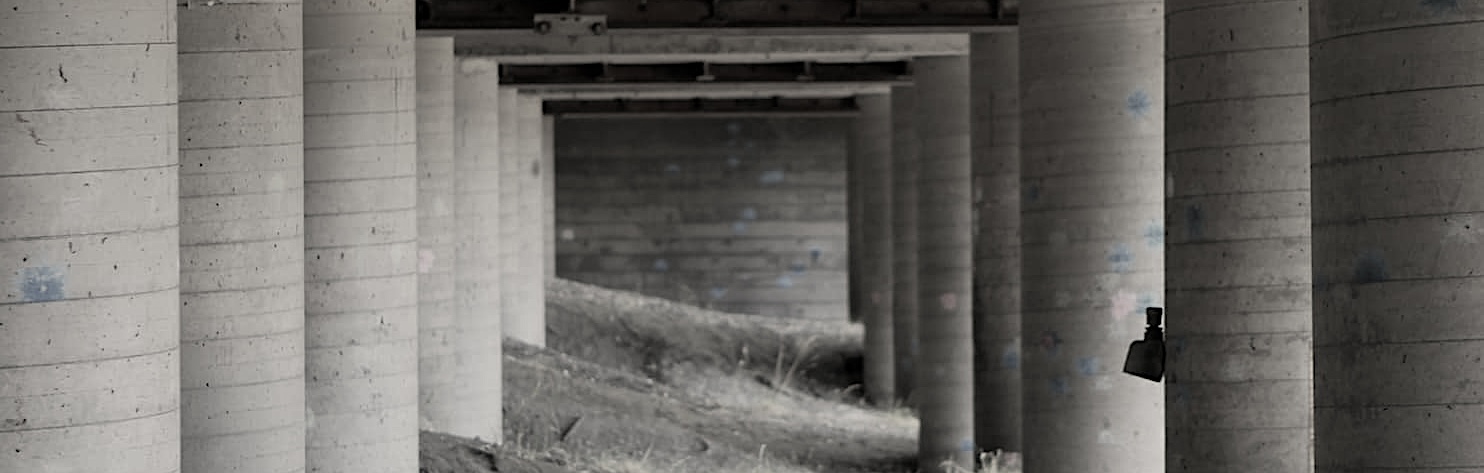
I dream restlessly of the darkness within which we sleep, spaced at odd diagonals, partially hidden from one another around the ore bin's pillars: a hand, a foot, a tuft of hair.
I hear my horse whickering and rise from my bedroll. The ceiling is so low that I experience a shock of claustrophobia: was it this low earlier? There is no wind in this dark, dank place; no stars in our concrete sky.
My mare turns her long face towards me in the darkness, her eyes black as two blobs of grape jelly beneath the star on her forehead. Her empty feed sack swings from her neck like a noose.
"Hey girl," I say, but there is no sound; the darkness devours my voice. I hadn’t noticed before how the white star on my mare's forehead looks more like an overturned crucifix.
Back where the shadows grow thick as Virginia creeper, Tess’s mare faces away from me, walking towards the back of the ore bin. She walks as though she's being led, like whoever untied her lead has hold of it, still. If not for the blue-halo-whiteness of her coat, which dazzles my eyes in the artificial night, I may have been able to discern her liberator: a sliver of pale flesh, bright as a dead moon—

I wake to my brothers standing over Tess's bedroll. Her mat is bare save for the bedding bundled neatly on top. Her mare, backpack, and saddle are gone.
"I didn't think she'd actually take off,” Sammy says finally.
“Me either.” Donnie. “She told us not to be surprised, but."
“No note?”
Don shakes his head. “Might not’ve brought anything to write with." Then, "Goddamn it. I was too dismissive last night; I’d probably be missing Jamie if I got to see him more than twice a month.” Jamie, the nephew I’d met all of three times before Donnie’s divorce at 26. “Probably knew we’d try to stop her.” Then, brightening: “I betcha she rode back to the truck to call Ava from the CarPlay."
“That’s a helluva long ride for a phone call,” Sam mutters. But Don is reassured.
"Here's what we'll do, since we came all the way out here: if Tess isn't back by dinner, we'll leave. Sammy, we can check out the mine pit like you wanted. You probably don't want to, huh?” He’s smiling sympathetically at me, the little brother whose claustrophobia prevents him from using even the roomiest elevators. I smile weakly.
"We'll make breakfast— Tess must’ve eaten from her pack— and find that damn mine pit."
When our horses are watered and roped in the shade of the ore bin, we set off in search of the mine, Sammy with his Winchester and Donnie with a buck knife and a walkie. I don't have so much as a boxcutter.
We retrace yesterday's route past the washing tank, the processing plant, the crushing circuit, and miscellaneous maintenance bays and core sheds. Then the gravelly terrain begins to slope, and we climb out atop a plateau, from which I can see those dead-mammoth hills slumped behind us in the distance. It's the sort of flattened, treeless space where you'd expect to find a central facility, or at least a few tonnes of mining machinery. But there is only the blank, bleached sky above the blank, bleached earth.
"Oh, hell yes!" Rifle bouncing, our sister's absence momentarily forgotten, Sammy bounds across the levelled earth and stops fifty yards ahead, gazing down.
From its edge, Craigmont's open-pit mine resembles an inverted Mayan temple, swung on its head and sunk into the earth. The pit's stepped sides have been carved away, year after year, layer after sedimentary layer, so that its base tapers to a pinpoint 2,000 feet below, and its gradated sides can be scaled via narrow, switchbacking lanes: a staircase for a giant.
It is down this staircase that Sam disappears.
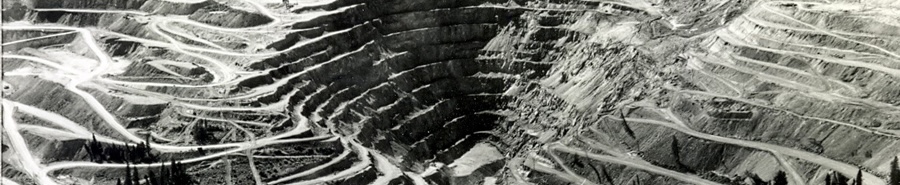
When Donnie and I draw up behind Sam, he's standing in the middle of a lane 600 feet down the pit, gaping into the cavernous mouth punched in its sandy wall. The mine shaft is a dead ringer for the ones in grandpa's photos: a doorway into a maze of miners' tunnels beneath the earth. Presumably.
"Take a photo of me, Don!" Sam shoves a disposable camera at Donnie and poses before the entrance like he's being sucked inside.
"Not too long in there, Sammy." Don tosses the Kodak back. "If you need to prove you were here with a photo or whatever, fine. But you go straight in; do not take any turns. Keep the exit visible at all times. I'm serious, dumbass; this is how people end up buried alive."
Sam pshaws. "You're being such a killjoy."
Ignoring him, "We'll be right outside waiting for you. Take some photos, grab a hunk of coal, and out in ten minutes. No turns. Sam? Ten Minutes."
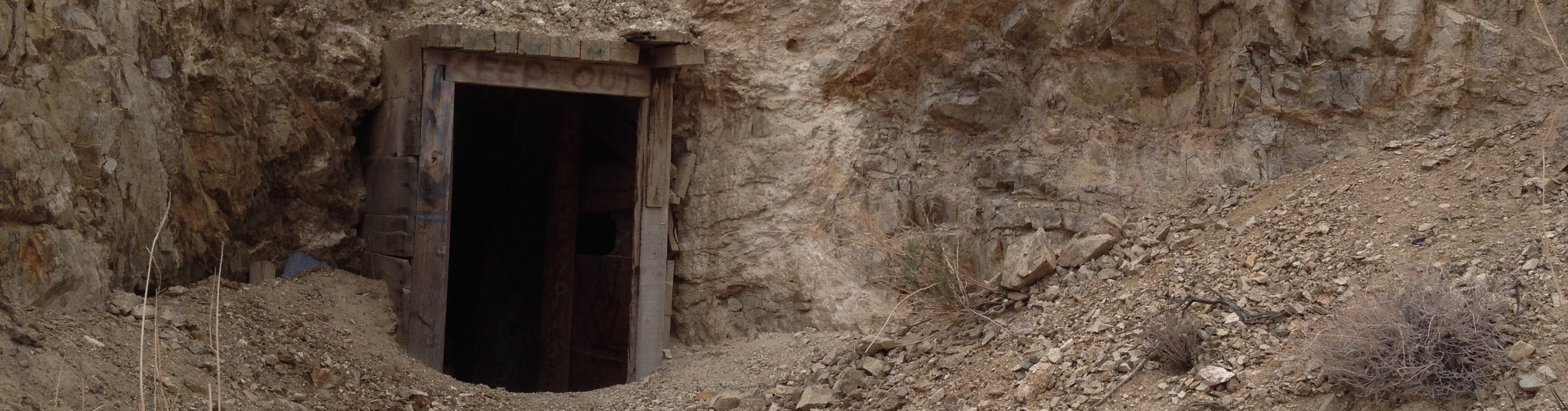
Don and I loiter at the mouth of the mine shaft, seconds passing like sludge. We're about a third of the way down the pit: a glance over its side gives me a head rush like the kind you get at the top of a Ferris wheel. And Sam's somewhere in the earth behind us.
Don squats beneath the shaft's rotting overhang to pare his nails with his blade. I pace to the pit's edge— vertigo— pace back. Don lets fifteen minutes pass before he rises to call for Sam. Instead, we both turn our heads to listen to the muffled speech floating out of the tunnel in unfamiliar baritones. Don takes a bewildered step towards the entrance. That's when we hear the rifle shot.
Sprinting, now jogging, now sprinting again. It hadn't done any good.
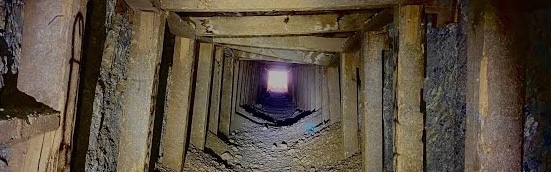
Don had hollered, threatened, charged in himself, but the shaft stretched deep as a snake's throat into the hillside before veering east out of sight.
"Goddamn it." Don's running, lagging behind me, panting with panic and exertion. "I! Told! Him! No! Turns!"
The nerves in my limbs are still afire. I'd hovered helplessly beside Don, who reckoned our brother must've tripped, fallen, turned, or gotten spooked in the dark; he'd tripped his trigger by mistake. Neither of us had mentioned the second voice in the tunnel. It had surely been Sammy's voice, distorted by the subterranean acoustics.
And now we were barrelling back to the ore bin, the gap between us widening. I'd been the fastest in rugby and now, in my thirties, salt in my pepper hair, I ran like the goddamn wind. The first one to the truck would call fire rescue in Kamloops, and they'd get here... as fast as they could get here.
I pass the washing tank— no horse— and skid into the shade of the ore bin— no Tess. I've untied and saddled my mare before I realize that Sammy's horse is missing.
Doesn't matter, I think wildly. No horse, no horse, no—
There is a rust-brown handprint the size of a football on my mare's flank.
The thought Someone is fucking with us occurs to me briefly, shrilly, and then I'm in my saddle and swinging towards the direction I'd come running with Don, who is
nowhere.
When had I lost him? He'd been huffing behind me down the hill from the pit, past the sun-faded Porta-Johns and the decommissioned haul truck—
Had Don passed the washing tank with me? Where there was now no horse, no blood, nothing but a town name.
I grab Don's Remington and the spare walkie, cut his horse's lead (if he was as slow a runner as I hoped, his spoiled mare wouldn't get far in the meantime) and urge my mount down the service road back to the highway.
On the asphalt, twenty minutes later, I try the walkie's radio setting— no service. Stormheads are gathering over the valley, oversaturating my surroundings: the highway looks like a tongue of black ice. I glance back up the service road, and then I spur my mare into a gallop. In ten minutes, her gallop becomes a canter; in twenty, a limping trot. When we reach the field at the turnoff, I let her legs buckle beneath us in the grass. I roll out of my saddle with my back flush to her clammy, heaving sides. I try Don's walkie again. And again.

I wake at dusk.
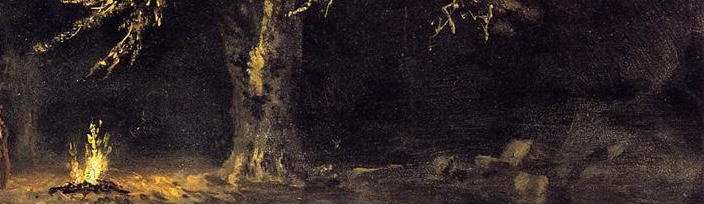
Someone is roasting meat. I can smell the crisping flesh and hear its fatty sizzle. A fire crackles cheerfully in the background, radiating its golden comfort from the firepit my siblings and I had used two days ago. I almost weep with relief.
"Thank god," I say, rising. My spine is stiff where I'd konked out against my mare, who lies rigid and heatless on her side behind me.
"God?" a voice says.
Ice water courses through my veins.
The man crouching over the fire is half-hidden from me by the tall grass: someone with my sister's frying pan in their blue-white hand and a black Winchester across their back. When the figure turns to look at me out of lashless, albino eyes, I see gristly ribbons of unrecognizable meat browning in Tess's pan, and the necklace of teeth that the apparition wears across its immense, hairless chest. Some are horse teeth. Some.
About the Creator
Jennifer A. G.
🇨🇦 Canadian Writer, Painter & Embroidery Artist
♾️ Métis Nation
🎓 University of Victoria Alumna
📝 Publications: The Malahat Review, Freefall Magazine, Geist, Best Canadian Poetry 2026
Enjoyed the story? Support the Creator.
Subscribe for free to receive all their stories in your feed.
Comments
There are no comments for this story
Be the first to respond and start the conversation.