
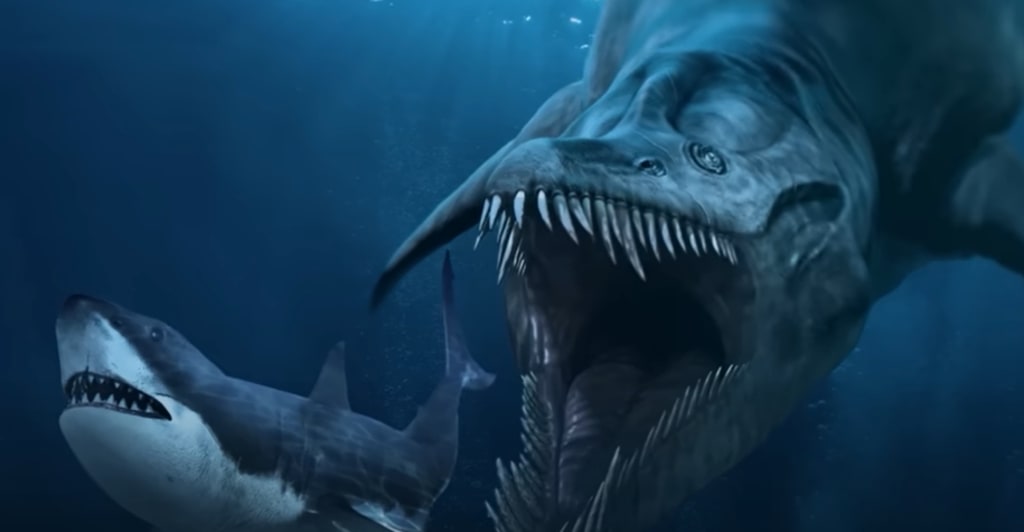
A massive Great White Shark was eaten by an unknown creature, leaving behind only its tracker. This incident sparked a mystery that led to speculation about what could have possibly devoured such a fearsome predator. The story began in 2003 when filmmakers Dave and Jennene Riggs discovered nine beached sperm whales in Bremer Bay, Australia. They observed a group of hungry Great White Sharks feeding on the whale carcasses and decided to alert a team of scientists to tag the sharks for research on their migration patterns. One of the tagged sharks, named Shark Alpha, mysteriously disappeared after four months, leaving behind only its tracker. Analysis of the data revealed that the shark had suddenly changed course and descended to a depth of around 1,900 feet on Christmas Eve. This puzzling turn of events led to speculation about what could have possibly consumed the giant Great White Shark.
However, killer whales primarily hunt near the surface and rarely dive deep for food, so it's unlikely that they were responsible for the incident. Additionally, killer whales have a body temperature of around 100 degrees Fahrenheit, while the tag was swallowed at a temperature of 78 degrees Fahrenheit, ruling out the possibility of a killer whale as the predator. So, if it wasn't a killer whale or a whaler shark, then what could it have been? One potential suspect is the giant squid, which lives in the deep sea and is difficult to study. Giant squid can grow to enormous sizes, with the largest one ever seen measuring 59 feet in length and weighing almost a ton. They also have powerful tentacles that they can use to capture prey, and there is evidence of them preying on sharks. Additionally, giant squid exhibit diurnal vertical migration, rising to the surface at night to hunt for food and returning to the depths during the day to avoid predators. This behavior could explain how a giant squid may have encountered and attacked the shark. However, the sharp increase in temperature when the shark was attacked presents a challenge to this theory.
The evidence suggests that the creature that ate the shark had a higher internal temperature than its surroundings, indicating it was warm-blooded. However, giant squids are cold-blooded and their body temperature depends on the environment. Therefore, if the tag had been in a giant squid's digestive system, it would have shown a temperature similar to the water, ruling out the possibility of a giant squid being the culprit. This eliminates the most likely suspects, leading to the need for more creative thinking. While killer whales are currently the only known natural predators of great white sharks, historically there have been other shark-eating creatures in the oceans. Could an extinct creature be responsible for this mysterious attack? With 80% of the ocean still unexplored, this theory may not be as far-fetched as it seems. For example, the Spinosaurus, a massive predatory dinosaur, was capable of swimming underwater and eating sharks whole. However, it has been extinct for millions of years and is only semi-aquatic, making it unlikely to be the culprit. On the other hand, the Mosasaurus, a ferocious ocean predator that lived at the same time as the Spinosaurus, fits the profile of a potential shark slayer. With its large size and ability to swim at high speeds, it could have easily hunted and devoured a shark.
The writer speculates about the outcome of a hypothetical battle between a Mosasaurus and a shark, ultimately concluding that the Mosasaurus would likely win due to its size and weight. The text also discusses the possibility of prehistoric creatures, such as the Mosasaurus and the megalodon, surviving extinction and still existing today. The writer considers the potential survival of these creatures, citing the example of the coelacanth, a deep-sea fish once thought to be extinct until its rediscovery in 1938.
The issue is that it's not difficult to lose sight of the small population of fish that live deep in the ocean, but megalodons were larger than a school bus. Additionally, scientists believe they spent most of their time in shallow, coastal areas, where they would have been visible. However, the fact that we haven't seen them doesn't necessarily mean they are extinct. There is a possibility that the ancient creature has evolved over millions of years and now resides in the deep sea, which is technically feasible. Humans only became homo sapiens around 300,000 years ago, and if the megalodon were alive today and living secretly in the deep, it would likely look very different. Deep-sea life near the ocean floor has to survive on limited species, so any sharks that have adapted to such depths are usually slow-moving. Therefore, if the megalodon has successfully adapted to deep-sea life, it would probably resemble a sleeper shark, which is unaggressive and slow-moving. This means that an evolved, modern-day megalodon would unlikely have the speed and power to prey on a nine-foot long great white shark. The question remains: could the megalodon still exist in some form? Share your theories in the comments below. I was starting to convince myself we had our answer, but I have more theories to discuss. Let's not forget about Livyatan Melvillei, an extinct type of sperm whale with enormous teeth, up to 14 inches long, which could have rivaled the megalodon. Scientists believe this creature could have eaten anything it wanted, including sharks and other whales, given the size of its teeth.
The 60-foot long super whale is believed to have been extinct for 9 million years, although the exact reason for its extinction remains uncertain. Some scientists speculate that a global cooling event may have led to the extinction, as the whale's prey could not survive in cooler waters. However, the colossal size of the whale may have also contributed to its need for more food, making it difficult to survive. Additionally, the fact that the whale, like modern dolphins and whales, needed to come up to the surface to breathe suggests that it would have been unlikely for them to remain unseen for 9 million years if they were still in existence. Another factor that has led to speculation about the possible existence of this extinct creature is a mysterious sound known as the "bloop," which was recorded in 1997 in the Southern Pacific Ocean. While some conspiracy theorists have linked the bloop to the fictional sunken city of R'lyeh and the mythical sea monster Cthulhu, scientists eventually determined the real source of the sound after years of investigation. The sound that was initially thought to be a mysterious sea monster turned out to be the mundane sound of sea ice cracking and breaking, a common event in the Southern Ocean. The audio had been sped up 16 times its normal speed when it was released to the public. The real answer to the mystery of what ate the great white shark was revealed in 2014, over a decade after the discovery of the dead whales that sparked the investigation. Researchers discovered that another great white shark, a colossal 16-foot long cannibal with giantism, had devoured the shark. This super shark, weighing over two tons, had a temperature spike matching that of the tracker of the eaten shark, indicating it was responsible for the attack. The cannibalistic behavior of the giant shark was not uncommon, as regular-sized sharks have been known to feed on smaller ones. The reason for the deep dive of the super shark and the consumption of its prey at the end of the dive remains uncertain. It is likely that the larger shark caught the smaller one in its jaws and quickly descended with it to disorient and make the final kill easier. This is a brutal behavior. However, before you decide to avoid the ocean altogether, it's important to note that sharks generally do not have an interest in consuming humans, so there is likely no need to fear encountering a cannibalistic shark. Despite this reassurance, swimming in Bremer Bay's kill zone doesn't seem appealing. Perhaps opting for a paddling pool would be a safer choice. The prevailing belief is that a giant shark was responsible for the incident, but there is also the possibility of an even stranger culprit. What are your thoughts on this?
About the Creator
Joseph
We are all programmed from birth on how to be, yet never taught how to tap into our full potential of how to hack the matrix true life; remote viewing, law of vibration & law of attraction is what we should be teaching in schools. Explore!
Enjoyed the story? Support the Creator.
Subscribe for free to receive all their stories in your feed.
Comments
There are no comments for this story
Be the first to respond and start the conversation.