
The goosebumps came first, crawling up my arms like ants before I understood why. Then my ears began to tingle, the way they do when someone says your name in a crowded room.
Good morning.
I nearly came out of my chair. The PA system in the old Spout Spring Elementary building hadn't worked since before any of my students were born. That's why I didn't recognize the sound at first.
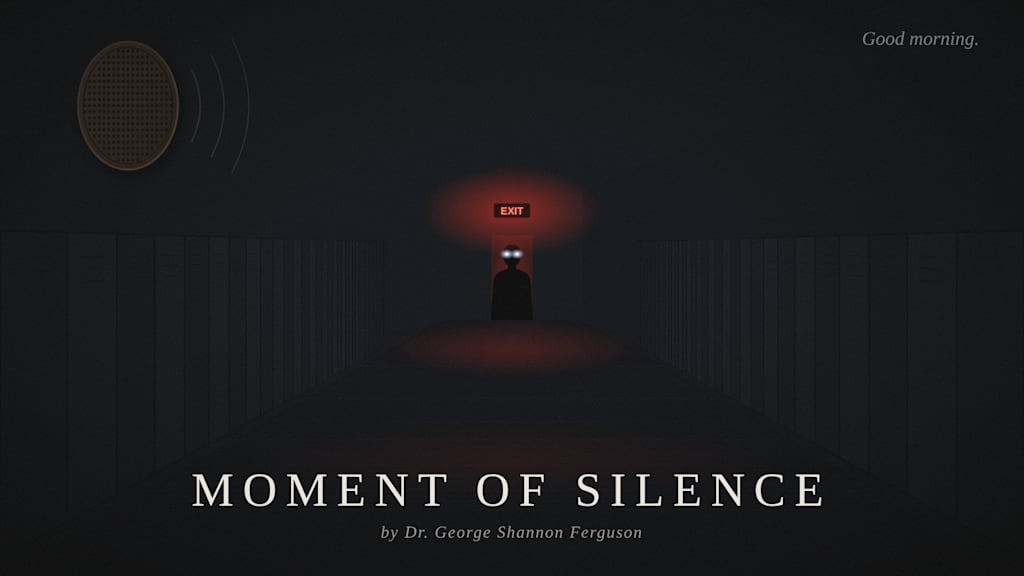
It was a quarter past six on a Thursday at the end of October, and I was finishing the last details for tomorrow's Halloween party. The heat had shut off at six, the way it always did, and the building had begun its nightly settling: a tick in the radiators, a groan somewhere in the ceiling tiles over the old cafeteria. Outside, Appomattox County had gone dark the way only rural Virginia does. No streetlights. Just the occasional pair of headlights on Route 24, sliding past the windows and gone. A box of orange streamers sat on the corner of my desk. The only light in the building came from my desk lamp and the red glow of the EXIT sign down the hall.
Then every speaker in the building clicked on at once.
It wasn't loud. Just a soft electric pop, like someone tapping a microphone in the next room. The speaker above my door is a brown grille the size of a dinner plate, painted over so many times the holes are half-filled.
It began to hiss.
I stopped typing. A shiver started at the base of my neck and kept going.
The hiss went on long enough that I began explaining it to myself. A power surge. A wire the mice had found. Old buildings make noises. Old buildings make all kinds of noises.
Then someone, very close to the microphone, cleared their throat.
"Good morning, Appomattox School."
I knew the voice before my mind would let me admit it. I'd heard it on voicemail greetings, and in recordings of my own lectures I could never stand to play back. It had my slight drag on the vowels. It had my habit of pausing a half-beat before a date, as if I needed to check it.
It was my voice.
But I was sitting right there, with my mouth closed.
"Today is Friday, October thirty-first."
My hand found the edge of the desk and held on.
That was tomorrow.
"A few reminders before first block. Route 9 will be running about twenty minutes behind this morning due to a downed tree on Route 24. Students on that route will not be marked tardy. The Phi Theta Kappa meeting has moved from the library to Room 4. Costumes are not permitted during class blocks, but the costume contest will be judged at trunk-or-treat in the back lot at five o'clock. Volunteers, please see Mrs. Hartwell. And seniors, your scholarship essays are due by three o'clock today. No extensions."
It was so ordinary. That was the worst part. It was exactly what I'd say, in the order I'd say it, in the tone I use when I want them to know I mean it but I'm not mad. No extensions. I say that every time, and I always grant one.
"Finally," my voice said, and the cheer drained out of it, "please join me in a moment of silence for John Smith."
I stood up so fast my chair hit the filing cabinet.
John Smith. With a name like that, the nickname was inevitable. Agent Smith, I called him, after the villain in The Matrix, because he wore the same cheap black sunglasses every single day. In class. In February. Always.
When John came to us as a sophomore, he didn't talk. He sat in the back corner of every room with those glasses on and his hood up, and his teachers kept emailing me to ask whether I could "do something about the sunglasses." I never did. I figured a fifteen-year-old who needs something to hide behind has a reason, and if he ever wanted to tell me what it was, he would.
He started coming by my office that winter. First to ask about his schedule, then to complain about chemistry, and eventually just to sit. Somewhere in there I called him Agent Smith, and he cracked a smile, the first one I'd ever seen from him. After that, he answered to nothing else.
By senior year, he was the loudest kid in the building.
He'd been in my office at 3:15 that afternoon, perched on the arm of the chair because he had too much energy to sit in one properly, laughing about his costume.
"I'm going as Agent Smith," he said.
"John, that's not a costume. That's a Tuesday."
"Exactly. Black suit, black tie, earpiece. I'm winning that contest, and you can't stop me." He leaned back and gave me his best villain drawl. "You're my ace in the hole, right, Mister Ferguson?"
"That's Dr. Ferguson," I said. "I didn't write a whole dissertation to be called Mister."
He sat up straight and gave me a slow, solemn nod, like he was accepting new orders. "My apologies. Dr. Ferguson."
"Better. And absolutely not," I said. "I'm Neo. I'm the one who takes you down."
He laughed so hard he nearly fell off the chair. Then he did something he'd never done in three years. He took off the glasses, folded them, and set them on my desk.
"For real, though," he said, eyes fixed carefully on the floor. "Thanks for never making me take these off."
He held out his fist, and I bumped it. His knuckles were ice cold, like he'd been standing out in the October dark instead of sitting in my warm office. I remember thinking he needed a better coat.
Then he put the glasses back on, said "Dr. Ferguson" one more time in that drawl, and walked out laughing.
I could still see the two small smudges his lenses had left on my desk. Above me, the speaker hissed.
The silence didn't just fill the room. It settled over me like a weight, heavy and damp, pressing on my chest until I realized I'd stopped breathing. I started counting without meaning to, the way you count underwater when you don't know how far the surface is.
Five.
Ten.
Twenty.
My lungs burned.
Forty.
I broke, gasping, dragging in air like I'd just kicked up out of a lake. The silence went on anyway, longer than any real moment of silence ever lasts.
And it wasn't empty. Somewhere under the static was a sound I couldn't name, steady and patient, like someone breathing very slowly through their nose. Someone who didn't need to come up for air.
Behind that, so faint I may have imagined it, was a low, rhythmic thudding, like a drum heard from very far across a field.
At sixty seconds, my voice came back.
Not the voice that had read John's name. That one had been heavy and hollow. This one was bright, bubbling with a glee so sudden and so wrong it was like hearing a stranger laugh at a funeral. It was still my voice. It just sounded like someone else was wearing it.
"Have a great day, everyone!"
Click.
The building went quiet. A radiator ticked. The EXIT sign buzzed.
I don't remember deciding to move. My legs carried me, stiff and slow, as if my body had made the decision without me. I drifted down the hallway like a sleepwalker until my mind surfaced in front of the bronze plaque by the main doors, the one I'd walked past a thousand times without reading.
SPOUT SPRING SCHOOL. ERECTED 1964. ON LAND ONCE CROSSED BY THE ARMY OF NORTHERN VIRGINIA, APRIL 1865.
For the first time, I wondered which direction they'd been walking, and how many never made it to the courthouse. I had the crawling feeling of being watched by people who weren't there. Or maybe I was the ghost, and none of this made sense because I was the thing that didn't belong.
I blinked.
Darkness. Cold metal under my hands.
I was in the supply closet behind the front office. The door was shut behind me. I had no memory of crossing the office, of opening the door that always sticks, of finding my way through the dark. My whole body was buzzing, like I'd grabbed a live wire and couldn't let go.
"How did I get here?" My voice sounded thin and small, nothing like the voice on the speakers.
I fumbled until my fingers found the pull chain. The bare bulb snapped on.
Under it sat the console: a gray metal box with a row of toggle switches labeled in someone's careful hand from decades ago. ROOMS 1–6. CAFETERIA. GYM. ALL CALL. A gooseneck microphone bent down over it, like it was listening.
The power cord lay coiled on the floor, unplugged. The wall outlet behind it had been painted over.
I touched the ALL CALL switch. My fingertip left a clean print in the dust, sharp and perfect, like the first footprint in fresh snow.
No one had touched it in years. No one had touched it tonight.
The announcements weren't just impossible. They were right. The bus. The meeting room. The trunk-or-treat. Three o'clock. If they were right about all of that, how could I argue with the rest?
I knew how I'd sound. The director out at Spout Spring, alone in that old building too many nights, finally cracked. I didn't care. Call John's mother. Call the sheriff. Call anyone.
My hand shook so badly it took two tries to unlock my phone with my thumb. My fingerprint. I thought of the other one, in the dust, and the screen lit up.
The weather app was still open. Clear skies all night. No wind.
No wind. No storm. Nothing to bring a tree down.
And Route 24 runs right past John's house.
His mother had called me only days before, asking if John could volunteer at the party. I could still hear her laughing: Lord knows he's got the energy for it. Her number sat near the top of my recent calls.
I pressed it.
It didn't ring.
It hissed. A long, low, steady sound, like a snake coiled somewhere in the dark of the line.
"Jesus," I whispered. Half curse, half prayer.
Full bars. Battery fine. Just a phone.
I tried again. Hiss.
A third time. I pressed it hard against my ear, and under the static, faint and patient, I heard it.
Slow breathing.
It wasn't in the speakers anymore. It was in my hand, against my ear, close enough to whisper.
I dropped the phone. It skittered across the closet floor, and I ran. Through the dark office, down the hallway, past the plaque and the red glow of the EXIT sign, my footsteps echoing like someone was running right behind me.
I hit the main doors. I remember the cold brass bar under my hands.
I remember pushing.
Then I heard buses. The hiss of air brakes. Engines idling in the front lot.
I opened my eyes.
I was sitting at my desk. Gray morning light came through the blinds. The box of orange streamers sat where I'd left it. My phone lay face-down beside my keyboard, though the last time I'd seen it, it was spinning across the closet floor.
I was still wearing yesterday's clothes.
Out in the hallway, lockers slammed. Someone yelled about a costume. Mrs. Hartwell leaned in my doorway with her coffee, looked me up and down, and frowned. "Dr. Ferguson, you look like you slept here."
I didn't answer. I didn't know if I had.
The clock read 7:52.
I turned my phone over. One new email, sent at 7:30 that morning from my own account. Morning Announcements. I hadn't written it. I read the first line anyway, though I already knew every word.
Route 9 will be running about twenty minutes behind this morning due to a downed tree on Route 24.
Through the window, I watched the Route 9 bus pull in, twenty minutes late.
I had lost the whole night.
Then a shadow fell across my doorway.
Sunglasses on, hood up, grinning like he'd already won the contest, stood John.
Alive.
"Morning, Dr. Ferguson."
Good morning. I'd heard those words last night, in my own voice, through a speaker that wasn't plugged in.
John flashed me a thumbs-up. "I'm winning today, right?" And he was gone down the hall.
I sank back into my chair. I didn't know what to believe, but I knew one thing: I wasn't letting John out of my sight.
I found reasons to pass his classes. I moved his lunch into my office "to go over tonight's party." By two o'clock he was squinting at me over the top of his sunglasses.
"You're being weird, Dr. Ferguson."
"It's Halloween," I said. "Am I supposed to be normal?" I laughed, but it came out thin.
At five, the back lot filled with headlights, open trunks, and kids in costumes. John was out there with his friends, stringing orange lights between the cars, in a black suit, black tie, and a curly earpiece cord taped behind one ear. When the contest started, he walked the length of the lot in slow, stiff steps, never once smiling, and the little kids shrieked and scattered. He won by a landslide.
While the crowd cheered, I slipped inside and called his mother.
My thumb hovered over her name. I thought of the hiss. The breathing.
It rang. Just a normal ring.
"Mrs. Smith, it's Dr. Ferguson. I need you to pick John up tonight. Don't let him drive, and please don't take Route 24. Take the back roads."
A long pause. "Is he in trouble?"
"No, ma'am. I just have a bad feeling. Humor me."
She must have heard something in my voice, because she didn't argue.
At seven-thirty, her car pulled into the lot. John climbed in, still in his suit, and waved his trophy at me through the window. I watched the taillights turn away from Route 24 and disappear down the gravel road into the dark.
Twenty minutes later, my phone buzzed. Home safe. Thank you, Dr. Ferguson.
My knees nearly gave out. Whatever was supposed to happen on Route 24 today, it wouldn't happen to John.
The lot emptied. Car doors slammed. The last headlights swept across the windows and were gone. Then it was just me, a lot full of candy wrappers, and the old building settling into the dark.
I should have gone home.
Instead, I stayed to clean up.
Around nine, I was stuffing streamers into a trash bag when I heard sirens out on Route 24. They screamed past the school, headed toward the stretch by John's house, and then, somewhere out in the dark, they simply stopped. Not faded. Stopped. No one came back the other way.
Something, somewhere, had still been collected.
At a quarter past nine, every speaker in the building clicked on.
"Good morning, Appomattox School. Today is Saturday, November first."
There is no school on Saturday. The voice went on anyway, bright and easy, announcing nothing. No buses. No meetings. No deadlines.
Then the cheer drained away.
"Please join me in a moment of silence for Dr. George Shannon Ferguson."
I didn't count this time. I just listened to the slow breathing and the distant drum, and to the static, growing louder and closer, like footsteps coming across a field.
Then the voice spoke again, and it was no longer mine.
It was slower, with a flat, mocking drawl I'd heard a hundred times.
"Thank you, Dr. Ferguson, for staying late. Someone always has to stay."
I ran to the closet. The door that always sticks swung open at a touch, as if someone had been waiting. Taped inside it, under the bare bulb, was a sheet of yellowed paper I had never seen before.
DIRECTOR'S SIGN-IN
Dozens of names. Each with a single date, and no time out. The oldest was in faded brown ink, dated April 1865.
The last line was blank.
Behind me, a floorboard creaked.
John stood in the doorway of the front office, still in his black suit, still wearing his sunglasses in the dark. I hadn't heard a car. I hadn't heard the main doors.
"John," I said. "How did you get here?"
He tilted his head, slow and precise, exactly like the character he'd played all night.
And I realized I had never seen his eyes. Not once in three years. Not even yesterday, when he folded those glasses on my desk and kept his gaze so carefully on the floor.
He reached up and slid the sunglasses off.
His eyes were glowing. A pale, steady light, like the moon behind clouds. Like an EXIT sign at the end of a long hallway.
Then he smiled.
It was not John's smile. It stretched too wide and held too long, and there was something in it very old, very patient, and very, very pleased.
"You always grant an extension, Mister Ferguson," he said softly.
He folded the glasses and held them out to me.
"Now it's your turn."
Down the hall, every speaker in the building began to hiss.
About the Creator
Dr. George Shannon Ferguson
Dr. George Shannon Ferguson. Educator by calling, poet by daily habit. I write about faith, gratitude, love, and the seasons that test us, with some short fiction (and a few ghosts) along the way. Pull up a chair.
Enjoyed the story? Support the Creator.
Subscribe for free to receive all their stories in your feed. You could also become a paid subscriber, letting them know you appreciate their work.
Comments
There are no comments for this story
Be the first to respond and start the conversation.