
MISIN — Chapter 2: Objects Remember
Do you know whose hands were on that before yours?
This is the second chapter of MISIN — a series on Korean shamanistic taboos that shamans know but ordinary people were never told.
Look around the room you're in right now.
Is there anything secondhand? A piece of furniture someone else owned, clothes passed down, dishes left behind when a friend moved? Things you brought home without thinking twice. Shamans, when asked about such things, tend to go quiet before asking:
"Do you actually know whose hands were on that before yours?"
In Korea's traditional worldview, objects are not inert. A thing that has been used for a long time, touched repeatedly by human hands, soaked through with someone's deep emotion or longing — it accumulates energy. The object becomes a kind of residue of the person who owned it.
This belief is not uniquely Korean. In Japan, there is an old folk concept called tsukumogami — the idea that tools and household objects, after approximately ninety-nine years of existence, develop spirits of their own. Objects that are discarded and forgotten carry resentment. They become something dangerous. Two cultures separated by an ocean arrived at the same conclusion through centuries of observation: objects remember the people who passed through them.
Among all objects, clothing is considered the most potent vessel in shamanistic tradition. It is the thing closest to skin — saturated with body heat, sweat, and the emotions of its final days. The ancient funeral ritual of cho-hon confirms this. Immediately after death, a family member would climb to the roof and wave the deceased's undershirt in the air, calling the name three times — an attempt to call the soul back. Clothing was believed to be the one thing a wandering soul could still recognize and follow home.
"Dirty house, mold on the bathroom walls, the entryway packed with junk — that's where the dark spirits gather. In all my years of practice, not one person who came to me possessed had been living in a clean space." — A shaman of 17 years
Homes where things pile up. Homes where nothing old is ever thrown away. Homes where the belongings of the dead are kept among the living. These become places where energy stagnates — spiritually still water.
— — —
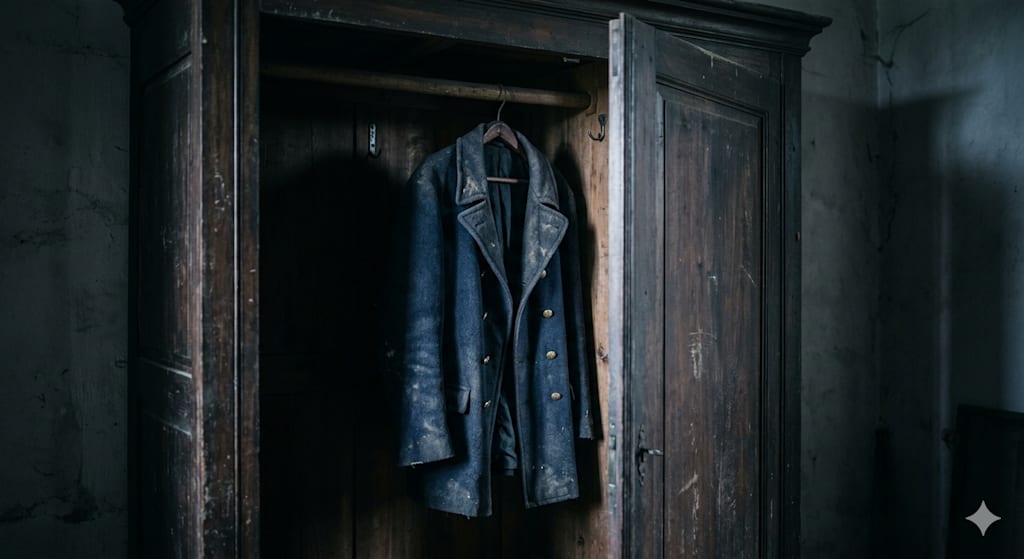
In the early 1990s, a young couple moved into a building in Mapo, Seoul. The previous tenant had left in a hurry, leaving several things behind: a wooden chest of drawers, a potted plant, and pushed to the very back of the wardrobe, a heavy navy wool coat. The fabric was beautiful. The cut was excellent. The husband started wearing it that winter.
The strangeness began around the winter solstice. He started waking in the night, sitting up and staring into the dark corner of the bedroom. His wife would call his name. He wouldn't respond. His eyes were open but unfocused. During the day, he would stop mid-sentence and stare at a blank wall for ten, fifteen minutes. The hospital found nothing wrong.
His mother came to visit one afternoon and opened the wardrobe. She froze.
"Whose coat is this?"
The previous tenant left it, his wife said. The mother's face changed. Without a word, she pulled the coat from its hanger and carried it to the courtyard. She poured salt over it and held a lighter to the hem. The thick wool caught faster than it should have.
That night, the husband slept through until morning for the first time in months.
They found out later. The previous tenant's son had hung that coat in the wardrobe, walked out the front door, and never came back.
— — —
Everything discarded has a reason behind it. And we cannot always know what that reason is.
About the Creator
Hee Park
Korean-born writer exploring the shamanic taboos most people were never told about. Some rules exist for a reason. I write about those reasons.
Enjoyed the story? Support the Creator.
Subscribe for free to receive all their stories in your feed.
Comments
There are no comments for this story
Be the first to respond and start the conversation.