
MISHIPESHU:
THE MONSTER WAITING BENEATH THE GREAT LAKES

TUESDAY CRYPTIDS
MISHIPESHU: THE MONSTER WAITING BENEATH THE GREAT LAKES
Miss Lil's Tea Table | Where the water runs black and something ancient is watching
There are places in Wisconsin where the woods get so quiet you can hear your own heartbeat.
And then there are places where the water gets so dark you start wondering whether you really want to know what lives beneath it.
Welcome back to Miss Lil's Tuesday Cryptids, my friends. Grab your favorite mug, settle in, and keep the porch light on tonight. Because this week, we're heading somewhere a little closer to home.
We're talking about the Great Lakes.
Specifically, that enormous stretch of cold, dark water separating Wisconsin, Minnesota, Michigan, and Canada. The kind of water that can swallow a boat, hide a wreck for generations, and leave absolutely no explanation for what somebody swears they saw.
And somewhere beneath those waters, according to Anishinaabe tradition, lives a creature that makes the ordinary lake monster look like a goldfish with an attitude.
Its name?
Mishipeshu.
The Underwater Panther.
The Great Lynx.
And if the stories are to be believed, you might want to think twice before taking anything that belongs to it.
Especially copper.
Because Mishipeshu doesn't take kindly to thieves.
And the last thing you want to do is anger something that can turn an entire lake against you.
So, let's pour the tea.
This one might get cold before we're finished.
THE CREATURE THAT DOESN'T BELONG ON LAND
Imagine standing on the shore of Lake Superior.
It's late afternoon. The sky has turned that miserable shade of gray that makes Wisconsin winters feel personal. The wind is coming off the water, sharp enough to sting your face.
You look out across the lake.
Nothing unusual.
Just water.
Miles and miles of it.
Then something moves.
Not a fish jumping.
Not a wave rolling toward shore.
Something large enough to disturb the water without breaking the surface.
You watch it for a moment.
The movement disappears.
And you tell yourself it was probably a current.
Because that's what sensible people do.
They explain things.
They go home.
They don't spend the next three nights wondering why the water seemed to move against the wind.
But the people who have lived around the Great Lakes for generations have stories about something that doesn't need explaining away.
Something that belongs to the water.
Something that has been there longer than the towns, the roads, the fishing boats, or the people who now claim the shoreline.
Mishipeshu.
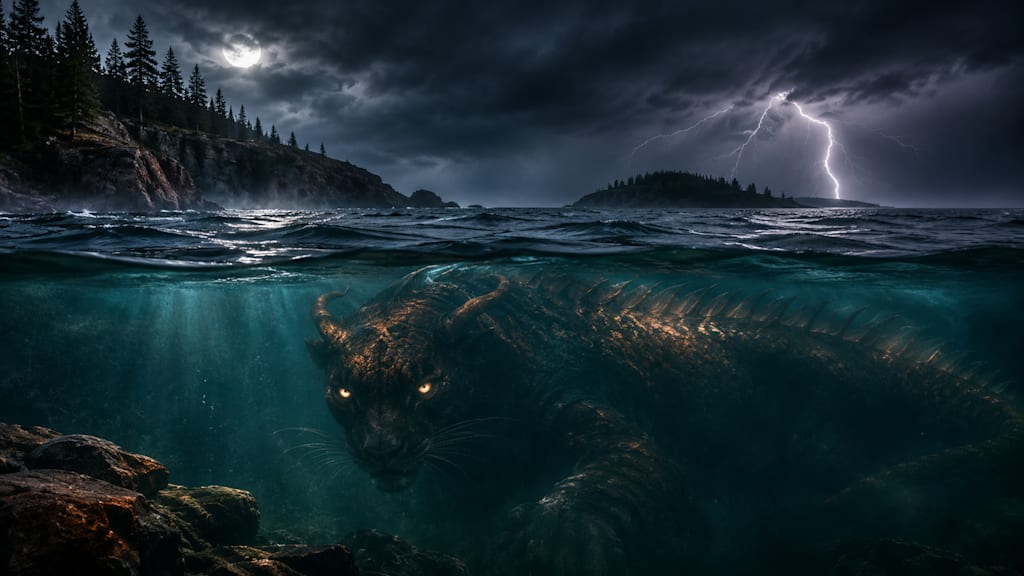
In Ojibwe traditions, Mishipeshu is commonly described as an underwater panther or Great Lynx. Its appearance varies between accounts, but descriptions often include the body of a great feline, horns, scales, sharp spines running along its back, and an enormous tail.
Some depictions give it the appearance of a creature assembled from several animals.
A panther's face.
A serpent's body.
The horns of a powerful animal.
And a tail capable of stirring the water into something deadly.
It is not simply a beast hiding in a lake.
Mishipeshu belongs to a much larger spiritual world in which the waters have their own powerful beings, relationships, and dangers.
And that distinction matters.
Because this isn't just a story about a monster that wants to eat somebody.
It's a story about a being that commands respect.
And sometimes, that respect is the only thing standing between a traveler and disaster.
LAKE SUPERIOR: WHERE THE WATER KEEPS ITS SECRETS
Now, if we're going to talk about Mishipeshu, we need to talk about Lake Superior.
Because if there is one place that feels like it was built for a creature of this kind, it's Superior.
This lake is enormous.
Cold.
Deep.
And capable of turning from peaceful to terrifying without giving you much warning.
The shoreline is rugged in places, the water dark, and the weather can change with frightening speed.
You can stand on the shore and look across the lake without seeing the other side.
Imagine being out there in a canoe.
No engine.
No modern navigation equipment.
Just you, your paddle, the wind, and an expanse of water that seems to stretch forever.
Now imagine the lake suddenly becoming angry.
The waves rise.
The wind changes.
Your canoe begins to rock.
You look down.
And something moves beneath you.
Not beside you.
Beneath you.
Something you cannot see.
Something that seems to be moving in the same direction as your boat.
You paddle harder.
The movement continues.
Then the water begins to churn.
That is the kind of setting in which stories of Mishipeshu have endured.
And the creature's connection to Lake Superior goes much deeper than modern cryptid enthusiasts might realize.
For the Anishinaabe, the Great Lakes were not simply bodies of water to cross.
They were living parts of a world inhabited by powerful spiritual beings.
Mishipeshu was associated with the underwater realm and with the protection of copper, a resource deeply valued by Indigenous peoples of the Great Lakes region.
In traditional accounts, the creature could create storms, dangerous waves, whirlpools, and other deadly disturbances.
It was powerful.
It was dangerous.
And it was not something a person could simply ignore.
The waters had rules.
And Mishipeshu was part of them.
THE COPPER THAT DIDN'T BELONG TO YOU
Now, this is where the story gets interesting.
Because Mishipeshu wasn't just believed to inhabit the Great Lakes.
It was also associated with protecting the copper found in the region.
And copper was no ordinary rock.
For Indigenous peoples of the Great Lakes, copper had important practical, cultural, and spiritual significance.
It could be shaped into tools and objects.
It was valuable.
And in traditional stories, Mishipeshu was connected to its protection.
Think about that for a moment.
Imagine discovering something valuable on an island.
Something beautiful.
Something you could carry home.
Something that might make your life easier.
You pick it up.
You put it in your canoe.
And then, somewhere out on the water, a voice calls.
Not a voice you recognize.
Not a fisherman shouting from shore.
Something coming from the lake itself.
Something demanding to know why you are taking what belongs to it.
There is an old account recorded by the French Jesuit Claude Dablon in the seventeenth century.
The story concerns four Indigenous travelers who landed on an island in Lake Superior.
They found copper and collected pieces of it.
When they departed, a frightening voice called out, demanding to know why they were carrying away its possessions.
The travelers were terrified.
The account describes their terrible journey afterward, with several dying before the survivor could fully tell what had happened.
The identity of the voice was interpreted differently in the historical account, including as a powerful spirit associated with the waters.
Later retellings connect stories like this to Mishipeshu and its role as guardian of copper.
And honestly?
I can understand why the story survived.
Because imagine being out on Lake Superior centuries ago.
No radio.
No engine.
No rescue crew waiting around the corner.
Just a canoe.
A handful of copper.
And a voice coming from somewhere you cannot see.
You might never look at that lake the same way again.
THE ISLAND THAT MAKES YOU WONDER
There is a place in Lake Superior that repeatedly appears in modern accounts of Mishipeshu.
Michipicoten Island.
Located off the northeastern shore of Lake Superior in Ontario, this remote island has become associated with stories of the underwater panther and its connection to copper.
And if you look at the island on a map, you can understand why it captures the imagination.
It's surrounded by the lake.
There is no convenient road leading you straight into the wilderness.
The water separates it from the mainland.
And the lake itself is enormous.
But the island's association with Mishipeshu is not simply a modern cryptid rumor.
The creature's connection to copper and the Great Lakes has roots in Indigenous traditions, historical accounts, and the region's long relationship with copper.
That doesn't mean every story about the island is an ancient traditional account.
Some details have been added, reshaped, or repeated through modern folklore.
And that's worth remembering.
The legend has traveled through generations of storytelling, and not every version tells the same story.
But the central idea remains unsettling.
There are places where the water is not considered empty.
There are places where something powerful is believed to dwell beneath the surface.
And there are places where taking something without permission might be more than a bad decision.
It might be an invitation to something you never wanted to meet.
WHAT DOES MISHIPESHU LOOK LIKE?
Let's talk about the creature itself.
Because this isn't your typical lake monster.
Forget the familiar image of a giant fish with glowing eyes.
Mishipeshu is often described as something far stranger.
Picture a massive feline.
The head of a panther.
The paws of a great wildcat.
A body covered in scales.
Horns rising from its head.
Sharp spines running down its back.
And a long, powerful tail that moves through the water like a living weapon.
Some traditional and artistic depictions emphasize copper-colored scales, horns, or other features connected to its relationship with the metal.
Other descriptions vary.
And that variation is important because Mishipeshu is not a single standardized monster with one official appearance.
Different communities and storytellers have their own traditions.
But the image that has captured the imagination of modern cryptid enthusiasts is unmistakable.
A great cat.
An underwater predator.
Something that can move through the lake without ever needing to come to the surface.
And when it does?
Well, that's when things become interesting.
Because the creature isn't always described as remaining underwater.
Some stories connect it to storms.
Others describe it as capable of appearing near shore.
And some accounts suggest that its presence can be felt before it is seen.
The water changes.
The weather shifts.
Something happens that makes people uneasy.
Then the creature appears.
Or perhaps it never appears at all.
Perhaps all you get is the sound.
A growl.
A disturbance.
A shadow beneath the surface.
And the terrible feeling that whatever is down there knows exactly where you are.
THE THING ABOUT THE WATER
Here's something I've always found fascinating about lake monsters.
People are comfortable with the idea of something living in the woods.
We understand that.
We have bears.
Wolves.
Coyotes.
Animals that move through the trees.
We know the forest is full of things we don't see.
But water?
Water is different.
You can look at a lake and see absolutely nothing.
You can stand on a dock and watch the surface.
You can swim.
You can fish.
You can spend your entire life around the same body of water.
And still have no idea what is happening beneath you.
The water hides everything.
And that makes it the perfect setting for a creature like Mishipeshu.
Because you don't need to see it.
You only need to believe that something might be there.
Imagine swimming in Lake Superior.
The water is cold.
You dive beneath the surface.
For a moment, everything is quiet.
Then you open your eyes.
The sunlight has disappeared.
The world above you is distant.
And below?
Nothing.
Just darkness.
You turn.
Something moves.
A shadow.
Large enough that your mind immediately begins searching for an explanation.
A fish?
A log?
A trick of the light?
You swim toward the surface.
You break through the water.
You gasp.
And when you look back?
The lake is perfectly still.
Tell me you wouldn't think about that for the rest of your life.
THE THUNDERBIRDS AND THE UNDERWATER PANTHER
Now, here's another piece of the story that deserves attention.
Mishipeshu is often discussed alongside the Thunderbird.
In Anishinaabe traditions, these powerful beings are associated with different realms.
The Thunderbird is connected with the sky.
Mishipeshu is associated with the waters beneath the surface.
Their relationship is sometimes described as a conflict between powerful forces.
Sky and water.
Thunder and deep currents.
Two beings whose presence reminds people that the natural world is not something to take lightly.
And if you think about it, the symbolism is extraordinary.
The Thunderbird brings thunder and storms from above.
Mishipeshu is associated with storms and dangerous waters below.
Imagine being caught between those two forces.
The sky darkens.
Thunder rolls.
The lake begins to rise.
And somewhere beneath the waves, the underwater panther is stirring.
It's a powerful image.
But it's also a reminder that these traditions are more complex than a simple battle between good and evil.
Mishipeshu is not universally understood as an evil creature.
It can be dangerous.
It can be respected.
And in some traditions, powerful beings associated with the waters can also have protective or beneficial roles.
The relationship is not always one of fear.
Sometimes it is one of respect, responsibility, and understanding.
Which makes the creature all the more fascinating.
Because something doesn't have to be evil to be dangerous.
And something doesn't have to be friendly to deserve respect.
THE ROCK THAT STILL WATCHES
If you want to see how deeply Mishipeshu is connected to the Great Lakes landscape, look toward Agawa Rock.
Located along the northern shore of Lake Superior in Ontario, Agawa Rock is known for its Indigenous pictographs.
Among the images associated with the site are depictions of Mishipeshu.
These images are not simply decorations.
They are part of a much larger cultural and spiritual relationship with the landscape.
The rock itself stands along a rugged shoreline.
The lake stretches beyond it.
And the images connect the stories of the people who traveled these waters with the powerful beings they believed inhabited them.
Think about that.
Long before modern tourism.
Long before cameras and social media.
People were making images of this creature along the shores of Lake Superior.
They were leaving marks on the landscape.
And those marks remain.
You can look at the rock and imagine the people who stood there.
The travelers.
The hunters.
The families.
The people who knew the lake in ways we can only begin to understand.
And perhaps, while standing there, they looked out across the water and remembered the stories.
The underwater panther.
The copper guardian.
The creature that could bring the lake to life.
Or perhaps they simply looked at the water.
And respected it.
Because sometimes the most frightening thing about a legend isn't the monster.
It's the possibility that the people who told the story understood something about the world that we have forgotten.
SO, IS MISHIPESHU REAL?
Let's put the tea down for a moment.
Because this is where we separate the folklore from the modern cryptid question.
There is no verified scientific evidence that a giant underwater panther lives in Lake Superior.
No confirmed specimen.
No reliable biological identification.
No documented creature that matches the legendary descriptions.
But that doesn't mean the stories are meaningless.
Mishipeshu is part of a living Indigenous tradition.
It has a place in the cultural history of the Great Lakes.
And the creature's connection to copper, dangerous waters, and respect for the natural world has been documented in historical and scholarly sources.
The question of whether a physical creature exists is separate from the importance of the tradition itself.
And honestly, I think that's where the story becomes most interesting.
Because the Great Lakes are already capable of terrifying us without a monster.
They are vast.
They are cold.
They have dangerous weather.
They contain shipwrecks and depths that remain difficult to explore.
And they can make even experienced people feel very small.
So when someone tells a story about something living beneath those waters?
You don't have to believe the creature exists to understand why the story took hold.
You only have to look at the lake.
And imagine what you cannot see.
WHAT IF SOMETHING REALLY IS DOWN THERE?
Now, here's where Miss Lil gets to ask the questions.
Because you know I wasn't going to leave this one without a little speculation.
What if something large did live in the deepest parts of Lake Superior?
What would it look like?
Could an animal remain hidden in such an enormous body of water?
Could it survive in those conditions?
Would we know if something unusual lived down there?
The honest answer is that the lake's size and depth make exploration difficult.
But difficulty is not evidence of a monster.
There are known animals living in the Great Lakes.
There are fish.
There are mammals.
There are organisms adapted to the cold.
And there are natural processes that can create strange movements, sounds, and disturbances.
A shadow beneath the water doesn't automatically become a cryptid.
A storm doesn't automatically become a supernatural event.
But when you combine the lake's enormous size with centuries of stories about a powerful underwater being?
Well.
You have the ingredients for one hell of a legend.
And I can understand why people keep looking.
Because there is something irresistible about the thought that a place we know so well might still hold secrets.
Not necessarily a monster.
Not necessarily something supernatural.
Just something we haven't discovered.
Something that reminds us that the world is bigger than our understanding of it.
And perhaps that is the real reason Mishipeshu continues to fascinate people.
The creature gives a name to the fear of the unknown.
And the Great Lakes provide an endless place for that fear to live.
BEFORE YOU TAKE THAT BOAT OUT
If you're heading out onto Lake Superior, here's a little advice from Miss Lil.
Respect the water.
Check the weather.
Wear your life jacket.
Know your limits.
And don't mistake a legend for a reason to ignore real dangers.
The Great Lakes are beautiful.
But they can be unforgiving.
And whether you believe in Mishipeshu or not, the lake deserves respect.
Because the water doesn't care whether you're a believer.
It doesn't care whether you think you're brave.
And it certainly doesn't care whether you have a good story to tell when you get back.
The lake is the lake.
And sometimes that's frightening enough.
THE LAST SIP: SOMETHING UNDER THE SURFACE
So, my friends.
We started this Tuesday Cryptid adventure with a creature said to dwell beneath the Great Lakes.
A great underwater panther.
A guardian of copper.
A powerful being associated with storms, dangerous waters, and the spiritual world of the Anishinaabe.
We followed its stories to Lake Superior.
We looked toward Michipicoten Island.
We explored the copper legends.
And we stood beside the ancient images at Agawa Rock.
But I want to leave you with one last thought.
Imagine you're standing on the Wisconsin shore.
It's late.
The wind has settled.
The water is dark.
You can see the lights of a distant boat moving across the lake.
Then the boat stops.
You watch.
Something happens.
The lights disappear.
A few seconds pass.
And then, somewhere out in the darkness, you hear a sound.
Not a motor.
Not a wave.
A deep, low growl.
You look toward the water.
Nothing.
You wait.
The lake remains still.
And then you notice something.
A long, dark shape moving beneath the surface.
It travels toward the shore.
Slowly.
Without disturbing the water.
You take a step back.
The shape stops.
And for one terrible moment, you get the feeling that it knows you're standing there.
Then it disappears.
The lake goes quiet.
You stand alone.
And somewhere in the distance, thunder begins to roll.
Now tell me.
Would you go back tomorrow?
Or would you leave the lake alone?
Because Mishipeshu may be a legend.
But the waters of the Great Lakes have always had a way of making people wonder.
And sometimes, I think the most frightening question isn't whether something lives beneath the surface.
It's whether we would recognize it if it came looking for us.
Until next Tuesday, keep your tea warm, your curiosity alive, and your eyes on the water.
Because you never know what might be watching from below.
Miss Lil
Tuesday Cryptids | Lily Writes
Some legends are born in the woods. Others are waiting beneath the water.
About the Creator
Lilithea Adasia
I dig where others look away. 🖤 True crime, paranormal mysteries, uncomfortable truths, and the beautifully broken human experience. I chase the stories others bury and ask the questions others avoid. Come curious. Leave questioning.
Enjoyed the story? Support the Creator.
Subscribe for free to receive all their stories in your feed. You could also become a paid subscriber, letting them know you appreciate their work.
Comments
There are no comments for this story
Be the first to respond and start the conversation.