

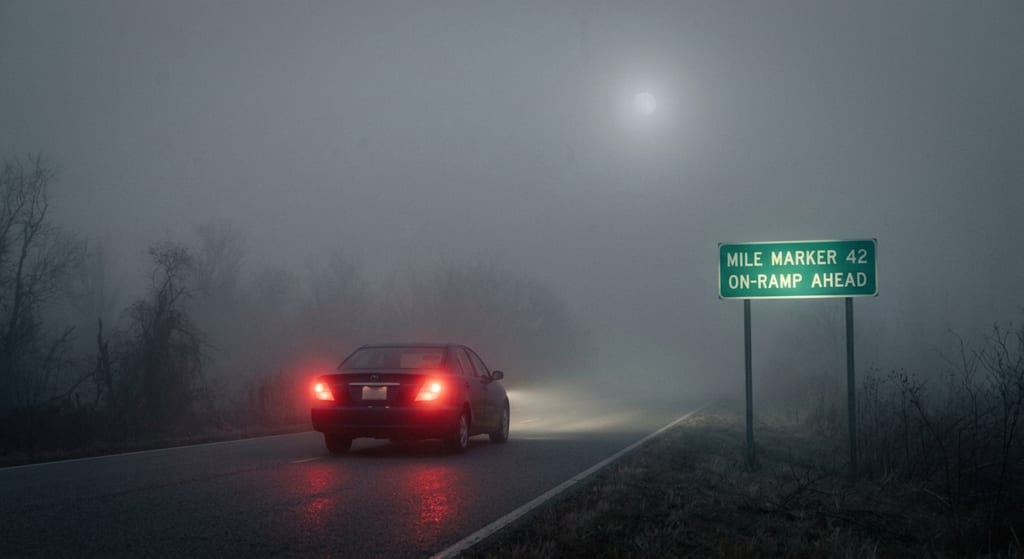
Mile Marker 42
Henry Vance. Occupation: ordinary citizen. Destination: a point on the map he can no longer quite name, but feels a pressing, stubborn need to reach. Like many travelers on a lonely night, Henry relies on the mechanical companionship of a sedan, the low, comforting hum of a radio, and the logical assumption that the road ahead is always a line moving forward.
But Henry is about to discover that logic is a fragile canopy when stretched across the open expanses of the infinite. The headlights up ahead are cutting through more than just a midnight fog. They are piercing the veil of a very specific stretch of highway—one that doesn't bypass purgatory, but creates it.
The asphalt rolled out into the dark like a ribbon dipped in ink. Fog clung heavily to the windshield, turning the headlights into weak, yellow halos that barely cut through the desolate night. Henry didn't recognize the road, and he couldn't quite remember the name of the town he was driving toward. His destination lingered somewhere at the edge of memory, familiar enough to pursue, too distant to name.
To keep the silence of the empty landscape at bay, he hummed along with the low, crackling static of the radio. A soft jazz melody played, just loud enough to fill the empty cabin of his sedan.
Suddenly, the music snapped off.
A sharp, piercing tone blared from the speakers, cutting straight through Henry's chest. He winced, reaching for the volume dial, but the emergency broadcast announcer's voice cut in first. It was cold, monotone, and clinical, stripped of the slightest hint of urgency.
“An emergency traffic update has been issued for Interstate 90. A serious multi-vehicle collision has occurred near the Mile Marker 42 on-ramp. Emergency personnel are on the scene, and all eastbound lanes are currently obstructed. Motorists are advised to seek an alternate route.”
Henry barely glanced at the radio. Accidents happened. That was why these alerts existed. He turned his attention back to the road, following the weak yellow beams of his headlights through the fog.
The announcer continued.
“Preliminary reports indicate that a dark-colored sport utility vehicle traveling in the right lane lost control while approaching the on-ramp. The vehicle crossed the dividing line and struck a midnight-blue four-door sedan traveling in the adjacent lane. The impact forced the sedan into the path of an approaching commercial truck.”
Henry's fingers tightened slightly around the steering wheel.
“Witnesses report that the truck struck the sedan broadside, forcing it into the concrete barrier. The sedan spun approximately one hundred and eighty degrees before coming to rest against the barrier. Emergency crews have reported extensive damage to the front end and driver's side of the vehicle.”
Henry frowned.
Something about the description made him uncomfortable, though he couldn't have explained why. He glanced at the front of his car, where the headlights illuminated the fog in two pale cones.
The announcer continued in the same measured tone.
“First responders have confirmed multiple fatalities. Among the deceased is twenty-four-year-old Henry Vance, the registered driver of a midnight-blue sedan.”
Henry's hand froze above the radio dial.
For a moment, the road seemed to narrow.
Henry Vance?
He swallowed.
That's my name.
His eyes flicked toward the rearview mirror, then back to the road.
“No,” he muttered.
The announcer continued.
“Witnesses at the scene report that the driver of the sedan was traveling alone. Identification was confirmed through the vehicle's registration and personal effects recovered from the wreckage.”
Henry's stomach tightened.
Personal effects?
He glanced at the passenger seat. His jacket lay crumpled beside him, one sleeve hanging over the edge. His wallet was in his pocket. His phone rested in the cup holder.
He touched the phone without taking his eyes off the road.
This is ridiculous. Millions of people are named Henry.
The announcer proceeded without pause.
“The vehicle has been identified as a midnight-blue four-door sedan bearing significant damage to the front bumper and driver's side. Investigators also noted a narrow, crescent-shaped scratch on the driver's-side door, located just below the rear window.”
Henry stopped breathing.
His eyes dropped toward the driver's-side window.
He couldn't see the door clearly through the darkness, but he knew exactly where the scratch was.
He had made it last Thursday, backing out of a narrow parking space beside a concrete pillar. The sound had been a short, ugly scrape. He had gotten out, examined the damage, and cursed himself for being careless.
The scratch was only a few inches long, thin at one end and widening into a pale crescent near the middle. He could still picture the exposed silver paint catching the afternoon sunlight.
He had considered touching it up over the weekend. He had even looked at a repair kit online, telling himself he would take care of it after work.
He hadn't gotten around to it.
Henry slowly turned his head toward the driver's-side door.
“No.”
His voice came out barely above a whisper.
The announcer continued.
“The scratch appears consistent with recent damage and has been included in the preliminary identification of the vehicle.”
Henry stared at the window.
A bead of sweat slipped from his hairline and traced a cold path down his temple.
That's impossible.
He reached across his body and felt along the inside of the driver's-side door, his fingers pressing against the panel as though the scratch might somehow be felt through the metal.
It couldn't be his car.
It couldn't be him.
He had made the scratch himself. He remembered the parking lot, the concrete pillar, the sickening sound of metal scraping stone.
And now a stranger on the radio was describing it as evidence recovered from a wreck.
“An official statement from the responding authorities is expected once next of kin have been notified,” the announcer said. “Motorists are reminded to remain alert and maintain a safe following distance in adverse weather conditions.”
Henry stared at the radio.
The announcement had returned to ordinary traffic advice as though nothing unusual had been said.
As though a man's death were no more remarkable than a lane closure.
As though the dead man weren't sitting behind the steering wheel, listening.
Henry's mouth went dry.
No. No, wait. That's literally impossible.
Millions of people were named Henry. Midnight-blue sedans were everywhere. And scratches happened. Cars got scratched every day.
It was a prank. Some hyper-localized pirate radio station trying to be edgy. Someone had hacked his signal and pulled information from somewhere online.
Or maybe he was falling asleep at the wheel and having a waking nightmare.
Yeah. That was it.
He was exhausted.
I am right here. I am holding the steering wheel. I can feel the leather. I can blink. I am alive.
He squeezed the wheel until his knuckles paled.
The road remained beneath him. The engine hummed. The headlights pushed into the fog.
Everything was exactly where it belonged.
Except for the voice coming from the radio.
Henry reached for the volume dial.
“Turn it off,” he whispered.
The announcer continued speaking.
Henry twisted the dial as far as it would go, but the voice remained audible, its steady cadence cutting through the low hiss of static.
“Authorities are urging motorists to avoid the area while recovery operations continue. Further updates will be provided as information becomes available.”
“Shut up.”
He pressed the power button.
The music display went dark, but the announcer continued.
Henry stared at the radio.
“Are you kidding me?”
He pressed the button again, harder this time.
“Who authorized this garbage? This isn't funny!”
The voice continued, calm and indifferent.
Henry slammed his palm against the dashboard.
“Turn it off! Shut the hell up!”
His hand stung. He barely noticed.
He struck the dashboard again, a furious heat roaring in his ears.
“Why is this happening to me? I'm a good driver! I wasn't even speeding! Why is this stupid radio messing with my head?”
His chest tightened. He took a ragged breath, then another.
“If this is a joke, it's sick! I swear to God, when I get to where I'm going, I'm suing this entire station. Let me out of this fog! Just give me a clear road, you piece of trash radio!”
His fury spiked, then collapsed into desperate, hollow panic.
He couldn't stop looking at the radio.
The display was dark. The controls were unresponsive. The announcer spoke as though Henry's anger didn't exist.
Okay. Okay, let's think.
He swallowed hard.
God, please. If this is a warning, I get it. I promise I'll never look at my phone while driving again. I'll pull over right now. I'll sell the car tomorrow. Just let this be a hallucination.
His eyes darted between the windshield and the dashboard.
Please, just let me wake up in my bed. If You let me get through this night alive, I'll fix everything. Just change the broadcast. Play the music again. Please.
The radio remained cold and clinical.
The silence between the announcer's sentences stretched out, heavy and absolute. The empty landscape pressed against the windows, and the reality of his isolation closed in around him.
It's real.
The thought arrived quietly.
Oh God, I'm dead. I'm actually gone.
His grip weakened.
I'm never going to make it to... where was I going?
He searched his memory, but the destination was gone, leaving only a vague sense that he had somewhere important to be.
It doesn't matter anymore. I'm just a ghost driving a ghost car on a road to nowhere.
His family.
They were going to get that call.
His job, his friends, all his plans, everything he had wanted to do—gone. All of it ending on a random night in the middle of nowhere.
What was the point of any of it? Why even keep driving? There's nothing left.
A single tear rolled down his cheek, feeling strangely like ice water against his flushed skin.
The sadness settled over him, heavy and suffocating. It lasted for miles, wrapping around him like the fog outside.
He thought about his family. The conversations he had put off. The things he had planned to do someday, as though someday were a place he could always reach.
He imagined their faces when they heard the news.
He lowered his head and wept.
The road continued beneath his tires.
Gradually, the tears stopped. The numbness faded into a strange, analytical quiet. His breathing steadied, and his thoughts began to arrange themselves into something that resembled order.
Wait.
He lifted his head.
If I'm dead, how am I thinking this? How am I watching the road?
He swallowed.
There has to be a logical explanation.
Maybe he had been in an accident and was currently in a coma. Maybe his brain was processing the trauma, constructing an elaborate nightmare from scraps of memory and fear.
If this was a mental construct, then perhaps he could find a way out.
He straightened in his seat.
Let's look at the facts.
The radio had identified the location of the accident: Mile Marker 42.
If he could drive past that marker without crashing, he could prove the broadcast wrong. He could show his subconscious that he was safe, that his mind had fabricated the entire thing.
That's it. I just need to pass the marker.
His breathing evened out. His shoulders settled. His grip on the steering wheel became firm, dry, and precise.
He had found something solid to hold on to: a test he could pass.
Whatever my brain is throwing at me, I'm stronger than this panic. I'm moving past the worst of the shock. I'm putting myself back together.
He nodded to himself.
I'm going to survive this mental break.
Up ahead, his headlights illuminated a green highway sign emerging from the fog.
Mile Marker 42. On-Ramp Ahead.
Henry peered through the mist.
There were no flashing lights. No twisted metal. No police sirens.
Just an empty, dark stretch of concrete merging onto the highway.
He slowed, peering down the on-ramp as he approached it.
Nothing.
He looked again, searching the darkness for some sign of the horrific scene the announcer had described.
There was nothing to find.
A long, breathless laugh escaped him, his throat clicking with relief.
“See?” he whispered. “Nothing.”
The tension drained from his shoulders.
It was all a hallucination. A trick of the mind brought on by exhaustion.
He accelerated, driving past the on-ramp and leaving the empty intersection behind him.
For several minutes, he continued along the highway, waiting for something to happen.
Nothing did.
The fog seemed thinner now. The road appeared less threatening, and his hands no longer felt as though they belonged to someone else.
He had done it.
He had faced the fear, tested his theory, and proved that he was still alive.
A smile spread across his face.
“God, that was awful.”
He shook his head, almost embarrassed by how thoroughly he had frightened himself.
He reached out and clicked the radio back on.
A soft jazz melody began to play.
Henry leaned back into his seat.
The familiar music filled the cabin, warm and gentle against the quiet hiss of the tires. He hummed along, tapping his fingers against the steering wheel.
He was alive.
He was safe.
Everything was going to be fine.
Suddenly, the music snapped off.
A sharp, piercing tone blared from the speakers.
The nausea returned instantly, a violent knot tying itself tight in his stomach.
“An emergency traffic update has been issued for Interstate 90. A serious multi-vehicle collision has occurred near the Mile Marker 42 on-ramp. Emergency personnel are on the scene, and all eastbound lanes are currently obstructed. Motorists are advised to seek an alternate route.”
Henry stared at the road.
The announcer continued.
“Preliminary reports indicate that a dark-colored sport utility vehicle traveling in the right lane lost control while approaching the on-ramp. The vehicle crossed the dividing line and struck a midnight-blue four-door sedan traveling in the adjacent lane. The impact forced the sedan into the path of an approaching commercial truck.”
Henry's stomach lurched.
“No.”
“Witnesses report that the truck struck the sedan broadside, forcing it into the concrete barrier. The sedan spun approximately one hundred and eighty degrees before coming to rest against the barrier. Emergency crews have reported extensive damage to the front end and driver's side of the vehicle.”
He stared through the windshield.
The voice was identical. Every pause, every inflection, every clinical word.
“First responders have confirmed multiple fatalities. Among the deceased is twenty-four-year-old Henry Vance, the registered driver of a midnight-blue sedan.”
Henry's hand tightened around the steering wheel.
“No. No, I already—”
He stopped.
He couldn't quite remember what he had been about to say.
The announcer continued.
“Witnesses at the scene report that the driver of the sedan was traveling alone. Identification was confirmed through the vehicle's registration and personal effects recovered from the wreckage.”
Henry's breathing quickened.
He looked toward the radio, then back at the road.
“The vehicle has been identified as a midnight-blue four-door sedan bearing significant damage to the front bumper and driver's side. Investigators also noted a narrow, crescent-shaped scratch on the driver's-side door, located just below the rear window.”
Henry recoiled.
The scratch.
The concrete pillar.
Thursday afternoon.
He could see it all so clearly: the narrow parking space, the scrape of metal, the pale crescent in the blue paint.
His stomach twisted.
“No,” he whispered. “No, that's not possible.”
“The scratch appears consistent with recent damage and has been included in the preliminary identification of the vehicle.”
Henry looked toward the driver's-side door.
His heart hammered.
That's impossible.
He reached for the radio and twisted the tuning knob.
The digital numbers flickered across the display.
Nothing changed.
He moved through the frequencies faster, searching for a voice, a song, anything that could interrupt the announcement.
Static hissed through the speakers, flat and lifeless. No alternative voices. No competing advertisements. No music.
And beneath the static, bleeding through every frequency like ink through wet paper, the announcer's voice remained.
“...multi-vehicle collision has occurred near the Mile Marker 42 on-ramp...”
“Stop it,” Henry breathed.
He slammed his fingers into the power button.
Once.
Twice.
He held it down until his finger bruised against the plastic.
The display died. The little blue lights behind the dial went dark.
The voice kept talking.
“...First responders are on the scene. Fatalities have been confirmed...”
Henry pulled his hands back as if the dashboard had turned red-hot.
He stared at the dead radio.
The car rolled forward, its tires humming against the asphalt. The headlights cut two narrow tunnels through the gray mist, revealing nothing beyond the next few yards.
He looked down at his trembling hands.
There had to be something ahead. A town. An exit. A gas station. Somewhere he could stop and find another person, someone who could tell him what was happening.
He couldn't remain alone with that voice.
The fog shifted.
A green rectangle began to form in the distance.
Henry leaned over the steering wheel.
His eyes widened.
The headlights climbed across the reflective lettering.
Mile Marker 42. On-Ramp Ahead.
He stared at the sign.
His breathing became shallow.
“No.”
He looked toward the on-ramp.
There were no flashing lights.
No twisted metal.
No police sirens.
Just an empty, dark stretch of concrete merging onto the highway.
Henry let out a shaky breath.
“See?” he whispered.
His hands loosened around the wheel.
“Nothing.”
He accelerated.
The sign disappeared behind him, swallowed by the fog.
The tension left his shoulders. His breathing settled, and the familiar road stretched out ahead of him.
He had been right.
The broadcast was malfunctioning. His mind was exhausted. There was nothing out there waiting for him.
He reached for the radio.
A soft jazz melody began to play.
Henry smiled, completely unaware of the miles fading behind him, humming along to the tune as he drove deeper into the dark, quiet fog.
The human mind is a remarkably resilient machine. Faced with a truth too heavy to bear, it will comfortably tear out its own gears, wipe its own slate clean, and choose the warm, soothing cradle of a lie over the cold reality of an ending.
Henry Vance will continue his journey tonight. He will listen to the music, he will feel the steering wheel beneath his fingers, and he will smile with the absolute certainty that he is safe. A man trapped not by walls of stone or iron bars, but by the infinite horizon of his own refusal to accept the final page. A permanent resident on a highway to nowhere, forever approaching... Mile Marker 42."
About the Creator
K-jay
I weave stories from social media,and life, blending critique, fiction, and horror. Inspired by Hamlet, George R.R. Martin, and Stephen King, I craft poetic, layered tales of intrigue and resilience,
Enjoyed the story? Support the Creator.
Subscribe for free to receive all their stories in your feed. You could also become a paid subscriber, letting them know you appreciate their work.
Comments
There are no comments for this story
Be the first to respond and start the conversation.