

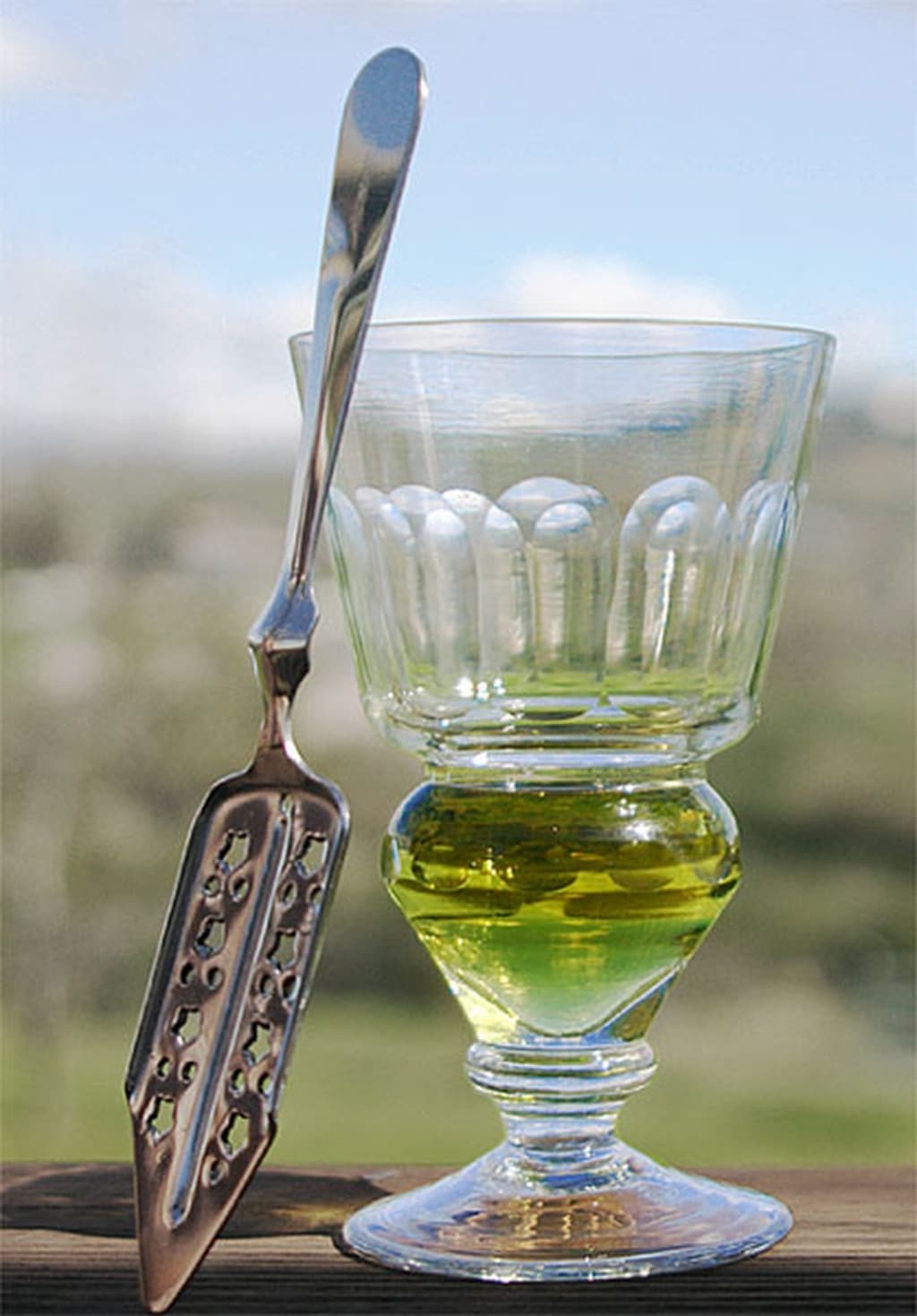
Ernest Perdu was a man of irritating (or endearing) predictability, depending on who you asked. Each afternoon, following his shift at the post, he would swap his work fatigues for a modest suit and brogues, and visit the local bar. He took comfort in its little rituals: the mahogany tables that wobbled on one side, their worn stool companions, and perhaps most importantly, the reservoir glass filled with his favored tipple. Absinthe may have fallen out of favor in the region decades before, but the distinctive aroma of anise and wormwood reminded him of a simpler time. And so he drank.
But today, to his dismay, was not predictable. He arrived, as per Parisian fashion, at 5 PM. The Green Hour. But instead of the curved glass seducing him with its vibrant liquid, he found it empty, sat beside a note.
TÉLÉGRAMME 08/12/1914
NOUS SOMMES TOUJOURS SIX À LA TABLE. GARDEZ-LE.
Despite his learned familiarity with the language, he translated it automatically to his mother tongue:
THERE ARE STILL SIX OF US AT THE TABLE. KEEP IT.
Ernest flared his nostrils, sighed heavily, and walked the paper to the woman at the bar.
“Qu’est-ce que c'est?!” He slammed the note onto the bar, sending a tower of precariously stacked lime pieces spilling onto the floor.
The woman behind the bar remained unfazed and proceeded to pour tonic into three large tumblers before picking the limes off the floor and garnishing the drinks with them.
“It is the boys from the gaming, mais oui, no?
“What?!”
“Boys from gaming nights. C’est ça. With the dice. They must have uh…perdu. They lost it.”
Ernest understood most of the words she said, but none of them made sense in that order. But sensing that this was a battle he wouldn’t win, he opted for one in which he was sure to be victorious.
“Un absinthe, s’il te plaît.”
The woman reached behind the bar for the familiar vessel, a box of lavender sugar cubes, and an ornate slotted spoon in the shape of a fairy wing.
He watched as she prepared the drink with seasoned hands, first pouring the nectar, then placing the spoon, then the sugar cube atop the glass. She then took a bottled water from the fridge, poured a bit into the cap, and onto the sugar. The louche was his favorite part. As the sugar dissolved, the vibrant green became a milky cloud. Ernest felt his shoulders relax and jaw unclench at the sight.
“5 francs”.
Ernest put 5 euros on the bar.
He heard her mutter “Putain Le Pen!” before turning on his heel and returning to his table.
He ran his finger around the rim of the glass before emptying it and awaiting for another the next day.
***
Claudine’s afternoon started like all the other’s. She unlocked the large wooden doors, washed down the bar, and prepared the garnishes for the night service. It wasn’t glamorous work, but it mostly paid the bills. Regulars like Ernest helped keep the café running, even after the eurozone crisis. He made passable small talk in French, but mostly kept to himself. She hoped today would be the same.
The clock above the bar tic-tic-tic-tocked until the bell chimed 5 times, and right on cue, stepped Ernest in his sensible suit.
The color drained from his face. Another note.
TÉLÉGRAMME 12/12/1924
ON SE VOIT À H 1700
SEE YOU AT 1700 HOURS.
“Claudine!” He shouted.
“Oui?”
“Game night again?”
“Quoi?”
“Game night again. Last night?”
“Mais no, once in the week only. Pourquoi? You want to play?”
Ernest grabbed the paper and left.
That night, he dreamt of muddy trenches, guns, and hand grenades. The day found him delivering the wrong post to several houses and eventually several streets off his normal route.
He somehow managed to wander into the café on time, knowing the drink would be non-negotiable.
He walked with purpose directly to the bar, startling Claudine in his postman’s uniform.
“Mon Dieu! Did someone die?”
“Yes, and I’m here to deliver their obituary.”
“Don’t ask questions. Just the usual.”
“I will bring to you today. Don’t get used.”
“Fine. But one here first, thanks. It’s been…a day.”
He barely glanced at the clouds forming in the glass before shooting it back in one generous glug. Claudine averted her gaze and dutifully began preparing a second one while Ernest retreated to the toilet.
Ernest swung the door open as if it had written him a bad check and quickly unzipped his fly. Mid-stream, his gaze shifted to the wall. Another telegram, this time tacked to the wall.
TÉLÉGRAMME 10/12/1914
NE BOUGEZ PAS. ATTENDEZ.
DO NOT MOVE. WAIT.
Ernest finished his business, shook twice for good measure, and examined the paper before tearing it from the wall and marching to the bar.
“Claudine!”
She was busy extracting a stubborn cork from a bottle of red.
“Oui, Ernest?”
“Enough.”
“Enough what?”
“These telegrams.”
“Bah, you are the postman. Perhaps you should deliver them.”
Claudine finally freed the cork, which struck the ceiling and disappeared behind the refrigerator.
“Tiens. Give it here.”
Ernest handed her the telegram.
She inspected it, turning it over several times.
“1914,” she said. “C’est vieux, ça.”
“Yes, Claudine. That’s rather the point.”
“Perhaps someone is playing a joke.”
“An exceptionally tedious one.”
She held the paper up to the light.
“It’s not new paper.”
Ernest looked at her.
“What?”
“Look. The yellow, the little holes. This is old.”
“People can make paper look old.”
“Alors, perhaps you have a very dedicated enemy.”
She returned the telegram and went in search of the cork.
Ernest sat down.
For the first time in several years, he left his absinthe unfinished.
***
The following morning, Ernest visited the municipal archives before his shift. This was a considerable departure from his routine, and one that required sacrificing his usual breakfast of toast and two boiled eggs. He considered the omission a personal affront.
The archivist was a young man with an impressive collection of facial piercings who regarded Ernest’s telegrams with the enthusiasm normally reserved for tax returns.
“December 1914,” he said.
“Yes.”
“During the war.”
“I’m familiar with the war.”
“Which one?”
Ernest stared at him.
“The first.”
“Ah.”
The young man typed something into his computer.
“Do you know the sender?”
“No.”
“The recipient?”
“No.”
“The bureau of origin?”
“No.”
The young man folded his hands.
“Then what exactly are we looking for?”
Ernest considered explaining that three telegrams had materialized in his favorite drinking establishment, but suspected the young man would recommend a different sort of institution.
“Postal records,” he said.
After considerable negotiation, he was directed toward a collection of digitized correspondence from the winter of 1914.
There were requisitions for horses, notices of troop movements, requests for supplies, and letters from soldiers asking after their wives, their children, and occasionally their livestock.
One man had written six times about a missing pair of boots. Ernest felt an immediate kinship with him.
He searched the date of the first telegram. Nothing.
The second. Nothing.
The third yielded a collection of military communications from the Meuse.
One entry caught his attention
NE BOUGEZ PAS. ATTENDEZ.
Ernest leaned toward the screen.
The archivist, who had been pretending not to watch him, wandered over.
“Found something?”
Ernest pointed.
“Can I see the original?”
The young man clicked through several pages.
“That’s strange.”
“What?”
“There’s no original attached. Just the transcription.”
“Where is the original?”
“Probably lost.”
Ernest exhaled through his nose.
“Of course.”
“During the war, a lot of documents were destroyed.”
“Yes, I imagine there were other pressing concerns.”
He copied the reference number into his notebook.
Then he noticed the entry immediately below it.
NOUS SOMMES TOUJOURS SIX À LA TABLE. GARDEZ-LE.
Ernest checked his watch.
Four forty-three. He had seventeen minutes to reach the bar.
***
Claudine was polishing glasses when he arrived.
“En avance!” she exclaimed. “Should I call a doctor?”
Ernest ignored her and went straight to his table.
His glass was there, freshly prepared.
Beside it lay another telegram.
TÉLÉGRAMME 11/12/1914
SIX TOUJOURS PRÉSENTS. ATTENDONS INSTRUCTIONS.
He sat. The room seemed unusually quiet.
“Claudine?”
“Oui?”
“Who brought this?”
She glanced over.
“Brought what?”
“The telegram.”
“Ah, encore ça.”
“Yes. Again.”
She shrugged.
“It was there when I opened.”
“On my table?”
“Oui.”
“Did you read it?”
“Non.”
“Why not?”
“Because it is not addressed to me.”
Ernest looked down. For the first time, he noticed the small printed field above the message.
DESTINATAIRE : PERDU E.
His stomach tightened.
He had assumed the telegrams were addressed to someone else. It had never occurred to him to check.
That night, Ernest did not sleep.
He laid the telegrams across his kitchen table in chronological order, weighted down with teaspoons.
He compared the dates, the paper, the ink, the folds.
At three in the morning, he made coffee.
He had spent twenty-three years delivering letters, parcels, registered documents, and the occasional package that emitted a suspicious odor. He knew handwriting.
There was a particular defect in the way he formed the number seven, a little horizontal stroke inherited from his mother, who had insisted that a seven without a crossbar was merely a one having an identity crisis.
The telegram bore the same mark.
***
On Friday, Ernest made three mistakes before noon.
He delivered a birthday card to a funeral home, a tax notice to a bakery, and a parcel containing orthopedic insoles to a woman who had died the previous February.
His supervisor summoned him.
“Ernest, are you feeling well?”
“Perfectly.”
“You’ve been distracted.”
“I’ve been thinking.” His supervisor regarded this as a troubling development.
“Perhaps take the afternoon off.”
Ernest declined.
At four thirty, he found himself on a street he did not recognize.
It was narrow and cobbled, with shuttered windows and a small stone fountain at its center. He consulted his route sheet. The street was not listed.
He checked his phone. No signal.
At the end of the street stood a building with a dark green awning.
A familiar wooden sign hung above the entrance.
He approached it slowly. The bar was closed.
Across the windows, someone had pasted long strips of brown paper. A notice was pinned to the door.
A motorcar rattled past, its driver wearing a flat cap. Then a bicycle. Then another. He turned.
Somewhere nearby, a bell rang five times. Ernest stepped backward.
A boy in a postal uniform brushed past him.
“Pardon, monsieur.”
The boy stopped and looked at Ernest’s modern uniform.
“Vous êtes de la poste?”
Ernest nodded.
The boy reached into his satchel.
“Alors, c’est pour vous.”
He handed Ernest a telegram.
TÉLÉGRAMME 12/12/1914
LE SIXIÈME EST ARRIVÉ. GARDEZ-LE.
THE SIXTH HAS ARRIVED. KEEP HIM.
***
He did not remember entering the bar, but remembered the smell first: Anise. Wormwood. Damp wool. Tobacco.
The room was crowded, though nobody seemed to be speaking above a murmur.
Six men sat around his usual table.
They wore military uniforms, their coats dark with rain and mud. Five were young. The sixth sat with his back to the door.
On the table stood six glasses of absinthe.
Ernest approached.
“Excusez-moi.”
Nobody answered.
“I believe there’s been a mistake.”
One of the men raised his head. He was missing an ear.
Another had a deep wound running from his temple to his jaw. The third held his left arm across his chest at an angle Ernest found anatomically improbable.
The fourth had no eyes. Ernest swallowed. The fifth man smiled.
“You’re late.”
His French was perfectly ordinary, though his voice had the distant, muffled quality of someone speaking through a wall.
“I don’t understand.”
“Five o’clock,” the man said. “We agreed.”
“I agreed to nothing.”
The man looked toward the sixth figure.
“He says he doesn’t remember.”
The sixth man did not turn.
Ernest took a step back.
“I have to go.”
The man without eyes tilted his head.
“Go where?”
“Home.”
A silence settled over the table.
Then the fifth man began to laugh. It was a small, polite laugh, almost apologetic. The others joined him.
Even the man with the ruined jaw managed a wet, clicking sound.
Ernest turned toward the door, but it was no longer there. In its place stood a wall covered in photographs.
Men in uniform. Men standing beside horses. Men smoking cigarettes outside railway stations.
And, in the center, a photograph of six soldiers seated around a table.
Ernest recognized the mahogany, the uneven stools, and the ornate absinthe spoons.
He leaned closer.
The sixth man in the photograph was wearing a modest suit and brogues.
About the Creator
E.K. Daniels
Writer, watercolorist, and regular at the restaurant at the end of the universe. Twitter @inkladen
Enjoyed the story? Support the Creator.
Subscribe for free to receive all their stories in your feed. You could also become a paid subscriber, letting them know you appreciate their work.
Comments
There are no comments for this story
Be the first to respond and start the conversation.