Latest Stories
Most recently published stories in Horror.
The Djinn’s Wife in the Mountains: A Forbidden Encounter Beyond the Veil of Reality
It was during a period of deep emotional turmoil that I decided to escape into the mountains. Life in the city had become a blur — noise, pressure, expectations. I felt suffocated. I needed silence. I needed nature. And maybe, without realizing it then, I needed answers from a world far older than mine. There were rumors about an ancient valley hidden deep in the hills, unreachable by any vehicle and avoided even by the locals. They said strange lights flickered there at night. Some called it cursed, others whispered about spirits. That only made me more curious. I packed a small bag, told no one, and set out at dawn. The path grew steeper and the trees darker with each passing mile. I could feel the atmosphere changing. It wasn’t just the altitude — it was something else, something deeper. The birds became silent. The wind carried a chill, even though it was summer. And then I found it. A narrow, winding trail veiled with creeping vines and pale-blue flowers led to a cave hidden behind a curtain of hanging moss. It was like walking through time. The entrance of the cave was marked with symbols — old, unfamiliar, and powerful. Still, I entered. Inside, it wasn’t cold as I expected. It was warm, dimly lit by oil lanterns hanging from jagged rocks. The air was heavy with the scent of burning herbs. As I stepped further in, I realized this place wasn’t abandoned. It was inhabited — not by man, but by presence. And then I saw her. She sat in front of a fire that burned without wood. Her long, jet-black hair flowed like liquid ink, reaching the ground. Her robe was white but shimmered with silvery tones as if stitched with moonlight. Most unsettling of all — I could not see her face. A veil of mist, or shadow, concealed it entirely. And yet... I could feel her eyes on me. She did not move. She simply said, “You have come.” My throat tightened. “I didn’t know where I was going.” “You never do. But your soul does.” I was frozen in place, not from fear, but from awe. The firelight danced, reflecting symbols on the cave walls. I dared to sit. “I am the wife of the Djinn who guards these hills,” she said calmly, her voice echoing as if from the mouth of the earth itself. My heart thudded. I had heard legends about djinns — creatures of smokeless fire, living in hidden realms, both feared and revered. But this... this was no legend. She was real. “Why me?” I asked. “You’re breaking,” she replied. “And we do not let broken souls wander. Sometimes we heal them. Sometimes... we keep them.” Her words were neither threat nor comfort. Just truth. “I didn’t mean to trespass,” I whispered. “But you were called,” she said. “Not all who wander are lost. Some are led.” Then, from a pouch beside her, she pulled out a black stone, smooth and warm. “Keep this. It will protect you from what follows. For now... leave.” Before I could ask more, the fire roared upward. The lanterns flickered violently. I blinked — and she was gone. The warmth vanished. The cave grew cold and still. I stumbled out, stone clenched in my hand, and found the path back. But nothing looked the same. The valley seemed older now. More watchful. Since that day, I’ve never been the same. I see shadows where none should be. I hear whispers in languages I don’t understand. And the stone she gave me? It still burns faintly at night. Sometimes I dream of her — the faceless woman in white. And sometimes... I hear her voice just before sleep. “Broken things still belong somewhere...”
By Noman Afridiabout a year ago in Horror
The Exorcist (1973): A Cinematic Masterpiece of Horror
Introduction Few films have left as indelible a mark on the horror genre as The Exorcist (1973). Directed by William Friedkin and based on William Peter Blatty’s 1971 novel of the same name, The Exorcist is widely regarded as one of the greatest and most terrifying horror films ever made. Its shocking imagery, intense performances, and profound exploration of faith and evil have cemented its place in cinematic history. Upon its release, The Exorcist became a cultural phenomenon, sparking controversy, inspiring countless imitations, and leaving audiences traumatized. Even decades later, its power to unsettle remains undiminished. This article delves into the film’s production, themes, impact, and legacy, examining why it continues to haunt viewers to this day. The Origins of The Exorcist William Peter Blatty’s Inspiration The story of The Exorcist was inspired by a real-life 1949 exorcism case involving a young boy (referred to as "Roland Doe" in records). William Peter Blatty, a novelist and screenwriter, came across the story while studying at Georgetown University and was fascinated by the themes of demonic possession and the battle between good and evil. His novel The Exorcist became a bestseller, blending horror with deep philosophical and theological questions. From Page to Screen Blatty adapted his own novel into a screenplay, and Warner Bros. enlisted William Friedkin, fresh off the success of The French Connection (1971), to direct. Friedkin approached the film with a documentary-like realism, insisting on authenticity in performances and special effects. This commitment to realism would contribute to the film’s visceral impact. Production: A Grueling and Controversial Process Casting and Performances Ellen Burstyn as Chris MacNeil – The actress brought emotional depth to the role of a desperate mother. Linda Blair as Regan MacNeil – Only 12 years old during filming, Blair delivered a performance that was both innocent and horrifying. Her physical and psychological transformation remains one of cinema’s most disturbing portrayals. Jason Miller as Father Damien Karras – A struggling priest grappling with faith, Miller’s performance added profound emotional weight. Max von Sydow as Father Lankester Merrin – Though only 44 at the time, von Sydow was aged with makeup to play the veteran exorcist. His presence brought gravitas to the film. Mercedes McCambridge as the Demon’s Voice – Her guttural, otherworldly vocal performance heightened the terror. Challenges on Set The production was plagued by rumors of a "curse," including injuries, fires, and even deaths among crew members. Whether coincidence or superstition, these incidents added to the film’s mystique. Friedkin pushed his actors to extremes: Burstyn suffered a permanent back injury during a violent scene. Blair endured grueling makeup sessions and psychological strain. The infamous "spider-walk" scene (cut from the original release but restored in later versions) required a stunt double to crawl backward down stairs. Groundbreaking Special Effects Special effects artist Dick Smith created some of the most iconic horror imagery: Regan’s spinning head, levitation, and vomit scenes. The grotesque makeup for her possessed state. Practical effects like freezing breath and furniture moving on its own. These effects were revolutionary for their time and remain disturbing even by modern standards. Themes: More Than Just a Horror Film Faith and Doubt At its core, The Exorcist is a story about faith. Father Karras, a psychiatrist and priest, struggles with his belief in God after his mother’s death. His crisis mirrors the film’s central question: How can evil exist in a world governed by a benevolent God? The exorcism becomes not just a battle for Regan’s soul but a test of Karras’s own faith. Science vs. Religion The film contrasts medical and supernatural explanations for Regan’s condition. Doctors initially diagnose her with neurological disorders, but as her condition worsens, science fails to provide answers. The exorcism ritual, though archaic, becomes the only solution—suggesting that some evils lie beyond human comprehension. Innocence Corrupted Regan’s possession represents the ultimate violation of innocence. Her transformation from a sweet child into a profane, violent entity is deeply unsettling, tapping into primal fears about the corruption of youth. Release and Cultural Impact Initial Reception Upon its release on December 26, 1973, The Exorcist became a box office sensation, earning over $441 million worldwide (adjusted for inflation). It was nominated for 10 Academy Awards, including Best Picture—a rarity for a horror film. Audiences reacted viscerally: Reports of fainting, vomiting, and panic attacks in theaters. Religious groups protested, accusing the film of being blasphemous or Satanic. Some theaters provided "barf bags" for viewers. Legacy and Influence The Exorcist reshaped horror cinema: Demonic possession films became a subgenre (The Omen, The Conjuring universe). Foundational for psychological horror—its slow buildup and realism influenced later films like Hereditary and The Babadook. Enduring popularity—multiple re-releases, director’s cuts, and a franchise (sequels, prequels, TV series). Why The Exorcist Still Terrifies Psychological Horror Unlike modern jump-scare-heavy horror, The Exorcist relies on dread and psychological torment. The idea of an unseen, malevolent force violating a child taps into deep-seated fears. Religious Terror For believers (and even non-believers), the film’s depiction of demonic forces challenges the safety of the spiritual world. The exorcism scenes feel like a genuine confrontation with evil. Uncanny Realism Friedkin’s documentary-style direction makes the supernatural events feel plausible. The lack of overt CGI (compared to modern films) enhances the horror. Conclusion More than 50 years after its release, The Exorcist remains the gold standard of horror cinema. Its masterful blend of psychological terror, groundbreaking effects, and profound themes ensures its place in film history. Whether viewed as a terrifying supernatural tale or a deep meditation on faith, The Exorcist continues to shock, disturb, and captivate audiences—proving that true horror never dies. Final Thought The Exorcist isn’t just a movie; it’s an experience. And like all great horror, its true power lies in what it makes us believe—even after the credits roll.
By Silas Blackwoodabout a year ago in Horror
Buried Alive: The Echoes Beneath
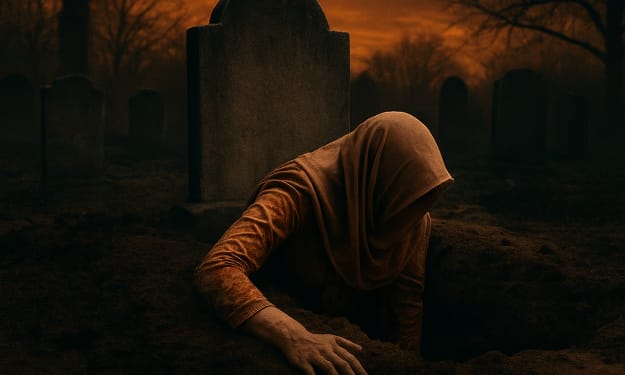
The sun had just slipped behind the horizon, draping the village in shades of rust and violet. A cold wind brushed past me, whispering secrets through the dry leaves, as I walked briskly along a seldom-used path. My shortcut home passed dangerously close to the graveyard — a place even the bravest avoided once the sky darkened. Tonight, however, I had no choice. As I neared the low stone boundary, something unusual caught my attention. It wasn’t the rustling of trees or the call of an owl. It was a sound I couldn’t name — a faint moan, soaked in agony, carried on the wind. I froze. Every instinct screamed at me to run. But something deeper — perhaps fate — held me in place. Then, another sound: a dull, rhythmic thud. It echoed like a heartbeat under the earth. Driven by an indescribable force, I climbed over the wall. The graveyard was older than the village itself, its stones worn and weeping with moss. As I ventured deeper, the sounds became clearer — moans, gasps, desperate thuds. They came from a freshly dug grave. I knelt beside it. A simple wooden plaque bore a name I recognized: Zainab. A young girl, no older than twenty, recently declared dead after being struck by lightning. The village had mourned her sudden loss — I remembered the somber procession. But now, her grave was alive with movement. I whispered, “Hello?” My voice cracked in the silence. The earth shifted. From behind a twisted tree, a hunched figure emerged — Old Man Qasim, the graveyard keeper. His eyes met mine, tired and hollow. “You heard it too?” he rasped. “It’s Zainab. She won’t stay quiet.” My breath caught. “What do you mean?” “They say her spirit’s trapped. Been like this since we buried her.” Just then, the soil shifted again — violently. A small fissure formed in the mound. I reached forward, brushing away the loose earth with trembling hands. And then I heard it — a gasp. Wet. Real. Alive. Qasim and I dug with frantic urgency. The earth flew from our hands. And then — we saw it. A hand. Pale. Clawing upward. With all our strength, we pulled open the cheap wooden coffin. And there she was. Zainab. Her wide, terror-filled eyes met mine. She gasped, choking on the stale air. She was weak, shaking, filthy — but alive. We lifted her out, her fragile body barely responding. She was rushed to the doctor — a young woman from the city. Shocked, the doctor examined her and unraveled the truth. Zainab had never died. The lightning strike had induced a coma so deep her breathing and heartbeat had slowed beyond detection. The villagers, terrified by her sudden collapse, mistook her state for death. Bound by custom and fear, they buried her within hours. But Zainab’s body had fought. Deep beneath the soil, she regained consciousness. Trapped. Alone. Suffocating. Her sounds — the thuds, the moans — were cries for help. The village reeled with guilt. The miracle of her survival was shadowed by the horror of what could have been. Zainab’s story became legend — not just of fear, but of awakening, of listening closely to the things we dismiss. As for me, I never took that shortcut again. But I still hear it, sometimes — the echo of her whispers beneath the ground. A reminder that sometimes, the dead are not dead at all.
By Noman Afridiabout a year ago in Horror
She Waits When the Lights Go Out
It started with the rain. Not a gentle drizzle, but a torrential downpour, slamming the roof and windows like an army of fists. Claire sat curled on the couch with a steaming cup of tea, wrapped in a fleece blanket, her golden retriever Max sprawled at her feet. The comforting silence of being home alone on a Saturday night was something she’d always enjoyed.
By Kreative William 254about a year ago in Horror
The Silent Dead
December 28 in Paris. Softly, snow falls beneath the pale streetlights. Cafes are illuminated with festive lights, the city is alive with digital life, and laughter reverberates across Instagram stories. Clara decides, amid the commotion, that they will go dark this New Year no networks, no social media. Silence, snow, and escape. Liam is a cryptocurrency trader, Elise is a vlogger, Sarah is a photographer, and Maxime is a digital creator. They reserve an obscure Airbnb cabin in Saint Veyran, a little-known alpine community tucked away in the southeast French Alps. It has no mobile service, is hardly discernible on Google Maps, and has a five year old review that says, Do not trust your shadow if you return.
By mohima mostarinabout a year ago in Horror
The Hypnotist's House
Dylan adjusted the collar of his shirt for the fifth time as he stood at the gate of an old, vine-covered mansion on the edge of town. His girlfriend, Elira, held his hand with a smile that didn’t quite reach her eyes. He chalked it up to nerves — after all, he was meeting her family for the first time. But something in the air felt off. Thick. Too still. “You ready?” Elira asked, her voice light, but Dylan noticed a strange tightness behind it. “Yeah, of course,” he replied, forcing a grin. The door creaked open before they knocked. A tall, slender woman in a flowing black dress stood in the doorway. Her eyes—icy blue and piercing—locked onto Dylan’s as if she was trying to see into his soul. Elira greeted her, “Mom,” and the woman nodded once before stepping aside. Inside, the house smelled of old books and something faintly sweet—like incense. The walls were lined with portraits that seemed to follow Dylan with their eyes. The furniture looked expensive but untouched, like a museum display. Shadows clung to the corners of the ceiling, even though the lights were on. “We’ve been expecting you,” a deep voice rumbled from the staircase. A tall man descended slowly, each step echoing in the silent house. Elira's father had a calm yet commanding presence, his silver hair slicked back, his hands clasped behind his back. “Dylan, welcome,” he said. “I’m Elias.” “Nice to meet you, sir,” Dylan managed, feeling the weight of Elias’s gaze. “Come, sit with us in the drawing room,” Elias said. As they walked, Dylan noticed strange carvings in the wood paneling. Spirals. Eyes. Symbols he couldn’t recognize. Elira squeezed his hand again, harder this time. Inside the drawing room, the rest of the family waited: an older woman with an empty stare and a young man about Dylan’s age who kept blinking oddly, like he was trying to wake up from a dream. The room had no windows, just dim lamps casting yellowish light. “We’d like to know more about you,” Elias said. “You know, Elira has always been… very special.” Dylan smiled awkwardly. “Yeah, she’s amazing. We met in literature class. Her essay on dream symbolism really—” “Dreams are more than just symbols,” Elira’s mother cut in sharply. “They are gateways.” “Mother,” Elira said, trying to sound playful, “don’t scare him.” Everyone chuckled, but Dylan noticed how no one else actually smiled. The sound was hollow. As they sat, Elias poured wine. Dylan hesitated. “Uh, I don’t really—” “One sip,” Elias insisted. “To family.” Dylan took a cautious sip. The flavor was sweet but laced with something bitter. He felt a tingle in his temples almost immediately. His vision blurred slightly. Elira’s hand was still on his, but it felt distant. “That’s better,” Elias said. “What’s in the wine?” Dylan asked. “A memory enhancer,” said Elira’s brother, finally speaking. “Makes things easier… for the process.” “What process?” No one answered. Elira looked away. Suddenly, the room felt colder. The air tightened around Dylan’s throat. Elias leaned forward. “We are hypnotists, Dylan. Not stage charlatans. Real ones. With power. Influence. Our daughter is a prodigy.” “What?” Elira finally looked at him. Her eyes shimmered with an unnatural glow. “I’m sorry,” she said quietly. “They made me do it. They’ve been using me since I was a child.” Dylan stood, but the dizziness hit him like a wave. “You’ve seen the news, haven’t you?” Elias said, walking slowly toward him. “Politicians backing out of debates. CEOs forgetting passwords. Judges recusing themselves after 'mental breaks.' All traced back to ‘stress’… or so they say.” Dylan’s heart pounded. He backed toward the door, but the walls seemed to shift. The symbols began to move. Spirals spun slowly, pulling at his vision. “You're trying to hypnotize me,” Dylan said, fighting to stay focused. “We already have,” Elira’s mother whispered. Suddenly, Dylan saw flashes — images of his past week twisted and rewired: the stranger who stared too long at the bookstore, the professor who started repeating his lectures word-for-word, the blackout he’d had on Thursday. All pieces of a puzzle he hadn’t even known existed. “This isn’t real,” Dylan muttered. “This can’t be real.” “It’s very real,” Elias said. “And now that you know, we have two options. You join us, or—” “Elira, help me,” Dylan begged. “I am,” she whispered, and slipped something into his coat pocket. Her hand lingered on his shoulder before she stepped back. Elias raised a hand, and Dylan’s vision swam again. Then — CRASH — the lights burst, plunging the room into darkness. “Elira!” someone shouted. Dylan ran. He didn’t know how he found the door. Somehow, his feet remembered. He stumbled into the hallway, symbols blinking in and out of the shadows. Doors creaked open and shut by themselves. Whispers curled around his ears. “Elira!” he called. “I’m sorry, Dylan,” her voice echoed from somewhere deeper inside the house. “Run. Don’t stop. Don’t look back.” He obeyed. The front door was gone. In its place: a spiraling black tunnel. He shoved his hand into his coat pocket — a mirror. Elira had given him a small, antique mirror. He held it up. The spirals recoiled. Dylan ran through. The cold night air hit him like a punch. He collapsed onto the lawn, breathing hard, the house silent behind him. He didn’t stop running until he reached the street. When he turned back, the mansion was gone. In its place: a crumbling ruin, overgrown and lifeless. No lights. No whispers. Just a hollow silence. A week later Dylan sat alone in his room, staring at the mirror Elira had given him. He’d tried to find her — nothing. No records, no phone, no trace. It was as if she’d never existed. But every night, in dreams, he saw her. “Don’t forget me,” she’d whisper. And behind her… the spirals were still turning.
By Muhammad Ahmar about a year ago in Horror
The Flame That Waited
The goddess Saraswati is said to have once adorned the soil of Rupnagar, according to legends. Within the school that blossomed in her angelic shadow was a girl named Nira, who was born with a voice so ethereal that it made stones cry when she sang. An oil lamp burned every full moon beneath a revered banyan tree at the village's outskirts. According to the villagers, the blessings of the goddess would cease the moment that lamp was extinguished, and a great love that had not yet been realized would start its eternal wait. The same lamp went out during the 1947 monsoon. The following evening, Nira vanished.
By mohima mostarinabout a year ago in Horror