Latest Stories
Most recently published stories in Horror.
The Jinn Who Cried from the Tree
The Jinn Who Cried from the Tree In the village of Chakar, there was a banyan tree so large it covered half the old graveyard. Its roots slithered through the earth like veins, and its branches hung like arms stretched in silent prayer. Children were told never to play near it. > “Shadows live there,” the elders said. Most obeyed. Except for Sana. --- Sana was nine. A quiet, observant girl with wide eyes and wild thoughts. Her parents were teachers, and she read books far beyond her age. But what made her different wasn’t her intelligence — it was her sight. She saw things others didn’t. Birds that paused in midair. A cat that blinked with three eyes. And on one dusky Thursday evening… a jinn sitting on the banyan tree. --- She wasn’t scared. He was tall, too tall. Sitting quietly, knees to chest, arms around them like a sad child. His body was black like burnt wood, but not burning. His face hidden in his arms. Long white hair hung over him like rain. And he was crying. Soft, long, echoing sobs. --- Sana stood still. She didn’t run. She came home and told her mother, "There’s a tall man in the graveyard tree. He’s crying." Her mother scolded her for making up stories. But Sana saw him again. And again. Every Thursday evening — same spot, same posture, same weeping. She started talking to him. > “Why are you sad?” He never replied. > “Did someone hurt you?” No response. > “I can bring you a blanket.” That day, the crying paused for a moment — then resumed. --- One evening, she brought him a red scarf. She placed it on a low branch. When she came back the next day, it was gone. That night, she dreamt of him for the first time. He stood in her dream — no longer crying — and whispered: > “You’re kind. No one has been kind for a long time.” She woke up smiling. But the story wasn’t going to stay innocent. --- Soon, others in the village began hearing things. The imam heard sobs during Fajr prayer. A farmer swore the tree wept when he passed at dawn. A little boy said a shadow called his name and asked, “Do you know how to forget?” And then came the fever. People who mocked Sana started falling ill. Not deadly — but deep, strange fevers with murmuring dreams and forgotten names. A local healer whispered to Sana’s mother: > “Your daughter has been chosen. The weeper sees her. And others don’t like that.” --- Sana’s father forbade her from going near the tree. So she started leaving little notes under a rock by the graveyard. > “Are you okay?” “Did someone leave you?” “Can I help?” The notes disappeared. One day, a reply came: > “Yes. Yes. And maybe.” Sana smiled for hours. But that night, her dream turned cold. She stood beneath the tree. The jinn was no longer weeping — he was screaming. Black tears flowed from his face. His eyes were hollow stars. > “They’re coming,” he said. “They don’t want me to be seen. They don’t want me to be healed.” --- The next day, the tree was burning. Someone — or something — had set fire to it. Villagers claimed lightning struck it. But there were no clouds that day. Sana rushed to the graveyard, sobbing. The fire had eaten the branches. The tree was still standing, but bare and blackened. There was no jinn. That night, she heard crying under her bed. --- Her parents tried doctors. Maulvis. Herbalists. One tried to "lock the sight" in her eyes. Nothing worked. Sana became pale, thin, silent. She didn’t speak for weeks. Then one day, she whispered to her mother: > “He’s not in the tree anymore.” > “Where is he?” > “In me.” --- The village fell silent again. But sometimes, children still heard weeping in the school hallways. And once a month, on a Thursday, Sana would sit by the charred stump of the banyan tree — wearing a red scarf — and hum a melody no one taught her. A sad, echoing tune… that made even the leaves tremble.
By Noman Afridiabout a year ago in Horror
The Jinn’s Child in a Human’s Arms
The Jinn’s Child in a Human’s Arms The forest of Kallar Kahar had always been a place of quiet danger — too silent in the mornings, and too loud at night. Locals avoided it after sundown. Not because of wild animals — but because of something else. Stories floated in the air like mist: shadows whispering, fires burning without wood, and footsteps on trees. But Rukhsana didn’t believe in stories. A widow living on the edge of the forest, she spent her days gathering firewood and wild herbs. Her heart was stronger than her body, and her grief made her fearless. --- One morning, as she ventured deeper than usual, she heard a sound that didn’t belong to the trees. A cry. Faint. Soft. Like a newborn. She followed the sound and found him — lying under a fig tree wrapped in green silk, eyes wide open, giggling at the sky. There were no footprints around. No sign of any human. Just him. He looked no older than three months. Fair skin, dark eyes — almost too dark — and tiny fingers that clutched the air like he was trying to grab stars. --- Rukhsana looked around, called out, waited. No one came. Against every instinct, she picked him up. > “You’re not mine,” she whispered. “But no soul deserves to be left alone.” She named him Aahil — the one who brings joy. --- As weeks passed, Aahil grew rapidly. He spoke his first word at three months. Walked at six. By the time he was one, he could recite full sentences and tell stories — stories he claimed he didn’t learn from anyone. > “The trees talk to me,” he once told her. She laughed, kissed his forehead, and dismissed it as imagination. But strange things followed. --- Animals refused to enter their yard. Birds flew away when Aahil cried. The wind behaved oddly around him — picking up only his toys, flipping only his pages. At night, he would sit by the window and whisper. > “Mama, the black man is here again.” > “Who, beta?” > “He stands behind the neem tree. He says I’m not yours.” Rukhsana’s heart trembled — but she held him tighter. > “You are mine. No matter what.” --- On Aahil’s fourth birthday, she found a strange gift at the doorstep — a silver ring, warm to the touch, engraved with unreadable script. Aahil smiled when he saw it. > “It’s from my real father,” he said. > “Who told you that?” she asked. > “The red-eyed lady in my dream.” That night, he didn’t sleep. And neither did she. --- The dreams turned into episodes. He would shake violently in sleep, speaking in voices too deep for a child. Once, he spoke in an ancient tongue — later identified by a local scholar as Suryani, a language no child could know. By the age of six, Aahil began to change. His eyes turned golden in moonlight. His laughter echoed for too long. Mirrors cracked when he stared into them. And once, when a neighbor slapped Rukhsana during an argument, the woman’s house caught fire that same night — without explanation. --- Fearing what he was becoming, Rukhsana went to a saintly elder. The man looked at her and asked just one question: > “Where did you find the child?” She told him. He fell silent. Then he whispered: > “That tree you found him under… is known as Shamsheer Darakht. In old lore, it is where jinns leave the children they wish to give away. But they don’t abandon them. They place them. For a purpose.” > “What purpose?” she asked. > “Sometimes to spy. Sometimes to grow among humans. Sometimes… to love.” --- Rukhsana returned home and found Aahil sitting quietly, staring into the sky. > “Mama, they want me to come back.” > “Will you go?” > “Only if you stop loving me.” Tears ran down her face. > “Then never go.” --- That night, she burned the silver ring. And for weeks, things were peaceful. No voices. No dreams. No strange events. But peace never lasts forever. One night, the forest roared louder than ever before. Wind shook the house. Aahil sat up in bed, eyes glowing gold. > “They’re here.” > “Who?” she asked, trembling. > “My real mother. She wants me back.” Rukhsana held him tight. "No. You're mine." He looked at her, his eyes filling with something not quite tears. > “I love you, Mama. But love doesn’t always win.” He fainted in her arms. --- The next morning, he was gone. No footprints. No scent. No trace. Just a note written in ash: > “He was born of fire, raised in love. But fire always returns to fire.” --- Rukhsana never stopped setting a plate for him at dinner. And sometimes, on silent nights, a toy moves. A candle lights itself. A faint giggle echoes. And the wind carries a soft voice: > “I’m still your son. Even if I burn.”
By Noman Afridiabout a year ago in Horror
The Blind Mother and Her Shining Dreams
The Blind Mother and Her Shining Dreams Noor Bibi was born in a quiet village with nothing in her hands but a heart full of courage — and no sight in her eyes. She had been blind since birth. She never saw color, never saw her own reflection, never saw the blue sky — but what she did see was far greater: she saw dreams. Not the kind that come at night — but the kind you build from pain, from prayer, from deep inside the soul. --- When her husband passed away while their only son, Amaan, was just two years old, everyone told her to remarry. “You’re blind. You need a man to take care of you.” But she only smiled. > “I may not see the world,” she said, “but I can build one.” She raised Amaan with her hands, her voice, her touch — every moment guided by feeling, by faith. She never let him feel that he had a mother who couldn’t see. She memorized every step in the house, counted every coin by touch, and even cooked his favorite meals by scent and sound. --- While other mothers admired their children’s clothes or school drawings, Noor Bibi admired his silence, his sighs, his footsteps. She could feel when he was happy and when he was sad — even when he tried to hide it. As he grew, Amaan became her eyes, and she became his wings. Every night before bed, she would place her hand on his forehead and whisper: > “One day, you will shine, beta. You’ll stand before the world, and the world will bow before your light.” --- Years passed. Amaan studied hard. Noor worked even harder — stitching clothes in dim candlelight, fasting often so he could eat more. And finally, Amaan got a scholarship to study in the city. Noor cried tears she couldn’t see. > “I cannot walk with you, my son. But my prayers will reach wherever you go.” --- He left. She waited. Days turned into months. At first, he called. Then, messages became rare. Eventually… silence. She would sit by the window, fingers tracing the air, trying to imagine his voice again. She still cooked his favorite dishes, still kept his bed neat — just in case he returned. The village mocked her. > “He’s a big man now,” they said. “He won’t come back to a blind old woman.” But she kept smiling. > “He will. I know it.” --- Then one day, the village radio announced that a man named Amaan had won a national award for innovation. His photo was on the front page of every newspaper. People ran to Noor Bibi with the news. They read out the article. Her face lit up. She held the paper like it was gold. > “That’s my son,” she whispered. “I knew he’d shine.” She asked someone to write a letter to him. > “Tell him I heard the news. Tell him his mother is proud. Tell him I don’t need a medal… just a hug.” The letter was never answered. --- Two years later, a black car arrived in the village. A tall, well-dressed man stepped out — sunglasses, shiny shoes, a leather briefcase. It was Amaan. The villagers gathered. He told them he was only here to sell the old house and arrange legal matters. When asked about his mother, he smiled nervously. > “She passed away,” he said. “Years ago.” Silence spread like poison. “She’s alive,” someone whispered. “She lives in the corner house. She waited for you every day.” Amaan’s face froze. He walked to the house — and there she was, sitting on the floor, fingers weaving threads, humming softly. --- “Who’s there?” she asked. He couldn’t answer. Couldn’t move. Her blind eyes turned toward him. > “Amaan? Is that you?” He ran. That night, Noor Bibi died — her heart finally giving up. But her face wore a smile. She didn’t need an apology. She had heard his breath, felt his silence — and knew he had come. --- The house was never sold. The villagers buried her beneath her favorite tree — and placed a plaque that read: > “She saw with her heart. She dreamed with her soul.” And sometimes, on stormy nights, people say they see a blind woman standing by the window — still waiting, still smiling, still shining.
By Noman Afridiabout a year ago in Horror
The Hand That Reached From the Grave
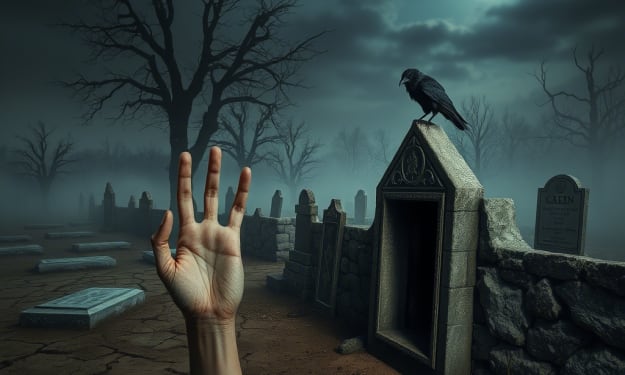
The Hand That Reached From the Grave In a quiet village nestled among Pakistan’s ancient hills, there lived an old man named Saeen Murad. Known for his silence and strength, he worked as a grave digger at the local cemetery. For years, he had dug hundreds of graves — without fear, without question. But the day he was asked to prepare a grave beside an old, crumbling wall changed everything. --- The graveyard was older than memory. Some graves had names, others only stones. And in the farthest corner stood a ruined enclosure — once a family tomb, now forgotten. One afternoon, the village cleric asked Saeen Murad to dig a fresh grave for a traveler who had died mysteriously in the mosque. The only space left was near the ruined wall. Murad nodded and began. He struck the earth with his shovel. The soil was unusually hard, dry despite the recent rain. As he dug deeper, he noticed pieces of old bricks mixed with the dirt. Then — the shovel hit something soft. --- He knelt and brushed the dirt away with his hands. It looked like a piece of thick rope at first. But as more soil cleared, it took the shape of a hand — a human hand, decayed but not skeletal, with nails that looked freshly trimmed. Murad froze. The hand wasn’t buried downward — it was reaching outward from inside the grave wall. Before he could think, the fingers twitched. He jumped back, dropping his shovel. His breathing turned sharp. He stared in disbelief as the hand moved again — slow, pained, like waking from a long nightmare. --- He ran to the cleric and gasped, “There’s something alive inside the wall!” Others gathered, skeptical but curious. By the time they returned, the hand was still. Cold. Lifeless again. A younger man dared to touch it. Cold as stone. Yet the hand didn’t look like a relic. It had veins, faint color, and one silver ring on the middle finger — engraved with letters that no one could read. --- The elders whispered. Some said it was a cursed soul, buried alive centuries ago. Others spoke of a sorcerer who had once lived in the village and vanished mysteriously. The cleric decided they would not dig further. “Seal it again,” he ordered. “Some graves are not meant to be disturbed.” Reluctantly, they poured soil back, covering the hand. But Murad couldn’t sleep that night. --- At midnight, he heard knocks — soft but steady — outside his mud-brick home. Three knocks. Silence. Three more. When he opened the door, no one was there. But on the ground… were muddy fingerprints. The same size as the hand in the grave. --- The next day, a boy from the village went missing. Then, a woman claimed to have seen a man with no eyes standing near the cemetery wall at dusk. And then — Murad’s dreams began. Every night, he saw the hand crawling through tunnels underground. It reached toward him, always closer, always hungrier. In the dream, the hand finally gripped his leg. He woke with a bruise on the same spot. --- He returned alone to the grave site. Using a small pick, he quietly chipped at the wall that had hidden the hand. Beneath it, a hollow chamber revealed bones scattered in ritual patterns, symbols etched in ash, and in the center — a corpse sitting upright, its eyes missing, and both hands gone. The corpse's mouth was wide open, as if frozen mid-scream. Murad stumbled back. And the hand… it was no longer in the wall. --- That night, the entire village heard a loud cracking sound from the graveyard. By morning, the ancient wall had collapsed — the chamber exposed. But inside, there were no bones. Just a single note, written in black dust: > “He woke me. You buried me again. Now I walk among you.” --- Murad fell ill. He whispered strange languages in his sleep. He scratched his arms raw, saying “Get the hand off me!” again and again. Then one morning, he disappeared — his bed cold, his footprints leading toward the cemetery. Some say his soul was taken. Others claim he still digs — in a realm between the living and the dead — forever cursed by the hand he should never have uncovered. --- But if you walk near the old wall on moonless nights... you might still see a hand reach out. Waiting for another Murad. Another mistake.
By Noman Afridiabout a year ago in Horror
The Girl Who Never Woke Up
The Girl Who Never Woke Up When Zara was sixteen, she fell asleep during a cold winter evening, never to wake up again. It was not a coma. The doctors were baffled. Her heartbeat was normal, her brain showed light activity, and she breathed steadily. But her consciousness was unreachable. Her family tried everything — from advanced medical treatments to spiritual healing — yet she remained in a state that no one could define.
By Noman Afridiabout a year ago in Horror
The Mirror That Refused to Show My Reflection
The Mirror That Refused to Show My Reflection I found the mirror at a yard sale on the outskirts of a small town in Vermont. It wasn’t anything special at first glance—a tall, narrow antique frame with vine-like carvings and a cracked backing. The woman selling it looked too eager to part with it, almost relieved. I thought maybe I was getting a good deal. I was wrong.
By Ali Asad Ullahabout a year ago in Horror
Voices in the Walls
Voices in the Walls Based on true events When my wife and I first moved into the farmhouse, it felt like a dream. A quiet, two-story home just outside of town, surrounded by wheat fields, thick woods, and silence—real silence, the kind you only get far away from the city. It had an old-world charm: squeaky floorboards, crooked shutters, and the smell of wood and dust that only time can create.
By Ali Asad Ullahabout a year ago in Horror
She Keeps Knocking at 3:17 AM. AI-Generated.
It started on a Thursday. At exactly **3:17 AM**, there was a knock at the door. Three soft taps. Darren sat up in bed, groggy and disoriented. The clock glowed red in the dark: *3:17*. His apartment sat on the third floor, down a quiet street. No one visited at this hour—especially not in this weather. Rain pelted the windows. Wind hissed through the cracks in the walls. Still, the knock came again.
By Asghar Badshahabout a year ago in Horror
The Whisper Game
Okay, so imagine I’m sitting next to you on a rainy night, and I tell you this: “There’s a game kids in Japan used to play. You summon a ghost by whispering her name. If you do it wrong... she whispers back.” And now, let me tell you what happened to Ami, my friend’s cousin from Osaka. This isn’t just a story. This is a warning. 🎌 The Dare Ami was 14—fun, loud, and always looking for trouble. She lived in Osaka, Japan, and went to a super old all-girls school with a creepy history. One day after class, her friends dared her to play something called The Whisper Game, also known as Kuchisake Hime’s Calling. Here’s how the game works: Go into a school bathroom—specifically, the third stall. Turn off the lights. Say “Kuchisake Hime” three times. Then whisper: “Do you want to play with me?” Wait. If you hear nothing, you’re safe. If you hear whispering back… run. Fast. Sounds silly, right? But every school kid knew the rule: Never answer her back. She wants you to talk. Because once you talk to her... she knows your voice. And once she knows your voice… she can follow it. 🚽 The Third Stall So of course, Ami had to do it. She laughed, grabbed her phone, and went into the old school bathroom after dark. Her friends waited outside, nervous but excited. The school was already empty. The halls were quiet. The air felt thick. Ami walked into the third stall, turned off the lights, and said: “Kuchisake Hime. Kuchisake Hime. Kuchisake Hime.” “Do you want to play with me?” She held her breath. Nothing. She was about to open the door when she heard it— A whisper. Right behind her ear. “Yessssss…” She screamed, ran out, laughing and shaking. Her friends were half-scared, half-impressed. They thought it was just a prank. But later that night, Ami started hearing whispering in her own house. 🏠 The Whisper Follows At first, she thought it was wind. Then she thought maybe it was the TV. But the whispers were always saying her name. “Ami… come play… Ami…” She’d walk past mirrors and see a flash of red cloth. Or she’d hear breathing under her bed. One night, while brushing her teeth, she looked up— And her reflection smiled before she did. Her mom thought she was tired. Told her to get more sleep. But Ami stopped sleeping altogether. She kept her lights on. Played loud music. But the whispering only got louder. Then, on the seventh night… She got a message. On her bedroom mirror. Written in fog, even though it wasn’t cold: "Do you still want to play?" 📖 The Legend Terrified, Ami started researching the legend of Kuchisake Hime—aka the Slit-Mouthed Woman. Hundreds of years ago, she was a woman who wore a red kimono and a white mask. People said she was beautiful—until someone sliced her mouth open from ear to ear. Now, she wanders around asking: “Am I pretty?” If you say yes, she removes her mask and shows her torn face. Then she kills you. But the Whisper Game is a modern version of her curse. It’s how she finds new voices—ones she can copy. Because when you play the game, she hears your voice. Then she whispers it back to trick you. And when you reply? You’re hers. 📸 The Disappearance Ami’s friends thought she was just pretending to be scared. Until she stopped coming to school. Her mom said she barely left her room. She talked less and less. And then— One night, Ami’s bedroom light went off at exactly 2:33 a.m. Her mom ran in. The window was open. The curtains were blowing in the wind. But Ami was gone. No signs of struggle. No footprints. No messages. Just her mirror… …with one word written on it: "Yes." 🧣 Where Is She Now? Some people say she ran away. But her friends? They know the truth. Sometimes when they walk home late at night, they hear soft whispering behind them. Sometimes it says: “Do you want to play?” And if they ever say anything back—anything at all— even a whisper… They start hearing their own name in the shadows. One girl even saw a figure in the reflection of a train window. Wearing a red scarf. The face? Was Ami’s. But her mouth was ripped open. And she was still whispering. ☠️ The Real Rule People say the Whisper Game is banned now in most schools in Japan. Teachers destroy any copies of the instructions. Students whisper about it in secret. But here’s the real rule no one tells you: If you’ve heard about the game… she already knows you. So remember—if you hear a voice late at night calling your name, and it sounds just like you… Don’t answer. Because once you do, You’ll never stop hearing her again.
By Silas Blackwoodabout a year ago in Horror