Latest Stories
Most recently published stories in Horror.
The Voice at the Door
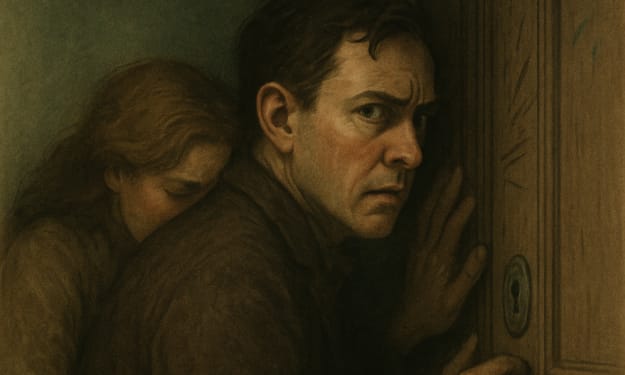
The rain was a steady, mournful rhythm against the windows, a soundtrack to the oppressive silence inside our small cottage. Three days. It had been three days since we’d buried my mother, Clara. Three days since her vibrant laughter, her comforting presence, had been reduced to a cold, sterile memory. The grief was a physical weight, pressing down on my chest, making every breath an effort. My wife, Sarah, sat across from me, her face pale and drawn. She hadn't cried much, not openly, but I could see the sorrow etched in the lines around her eyes, the way she clutched the steaming mug of tea, as if seeking warmth against an internal chill. She had loved my mother, truly loved her, and her quiet suffering was almost harder to bear than my own. A sudden, sharp rap echoed through the house, cutting through the rain and our unspoken grief. We both stiffened, our eyes meeting across the dimly lit room. It was late, past midnight. Who could it be? Another rap, louder this time, more insistent. I pushed myself up from the armchair. “I’ll get it,” I murmured, my voice raspy. “No!” Sarah’s voice was sharp, a sudden tremor in her tone. She stood up, her eyes wide, almost pleading. “Don’t, Daniel. Don’t open it.” I paused, surprised by her vehemence. “Sarah, it’s probably just a neighbor, or someone lost. It’s pouring outside.” “No,” she repeated, stepping towards me, her hand reaching out to grasp my arm. Her fingers were cold. “Please, just… don’t.” Before I could question her, a sound, faint but unmistakable, drifted from the front door. A voice. A voice that sent a jolt of ice through my veins, making the hairs on my arms stand on end. “Daniel? Are you there, my son? It’s your mother. Let me in, it’s so cold out here.” My blood ran cold. It was Mother’s voice. Her gentle, slightly reedy tone, the familiar way she elongated the ‘so’ in ‘so cold.’ Impossible. My mind screamed in protest. This had to be a cruel, sadistic prank. But who would do such a thing? I turned to Sarah, my face a mask of disbelief and dawning horror. “Sarah… did you hear that? It’s Mother! But… how?” Sarah’s grip on my arm tightened, her nails digging into my skin. Her eyes, usually so warm, were filled with a profound, terrifying dread. “Don’t open the door, Daniel!” she hissed, her voice barely a whisper, yet filled with an urgency that terrified me. “Please, for God’s sake, don’t!” Another series of knocks, more frantic now, accompanied by that voice, pleading, cajoling. “Daniel, darling, please. My old bones are freezing. Just a moment, let me come in. I need my son.” My heart was a war drum in my chest. Every fiber of my being yearned to rush to the door, to throw it open, to embrace the mother I had just buried. My grief-stricken mind wrestled with the horrifying reality. She was dead. We had stood by her grave just three days ago, watched the coffin lowered into the earth. “It’s not her, Daniel,” Sarah choked out, tears finally streaming down her face. “It can’t be. It’s… it’s something else. Something trying to get in.” Her words made a chilling kind of sense, even as my emotions fought against them. The raw, desperate need in that voice, the way it played on my deepest sorrow, felt predatory. But the resemblance was uncanny. Every inflection, every nuance, was exactly like Mother. The knocking escalated into a frantic pounding, rattling the doorframe. And the voice changed, subtly. The soft pleading took on a sharper edge, a hint of impatience, even anger. “Daniel! Are you going to leave your mother out in the storm? After all I’ve done for you? After all these years?” A shiver of genuine fear ran down my spine. Mother, for all her love, had never resorted to emotional manipulation, not like this. This was a twisted mimicry, a violation of her memory. “Who are you?” I yelled back, my voice trembling, cracking. “Leave us alone!” A silence fell, thick and unnerving, broken only by the relentless rain. My heart pounded so loudly I thought Sarah must hear it. Then, a low, guttural chuckle emanated from the other side of the door. It wasn't Mother’s laughter. It was something else. Something ancient and malevolent, devoid of humor, filled with contempt. And then the voice returned, but this time, it was a chilling, distorted parody of my mother’s voice, stretched and deepened, laced with a faint, gurgling sound, like water bubbling through mud. “You buried me, Daniel. You put me in the cold, dark ground. But I’m still here. And I need to come home.” The pounding on the door intensified, becoming violent, as if something heavy was slamming against it. The entire frame shuddered. Sarah let out a strangled cry, burying her face in my shoulder. I could feel her shaking uncontrollably. “It knows,” I whispered, my eyes fixed on the trembling wood of the door. “It knows we buried her.” “It’s not her, Daniel,” Sarah sobbed into my shirt. “It's using her… to get to us.” Suddenly, the pounding stopped. Another silence, even more terrifying than the last. Then, a scratching sound began, slow and deliberate, like long, sharp nails dragging across the wood, moving from the doorknob, upwards. And then, I heard it. A faint, wet sniffing sound from directly outside the keyhole, followed by a soft, almost inaudible sigh. Then, the voice again, a whisper now, right at the keyhole, raw and intimate, filled with a horrific intimacy that turned my stomach. “I can smell your fear, Daniel. And I can smell your grief. Such a heavy grief. It’s almost as heavy as the earth on my coffin.” I stumbled back, pulling Sarah with me, away from the door. My mind reeled. This wasn't some trick of sound or light. This was real. Something was out there. Something that had taken on my mother’s voice, her memories, to gain entry. Something that was preying on my sorrow. The scratching continued, now higher up the door, then lower, as if whatever was outside was circling, testing, searching for a weakness. A faint, earthy scent, like damp grave soil, began to seep through the cracks around the doorframe, mixing with the clean smell of rain. Sarah clung to me, her face buried against my chest. “What does it want?” she whimpered. The voice answered, a low, satisfied murmur from the other side of the door. “I want to be warm again, my son. And you are so warm. You held my hand when I was cold. Now, let me hold yours. Forever.” A chilling sound, like a wet, sucking noise, came from the keyhole, followed by a faint, clicking sound, as if something was attempting to turn the lock from the outside. Panic surged through me, cold and absolute. It wasn't just a voice. It was trying to get in. It was trying to claim me, just as it had claimed Mother’s voice. I dragged Sarah back, away from the door, towards the deepest part of the house, the small, enclosed pantry where we kept emergency supplies. We huddled there, in the oppressive darkness, listening to the rain, and to the faint, persistent scratching that continued at the front door. It went on and on, punctuated by the chilling whispers of a voice that was both familiar and utterly alien. I knew then, with a sickening certainty, that the grave had not held her. And now, the thing that had followed her back was patiently waiting, clawing at the door, to finally claim what it believed was its due. My mother's voice, transformed into a siren's call from the abyss. And the night was long. So very long.
By Noman Afridiabout a year ago in Horror
The Grave That Waited
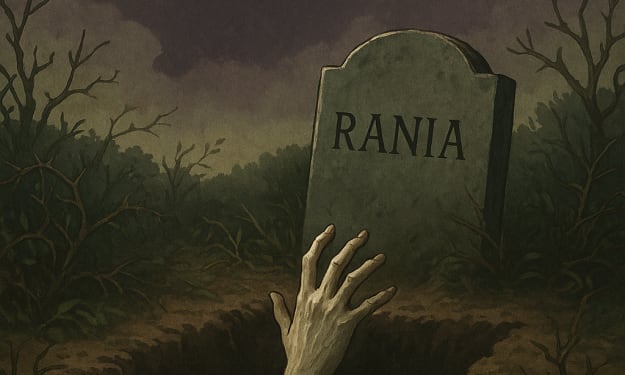
The dreams began subtly, a faint whisper in the dark, then grew into a suffocating presence. It was always the same: a patch of untamed earth, overgrown with thorny weeds and gnarled roots, under a sky the color of bruised plums. And in the center, a freshly dug grave. The earth around it was dark, clumpy, as if disturbed only moments before. But the truly chilling detail was the simple, unadorned headstone. No ornate carvings, no flowery epitaphs. Just one word, starkly etched into the grey stone: Rania. My name. I'd wake up in a cold sweat, my heart hammering against my ribs, the metallic taste of fear coating my tongue. For days, I dismissed it. Stress. Too many late-night thrillers. My overactive imagination. I was a practical, logical person. Dreams were just subconscious noise, right? But the dreams persisted, night after night, each one more vivid, more insistent than the last. I could almost smell the damp earth, feel the oppressive silence of the gravesite. In one dream, I saw my reflection in the still water gathered at the bottom of the pit — my face pale and distorted by the murky depths. In another, a faint, cold breeze whispered from the grave, carrying a sound I couldn't quite decipher — a sigh, a lament, or perhaps, an invitation. I started avoiding sleep. Coffee became my best friend, anxiety my constant companion. My usually calm demeanor frayed at the edges. My parents noticed my pallor, my jumpiness. > “Are you feeling alright, Rania?” My mother would ask, her brow furrowed with concern. I’d force a smile, mumbling something about deadlines at university. How could I tell them I was being haunted by a grave with my own name on it? They’d think I was losing my mind. One particularly grueling night, the dream took an even more sinister turn. I was standing at the edge of the grave, looking down. The name RANIA on the headstone seemed to glow with an internal, malevolent light. Then, slowly, terrifyingly, a hand — pale and skeletal — emerged from the dark soil within the grave. Its fingers, tipped with dirt-caked nails, curled upward, beckoning. A low, raspy whisper, chillingly devoid of emotion, echoed in the dreamscape: > "Come, Rania. It's time." I jolted awake with a scream caught in my throat, my body trembling uncontrollably. The sun was barely peeking over the horizon, casting weak, grey light into my room. I flung myself out of bed, needing to escape the lingering horror, to ground myself in reality. I stumbled into the kitchen, desperately needing a glass of water — anything to wash away the nightmare. As I leaned against the counter, trying to steady my racing pulse, my gaze drifted toward the window that overlooked our backyard. It was a small, neglected patch of land, mostly overgrown, but peaceful. We rarely went back there, preferring the front garden. And then I saw it. At first, I thought it was just a shadow, a trick of the early morning light. But as my eyes adjusted, my breath hitched in my throat. There, at the very back of our yard, nestled amongst the wild bushes and tangled vines, was a patch of freshly disturbed earth. Dark, clumpy soil — exactly like in my dreams. My mind reeled. It couldn’t be. It was impossible. My logical brain screamed for a rational explanation. A neighbor digging? A fallen tree uprooting the soil? But the shape… it was too precise, too distinct. An oblong rectangle, unmistakably like… > A grave. My heart hammered so violently it felt like it would burst through my chest. My legs felt like lead, yet an uncontrollable urge pulled me toward the back door. Every step was a battle against the overwhelming dread. The air in the house seemed to grow heavy, thick with an unspoken presence. I pushed open the back door, and the cool morning air hit me, mingling with a faint, earthy scent. The kind of smell that clings to freshly turned soil. I walked slowly, cautiously, my eyes fixed on the disturbing sight. As I got closer, the details sharpened, solidifying the nightmare into a horrifying reality. It was exactly as in my dreams. The same patch of untamed earth, the same gnarled roots, the same ominous stillness. And there, driven into the ground at the head of the dug-out plot, was a simple, grey stone. My blood turned to ice. On it, etched with chilling precision, was the single word: > RANIA A strangled whimper escaped my lips. This wasn’t a dream. This wasn’t a hallucination. This was real. The grave was real. It was in my backyard. It had appeared overnight, out of nothing. I stumbled backwards, my mind screaming in protest. Who would do this? Why? Was this a twisted prank? But the sheer audacity, the disturbing accuracy to my dreams, ruled out any mundane explanation. This was something else. Something far more sinister. I looked around frantically. The house was quiet. My parents were still asleep. I was alone with this impossible horror. Then, a faint sound, like dry leaves rustling, came from within the freshly dug grave. My eyes widened in terror. The earth at the bottom of the pit seemed to shift, subtly, almost imperceptibly. And then — just as in my nightmare — a pale, slender hand, covered in dark soil, slowly began to emerge from the depths. Its fingers, long and delicate, curled upwards, reaching, beckoning. A cold, unseen presence enveloped me, chilling me to the bone. I could feel a faint whisper against my ear — not quite a sound, more like a thought, a dreadful certainty: > "You shouldn't have seen it. But now that you have... you have to fill it." My gaze locked onto the hand, which was now fully exposed, reaching higher, almost out of the pit. The fingernails were long and sharp, coated with a glistening, dark mud. It wasn't skeletal, as in my dream, but disturbingly fleshy — yet so incredibly pale. A primal scream tore from my throat, raw and desperate. I turned and fled, tripping over my own feet, not looking back. I burst through the back door, slamming it shut behind me, fumbling with the lock. I ran through the living room, my legs burning, until I reached my parents' bedroom, banging frantically on the door, sobbing incoherently. > “Mom! Dad! Wake up! Please! There’s… there’s a grave… in the backyard… and it has my name on it!” I knew they wouldn't believe me. Not at first. How could they? But as I sank to the floor, gasping for breath, the image of that hand — reaching, beckoning — branded itself onto my mind. The grave was waiting. And something was in it… waiting for me. And I knew, with a horrifying certainty, that it wouldn't wait forever.
By Noman Afridiabout a year ago in Horror
The Shadow's Embrace
The old polaroid camera was a relic, a bulky, dusty testament to a bygone era. Liam, my younger brother, had unearthed it from our grandpa’s attic, declaring it his new obsession. > “It captures moments, Elara,” he’d explained, his eyes alight with the thrill of his discovery. “Not just pixels, but the actual feel of a second in time.” I’d humored him, watching as he meticulously cleaned the lens, loaded the faded film pack, and, with a triumphant click, took his first self-portrait. He’d beamed at the developing square, holding it up for me to see. It was a typical Liam photo – messy brown hair, a wide, slightly goofy grin, and the faint freckles dusting his nose. But then he frowned. > “Huh,” he muttered, tilting the picture. “What’s that?” I leaned closer. In the dim, dusty corner of the attic behind him, a faint, elongated smudge of darkness seemed to cling to the wall. It was barely perceptible, easily dismissed as a trick of the light or a flaw in the old film. > “Just a shadow, Liam,” I’d said, shrugging. “It’s an old camera. Probably some light leak.” He’d hummed, unconvinced, but soon enough, his attention had shifted to other projects. --- The next few days were a whirlwind of Liam’s photographic endeavors. He took pictures of everything: our grumpy cat, the half-eaten pizza on the counter, the sunset from his bedroom window. And, of course, more self-portraits. He was obsessed with documenting himself, almost as if he was trying to capture every fleeting moment of his existence. One evening, I found him hunched over his desk, a stack of freshly developed polaroids fanned out before him. The room was dark, save for the glow of his phone screen, casting an eerie blue light on his face. He looked pale, and there was a tremor in his hand as he picked up a photo. > “Look, Elara,” he whispered, his voice tight with a fear I hadn’t heard before. It was another self-portrait, taken in his room. He was sitting on his bed, a textbook open in his lap, looking up at the camera with a casual, almost bored expression. But beside him, standing just inches from his shoulder, was the shadow. It was clearer this time — a distinct, human-like silhouette, impossibly dark, with edges that seemed to drink in the light. Its form was elongated, almost stretched, and where its face should have been, there was only an inky void. My heart gave a sudden lurch. > “Liam, what is that?” > “I don’t know,” he breathed, his eyes wide. “It’s in all of them. Every single one since the attic.” He shuffled through the stack. – A picture of him reading on the couch – the shadow lurked behind the cushions. – A shot of him eating breakfast – the shadow stood just outside the kitchen window, a faint, distorted reflection. Each photo showed the shadow closer, more defined, its presence more imposing. > “It wasn’t there when I took them,” he insisted, his voice rising. “I swear, I was alone.” I tried to rationalize it. > “Maybe it’s a double exposure? Or… a prank? Are you messing with me?” He shook his head vehemently. > “No! Look at this one.” He handed me the most recent photo. It was taken just minutes ago, from his bedside table, pointing towards his bed. Liam was lying on his back, looking directly at the camera, a faint, uneasy smile on his lips. And standing right over him, leaning down as if whispering into his ear, was the shadow. It was so close, so intimately positioned, that its form seemed to almost merge with his. Its edges were no longer blurred; they were sharp, distinct. And for the first time, I felt an icy dread crawl up my spine. There was an unsettling weight to its presence, even in the two-dimensional image. > “It feels cold, Elara,” Liam murmured, his voice barely audible. “When I took that last one, I felt a chill. Like someone was breathing on my neck.” He pointed to the inky void where the shadow’s face should have been. > “And sometimes… sometimes I think I can see something in there. Like a black hole. Or eyes, watching me.” I wanted to tell him it was his imagination, to dismiss it as a trick of his old camera. But the fear in his eyes, the undeniable progression in the photos, was too real. > “Liam,” I said, trying to keep my voice steady, “put that camera away. Don’t take any more pictures. Not tonight.” He nodded, too frightened to argue. We spent the rest of the evening in the living room, watching a movie, the lights on bright. I kept glancing at him, reassuring myself that he was fine, that it was all just a bizarre coincidence. He seemed to relax a little, but every so often, I’d catch him looking over his shoulder, as if expecting something to appear. --- Before bed, he came into my room. > “Goodnight, Elara,” he said, his voice softer than usual. He hesitated at the door. “You think… you think it’s just the camera, right?” I forced a smile. > “Of course, little brother. Just a faulty old camera.” He nodded, a flicker of relief in his eyes, and went to his room. I stayed up for a while, scrolling through my phone, trying to shake off the unsettling feeling. Around midnight, I heard a faint thud from Liam’s room. I frowned, wondering what it was, but then dismissed it as him knocking something over. Kids are always clumsy. --- The next morning, I woke up to an unsettling silence. Our house was rarely this quiet. Liam was usually up early, blasting music or making a racket in the kitchen. I called his name, but there was no response. A knot of dread tightened in my stomach. I got out of bed and walked to his room. The door was slightly ajar. I pushed it open. The room was still dark, the curtains drawn. Liam was in his bed, covers pulled up to his chin. I exhaled, a wave of relief washing over me. He was just sleeping in. > “Liam,” I said softly, walking over to his bed. “Come on, wake up, lazybones.” I reached out to shake his shoulder, but stopped. Something was wrong. The air in the room was impossibly cold, colder than the deepest winter morning. And there was a faint, metallic scent, almost like… rust. Then I saw it. Lying on his pillow, beside his head, was the polaroid camera. And on top of it, a newly developed photo. My blood ran cold. He hadn’t listened. He’d taken another picture. I reached for it, my hand trembling so violently I almost dropped it. It was a close-up. Liam’s face, pale and still, his eyes closed. And behind him, so close it was almost consuming him, was the shadow. But it wasn’t just a shadow anymore. Its form was no longer flat; it had depth, texture. And where its face had been an inky void, there was now a faint, terrible outline. Not a face, but an impression of one — twisted in a silent, predatory grin. The most horrifying detail was what the shadow was doing. Its elongated, dark arm was wrapped around Liam, almost like an embrace. And its hand, with long, shadowy fingers, was pressed firmly over Liam’s mouth, as if to silence a scream that never came. I dropped the photo, a strangled cry escaping my lips. My gaze snapped back to Liam. He lay perfectly still, his chest unmoving. His lips were slightly parted, but no breath escaped. His skin was as cold as the room. And for a fleeting, terrifying moment, I thought I saw it — a ripple in the darkness behind him, a shifting of shadows, as if something had just slipped away, leaving behind only the profound, suffocating silence.
By Noman Afridiabout a year ago in Horror
The Hand That Lingered
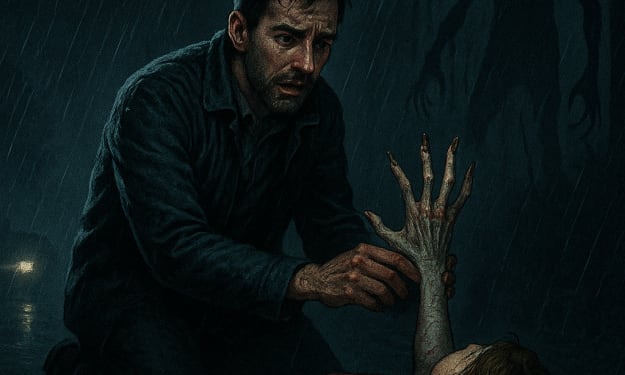
The rain lashed down, a relentless drumbeat against the asphalt, mirroring the tempest in David’s soul. He knelt on the slick, black road, oblivious to the chill seeping into his bones, the growing numbness in his fingers. All that mattered was the small hand cradled in his. It was so small, so fragile, yet it felt impossibly warm against his trembling grip. “Lily,” he choked out, his voice a raw whisper torn by the wind. “My sweet Lily.” Her hair, once the color of spun gold, was matted with mud and something darker, more ominous. Her little pink dress, chosen with such delight just yesterday, was now a tattered, crimson-stained mess. The headlights of a distant, swerving car had been the last thing he saw before the world became a blur of screeching tires and shattering glass. And then, silence. A deafening, absolute silence that swallowed his screams. He squeezed her hand tighter, willing warmth back into her tiny limbs, willing her eyes to flutter open, willing the last year to simply vanish like a bad dream. But the truth was a cruel, unyielding fist around his heart. Lily had died a year ago. A year ago, almost to the day, in a similar, rain-slicked accident. He’d been driving her to her grandmother’s. A deer had darted out, he’d swerved, and the world had tilted on its axis, plunging him into an abyss of grief from which he hadn’t truly emerged. So, whose hand was this? Panic, cold and sharp, began to prickle at the edges of his grief-muddled mind. He lifted his gaze from the small, still form beside him. The rain was blurring his vision, or was it tears? He blinked, trying to clear his sight, and for a fleeting moment, the shape beside him seemed to shimmer, to fade at the edges. "No," he muttered, shaking his head. "It's real. You're real, Lily." He ran a thumb over the delicate knuckles, feeling the smooth skin, the faint pulse that wasn’t there, couldn't be there. He remembered the last time he’d held her hand, in the sterile white room of the hospital, as her life ebbed away. It had been cold then, too. Unbearably cold. He leaned in, pulling her closer, trying to shield her from the onslaught of the rain. A strange, sweet scent, like honeysuckle and damp earth, wafted up from her, a smell that had been unique to Lily. He closed his eyes, inhaling deeply, desperately clinging to this impossible moment. It was a miracle. It had to be. His Lily, back. A low, guttural growl rippled through the air, cutting through the drumming rain. David’s eyes snapped open. He scanned the darkness beyond the glow of the distant headlights. Nothing. Just the vast, empty expanse of the road and the dense, silent forest bordering it. He dismissed it as the wind, a trick of his frayed nerves. He looked down at Lily again, his heart swelling with an irrational joy. He would take her home. He would tell Sarah, his wife, who had withered into a ghost of her former self after Lily’s death, that their daughter was back. They could be a family again. The thought ignited a flicker of hope in the desolate landscape of his soul. He tried to lift her, to gather her into his arms, but her weight was… wrong. It was too light, almost insubstantial. And her hand, the one he still clung to, felt suddenly… different. The warmth was gone, replaced by an unnatural chill, a dampness that was not from the rain. He forced himself to look at it, really look at it. In the faint, flickering light from the road, he saw it. The skin was not smooth and rosy like Lily’s. It was pale, almost translucent, and marred by faint, dark veins that seemed to pulse just beneath the surface. And the fingernails… they were too long, too sharp, and stained with the same dark earth that clung to the rest of the child. A wave of nausea washed over him. This wasn't Lily. It couldn't be. He wanted to let go, to recoil in horror, but his fingers were locked, impossibly, around the small hand. It felt as if his own flesh had merged with hers, a macabre embrace he couldn't break. The growl sounded again, closer this time, accompanied by a faint rustling in the undergrowth of the forest. David’s head snapped up. Two pinpricks of red light glowed in the darkness, unblinking, unmoving. Predator's eyes. He squeezed his eyes shut, shaking his head violently. This was a nightmare. He was still asleep, trapped in the torment of his grief. He would wake up in his bed, the sun streaming through the window, and Lily’s laughter would echo down the hallway. But when he opened his eyes, the red lights were closer, and a faint, putrid smell, like decay and wet earth, filled his nostrils. He could make out a shape now, lumbering slowly out of the shadows. It was tall, impossibly thin, its limbs twisted at unnatural angles. Its head was a dark, featureless mass, but the two red pinpricks burned with malevolent intent. He tried to scream, but no sound escaped his throat. His breath caught, trapped in his lungs. He struggled to pull his hand free, to sever the unholy connection, but it was useless. The small hand, once so comforting, was now a cold, dead weight, tethering him to the earth. The creature stopped at the edge of the road, perhaps twenty feet away. The red eyes fixed on him, on the small, limp form beside him, and a low, chittering sound, like insects skittering over dry leaves, emanated from its form. And then, the small hand in his began to move. Not Lily’s movement, not the familiar squeeze of her fingers around his. This was something else. The tiny fingers curled, slowly, deliberately, into a tight grip—tighter than any child could manage. The fingernails, those too-long, too-sharp nails, began to dig into his flesh. Pain, hot and searing, shot up his arm. He gasped, a strangled sound that was almost a sob. He watched in horrified fascination as the small wrist twisted, rotating unnaturally within his grasp, until the palm was facing upwards. And then, slowly, a single, pale finger began to point. Not at him. Not at the creature in the shadows. It pointed towards the dense, dark woods, towards the deepest, most impenetrable part of the forest. The creature in the shadows took a step forward, then another. The chittering grew louder, more insistent. David looked from the pointing hand to the approaching monster, terror paralyzing him. He understood now. This wasn't Lily. This was a mimicry, a lure. A trap. The small hand pulsed in his, and he could feel something cold and fibrous beginning to snake its way up his arm, burrowing beneath his skin. He saw the faint outlines of the veins in the pale hand glow with a faint, greenish light. He closed his eyes again, tears finally flowing freely, mingling with the rain on his face. He should have let go. He should have accepted her death. His refusal to let go, his desperate yearning, had opened a door to something ancient and hungry, lurking in the shadows of grief. The creature was almost upon him now, its foul odor overwhelming his senses. He could feel its breath, cold and wet, on his face. He felt the grip of the small hand tighten further, its sharp nails tearing into his flesh, drawing blood. And then, a whisper, not in his ear, but in his mind, cold and clear as the deepest winter night: > "You held on, didn't you? You just couldn't let go." The hand in his jerked, pulling him forward, irresistibly, towards the dark, waiting maw of the forest—towards the creature that was no longer just a shadow, but a gaping void of teeth and hunger. He screamed then, a real scream, one that tore from the depths of his being, a final, futile cry swallowed by the rain and the hungry silence of the night.
By Noman Afridiabout a year ago in Horror
“The Secret Room My Landlord Never Told Me About”
When I first moved into Apartment 3B on Halstead Street, I thought I'd found the deal of a lifetime. Two bedrooms, high ceilings, vintage windows, and a view that didn’t face another brick wall. It was oddly affordable, the kind of place that makes you pause and think, "What's the catch?"
By Hamad Haiderabout a year ago in Horror
Every Night at 3:07 AM, My Doorbell Rings. No One’s Ever There.
I checked the cameras. What I saw made my blood run cold. I moved into this house three months ago, chasing what people like to call a “fresh start.” A new job in a quieter town, a modest two-bedroom house with a creaky porch and a view of nothing but thick, endless woods behind it. It wasn’t perfect, but it was mine. For the first few weeks, life was simple. I unpacked boxes, learned which floorboards groaned the loudest, and let the silence settle in like a heavy blanket. No neighbors stopping by, no friendly small talk. Just me, my overworked coffee maker, and the hum of old pipes in the walls. Then, on a Wednesday night, it started. At **3:07 AM**, the sharp, high-pitched chime of my doorbell shattered the quiet. I jolted upright in bed, heart pounding against my ribs. I wasn’t expecting anyone — no one even knew me here. It must’ve been a mistake. A drunk kid? A late package? I waited, listening, but heard nothing else. No footsteps. No knock. Too tired to investigate, I told myself it was nothing and rolled over. The next night, the bell rang again. **3:07 AM. Exactly.** This time, curiosity won over hesitation. I grabbed my phone, opening the feed from my new video doorbell — one of those motion-activated smart cameras I’d installed the day I moved in, mostly for peace of mind. But the feed showed nothing. The porch was empty. No person, no animal. Just the faint flicker of the porch light, swaying branches in the distance, and the time stamp: **3:07 AM**. I chalked it up to a glitch. On the third night, I was ready. I stayed up, huddled under a blanket on the couch with my phone open to the live feed. **3:05 AM. 3:06 AM.** I held my breath. Then — **DING DONG.** I jumped, nearly dropping my phone. The live feed refreshed… and there it was. A figure. Just barely visible at the very edge of the porch, standing in the darkness beyond the light’s reach. Tall, thin, unnervingly still. I couldn’t make out a face or details, just the unmistakable outline of a person. I scrambled to the window, pulling the curtain aside — no one. Back to the phone. The feed was empty again. I didn’t sleep after that. --- The next morning, bleary-eyed and jittery from too much coffee, I called the police. An officer came by, a guy named Jensen. I explained everything. He glanced at my porch, checked the doorbell logs, and shrugged. “Could be some kid messing with you,” he offered. “Or an animal triggering the motion sensor.” I showed him the clip, though the figure barely showed up on the saved footage. The poor quality made it look more like a smudge of darkness than a person. Still, I saw it. I knew what I saw. “We’ll patrol by tonight,” Jensen promised, scribbling something in a notebook before leaving. --- That night, I left every light on. Sat clutching a baseball bat, refreshing the camera feed every five minutes. **3:07 AM. DING DONG.** I felt the blood drain from my face. I forced myself to look at the feed. This time, the figure was closer. Standing just beneath the porch light, though the camera still refused to capture anything clearly. Like it was bending the shadows around it. The way it stood — too still, too quiet — set every instinct screaming. And then it moved. A slow tilt of the head, as if it knew I was watching. And that’s when it happened. It raised a hand… and waved. A slow, deliberate wave. I let out a sound somewhere between a sob and a scream, bolted upstairs, and locked myself in my room. I didn’t check the footage again until dawn. When I finally did, the saved clip was gone. No event logged at 3:07 AM. No figure. No wave. Nothing. --- By the fifth night, I was a wreck. Dark circles under my eyes, nerves frayed to the point where every creak and groan made me jump. I called the police again. Jensen came by, but there was nothing to report. No evidence. No prints. No saved footage. “Maybe it’s time to get some rest,” he said carefully, eyeing the growing mess of empty coffee cups and takeout containers. I wanted to leave. Sell the house. Burn it down, maybe. But something — call it stubbornness or sheer terror — kept me here. That night, at **3:07 AM**, the doorbell rang one final time. I didn’t check the camera. Didn’t peek through the blinds. I just sat there in the dark, staring at my phone, waiting for it to end. After a long, suffocating minute, a soft knock followed. Three precise raps against the door. And then… a voice. A woman’s voice. Soft. Familiar. “Let me in.” I swear my heart stopped. Because it sounded like her. **Lena.** My best friend. The one who disappeared seven years ago without a trace. The one whose voice I hadn’t heard since the night she vanished. I wanted to believe it was a trick. A cruel, impossible prank. But something inside me — a memory, a buried instinct — knew it wasn’t. I managed to crawl to the door, every part of me screaming not to. I pressed my ear against the cold wood. “Please,” the voice whispered. “I’m so cold.” I reached for the doorknob. Paused. And then turned away. I don’t remember falling asleep, but the next thing I knew, sunlight was streaming through the window. The porch was empty. No sign of anyone. No footprints. No evidence. I moved out the same day. --- I never found out who — or what — was ringing my doorbell at 3:07 AM. I never heard Lena’s voice again. But sometimes, in the dead quiet of early morning, I still wake up at exactly **3:07 AM**. And I swear, for just a second, I hear the doorbell chime.
By Muhammad Ilyasabout a year ago in Horror
The Sleep Recorder.
I’ve always been a bit of a data junkie. I track my steps, my heart rate, my screen time—all in the name of self-optimization. So, when I found "Somnus," a sleek new sleep-tracking app, I downloaded it instantly. The interface was clean, the promises were grand: it would analyze my sleep cycles, identify disturbances, and record any nocturnal sounds to give me a complete picture of my rest. For the first two weeks, it was boringly brilliant. It produced clean graphs of my REM cycles and a few pathetic audio clips of my own snoring. It was exactly what I wanted: predictable, sterile data.
By MUHAMMAD FARHANabout a year ago in Horror
10 Queer Characters with Great Influence on the Horror Genre. AI-Generated.
Horror has historically been a type of story that focuses on the excluded: bodies, desires and identities that do not fit into a single category or social norms. For this reason, the queer community has found connection in its shadows and screams over time, even when its representation was mostly indirect or based on stereotypes. Recently, the situation on the fringes of terror has changed. From subtle ghost stories to flashy horror films and supernatural dramas, a growing number of series are focusing on queer figures. These characters are no longer just companions or victims, but well-developed protagonists who have initiative, complexity and a deep emotional charge. They are not only present or survive in history, but also transform it.
By Ninfa Galeanoabout a year ago in Horror