Latest Stories
Most recently published stories in Horror.
The Whispering Dolls of Mexico’s Island – When Toys Start Talking Back. AI-Generated.
In the deep swamps of Xochimilco, Mexico, there lies an island unlike any other. Locals call it “La Isla de las Muñecas” — The Island of the Dolls. Tourists know it as a creepy attraction filled with hanging dolls, torn faces, and lifeless eyes staring from the trees. But the truth… is far darker than any ghost tour will ever tell you. The Origin of the Island: Many decades ago, a man named Don Julián Santana Barrera decided to live alone on this tiny island. He left behind his wife and daughter in the city, wanting peace and silence away from the chaos of Mexico City. But silence can be a dangerous companion. One humid evening, while walking near the edge of the water, Julián found something floating — a body of a little girl, tangled in the roots of a willow tree. She had drowned, her eyes wide open, staring up toward the gray sky. Shaken to his core, Julián buried her with his own hands, whispering prayers. But the very next morning, he saw a doll floating in the same spot where her body was found. Thinking it belonged to the girl, he hung the doll on a nearby tree as a sign of respect — a memorial to the dead child. But that one doll was just the beginning. The Whispers Begin: At first, Julián thought it was his imagination. He would hear faint giggles at night… tiny footsteps splashing in the shallow water… whispers calling his name. “Julián… ven aquí…” — Julián, come here… He started to collect more dolls — from garbage dumps, from canals, even from the hands of strangers. He hung them on trees, fences, and ropes. He said they kept the girl’s spirit calm. But locals noticed a change in him. He would talk to the dolls like they were alive. He said they answered him back. The Possession: One night, a visitor from the nearby village came to see him. The man found Julián sitting near a fire, surrounded by dolls — hundreds of them, all facing him in a circle. He was whispering to them, nodding, as if listening to their replies. When the visitor called his name, Julián turned slowly and said, “They don’t like strangers… they say you shouldn’t have come.” The visitor laughed nervously, but his laughter faded as he noticed something horrifying — the dolls were moving. Not much, just slightly — heads tilting, eyes turning. He ran away, swearing never to return. The Death of Don Julián: Years passed. People forgot about the madman on the island. Until one day in 2001, Julián’s nephew came to visit him — only to find his uncle’s body floating in the same spot where the little girl had drowned fifty years earlier. Locals said it was fate. Others said… the girl had finally taken him. Since then, no one has lived permanently on that island again. But that didn’t stop the whispers. Modern-Day Visitors: Today, brave tourists travel by boat to see the Island of the Dolls. Some bring offerings — candies, flowers, or new dolls — hoping the spirits will spare them. But many return with terrifying stories. One woman claimed that while taking pictures, she heard a child’s voice say, “Why did you take my doll?” When she checked her bag later, a wet, muddy doll was inside — one she had never seen before. Another tourist fainted after feeling small hands tug at her dress while walking through the trees. When she woke up, her camera was gone — only to be found later with all photos erased… except one. A close-up shot of her own terrified face — taken from behind. The Curse Lives On: Locals warn visitors: never insult the dolls, never take anything from the island, and never stay after sunset. Because after dark, the whispers grow louder. They say the dolls talk to each other — in the same soft voice of the drowned girl. And sometimes… if you listen carefully, they might whisper your name too. Accounts Witness: A few years ago, a group of ghost hunters visited the island for a documentary. Their equipment recorded high-pitched voices around 3 a.m. — voices that said, “Stay with us.” One of the crew members later claimed he saw a child’s reflection in a doll’s glass eye — even though there was no one else there. The next morning, they left in panic. Their footage mysteriously got corrupted during editing. Only one file remained intact — an audio clip that played nothing but the faint sound of giggling… and a single word whispered in Spanish: “Gracias.” (Thank you.) Final Words: To this day, the Island of the Dolls stands as one of the creepiest places in the world. Thousands of dolls still hang there, rotting, staring, whispering in the wind. No one knows if they protect the island — or if they are what needs protecting from it. So if you ever visit Xochimilco, and your guide tells you to cover your ears when the wind passes through the trees… do it. Because sometimes, the wind isn’t wind at all. It’s the little girl’s whisper… asking you to stay. Some stories are told by humans. Others… by the dolls that never learned to stay silent.
By Mr. Jackie12 months ago in Horror
Japan’s Suicide Forest Where the Dead Still Speak. AI-Generated.
Imagine a forest so quiet that even your own heartbeat feels too loud. A place where the wind doesn’t whisper—it mourns. This isn’t a scene from a horror movie. It’s real. It’s Aokigahara, Japan’s most infamous stretch of woods, resting at the base of Mount Fuji — better known to the world as “The Suicide Forest.” For centuries, this forest has been wrapped in mystery, fear, and tragedy. Locals call it Jukai, meaning Sea of Trees, because when you look from above, the forest looks like a dark green ocean frozen in time. But deep within, beyond the hiking trails and tourist paths, lies another world — a place that even sunlight seems too afraid to touch. It’s said that if you step too far inside, your compass stops working. GPS signals fade. And strange voices call your name from nowhere. Many believe the spirits of those who died here never left — forever trapped among the tangled roots and endless silence. The forest’s connection with death isn’t new. Its dark reputation goes back hundreds of years, even before modern suicides began. In ancient Japan, when families faced extreme famine, they sometimes abandoned the elderly in this forest — a cruel practice called ubasute. The abandoned were left to die among the trees, and locals believe their restless souls still wander there. But the horror truly began in the modern age. Since the 1950s, Aokigahara has become the most popular suicide site in the world after the Golden Gate Bridge. Every year, dozens — sometimes hundreds — of people walk into this forest and never come out. Authorities stopped publishing official numbers years ago to avoid encouraging copycats. Still, volunteers who search the area say they find bodies almost every month. But why here? Why do people choose this particular forest to end their lives? Some blame the novel “Kuroi Jukai” (Black Sea of Trees) written in 1960, where two lovers end their lives inside Aokigahara. Others say it’s because of its quiet — the kind of silence that feels eternal. Those who enter say it feels like the forest understands pain — like it absorbs sorrow from anyone who steps inside. Japanese police and volunteers have tried to mark the trails with bright ribbons tied to trees — so that people who change their minds can find their way back. They’ve also placed warning signs everywhere that read: > “Your life is a precious gift from your parents.” “Please think again.” “Don’t face this alone — talk to someone.” But many never turn around. One search volunteer, named Kenta, once shared a story that still haunts him. He found a tent deep inside the forest, perfectly set up — sleeping bag, food, water — everything untouched. It looked like someone had been living there. But when he called out, no one answered. For three days, the tent remained empty. On the fourth day, he found the man hanging less than twenty meters away — as if he had stayed in that tent debating life and death before finally giving in. Visitors often describe a strange, heavy feeling in the air. Some say they hear footsteps behind them but see no one. Others claim to hear faint crying or whispers calling their names. Even compasses behave strangely — spinning endlessly because of the forest’s magnetic volcanic soil. For some, it’s a scientific reason. For others, it’s something much darker — the pull of lost souls. One tourist once shared his experience online. He and his friend entered the forest for adventure. After walking for hours, they found red string tied around trees — a path made by someone trying not to get lost. They followed it… until it suddenly stopped mid-air, as if cut off. A few feet ahead, they found a wallet, a pair of shoes, and a small note written in Japanese: > “I’m sorry, Mom.” They ran out of the forest and never went back. Despite the darkness that surrounds it, Aokigahara is also heartbreakingly beautiful. Its moss-covered roots, crystal caves, and quiet atmosphere hide an eerie serenity. To an outsider, it’s peaceful. To those who know its truth, it’s sacred — and cursed. Locals believe that if you disrespect the forest, the spirits will follow you home. Many photographers and explorers have shared stories of strange figures appearing in their footage — faces among the trees, shadows moving when no one was there. One YouTuber even claimed he heard breathing behind him while filming alone, though his camera captured nothing. Today, Japanese authorities have increased patrols, and volunteers regularly search for anyone in distress. Mental health organizations have set up hotlines and awareness campaigns to reduce the tragedy tied to this place. But still… every year, the forest claims more lives. They say the trees remember. Every person who entered with pain in their heart leaves a piece of it behind. And that’s why the silence feels so heavy — because it’s filled with thousands of unheard goodbyes. If you ever visit, you’ll feel it too. That weight. That sorrow. That strange, cold whisper that seems to come from nowhere — or maybe from everywhere. Aokigahara is not just a forest. It’s a mirror of human pain. A living, breathing reminder that even the most peaceful places can hide the deepest darkness.
By Mr. Jackie12 months ago in Horror
“The Stranger Who Changed My Life on a Rainy Tuesday”
“The Stranger Who Changed My Life on a Rainy Tuesday” By : Sami. ullah It was a Tuesday that already felt doomed before it began. My alarm had failed me, my inbox was a battlefield, and my thoughts wouldn’t stop circling around the dozens of things I hadn’t accomplished. By the time the afternoon came, my chest felt tight with exhaustion. When I stepped out of the café that evening, the sky was heavy and bruised, the kind of gray that promises more than just drizzle. Within seconds, the heavens opened. Rain came down in sheets, relentless and cold, soaking the sidewalk and everyone unlucky enough to be caught outside. I was one of those unlucky ones. Umbrella? Forgotten at home. Jacket? A thin one, no hood. I pressed myself under a narrow awning, hugging my bag to my chest. Streams of water rushed down the street like rivers, and the smell of wet concrete filled the air. Normally I love rain — but not when I’m drowning in it, inside and out. That’s when I saw him. A man, maybe in his late fifties, was walking toward me with a large navy umbrella. His pace was steady, his face calm. He looked directly at me and smiled, the kind of smile that was neither forced nor intrusive, but strangely reassuring. “You’ll catch a cold out here,” he said simply. Before I could respond, he tilted the umbrella toward me, creating a dry pocket of space. For a moment, I hesitated. Sharing an umbrella with a stranger in the middle of the city isn’t exactly on my list of normal life choices. But something about his gesture — uncalculated, warm — pushed my fear aside. I stepped in. We began walking together, side by side, strangers bound by the same canopy. For three blocks, the storm roared around us, but under that umbrella, it felt quieter somehow. In those short minutes, he told me about his daughter. She had just moved across the country for her first big job, and though he was proud, the silence of his house was suffocating. I admitted, almost without thinking, that I’d been feeling lost too — working hard but unsure what any of it was for. He didn’t offer clichés. He didn’t give me advice. He just listened, nodding with the kind of patience that feels rare in this world of constant rushing. Finally, when I trailed off into silence, he said something that has stayed with me ever since: > “Sometimes life puts us in the rain so we’ll slow down long enough to notice who’s walking beside us.” The words hit me harder than the rain. I’d been so consumed by my own noise — the endless scroll of tasks, worries, comparisons — that I’d forgotten the beauty of simply noticing. Noticing people. Noticing moments. Noticing myself. When we reached the corner where our paths were set to diverge, I prepared to thank him and step back into the storm. But before I could, he pushed the umbrella into my hands. “Keep it,” he said with that same gentle smile. “You’ll know when to pass it on.” And then he was gone, disappearing into the blur of headlights and raindrops, swallowed by the city as quickly as he had appeared. I stood there, stunned, umbrella in hand, dry while the rain hammered the world around me. I never saw him again. But since that Tuesday, the umbrella has stayed with me. I’ve carried it through countless commutes and drizzles. And every time I open it, I remember his words — and the lesson hidden in them. Kindness doesn’t need grand gestures. Connection doesn’t require years of history. Sometimes, the most ordinary moment — a stranger, an umbrella, a storm — carries extraordinary meaning. And perhaps one day, when I see someone stranded under a gray sky, drenched and weary, I’ll pass it on. Because the stranger who changed my life on a rainy Tuesday didn’t just give me shelter. He gave me a reminder: even in the storm, none of us are really walking alone. ---
By Sami ullah12 months ago in Horror
The Forbidden Nebula
In 2200, the deep-space research vessel Odyssey II was dispatched to study the Vesper Nebula, a dense cloud of gas and dust lying at the edge of human-explored space. Early surveys had detected unusual electromagnetic anomalies, but the source remained a mystery. The crew of twelve, led by Captain Selene Orin, included astrophysicists, engineers, and a xenopsychologist, Dr. Aric Voss.
By Razu Islam – Lifestyle & Futuristic Writer12 months ago in Horror
Part two: Where did she go?
Zanthy stared blankly out of the window. She had been simply floating in her body since Mickey passed away. Zanthy could not wrap her head around how or why Mickey died. It did not make sense to her. She had just woken up and while she was disoriented, she had no reason to believe that she would not survive. The way she died did not sit right with Zanthy. No one at the hospital could give her or Mickey’s family any real reason she suffocated to death.
By Jasmine McClain12 months ago in Horror
Veil of Shadows: The Fresno Nightcrawlers
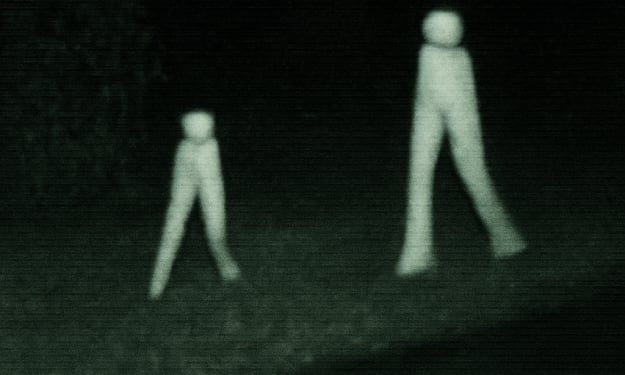
Between the Streetlights: The Mystery of the Fresno Nightcrawlers There are cryptids that roar from the treetops, their legends wrapped in fangs, claws, and danger. And then there are others that unsettle us in silence. They arrive not with a chase or an attack, but with a strange gait across a grainy camera feed. Their power is not in what they do, but in what they refuse to explain. Few modern mysteries embody that uncanny restraint better than the beings now known as the Fresno Nightcrawlers.
By Veil of Shadows12 months ago in Horror
The Abandoned Dyson Sphere
By 2195, humanity had advanced enough to detect an immense artificial megastructure around a distant star: a Dyson Sphere, seemingly abandoned. A deep-space expedition aboard the vessel Horizon was dispatched to investigate. The crew of fourteen, led by Captain Marin Kessler, included engineers, scientists, and a xenopsychologist, Dr. Selene Trask.
By Razu Islam – Lifestyle & Futuristic Writer12 months ago in Horror
Titanic’s Ghost Passengers – Spirits Lost at Sea. AI-Generated.
When the RMS Titanic struck an iceberg on April 14, 1912, and sank into the icy waters of the North Atlantic, more than 1,500 souls were lost. It was called “the ship of dreams,” yet it became a floating graveyard. For over a century, the Titanic has been remembered as one of history’s greatest tragedies. But beyond the cold facts and historic records lies another layer of its legacy—one whispered in hushed voices and terrifying tales: the ghosts of Titanic’s passengers who never left the ship. The Night of the Tragedy: The Titanic was thought to be unsinkable. But when the iceberg tore through its hull, panic and chaos gripped the decks. Families were separated, lifeboats launched half-empty, and haunting cries echoed across the black ocean. Survivors later recalled that the last sounds they heard were desperate voices fading into silence. For many, it was the end. But some believe the spirits of those passengers remain—trapped in time, forever reliving their final night. Voices from the Deep: Decades after the disaster, when explorers finally reached Titanic’s wreck in 1985, strange stories began to emerge. Divers reported eerie sensations—like being watched. Some swore they heard faint cries or music in the crushing silence of the deep. A few even claimed to see shadowy figures drifting past broken corridors and empty cabins. Were these hallucinations caused by pressure and darkness? Or did the Titanic’s dead still roam their watery tomb? One diver described the experience chillingly: “It felt like hundreds of eyes were following us. The wreck wasn’t empty—it was alive with presence.” Ghost Sightings on Land: The hauntings were not limited to the ocean floor. Artifacts recovered from Titanic—furniture, jewelry, even small personal belongings—have been displayed in museums around the world. But with them came stories of paranormal activity. Visitors reported sudden chills, feelings of grief, and the sound of footsteps in empty exhibit halls. Some even claimed to see ghostly figures dressed in early 20th-century clothing, wandering among the displays. Museum staff have whispered of locked doors opening on their own, alarms triggered at night when no one was there, and a woman’s voice weeping near a child’s shoe recovered from the wreck. The Phantom Passengers: Among the most chilling stories are those of Titanic’s “phantom passengers.” In some hotels near Titanic memorials, guests claim to have seen a woman in a lifejacket dripping with seawater, who vanishes when approached. Psychics visiting the wreck have reported “contact” with terrified souls still calling for help. Survivors’ descendants have told stories of seeing their lost relatives in dreams, dressed in Titanic’s evening attire, silently staring through mirrors. One tale speaks of a Titanic exhibit worker who felt a cold hand grip her arm as she stood near a display. When she turned around, no one was there. Why Do the Ghosts Remain? Legends say spirits often linger where tragedy is greatest. The Titanic was not just a ship—it was a promise of luxury, wealth, and safety. For many, it ended in fear and betrayal as lifeboats launched with only the privileged while hundreds were left to perish. Perhaps the souls of the Titanic’s passengers linger because they never found peace. Their journey ended not with arrival, but with icy waters swallowing their dreams. Mysteries That Refuse to Sink: Even Hollywood could not resist the Titanic’s ghostly allure. After the 1997 film’s release, stories resurfaced of strange accidents on set—lights flickering, equipment failing, actors feeling watched. James Cameron himself, who dived to the wreck multiple times, admitted that the site carried an unexplainable presence. Skeptics argue that ghost stories are simply a way to process trauma. Survivors, overwhelmed by guilt, passed down legends that grew into haunting tales. But believers insist that so much sudden death could never fade quietly into history. Legend or Reality? Today, the Titanic rests nearly 12,500 feet below the surface. It is slowly being claimed by the ocean, its once-grand halls collapsing under the weight of time. Yet, its legend grows stronger. Ghost hunters, psychics, and even ordinary tourists still seek signs of its restless passengers. Some come away with photographs showing mysterious faces in the glass of display cases. Others hear whispers in recordings taken near the wreck. Is it all imagination? Or are the Titanic’s ghost passengers still sailing the ocean, waiting for someone to listen to their cries? Eternal Voyage: The Titanic was built to be unsinkable. Instead, it became immortal through its tragedy. The lives lost that night are etched in history—but perhaps also in the shadows of our world. The next time you hear the name Titanic, don’t just think of the iceberg. Think of the passengers who never made it home. Because some say they’re still here… drifting between worlds, forever passengers on a ship that never completed its voyage.
By Mr. Jackie12 months ago in Horror
The Last Godfather: The Untold Story of Vito Rizzuto. AI-Generated.
When people think of the Mafia, images of New York or Sicily often come to mind. But one of the most powerful and feared Mafia bosses of modern times operated far from those legendary strongholds. His name was Vito Rizzuto, the so-called “Canadian Godfather,” who turned Montreal into a hub of international organized crime. His story is one of ambition, betrayal, and the heavy cost of power.
By shakir hamid12 months ago in Horror